The UAE government targets 50 percent of vehicles on the road to be electric or hybrid by 2050, and Dubai’s Green Mobility Strategy is accelerating commercial EV adoption with DEWA charging infrastructure expansion, financial incentives for EV registration, and growing ESG reporting requirements from enterprise clients who want to see supply chain carbon reduction in their sustainability reports. But EV fleet management is not just regular fleet management with a different energy source it requires fundamentally different tools for a fundamentally different set of management problems: charging optimisation instead of fuel card reconciliation, state-of-charge monitoring instead of fuel level alerts, range-aware routing instead of pure distance optimisation, and battery health forecasting instead of engine maintenance scheduling.
VZone International’s fleet management system supports hybrid and electric vehicles alongside traditional ICE fleets from a single dashboard giving fleet managers unified visibility across mixed fleets during the transition period when most UAE commercial operators will run both EV and ICE vehicles simultaneously. This guide explains what EV fleet management requires, what UAE’s specific challenges are for electric fleets, how to plan the transition, and what capabilities a fleet management system needs to manage EVs effectively.
Key Takeaways
- EV fleet management requires additional capabilities beyond traditional fleet management: state of charge (SoC) monitoring, smart charging schedule management, range-aware route optimisation, and battery health analytics none of which standard GPS vehicle tracking systems or fuel-card-based fleet management tools provide.
- UAE’s extreme summer heat reduces EV battery range by 15 to 30 percent compared to manufacturer specifications a critical fleet planning variable that fleet managers must account for in route assignment and charge scheduling to avoid range anxiety events in the field.
- The total cost of ownership (TCO) advantage of EVs over diesel vehicles in UAE is strongest for high-mileage urban routes DEWA off-peak electricity at AED 0.04 per kWh vs diesel at AED 2.83 per litre creates a per-km energy cost advantage of 60 to 70 percent for comparable vehicles, compounding significantly across high-annual-mileage commercial fleet vehicles.
- Mixed-fleet complexity managing EVs and ICE vehicles simultaneously during the transition period requires a fleet management system that handles both vehicle types in a unified dashboard, displaying state of charge alongside fuel level and applying appropriate alert and routing logic for each vehicle type without requiring fleet managers to use separate platforms.
- The 12 to 24 month transition timeline for a mid-size UAE fleet from ICE to a hybrid EV/ICE fleet is most effectively managed in four phases: data audit of current fleet operations, EV pilot on suitable urban routes, charging infrastructure installation, and data-driven scale-up based on pilot ROI.
What Is EV Fleet Management?
EV fleet management is the integrated management of electric vehicle fleets using specialised software tools that extend traditional fleet management capabilities to address the specific operational requirements of battery-powered vehicles. Where traditional fleet management centres on GPS vehicle tracking, driver behaviour monitoring, fuel cost control, and maintenance scheduling, EV fleet management adds a distinct layer of battery-centric management: real-time state of charge (SoC) monitoring across the fleet, smart charging schedule management that minimises energy cost while ensuring vehicles are charged for their next route, range-aware route planning that accounts for current SoC and UAE ambient temperature effects on battery capacity, and battery health analytics that forecast degradation and replacement timing.
The key new variables that distinguish EV fleet management from ICE fleet management are: state of charge (the percentage of battery capacity remaining equivalent to fuel level but with fundamentally different characteristics in terms of refill speed and ambient temperature sensitivity); energy consumption per kilometre (which varies with driving style, air-conditioning load, temperature, and speed in ways that fuel consumption does also, but with different sensitivities); and charging time (which cannot be replicated by the 5-minute refuelling event that ICE vehicles allow, requiring fleet operations to be planned around charging windows rather than refuelling stops).
Why UAE Fleets Are Moving to Electric Vehicles
Government Mandates and Incentives
Dubai’s Green Mobility Strategy targets 30 percent of trips on Dubai’s roads to be made by autonomous and electric vehicles by 2030, with government fleet electrification programmes creating institutional demand that cascades into commercial fleet supply chains. DEWA’s extensive EV charging network currently the most comprehensive in the GCC provides the public charging infrastructure that makes EV deployment practical for Dubai-based commercial fleets. Abu Dhabi’s Department of Energy has parallel electrification initiatives for the capital’s commercial fleet sector. EV registration fee waivers, free Salik toll passage, and free public parking for EVs in Dubai provide direct financial incentives that reduce the total cost of ownership advantage gap between EV and diesel vehicles during the current market development phase.
TCO Comparison EV vs Diesel for UAE Fleet Use
| Cost Category | Diesel Commercial Van (100,000 km/year) | Equivalent EV Van (100,000 km/year) | EV Advantage |
| Energy cost (fuel/electricity) | AED 56,600/year (at 17L/100km, AED 2.83/L) | AED 6,800/year (at 17 kWh/100km, AED 0.04/kWh off-peak DEWA) | AED 49,800/year saving |
| Maintenance (engine, oil, exhaust) | AED 8,500/year (scheduled service + components) | AED 3,200/year (reduced: brakes, tyres, cabin HVAC only) | AED 5,300/year saving |
| Registration and road fees | Standard commercial vehicle registration | Registration fee waiver + free Salik (Dubai) | AED 2,000-5,000/year saving |
| Battery replacement (amortised) | N/A | AED 4,500/year (AED 45,000 battery at 10-year amortisation) | -AED 4,500/year additional cost |
| Vehicle purchase premium | AED 0 (lower base price) | AED 15,000-25,000 higher purchase price | -AED 2,500-4,200/year at 6-year amortisation |
| TOTAL TCO per year | ~AED 110,000-130,000 (all-in operating cost) | ~AED 62,000-74,000 (all-in operating cost) | AED 48,000-56,000/year saving per vehicle |
At 100,000 km per year a typical high-mileage commercial delivery van in UAE the EV TCO advantage is approximately AED 48,000 to AED 56,000 per vehicle per year after accounting for higher purchase price and battery replacement. For a 50-vehicle fleet with high annual mileage, full electrification represents AED 2.4 million to AED 2.8 million in annual operating cost reduction at current DEWA off-peak electricity rates.
ESG Reporting and Sustainability Differentiation
UAE corporate sustainability reporting requirements are accelerating, driven by mandatory ESG disclosure frameworks for publicly listed UAE companies and growing client ESG requirements for major commercial contracts. For logistics and delivery fleet operators whose services are purchased by large UAE enterprises with Scope 3 emissions reporting obligations, EV fleet transition directly reduces the client’s supply chain carbon footprint creating a commercial differentiation argument that goes beyond operational cost. Fleet operators who can provide verified per-delivery carbon data from EV operations are increasingly preferred suppliers for enterprise clients with sustainability commitments, creating a revenue protection argument for EV transition beyond the direct TCO saving.
Unique Challenges of EV Fleet Management in the UAE
Range Planning in Extreme Heat Battery Degradation at 45°C+
UAE summer heat creates the most significant EV fleet management challenge that does not exist for ICE vehicle fleets: lithium-ion battery capacity degrades materially at sustained temperatures above 35°C, and the air-conditioning demand that UAE summer heat requires significantly increases energy consumption per kilometre above manufacturer-specified range. A commercial EV van with a manufacturer-specified range of 250 km at 20°C may deliver only 175 to 200 km of practical range in UAE July conditions a 20 to 30 percent effective range reduction that fleet managers must account for in route assignment and charging schedule planning to prevent vehicles running out of charge before completing their routes.
Battery thermal management systems (BTMs) in modern commercial EVs mitigate but do not eliminate this heat-related range reduction BTM systems consume additional energy to cool the battery pack, which itself reduces available range. Fleet management systems for EV fleets in UAE must apply UAE-specific range reduction factors in their route planning algorithms rather than using manufacturer-specified range as the planning baseline, and should display adjusted range estimates that account for current ambient temperature conditions and air-conditioning load rather than idealised range figures.
Charging Infrastructure Gaps Outside Major Cities
UAE’s EV charging infrastructure is concentrated in Dubai, Abu Dhabi, and Sharjah urban areas with coverage becoming significantly sparser on inter-emirate routes, in the Western Region, and on logistics corridors to construction and industrial sites outside the major urban clusters. A fleet management system for UAE EV operations must maintain a current database of charging station locations, connector types (Type 2 AC, CCS DC fast charge, CHAdeMO), and real-time availability status, and must factor charging station locations and current SoC into route planning for routes that may require en-route charging rather than depot-only charging.
For UAE fleet operators transitioning mixed ICE/EV fleets, charging infrastructure gaps outside cities are the primary constraint on which vehicles can be electrified in the short term urban delivery routes with depot return daily are the natural first candidates for electrification; long-haul and inter-emirate routes typically require ICE vehicles until the en-route charging infrastructure matures sufficiently for commercial fleet reliability.
Mixed Fleet Complexity EVs and ICE Vehicles in One System
During the transition period which for most UAE commercial fleet operators will span 3 to 7 years fleets will operate a mix of EV and ICE vehicles simultaneously. A fleet management system that handles only one vehicle type, or that requires separate platforms for EV and ICE management, creates the data silo problem that fleet management systems are designed to prevent. Fleet managers need to see a single dashboard displaying all vehicles with state of charge for EVs and fuel level for ICE vehicles, with range-aware routing for EVs and standard routing for ICE vehicles, and with energy cost tracking for EVs alongside fuel cost tracking for ICE vehicles without requiring separate system logins or manual data reconciliation between platforms.
Energy Cost Optimisation vs Fuel Card Simplicity
Fuel cost management for ICE fleets is relatively straightforward: fuel is purchased at a known price per litre from authorised stations, recorded via fuel card, and reconciled against GPS distance data. Energy cost management for EV fleets is more complex: electricity cost varies by charging provider (DEWA off-peak rates, private fast-charging network rates, and third-party charging rates differ significantly), charging session costs must be tracked per vehicle and per charge event, and the cost optimisation opportunity of scheduling charging during DEWA’s off-peak rate periods (AED 0.04/kWh) versus peak periods (higher rates) is significant but requires active schedule management rather than passive fuelling.
For a 50-vehicle EV fleet charging 17 kWh per 100 km at 100,000 km per year per vehicle, the difference between all charging at DEWA off-peak rates (AED 0.04/kWh = AED 340,000 annual energy cost) and all charging at commercial fast-charge network rates (approximately AED 0.25/kWh = AED 2,125,000 annual energy cost) is AED 1,785,000 per year a cost differential that smart charging schedule management in the fleet management system is specifically designed to optimise.
Battery Health Monitoring and Replacement Planning
Battery pack health expressed as State of Health (SoH), the percentage of original capacity that the battery retains as it ages is the equivalent of engine condition monitoring in ICE fleet management, but with a fundamentally different replacement cost profile: a battery pack replacement for a commercial EV van costs AED 40,000 to AED 70,000 at current market prices, compared to AED 10,000 to AED 20,000 for a diesel engine rebuild. Fleet management systems for EV fleets must monitor battery SoH across every vehicle, project the replacement timeline based on degradation trajectory, and include battery replacement cost in the vehicle’s total cost of ownership calculation without which the apparent TCO advantage of EV over ICE is overstated if battery replacement timing is not factored into the financial model.
Essential Features of an EV Fleet Management System
State of Charge Monitoring via GPS Vehicle Tracking System
Real-time SoC display for every EV in the fleet alongside GPS vehicle location is the foundational EV fleet management feature. The GPS vehicle tracking system retrieves SoC data from the vehicle’s onboard diagnostic system (via OBD-II or CAN bus integration) and displays it on the fleet management dashboard alongside GPS position, updated at the same interval as the vehicle’s GPS location. When SoC drops below a configured alert threshold typically 20 percent the fleet management system fires a low-SoC alert to the fleet manager and driver, with the current GPS location and the distance to the nearest compatible charging station.
Smart Charging Scheduling Off-Peak DEWA Rates
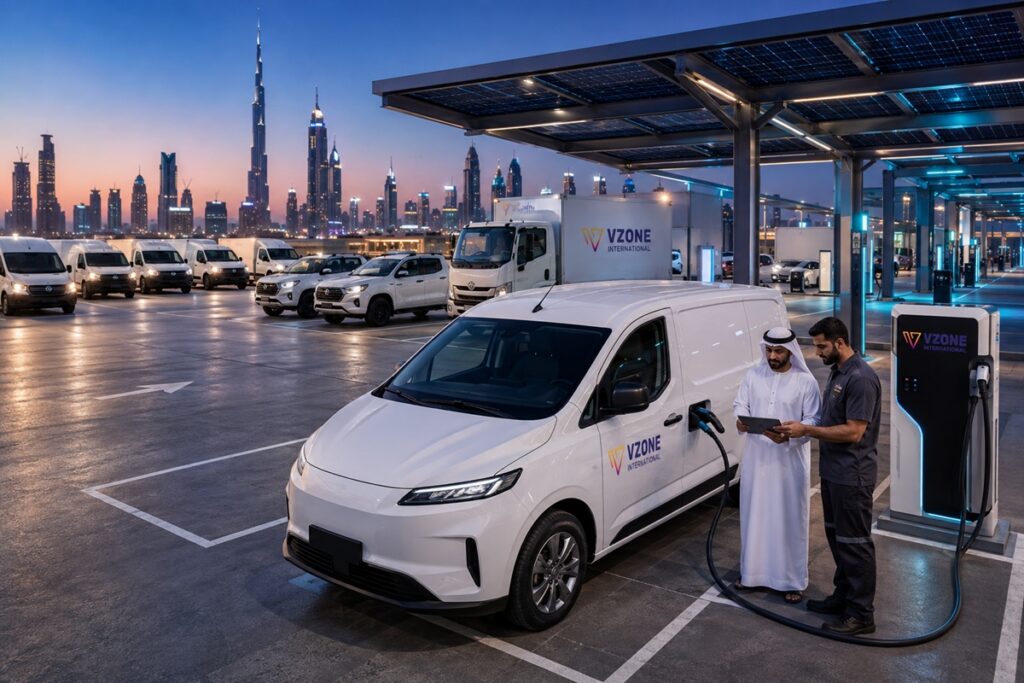
Smart charging scheduling enables the fleet management system to automatically assign charging windows for each EV in the depot fleet based on the vehicle’s next route departure time, current SoC, required SoC at departure, and the available charging infrastructure capacity at the depot. The schedule prioritises off-peak DEWA rate periods (minimising energy cost per charge cycle) while ensuring every vehicle reaches its required departure SoC before its scheduled route start. For a 50-vehicle EV fleet with morning departure slots between 6:00 AM and 8:00 AM, the system distributes charging across the overnight window staggering vehicle charging start times to avoid exceeding depot grid connection capacity limits while maximising off-peak charging exposure.
Range-Aware Route Optimisation
Standard route optimisation algorithms minimise distance or time without considering whether the vehicle has sufficient charge to complete the optimised route. Range-aware route optimisation for EV fleets incorporates each vehicle’s current SoC, UAE ambient temperature (and the resulting range reduction factor), and en-route charging station locations into the route planning algorithm generating routes that are both distance-efficient and range-feasible for the specific vehicle’s current charge state. If a vehicle’s current SoC is insufficient to complete the planned route without charging, the route optimisation inserts the nearest compatible charging station as a waypoint with a charging stop duration sufficient to recover the required additional range.
Battery Health Analytics and Degradation Forecasting
Battery degradation is a gradual process that fleet managers can plan for if they have visibility into the trajectory and an unexpected one that creates operational disruption and unplanned capital expenditure if they do not. Battery health analytics in the fleet management system tracks each vehicle’s SoH over time, plots the degradation curve against the manufacturer’s expected degradation profile, identifies vehicles whose degradation is accelerating above the expected rate (indicating potential battery issues requiring inspection), and projects each vehicle’s battery replacement date based on the current degradation trajectory. This forward-looking visibility enables fleet managers to include battery replacement in the capital expenditure budget for the correct year rather than absorbing it as an unplanned cost.
Energy Cost Tracking and Reporting
Energy cost tracking for EV fleets produces the per-vehicle, per-trip energy cost data that replaces fuel card reconciliation in ICE fleet finance reporting. The fleet management system records every charging session for each vehicle charging provider, energy delivered (kWh), cost per kWh, total session cost, and the vehicle’s GPS location at the charging station and aggregates charging costs into per-vehicle monthly energy cost reports formatted for finance system import. For mixed EV/ICE fleets, the unified cost report includes both energy costs for EV vehicles and fuel costs for ICE vehicles on a comparable per-km basis enabling meaningful cost comparison between vehicle types and supporting the business case analysis for further EV expansion.
Unified Dashboard for EV and ICE Fleet Management
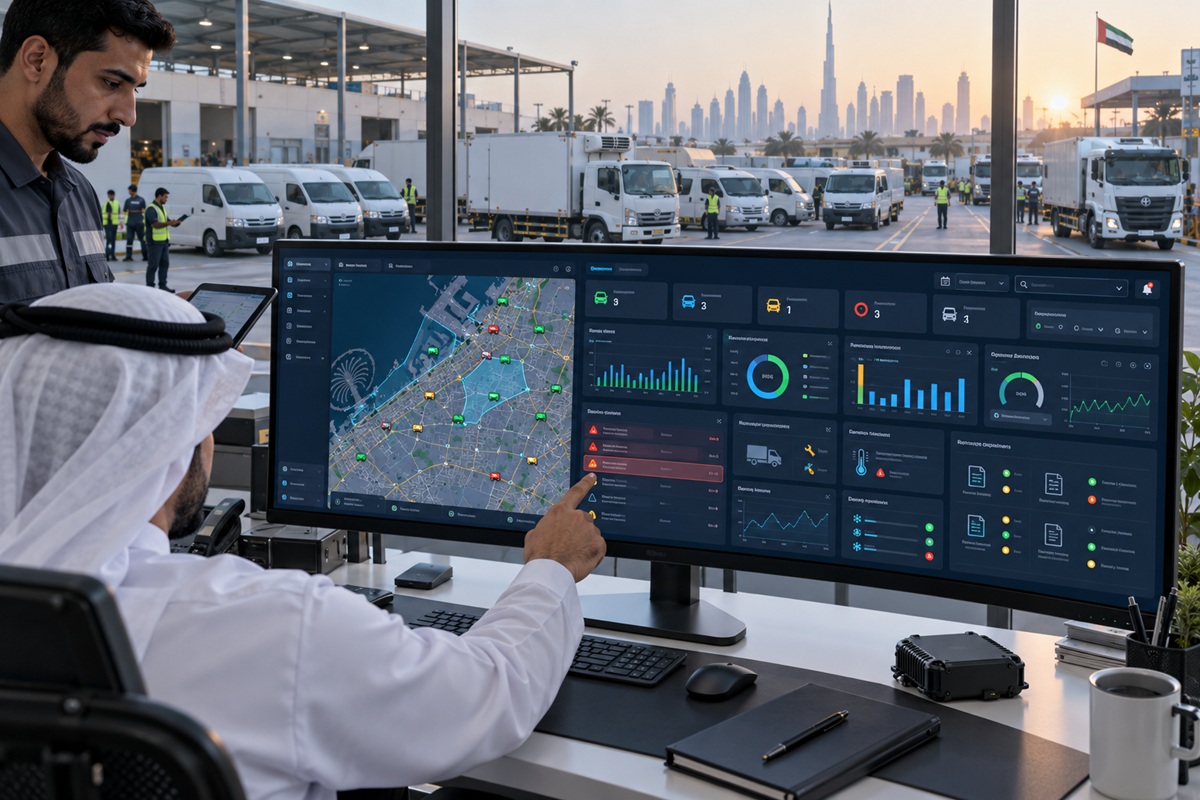
The unified fleet management dashboard is the feature that makes mixed-fleet transition manageable during the period when UAE commercial fleets operate both vehicle types simultaneously. On the same live map: ICE vehicles display fuel level (percentage), recent harsh events, and scheduled maintenance alerts; EV vehicles display state of charge (percentage), estimated remaining range (adjusted for UAE temperature conditions), charging status (charging, full, in transit), and battery health indicator. Route assignments can be made from the same dispatch interface with the system automatically selecting range-appropriate vehicles for each route assigning EV vehicles to routes within their current adjusted range and ICE vehicles to routes that exceed EV range capability.
How to Transition from ICE to EV Fleet Management
| PHASE 1 | Audit Current Fleet Data (Months 1-3) Use your existing fleet management system data to identify which vehicles and routes are most suitable for electrification. Analyse daily route distances by vehicle vehicles averaging under 150 km per day on urban routes are strong EV candidates; vehicles averaging over 200 km per day or operating on inter-emirate routes require ICE or range-extended EV options. Identify vehicles with high annual fuel consumption these represent the highest TCO saving opportunity from electrification. Map current depot charging infrastructure capacity and assess upgrade requirements for the EV pilot volume. |
| PHASE 2 | EV Pilot 10-20% of Fleet on Urban Routes (Months 4-9) Deploy 5 to 20 EV vehicles on the routes identified in Phase 1 as most suitable short urban routes with depot return daily, highest fuel consumption, and lowest range requirement relative to the EV’s adjusted UAE range. Monitor SoC patterns, charging behaviour, energy cost per km, and driver feedback over at least 3 months (including at least one full summer month to capture heat-related range reduction in the operational data). Configure the fleet management system to handle both EV and ICE vehicle data from the pilot onwards, establishing the mixed-fleet dashboard before the full transition. |
| PHASE 3 | Charging Infrastructure and Scale Preparation (Months 7-15) Install depot charging infrastructure scaled for the target EV fleet size not just the pilot volume. Commercial depot charging for a 50-EV fleet requires 25 to 50 AC charging points (7 kW to 22 kW per point) plus 2 to 5 DC fast chargers for urgent mid-day top-up requirements. Commission DEWA grid connection upgrade if depot electrical infrastructure is insufficient for the combined EV charging load. Negotiate en-route charging agreements with DEWA and private charging networks for routes that require mid-route charging. Begin procurement of the next EV vehicle tranche based on pilot performance data. |
| PHASE 4 | Data-Driven Scale-Up (Months 12-24) Scale EV proportion based on the pilot ROI data and the routes identified in Phase 1 as suitable. Target 40 to 60 percent electrification of the fleet within 24 months for urban commercial fleet operators retaining ICE vehicles for routes outside EV range capability until charging infrastructure and EV range technology mature. Review battery SoH data from pilot vehicles at Month 12 to validate degradation trajectory assumptions and confirm battery replacement timeline projections. Update the fleet management system EV configuration as fleet EV count grows ensuring the smart charging schedule and range-aware routing algorithms remain calibrated to the current fleet composition. |
EV Fleet Management and the Role of a GPS Vehicle Tracking System
GPS vehicle tracking is more critical for EV fleets than for ICE fleets not less because the GPS data layer enables the range management decisions that EV fleet operations require and ICE fleet operations do not. For an ICE vehicle running low on fuel, any petrol station resolves the problem within 5 minutes. For an EV vehicle running low on charge, the fleet management system must identify the nearest compatible charging station, confirm its availability, calculate whether the vehicle has sufficient remaining range to reach it from its current GPS position, and reroute the vehicle accordingly all of which requires real-time GPS position data correlated with current SoC.
VZone International’s GPS vehicle tracking system handles EV-specific data through CAN bus and OBD-II integration with the vehicle’s battery management system retrieving SoC, SoH, charging status, and energy consumption data alongside the standard GPS position, speed, and driver behaviour data that all fleet vehicles generate. The Wialon platform displays EV-specific data fields on the same dashboard as ICE vehicle data state of charge alongside fuel level, energy per km alongside fuel per km, and charging schedule alongside maintenance schedule in a unified fleet view that does not require the fleet manager to use separate applications for different vehicle types.
DEWA smart charging integration enabling the fleet management system to send charging schedule signals to DEWA-connected depot chargers and retrieve session energy and cost data automatically is a planned VZone capability in development for the UAE market, aligned with DEWA’s smart charging API deployment timeline. Fleet operators interested in the DEWA integration should contact VZone International to register interest and receive updates on availability.
Talk to VZone About EV-Ready Fleet Management
VZone International’s fleet management system is EV-ready supporting electric vehicles, hybrid vehicles, and ICE vehicles from a unified Wialon dashboard. Whether you are evaluating EV transition for your UAE fleet, piloting your first EVs alongside existing ICE vehicles, or planning a full fleet electrification programme, our team can show you how VZone handles EV-specific fleet management requirements alongside your existing compliance, driver behaviour, fuel monitoring, and reporting functions. Contact our team to discuss your EV fleet transition.
Frequently Asked Questions
EV fleet management is the specialised management of electric vehicle fleets using fleet management system capabilities that extend beyond traditional GPS tracking to include state of charge monitoring, smart charging schedule management, range-aware route planning, battery health analytics, and energy cost tracking. It encompasses both the operational management of daily EV fleet activities (ensuring vehicles are charged for their routes, routing within range constraints, monitoring charging costs) and the strategic management of the EV fleet's total cost of ownership (battery health forecasting, replacement planning, energy cost optimisation through smart charging tariff management). In UAE, EV fleet management also specifically addresses the challenges of battery range reduction in extreme summer heat and the optimisation of DEWA off-peak charging tariffs.
Standard traditional fleet management systems built for ICE vehicles typically cannot handle the EV-specific data and management requirements without significant modification: they display fuel level but not state of charge, provide standard route optimisation without range awareness, track fuel card spend but not charging session costs, and schedule maintenance without battery SoH monitoring. Fleet management systems built for mixed EV/ICE fleets or traditional platforms with EV modules added can handle both vehicle types when the EV data integration (CAN bus or OBD-II connection to the vehicle's battery management system) is implemented correctly. VZone International's platform supports both vehicle types from a unified dashboard fleet operators transitioning to EV do not need to deploy a separate EV fleet management system alongside their existing VZone deployment.
UAE summer heat affects EV fleet management in three specific ways. Battery range reduction: lithium-ion battery capacity and chemical reaction efficiency decrease at sustained temperatures above 35°C UAE summer conditions (45°C to 50°C ambient) reduce practical vehicle range by 20 to 30 percent below manufacturer specifications, requiring fleet managers to use UAE-temperature-adjusted range estimates for route planning rather than stated maximum range figures. Air-conditioning energy load: cabin cooling in UAE summer conditions consumes 3 to 5 kW continuously from the battery pack reducing range by a further 10 to 15 percent on top of the temperature-related battery efficiency reduction. Battery degradation acceleration: sustained exposure to high ambient temperatures accelerates long-term battery capacity loss UAE EV fleets may experience slightly faster SoH decline than the same vehicles in cooler climates, making battery health monitoring and proactive replacement planning more important than in temperate-market EV fleet deployments.
The total cost of ownership advantage of EV over diesel in UAE is primarily driven by energy cost: DEWA off-peak electricity at AED 0.04 per kWh versus diesel at AED 2.83 per litre creates a 60 to 70 percent per-km energy cost reduction for comparable vehicles at high annual mileage. For a commercial van at 100,000 km per year, EV energy cost is approximately AED 6,800 per year versus diesel at AED 56,600 per year an AED 49,800 annual energy saving. Against higher vehicle purchase cost (AED 15,000 to AED 25,000 premium) and battery replacement provision (AED 4,500 per year amortised), the net TCO advantage is AED 48,000 to AED 56,000 per vehicle per year at high annual mileage. Fleet management system costs are comparable between EV and ICE fleets the EV platform adds charging management and battery analytics capabilities but does not significantly change the platform subscription cost.
VZone International's fleet management system on the Wialon platform supports both electric and ICE vehicles from a unified dashboard displaying state of charge alongside fuel level, energy consumption alongside fuel consumption, and charging schedule alongside maintenance schedule for mixed fleets. The platform retrieves EV-specific data through CAN bus and OBD-II integration with the vehicle's battery management system, making EV data available in the same dashboard view as all other fleet vehicle data. Fleet operators transitioning progressively from ICE to EV do not need to change their fleet management platform as EV vehicles are added to the fleet the existing VZone deployment handles both vehicle types as the fleet composition evolves.