For UAE businesses with workers spread across multiple sites security companies with patrol guards across a portfolio of client buildings, facilities management firms with maintenance technicians covering commercial towers, logistics companies with delivery drivers across Dubai’s suburban neighbourhoods keeping track of who is where, what they are doing, and whether tasks are being completed on schedule is a constant operational challenge. The traditional response to this challenge is supervisor phone calls, manual attendance registers, and end-of-day paper reports that tell you what happened yesterday, not what is happening right now.
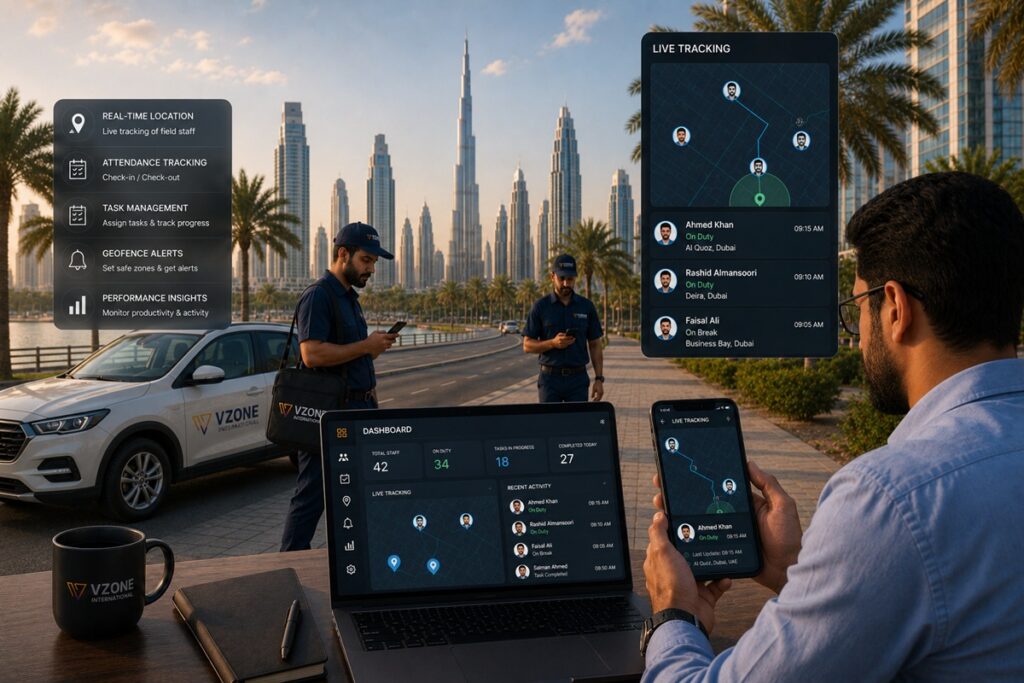
GPS workforce tracking gives operations managers the real-time visibility they need without the micromanagement overhead of constant phone check-ins. Workers carry GPS-enabled mobile apps that share their location continuously during working hours. Managers see every team member on a live map. Task assignments are dispatched digitally and confirmed with GPS-verified site check-ins. Job completion is documented with timestamped photos and digital sign-offs rather than paper forms that require manual processing.
This guide covers the different GPS tracking approaches for different field worker categories when mobile app tracking is the right solution, when hardwired vehicle GPS is required, and when both are needed simultaneously alongside the specific tracking requirements for security guards, field technicians, delivery drivers, and the UAE labour law compliance considerations that apply to GPS-tracked workforces.
Key Takeaways
- GPS workforce tracking uses two distinct technologies for different field worker categories: mobile GPS apps for foot patrol guards, technicians, and sales representatives who work independently of vehicles; and hardwired vehicle GPS for drivers and maintenance crews who work primarily in or from their vehicles.
- Security guard patrol tracking requires checkpoint verification NFC tags or app-based check-in at defined patrol points alongside GPS continuous location, creating a verifiable patrol completion record that satisfies both SIRA licensing requirements and client accountability expectations.
- Digital job dispatch from the management dashboard to worker mobile apps eliminates the paper work order and WhatsApp communication overhead that creates task management gaps and accountability ambiguity in large field service operations.
- Time-stamped GPS site check-in records for field technicians and service workers provide accurate billing support for time-based service contracts and create the attendance evidence that UAE labour law compliance requires.
- UAE labour law (MOHRE) mandates maximum working hours and rest periods for all employees GPS-tracked time records provide the electronic documentation that satisfies Ministry of Human Resources audit requirements and protects employers in labour dispute proceedings.
- Employee GPS tracking in UAE is legal when disclosed to employees as part of their employment contract and conducted during working hours covert monitoring outside working hours or tracking personal movements creates legal exposure under UAE privacy regulations.
What Is Field Staff GPS Tracking?
Field staff GPS tracking is the application of GPS location monitoring to a mobile workforce workers who operate away from a fixed office or depot location during their working hours. Unlike vehicle fleet tracking, which monitors the vehicle and derives driver behaviour from the vehicle’s movements, field staff tracking monitors the worker directly typically through a GPS-enabled mobile app on their company-issued or personal smartphone, or through a dedicated GPS device carried on their person.
The operational management problems that field staff tracking addresses are fundamentally the same across different industry sectors: verifying that workers are at the locations they are supposed to be at, confirming that tasks are completed on time, documenting the time spent at each client site, and maintaining real-time visibility over distributed teams without requiring supervisors to be physically present at every location.
Vehicle GPS vs. Mobile App Worker Tracking Key Differences
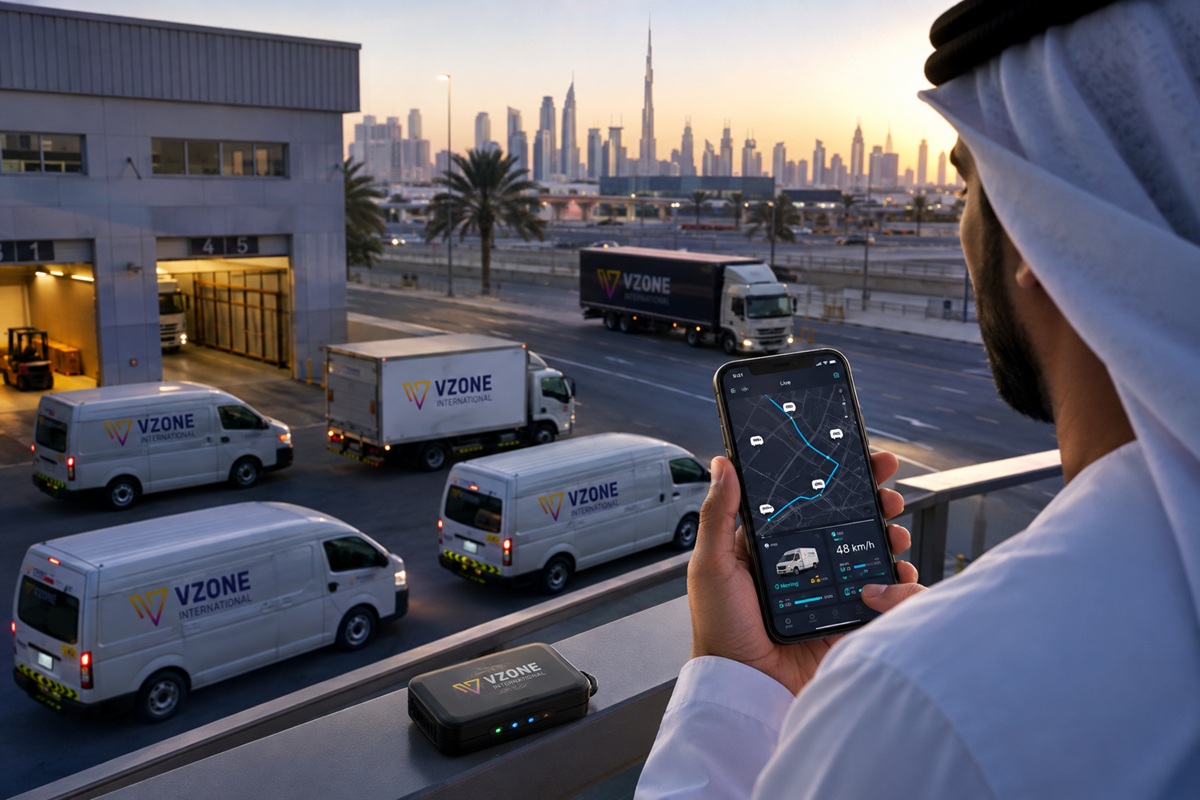
The choice between vehicle GPS and mobile app tracking depends on the nature of the work and the primary location of the worker’s operational activity. Vehicle GPS is the appropriate primary tracking method for workers who spend the majority of their shift in a vehicle delivery drivers, mobile maintenance crews driving between sites, patrol security drivers. The vehicle GPS captures the vehicle’s location continuously, and the driver is physically present in the tracked vehicle for most of their working time.
Mobile app GPS is the appropriate primary method for workers who spend significant portions of their shift away from their vehicle foot patrol security guards checking each floor of a building, field technicians who park and then work inside a client facility for several hours, sales representatives who spend time in client offices between vehicle journeys. For these workers, the vehicle’s GPS location at the car park is not the same as the worker’s location in the building mobile app tracking follows the worker, not the vehicle.
Many field operations require both simultaneously: a maintenance technician who drives between sites (tracked by vehicle GPS) and then works inside each site for one to three hours (tracked by mobile app) creates a combined tracking record that covers the full working day without gaps. Platform-level integration of both data streams into a single worker timeline is what makes this dual-tracking approach operationally useful rather than administratively complex.
When to Use Mobile GPS vs. Hardwired Vehicle Trackers
| Workforce Category | Primary Tracking Method | Key Platform Features | Business Benefit |
| Security guards (foot patrol) | Mobile app GPS + NFC/app checkpoint | Patrol verification, SOS alert, supervisor live map | SIRA compliance + client accountability reporting |
| Security drivers (patrol vehicles) | Hardwired vehicle GPS | Route tracking, speed monitoring, after-hours alerts | SIRA compliance + patrol coverage evidence |
| Delivery drivers | Hardwired vehicle GPS | Route, delivery confirmation, driver behaviour | On-time delivery + fuel savings + POD |
| Field technicians (FM / HVAC / IT) | Mobile app GPS + vehicle GPS | Job dispatch, site check-in, task completion | Billing accuracy + productivity reporting |
| Maintenance and repair crews | Vehicle GPS + mobile app | Task management, parts tracking, site coverage | Contract compliance + utilisation reporting |
| Sales representatives | Mobile app GPS | Visit logging, route analysis, territory coverage | Accountability + territory management insight |
| Healthcare / home visit workers | Mobile app GPS | Visit check-in, duration logging, SOS button | Compliance + lone worker safety protection |
| Cleaning and janitorial staff (multi-site) | Mobile app GPS + site NFC tags | Site check-in, task completion, supervisor dashboard | Contract verification + client billing accuracy |
Security Guard Tracking in UAE
Security guard workforce management in UAE sits at the intersection of operational efficiency and regulatory compliance in a way that makes GPS tracking both a business necessity and a licence requirement. SIRA-licensed security companies in Dubai must demonstrate operational accountability to both the regulator and their clients and GPS tracking is the technology that makes that accountability measurable, documented, and defensible.
SIRA Licensing and GPS Requirements for Security Companies
The Security Industry Regulatory Agency requires security companies operating in Dubai to use approved GPS solutions for their patrol vehicles and field operations covered in detail in Art-07 of this series. In the workforce tracking context, the SIRA requirement extends beyond vehicle tracking to encompass the accountability of security personnel in the field: the ability to demonstrate that guards completed their assigned patrols, visited each checkpoint on schedule, and were present at their assigned post throughout their shift.
GPS mobile app tracking for foot patrol guards, combined with vehicle GPS for patrol cars, creates the complete operational visibility record that SIRA compliance requires. The mobile app records each guard’s location continuously during their shift creating an unambiguous presence record for each hour of the assignment while checkpoint verification (addressed below) creates the specific evidence that contracted patrol activities were actually performed rather than simply that a guard was somewhere in the vicinity of the site.
Patrol Route Monitoring Ensuring Guard Presence at All Points
Live patrol monitoring on the operations centre dashboard shows the current location of every active guard simultaneously enabling duty supervisors to identify any guard who has deviated significantly from their assigned patrol route, has remained stationary for an unexpectedly long period, or has exited the client site boundary without authorisation. These deviations generate automated alerts that prompt the supervisor to investigate whether the guard is experiencing an incident or has abandoned their post.
Patrol history replay the ability to review a guard’s movement throughout their shift retrospectively is the client reporting tool that differentiates security service providers in UAE’s competitive corporate security market. A client who asks ‘was your guard present at our server room at 3am last Thursday?’ deserves a GPS-verified answer, not a verbal assurance. Security companies that provide GPS patrol reports as a standard client deliverable retain contracts at higher rates than those whose service accountability rests on supervisor attestations.
Checkpoint Check-In and Tour Verification
Checkpoint verification is the patrol accountability layer above continuous GPS location tracking. NFC tags small programmable chips are installed at defined checkpoints within a client site: server room door, main lobby, car park perimeter, emergency stairwell exits. Guards carry NFC-capable smartphones and tap the checkpoint tag when they visit each location during their patrol tour. The tap is logged with the guard’s identity, the checkpoint ID, a timestamp, and the GPS location creating an irrefutable record of physical presence at the specific checkpoint at the specific time.
Tour verification reports automatically generated at the end of each guard shift show every checkpoint visited, the time of each visit, and any checkpoints that were missed or visited outside the scheduled window. For clients with specific security requirements financial services companies with regulatory inspection zones, healthcare facilities with medication storage access requirements this tour verification record is a compliance document in its own right, not just an internal security management tool.
The combination of continuous GPS location tracking and NFC checkpoint verification creates a two-layer patrol accountability record: GPS proves the guard was in the general location; NFC proves they were at the specific checkpoint. A guard who walked a patrol route that passed near a checkpoint but did not actually enter the checkpoint room will show GPS presence near the area but no NFC tap at the required point the fraud detection capability that makes tour verification meaningfully more accountable than GPS alone.
Driver and Technician Task Management
For field worker categories beyond security maintenance technicians, HVAC engineers, IT support teams, cleaning crews the workforce tracking challenge is primarily about task management rather than patrol verification. The operational need is not proving that workers completed a patrol loop but confirming that specific jobs were completed at specific locations within contracted timeframes, and generating the documentation that client billing and service level agreements require.
Digital Job Dispatch Assigning Work Orders via App
Digital job dispatch replaces the daily briefing sheet, WhatsApp message, or phone call that most UAE facilities management and field service operations still use to communicate job assignments to field workers. Through the management dashboard, supervisors create work orders specifying the job type, client site, arrival window, priority, and any specific instructions and dispatch them directly to the assigned worker’s mobile app. The worker receives a push notification with the full job details, including the client site address linked to the GPS navigation function on their phone, and can accept or query the assignment immediately.
The dispatch record in the platform creates a timestamped evidence trail: when the job was created, when it was dispatched, when the worker acknowledged receipt, when they arrived at the site, when they completed the job, and any job-related notes or photos they uploaded during the assignment. This complete record satisfies client billing documentation requirements, resolves disputes about whether a job was attended on time, and provides the supervisor with the information they need to manage job queue and worker allocation across the day without requiring individual phone calls to find out each worker’s current status.
Time-Stamped GPS Check-In at Client Sites
GPS site check-in records the moment a worker’s mobile app detects that they have arrived within the geofenced boundary of a client site generating a timestamped arrival record linked to the job assignment. When the worker leaves the site, a departure record is created. The time between arrival and departure, cross-referenced with the job assignment, provides the site attendance evidence that time-based service contracts require for accurate billing.
In UAE’s facilities management sector, where contracts are typically structured around service level agreements specifying response times and on-site duration minimums, GPS-verified attendance records are the objective evidence that demonstrates contract compliance. A client who disputes whether a technician was on-site for the contracted minimum duration cannot successfully contest a GPS record showing the precise arrival and departure timestamps. This objective documentation protects the service provider as much as it holds them accountable the GPS record exonerates as well as documents.
Task Completion Confirmation and Photo Evidence
Digital task completion confirmation through the mobile app including mandatory photo capture for visual verification jobs creates the field service documentation layer that replaces paper job sheets. Workers photograph the completed work, any equipment serial numbers or installation details, and any issues found for follow-up. Photos are geotagged and timestamped by the app before upload, creating a tamper-resistant record that confirms both the nature of the completed work and the location at which it was performed.
For maintenance and repair operations, photo evidence of completed work is increasingly a client contract requirement particularly for high-value equipment maintenance where proof of service creates a component of the asset’s maintenance history. Facilities management companies that provide digital job completion reports with GPS-stamped photos as a standard service deliverable differentiate their offering from competitors still relying on handwritten job sheets that arrive at the client’s facilities desk days after the work was completed.
UAE Labour Law Compliance for GPS-Tracked Field Workers
Maximum Working Hours GPS-Verified Time Records
UAE labour law (Federal Law No. 33 of 2021, implemented by the Ministry of Human Resources and Emiratisation MOHRE) sets maximum daily and weekly working hours for private sector employees. For most workers, the standard working day is eight hours with a maximum of 48 hours per week outside Ramadan. Certain categories of outdoor worker in extreme heat conditions have additional protections under UAE summer outdoor work ban regulations restricting outdoor work between 12:30pm and 3:00pm during the summer months.
GPS workforce tracking generates the electronic time records that MOHRE compliance audits examine: actual working hours per worker per day, verified by GPS activity start and end times, with any overtime documented automatically. Paper timesheets can be manipulated retroactively; GPS-derived time records from a cloud platform with tamper-resistant timestamping cannot be retroactively altered. For employers who face MOHRE inspections or employment dispute proceedings, GPS-verified time records provide the evidential foundation for demonstrating working hours compliance.
Rest Period Compliance for Drivers
For commercial vehicle drivers, UAE regulations require minimum rest periods between shifts a requirement that GPS driving time records can automatically monitor. Driver management platforms that track driving time duration and generate alerts when a driver’s continuous working time approaches regulatory limits provide the proactive compliance tool that prevents violations before they occur, rather than identifying them retrospectively from driving logs.
For logistics companies and transport operators whose drivers are subject to the UAE’s commercial driver working hour regulations, GPS-derived driving time records are the compliance documentation standard that the relevant authorities expect to see in inspection situations. Manual tachograph records where still in use are increasingly supplemented or replaced by GPS-derived driving time data that provides the same compliance evidence with higher accuracy and no manual transcription overhead.
Is GPS Tracking of Employees Legal in UAE?
GPS tracking of employees in UAE is legal within defined conditions. The primary legal requirement is disclosure: employees must be informed that GPS tracking is in place, typically through their employment contract or an employer policy document that forms part of the employment terms. Tracking must be limited to working hours and work-related activities monitoring employee location outside working hours or tracking personal movements outside the scope of employment is not permitted and creates exposure under UAE privacy legislation.
MOHRE does not prohibit employer GPS monitoring of field workers during working hours the purpose (operational management and safety oversight of a mobile workforce) is a legitimate business purpose that is recognised in UAE employment law. Employers who include GPS monitoring disclosure in employment contracts, limit tracking to working hours, and use the data for operational management purposes (not personal surveillance) are operating within the legal framework. VZone International’s workforce tracking solutions are configured for working-hours-only tracking with clear disclosure documentation recommendations for client HR teams.
VZone International’s Workforce GPS Tracking Solution
VZone International provides GPS workforce management for UAE businesses with mobile field teams combining mobile app tracking for foot-patrol and non-vehicle workers with vehicle GPS integration for driving teams, on a unified Wialon and FMSiTrack platform that presents all worker types in a single operational dashboard.
Mobile App for Field Workers Android and iOS
VZone’s worker mobile app available on Android and iOS provides GPS location sharing during working hours, NFC checkpoint check-in for security guard patrol verification, job dispatch and task management integration, digital job completion with photo capture, SOS emergency alert with GPS coordinates for lone worker safety, and working hours logging with automatic break time detection. The app is designed for operational use in UAE field conditions high ambient temperatures, variable network coverage, and multilingual workforces with an interface available in both Arabic and English.
Supervisor Dashboard Live Map and Task Management
The supervisor dashboard presents every active field worker on a live map alongside their current task assignment and status providing operations managers with the real-time team visibility that phone-based check-in processes attempt but cannot reliably deliver at scale. Job queues, priority assignments, and workload distribution are managed from the dashboard, with direct dispatch to worker apps eliminating the communication lag of phone and WhatsApp coordination.
Tour verification reports for security clients, task completion reports for facilities management clients, and working hours summaries for HR and MOHRE compliance are generated automatically from the platform data available the same day rather than compiled weekly from paper records.
Integration with Vehicle GPS for Mixed Mobile and Driving Workforces
For field operations that combine vehicle driving with on-site foot work the maintenance technician’s full working day profile VZone’s platform integrates vehicle GPS and mobile app tracking into a single worker timeline. Managers see the complete working day: vehicle departure from depot, drive to first site, on-site activity, vehicle journey to second site, on-site work, return to depot. The unified timeline eliminates the visibility gap between vehicle-tracked segments and site-based activity that separate vehicle and worker tracking systems create.
Conclusion: Field Staff GPS Tracking Creates Accountability Without Micromanagement
The operational shift that GPS workforce tracking enables for UAE businesses with mobile field teams is the move from reactive supervision discovering problems after they occur through complaints, missed deadlines, or billing disputes to proactive management based on real-time data. A supervisor who can see every guard’s location, every technician’s current job status, and every driver’s route progress from a single dashboard at 11pm does not need to make 40 phone calls to establish the same picture.
The accountability that GPS workforce tracking creates is symmetrical it protects workers from unfair performance accusations as effectively as it holds them accountable for genuine performance gaps. A maintenance technician whose GPS record shows they arrived on site at the contracted time and stayed for the contracted duration cannot be legitimately accused of negligence in their service delivery. The same record that documents the company’s compliance also documents the worker’s performance creating a management culture where accountability is data-based rather than supervisor-dependent.
For UAE businesses in security, facilities management, logistics, healthcare, and field service sectors, GPS workforce tracking is the operational infrastructure that makes managing a distributed mobile workforce at scale both practical and professionally defensible. The technology is accessible, the implementation is straightforward, and the operational return in supervisor time saved, billing accuracy improved, and compliance risk reduced is measurable within the first month of deployment.
Manage your UAE field workforce with precision from security guards to delivery drivers.
VZone International’s workforce GPS platform gives you real-time location visibility, NFC checkpoint verification, digital job dispatch, and automated attendance and compliance reports all in a single platform integrated with vehicle GPS for driving teams. Get a workforce tracking demo tailored to your team type and UAE operational requirements.
Frequently Asked Questions
Field staff tracking uses a mobile GPS app installed on worker smartphones typically the company-issued device or a personal device where policy permits. The app shares the worker's location continuously during working hours, enabling managers to see every team member on a live map from a web or mobile dashboard. For workers who also drive company vehicles, hardwired vehicle GPS runs simultaneously, with both data streams integrating into a single worker timeline on the platform. VZone International provides the mobile app and vehicle GPS integration for UAE field workforce tracking.
GPS workforce management combines real-time location tracking with digital task management: supervisors dispatch work orders to worker mobile apps, workers receive job details including navigation to the client site, GPS-verified site check-in records arrival and departure times, and digital job completion with photos creates the task completion evidence. Weekly productivity reports showing jobs completed per worker, on-time performance, and site attendance duration are generated automatically from the platform data without manual timesheet processing.
Security guard patrol tracking uses mobile app GPS for foot patrols and vehicle GPS for patrol cars. Guards check in at designated patrol checkpoints by tapping NFC tags installed at each checkpoint location the tap records their identity, the checkpoint, a timestamp, and GPS coordinates. Supervisors see live patrol status on the operations centre dashboard. Automated tour verification reports show checkpoint visit compliance for each guard shift, providing the patrol accountability documentation that SIRA requirements and client contracts demand.
Yes, GPS tracking of employees is legal in UAE when disclosed to employees in their employment contract or a written employer policy, limited to working hours and work-related activities, and used for legitimate operational management purposes. Tracking employee location outside working hours or using GPS data for non-work purposes is not permitted. MOHRE (Ministry of Human Resources and Emiratisation) recognises GPS time records as valid working hours documentation in compliance audits and employment dispute proceedings.
Vehicle GPS tracks the vehicle's location using a hardwired device appropriate for workers who spend most of their shift in the vehicle (delivery drivers, mobile patrol drivers). Mobile app GPS tracks the worker's location using their smartphone appropriate for workers who spend significant time away from their vehicle (foot patrol guards, field technicians inside buildings, sales representatives). Most comprehensive field workforce tracking deploys both: vehicle GPS for driving time and mobile app GPS for on-site time, with both streams integrated into a single worker timeline on the management platform.