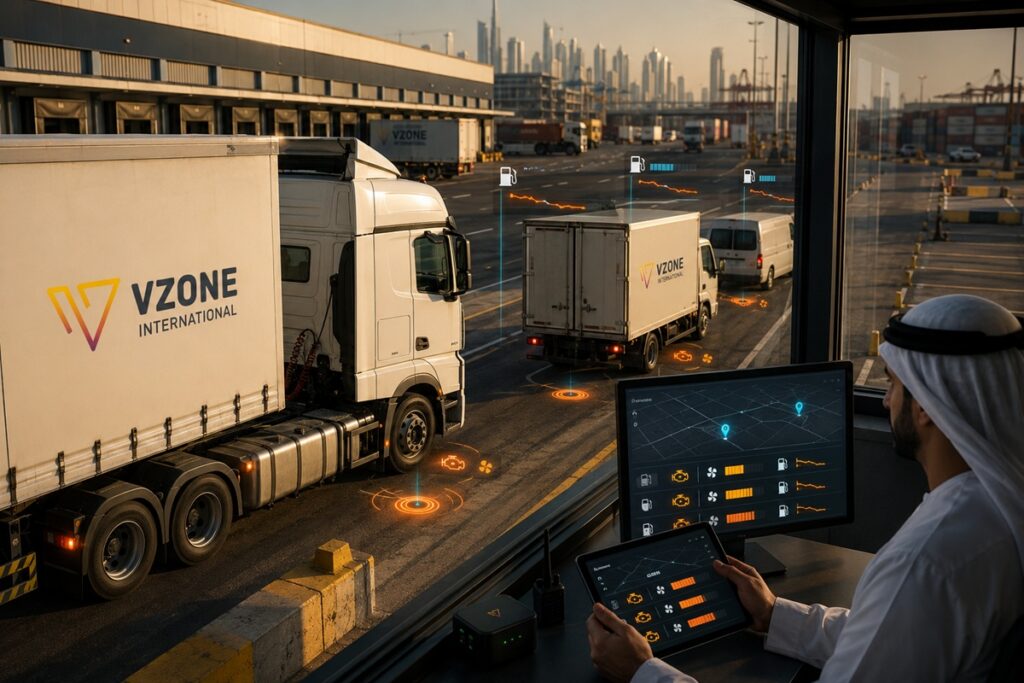
Every minute a commercial vehicle’s engine runs without the vehicle moving, fuel is consumed and money is spent with zero operational output. Engine idling the running of a vehicle’s engine while it is stationary is the most visible and most immediately addressable source of fleet fuel waste, and in UAE commercial fleets it accounts for a disproportionate share of total consumption because UAE’s extreme summer climate creates an idling category that temperate-market fleet guides do not address: A/C idling.
UAE fleet idling falls into four distinct categories, each with a different cause and a different management response. A/C idling running the engine to power cooling during breaks in 47°C heat is a driver welfare issue as much as a fuel efficiency issue. Traffic queue idling engines running in stationary queues on Dubai’s Sheikh Zayed Road or Abu Dhabi’s Airport Road at peak hours is a route and scheduling management issue. Operational idling engines running during loading, unloading, and delivery wait times is a process efficiency issue. Administrative idling engines left running while drivers complete paperwork, make calls, or wait for access clearance is a discipline and policy issue. Each category responds to different interventions, and understanding which category dominates a specific fleet’s idling profile is the prerequisite for targeting the right solution.
Key Takeaways
- UAE commercial fleet idling typically consumes 8 to 15 percent of total fuel producing zero vehicle movement and zero operational output. For a fleet spending AED 500,000 per year on fuel, the idling cost is AED 40,000 to AED 75,000 annually.
- UAE’s summer A/C idling is the most significant idling category unique to the region drivers running engines to power cooling during 30-minute breaks in 47°C ambient temperatures accumulate 100 to 150 hours of idling per vehicle per summer season, costing AED 400 to AED 750 per vehicle in summer A/C idling fuel alone.
- GPS fleet management software detects idling by combining ignition-on status with vehicle speed = 0, measuring exact idling duration per event and per vehicle, and calculating the fuel cost of each idling period at the vehicle’s measured idle fuel consumption rate.
- The most effective idling reduction programme combines three elements: real-time in-cab idling alerts (a notification that fires in the driver’s cab when idling exceeds the configured threshold, giving the driver immediate feedback), daily idling reports to the fleet manager (showing which vehicles idled most and when), and a clear fleet idling policy that defines what constitutes authorised idling and the expectation for all other situations.
- Idling reduction is the fastest fleet fuel saving to implement idling alerts can be configured and active within days of GPS platform deployment, and driver behaviour change is visible within the first week. No hardware beyond the existing GPS device is required for basic idling monitoring.
Section 1 The Four UAE Fleet Idling Categories
Category 1 A/C Idling (UAE-Specific, Summer Peak)
A/C idling is the most significant idling category in UAE fleet operations and the one with no equivalent in European fleet management programmes. When ambient temperatures reach 47°C in July and August, a driver sitting in a parked commercial vehicle without the engine and A/C running faces a genuine heat health risk cab temperatures in a parked vehicle in direct UAE summer sun can exceed 70°C within 15 minutes. Drivers manage this risk by running the engine during breaks, meal stops, and waiting periods to maintain A/C cooling. The fuel cost of this behaviour is real: a light commercial van idling with A/C at high output in UAE summer consumes 1.0 to 1.5 litres per hour; a 30-minute lunch break with engine running costs AED 1.80 to AED 2.70 per day per vehicle.
For a 50-vehicle urban delivery fleet where each driver takes one 30-minute engine-on break per day during the June to September summer period (approximately 90 working days), the total A/C idling cost is: 50 vehicles × AED 2.25 average × 90 days = AED 10,125. This is the minimum A/C idling cost for a well-disciplined fleet fleets where drivers also idle during shorter waits, morning pre-shift warm-up periods, and administrative tasks accumulate significantly more. Idling monitoring that shows the fleet manager each vehicle’s daily A/C idling duration converts this invisible cost into a visible management metric.
Category 2 Traffic Queue Idling
Traffic queue idling is the engine-running time accumulated when fleet vehicles are stuck in Dubai, Abu Dhabi, or Sharjah’s peak-hour congestion. Unlike A/C idling (which is within driver control), traffic queue idling is driven by route selection and departure timing the fleet manager’s dispatch and scheduling decisions determine how much queue idling each vehicle accumulates. A delivery van departing Dubai’s Deira industrial area at 7:45 AM will spend 45 to 60 minutes in queue idling before reaching Al Quoz, burning AED 4.50 to AED 9.00 in fuel that produces no movement. The same van departing at 9:30 AM reaches Al Quoz in 20 minutes with less than AED 2.00 in queue idling cost.
GPS fleet management data enables traffic queue idling analysis by route and time of day: which routes accumulate the most idling, at which times, and with which departure windows. This analysis enables dispatch scheduling optimisation that reduces queue idling across the fleet without requiring any driver behaviour change the saving comes from scheduling intelligence rather than coaching.
Category 3 Operational Idling at Delivery and Loading Points
Operational idling occurs when vehicles idle during legitimate operational activities waiting for a loading dock to become available, waiting for a customer representative to sign for a delivery, waiting at a construction site access gate for clearance. This idling category is partially within driver control (the driver can switch off the engine during a wait and restart when the wait ends) and partially a function of the operational process (a driver who cannot predict how long a loading wait will take is less likely to switch off the engine than one who knows the wait is 20 minutes). Operational idling is reduced by a combination of driver policy (switch off engine for any wait expected to exceed 5 minutes), process improvement (pre-notifications to delivery points that reduce wait time), and dispatch communication (drivers informed of expected wait times before arrival so they can plan engine-off periods).
Category 4 Administrative and Habit Idling
Administrative idling is the engine-running time accumulated when drivers leave the engine running while completing paperwork, making phone calls, updating delivery records in the driver app, or waiting for their next job dispatch. This category has no operational justification the engine is running because switching it off and restarting it is a minor effort that many drivers do not bother with unless they are specifically conscious of idling policy. Administrative idling events are typically shorter (5 to 15 minutes) than A/C idling events but accumulate across many events per shift. Idling alerts configured at 5 minutes are particularly effective for this category the in-cab notification interrupts the driver’s administrative activity and prompts the engine-off decision that habit alone does not trigger.
Section 2 How GPS Measures Fleet Idling
GPS fleet management software measures idling by combining two data streams: the vehicle’s ignition status (on or off, detected by the GPS device’s connection to the ignition circuit) and the vehicle’s GPS speed reading (kilometres per hour from the GNSS position update). An ignition-on event with a GPS speed reading of zero for more than the configured minimum duration typically 2 to 5 minutes is classified as an idling event. The platform records: the idling event start time, the GPS location where idling began, the idling duration when the event ends (ignition off or vehicle begins moving), and the calculated fuel cost at the vehicle’s measured idle consumption rate.
Idling Fuel Cost Calculation
The idle fuel consumption rate for each vehicle model is determined either from manufacturer specifications or from the fleet’s own consumption data during confirmed idling periods. Typical idle consumption rates for UAE commercial fleet vehicle types are: light commercial van (1.0 to 1.3 L/hour at moderate A/C load), pickup truck (1.2 to 1.8 L/hour depending on engine size), medium commercial truck (2.0 to 3.5 L/hour), heavy truck (3.5 to 6.0 L/hour). At UAE commercial diesel prices, these translate to approximately AED 1.80 to AED 2.30 per idling hour for a van, and AED 6.30 to AED 10.80 per idling hour for a heavy truck. The fleet management platform uses these rates to calculate the AED cost of each idling event and cumulates them into daily, weekly, and monthly idling cost totals per vehicle the financial report that makes the invisible cost visible to fleet managers and finance teams.
Idling Reports and Dashboards
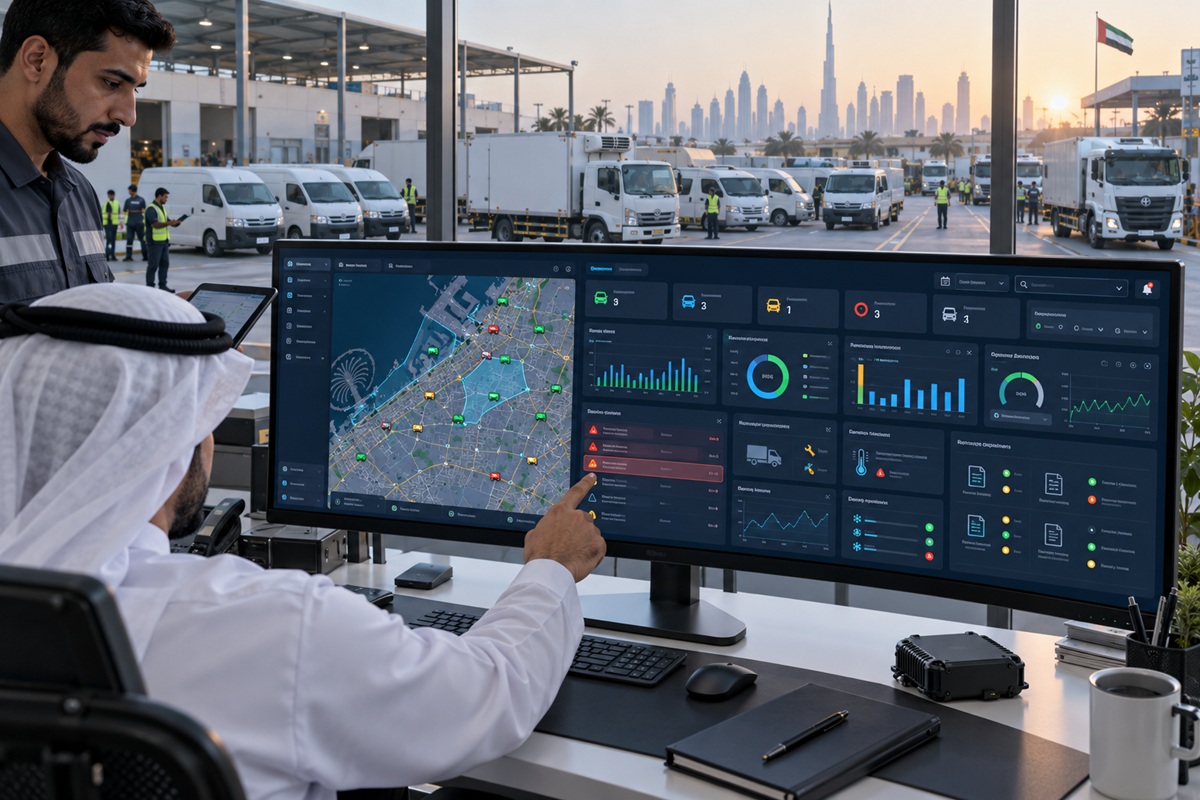
Fleet idling reports in VZone International’s Wialon platform provide: the daily idling duration per vehicle (total minutes idling, number of idling events, average event duration), the top 10 vehicles by daily idling cost (the vehicles generating the most avoidable fuel cost from idling), the idling duration by time of day (identifying whether the fleet’s idling peak is in the morning A/C warm-up period, at midday during break periods, or in afternoon traffic queues), and the weekly trend per vehicle (showing whether idling is increasing, decreasing, or static in response to coaching). These reports require no manual data extraction they are generated automatically from the GPS data and available to the fleet manager on the dashboard and via scheduled email delivery to the fleet manager and finance team.
Section 3 The Cost of Fleet Idling: UAE Calculation
| Vehicle Type | Idle Consumption Rate | Typical UAE Daily Idling | Daily Idling Cost (AED) | Annual Idling Cost per Vehicle (AED) | 50-Vehicle Fleet Annual Idling Cost (AED) |
| Light commercial van (urban delivery) | 1.1 L/hour | 60-90 min/day (A/C + queue + operational) | AED 2.00-3.00 | AED 520-780/year | AED 26,000-39,000 |
| Pickup truck (construction site) | 1.5 L/hour | 90-120 min/day (site waiting + A/C) | AED 3.40-4.50 | AED 884-1,170/year | AED 44,200-58,500 |
| Medium truck (mixed urban/highway) | 2.5 L/hour | 45-75 min/day (loading + queue) | AED 2.85-4.75 | AED 741-1,235/year | AED 37,050-61,750 |
| Heavy truck (GCC long haul) | 4.5 L/hour | 30-60 min/day (border crossing + loading) | AED 3.40-6.75 | AED 884-1,755/year | AED 44,200-87,750 |
| Refrigerated delivery van | 1.3 L/hour (vehicle engine only) | 75-105 min/day (delivery wait + A/C) | AED 2.45-3.45 | AED 637-897/year | AED 31,850-44,850 |
UAE Fleet Idling Cost Key Metric For a mixed 50-vehicle UAE commercial fleet (vans, pickups, medium trucks), total annual idling cost typically falls in the range of AED 40,000 to AED 80,000 per year representing fuel consumed with zero vehicle movement and zero operational output. A 65% idling reduction from monitoring and coaching saves AED 26,000 to AED 52,000 annually. The GPS platform cost to achieve this is zero incremental for fleets already running fleet management software idling monitoring is a configuration of the existing GPS tracking deployment. |
Section 4 UAE-Specific Idling Policy: Balancing Cost and Driver Welfare
The idling policy that works for a European fleet in 18°C ambient temperature does not work for a UAE fleet in 47°C ambient temperature. A blanket ‘switch off engine whenever stationary’ policy in UAE summer creates genuine driver welfare and health risks that fleet managers must acknowledge in their policy design. The UAE idling policy that achieves fuel saving without creating safety or welfare problems requires differentiated rules for different idling categories.
Recommended UAE Fleet Idling Policy Framework
| Idling Category | Policy Rule | Alert Configuration | Exception Provision |
| A/C idling during breaks (summer) | Engine off for breaks longer than 15 minutes where a shaded or air-conditioned facility is accessible. Engine may run for up to 10 minutes at the start of a break to cool the cab before switching off. | Alert after 15 minutes of A/C idling during scheduled break periods | Exception for drivers waiting in locations with no access to shade or cooled facility record location in driver app |
| Traffic queue idling | No engine-off requirement in moving traffic queues safety concern to restart in dense traffic. Address through route optimisation and timing, not driver switch-off. | No alert for queue idling GPS distinguishes queue (slow movement events) from stationary idling | N/A address through dispatch scheduling rather than driver behaviour |
| Operational idling at delivery points | Engine off for any wait expected to exceed 5 minutes. Drivers to assess wait time on arrival and switch off if wait exceeds threshold. | Alert after 5 minutes of stationary idling at a location flagged as a delivery address | Exception for refrigerated vehicles where engine powers reefer unit reefer unit has separate engine; vehicle engine switch-off permitted |
| Administrative idling (paperwork, calls) | Engine off whenever vehicle is stationary for non-driving purposes. No exceptions. | Alert after 3 minutes of stationary idling at any non-delivery location | None this category has no operational justification for idling |
| Cold start / engine warm-up | Maximum 3 minutes warm-up before moving engines do not require extended warm-up in UAE ambient temperatures (unlike sub-zero climates). Move off within 3 minutes of starting. | Alert after 5 minutes of ignition-on without vehicle movement from depot | None extended warm-up is not mechanically required in UAE conditions |
Section 5 Implementing an Idling Reduction Programme
Step 1 Establish the Idling Baseline
Before configuring idling alerts, run the fleet for 2 to 4 weeks with idling monitoring active but no alerts sent to drivers the monitoring-only period establishes the baseline idling duration per vehicle and identifies the distribution of idling across the fleet (which vehicles, which times of day, which routes). This baseline serves two purposes: it quantifies the cost of current idling in AED terms (the ‘before’ figure for ROI measurement), and it identifies the 20 percent of vehicles accumulating 60 percent of idling time the primary coaching targets for the programme.
Step 2 Communicate the Policy Before Activating Alerts
Before activating in-cab idling alerts, communicate the idling policy to all drivers simultaneously what the policy requires, what constitutes authorised idling under UAE summer conditions, and what the alert will say when it fires. Drivers who receive an in-cab alert without prior communication about what it means and why it is active respond with confusion and resistance. Drivers who have been briefed on the policy and understand that the alert is a feedback tool rather than a surveillance trigger respond with the self-correction that makes the programme effective. The communication should be delivered in Arabic and English and should acknowledge the UAE summer welfare context explicitly ‘we understand the heat makes this challenging, and the policy is designed with that in mind.’
Step 3 Activate Alerts and Review Weekly
Activate in-cab idling alerts at the configured thresholds and begin the weekly idling report review. In the first week, idling duration typically drops 30 to 40 percent from the baseline the awareness effect of known monitoring produces immediate behaviour change before any coaching conversation has occurred. In weeks 2 to 4, coaching conversations with the top idling vehicles produce a further 20 to 30 percent reduction. By month 2, the fleet’s average daily idling is typically 60 to 70 percent below the pre-programme baseline the level that stabilises with ongoing weekly monitoring and occasional coaching for drivers who regress.
VZone International Fleet Idling Monitoring Real-Time Alerts and Daily Reports for UAE Fleets
VZone International’s fleet management platform measures idling duration, calculates AED idling cost, delivers in-cab and manager push notification alerts at configured thresholds, and generates daily idling reports per vehicle all from the existing GPS tracking deployment, with no additional hardware required. Idling monitoring is included in the standard Wialon fleet management platform for all VZone International fleet clients. Contact our team to configure idling monitoring and alerts for your UAE fleet.
Frequently Asked Questions
Fleet engine idling typically wastes 8 to 15 percent of total fuel consumption in UAE commercial fleets. For a light commercial van, idling consumes 1.0 to 1.3 litres per hour at 60 to 90 minutes of daily idling, the annual fuel waste per van is AED 520 to AED 780. For a pickup truck with 90 to 120 minutes of daily site idling, the annual waste is AED 884 to AED 1,170. For a 50-vehicle mixed fleet, total annual idling fuel waste typically falls between AED 40,000 and AED 80,000 fuel consumed with zero vehicle movement and zero operational output. UAE summer A/C idling is a significant contributing category not present in European fleet data: a 30-minute engine-on lunch break in UAE summer costs AED 1.80 to AED 2.70 per day per vehicle, accumulating to AED 400 to AED 600 per vehicle over the 90-day summer peak.
GPS fleet management software detects idling by combining two data points: the vehicle's ignition status (on or off) and the vehicle's GPS speed reading (km/h from the satellite position update). When the GPS device detects that the ignition is on but the vehicle's speed is zero for more than the configured minimum duration typically 2 to 5 minutes it classifies the period as an idling event and logs it with the start time, GPS location, and duration. When the vehicle begins moving or the ignition is switched off, the idling event ends and the duration is recorded. The fleet management platform accumulates these events per vehicle and calculates the fuel cost of each idling period at the vehicle's measured idle consumption rate (litres per hour), providing fleet managers with daily idling duration and AED cost per vehicle without any manual data collection.
The best UAE fleet idling policy in summer differentiates between idling categories rather than applying a blanket engine-off rule. A/C idling during breaks: engine off for breaks longer than 15 minutes where shade or cooled facilities are accessible; up to 10 minutes of engine-on cooling at the start of a break is permitted before switching off. Administrative idling (paperwork, calls, waiting): engine off immediately no operational justification. Operational idling at delivery points: engine off for any wait expected to exceed 5 minutes. Traffic queue idling: address through route optimisation and timing, not driver switch-off requirement (restarting in dense traffic is a safety concern). Cold start warm-up: maximum 3 minutes before moving extended warm-up is not mechanically required in UAE ambient temperatures. This differentiated policy acknowledges the genuine driver welfare dimension of UAE summer heat while targeting the avoidable idling categories that generate fuel waste without operational justification.
Idling reduction produces visible fuel savings within the first week of alert activation. The awareness effect drivers knowing that their idling is monitored and that alerts will fire produces a 30 to 40 percent idling reduction before any coaching conversation has taken place. The pattern is consistent across UAE fleet deployments: in week 1 after alert activation, the fleet's average daily idling drops significantly; in weeks 2 to 4, coaching conversations with the highest-idling vehicles produce a further reduction; by month 2, the fleet is typically achieving 60 to 70 percent below the pre-programme baseline. For a 50-vehicle fleet with AED 60,000 in annual idling cost, a 65 percent reduction saves AED 39,000 per year with the first-month saving visible within 30 days of programme activation.