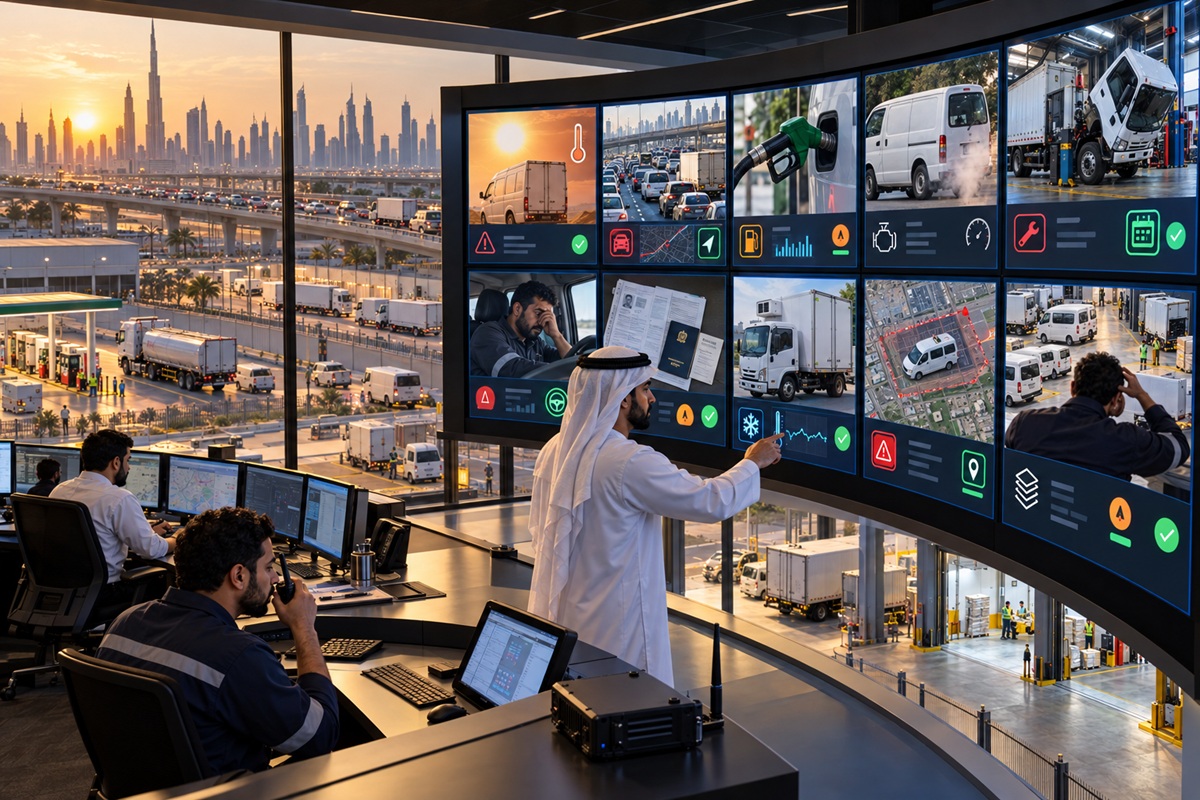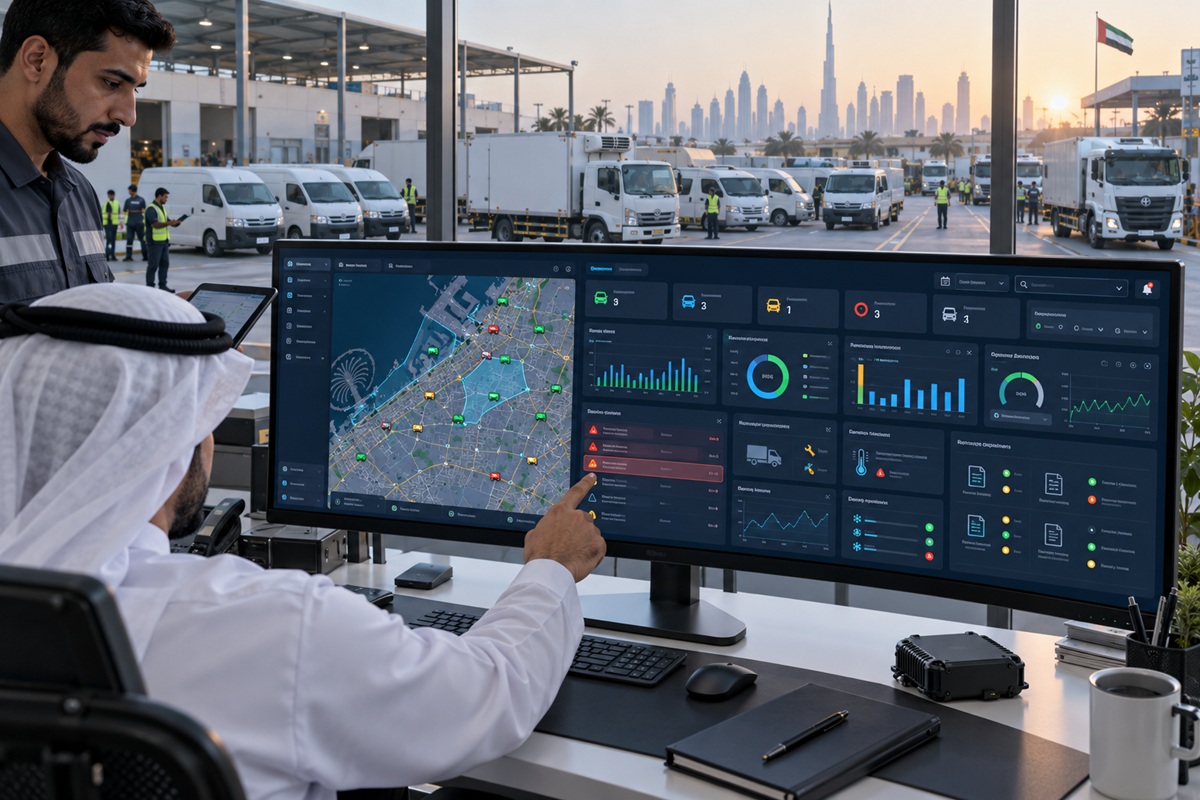
A UAE logistics company recently replaced its fleet management software after an ADNOC HSE audit found that its IVMS data was missing. The software they had been using tracked vehicle locations, generated mileage reports, and managed maintenance schedules. It did not capture the multi-tier driver behaviour event data harsh braking, seatbelt compliance, driver ID per trip that ADNOC’s IVMS standard requires. It was fleet management software. The audit required a telematics platform.
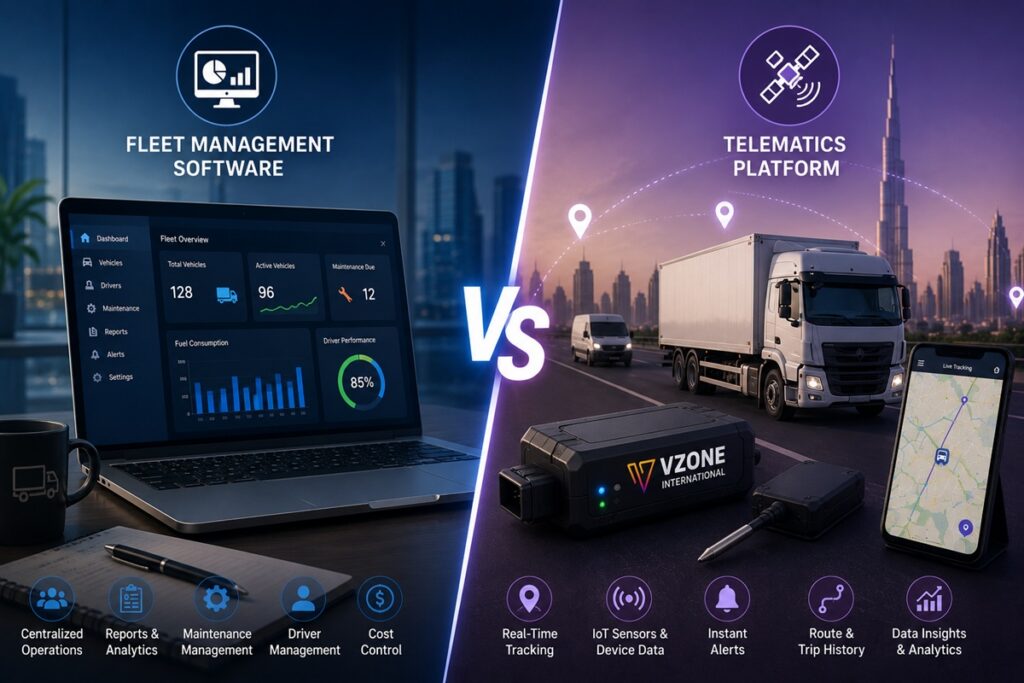
This distinction fleet management software versus telematics platform matters enormously in the UAE market, where compliance programmes like Asateel, SecurePath, ADNOC IVMS, and SIRA have specific technical data requirements that determine which category of technology satisfies them. Understanding the difference is not a technical exercise for IT teams. It is a procurement decision with direct regulatory and commercial consequences.
This guide explains what each category actually includes, where they overlap and where they diverge, which UAE fleet types need which solution level, and how modern enterprise platforms combine both into a single system that eliminates the choice entirely.
Key Takeaways
- Fleet management software and telematics platforms are not interchangeable terms they describe different capability levels with different data inputs, different compliance outputs, and different operational intelligence.
- Basic fleet management software provides location tracking, scheduling, and reporting. A telematics platform adds the real-time sensor data layer driver behaviour, engine diagnostics, fuel consumption, environmental monitoring that transforms location data into operational intelligence.
- UAE compliance programmes (Asateel, IVMS, SIRA) have specific technical requirements that basic fleet management software cannot satisfy they require behavioural event data capture, HSE-formatted reports, and in some cases AI dashcam integration that only a telematics platform provides.
- The practical difference for most UAE fleet operators is not which category to choose but which platform level within telematics basic telematics (GPS + driver behaviour) or enterprise telematics (full IoT integration, AI cameras, predictive analytics, compliance automation).
- Modern enterprise fleet platforms like VZone International’s Wialon and FMSiTrack deployment combine fleet management software capabilities and full telematics in a single system, eliminating the need to choose between administrative management and operational intelligence.
What Is Fleet Management Software?
Fleet management software is a technology platform designed to help businesses manage their vehicle fleets administratively tracking where vehicles are, scheduling maintenance, managing driver assignments, generating reports, and ensuring vehicles meet licensing and registration requirements. It is primarily a management and reporting tool that organises fleet information and automates administrative processes.
The category has existed since the early 2000s, predating the widespread deployment of IoT sensors and AI analytics. Many legacy fleet management software products were designed for administrative departments rather than operational teams producing the reports that finance and compliance teams need without providing the real-time operational data that fleet managers and dispatchers require during the working day.
Core GPS Tracking and Reporting Capabilities
Standard fleet management software at its foundation provides GPS vehicle location tracking knowing where each vehicle is at any given moment combined with a suite of reporting tools that translate location history into useful management information. Journey history reports show where vehicles went and for how long. Mileage reports support expense reimbursement and maintenance scheduling. Utilisation reports show which vehicles are being used and which are sitting idle. Exception reports flag vehicles that arrived late, deviated from routes, or operated outside authorised hours.
For many small to medium UAE fleets a property management company’s maintenance vans, a retail chain’s delivery vehicles, a professional services firm’s sales team cars this administrative reporting layer is exactly what is needed. It satisfies basic Asateel GPS registration requirements (providing the location data the ITC portal requires), supports fuel card reconciliation, and gives management the visibility over vehicle usage that protects against misuse without requiring the advanced analytics of a full telematics platform.
Scheduling, Maintenance, and Compliance Modules
Beyond location tracking, fleet management software typically includes maintenance scheduling (service interval alerts based on mileage or calendar time), vehicle document management (registration renewal reminders, insurance expiry alerts, Mulkia and Fahas reminders), driver licence expiry tracking, and in more capable systems, digital work order management for vehicle maintenance events. These administrative modules address the compliance calendar that every UAE fleet operator must manage Asateel registration, RTA Mulkia renewals, periodic vehicle roadworthiness inspections and the maintenance discipline that protects vehicle residual values.
Fleet management software with strong administrative modules is genuinely valuable regardless of whether the fleet also needs telematics capability. A 200-vehicle government fleet that needs to manage Mulkia renewals, insurance policy administration, and maintenance scheduling for a complex mixed vehicle inventory without necessarily needing driver behaviour scoring benefits substantially from the administrative management layer even without the full telematics data layer above it.
What Is a Telematics Platform?
A telematics platform extends fleet management software by adding a continuous real-time data stream from sensors installed in, on, and around fleet vehicles sensors that measure not just where a vehicle is but how it is being driven, what its engine is doing, how much fuel it is consuming, what the cargo environment looks like, and in AI-enabled systems, what the driver is doing in the cab. The word ‘telematics’ combines ‘telecommunications’ and ‘informatics’ it describes systems that transmit data from vehicles to a central intelligence platform for processing and analysis.
A telematics platform does not replace fleet management software it includes and extends it. Every telematics platform provides the GPS location tracking and administrative management modules that fleet management software offers. What it adds is the sensor data layer that generates operational intelligence: real-time alerts when driver behaviour events occur, engine diagnostic data that predicts maintenance failures before they happen, fuel consumption analysis that identifies waste and theft, and in enterprise-grade systems, AI video analysis that monitors driver attention and documents incidents.
Data Layers: Location, Behaviour, Engine, Environment
A mature telematics platform processes data from four distinct layers simultaneously, each adding a dimension of operational intelligence that the previous layer alone cannot provide.
The location layer is GPS position, speed, and heading where the vehicle is, how fast it is moving, and what direction it is travelling. This is the data layer that fleet management software also provides, and it is the foundation that all other telematics data layers build on.
The behaviour layer captures driver actions through accelerometers and the vehicle’s CAN bus harsh braking events, aggressive acceleration, harsh cornering, rapid lane changes, speeding events above configured thresholds, and idling duration. This is the data layer that ADNOC IVMS compliance requires and that driver safety programmes use to identify and coach high-risk drivers. It is not available from GPS location data alone; it requires the dedicated sensor and event processing capability of a telematics platform.
The engine layer accesses vehicle diagnostic data through OBD-II port connections or direct CAN bus integration engine RPM, coolant temperature, battery voltage, diagnostic fault codes, fuel consumption rate, and for heavy vehicles, axle load data and tachograph integration. Engine layer data is what enables predictive maintenance (detecting developing faults from sensor trends before failure occurs) and accurate fuel consumption accounting (not estimated from GPS mileage but measured from actual fuel flow data).
The environment layer connects IoT sensors beyond the vehicle itself cargo compartment temperature for cold chain monitoring, humidity sensors for sensitive cargo, fuel tank level sensors for theft detection, tyre pressure sensors for blowout prevention, and AI dashcam feeds for driver attention monitoring and incident documentation. This layer is what makes a telematics platform an IoT fleet management platform rather than just a vehicle tracking system.
Fleet Management Software vs. Telematics Platform Feature Comparison
| Capability | Fleet Management Software | Telematics Platform | Required for UAE Compliance? |
| Real-time GPS vehicle location | Yes | Yes | Yes, Asateel, SecurePath |
| Journey history and route replay | Yes | Yes | Yes, audit evidence |
| Geofencing and zone alerts | Basic | Advanced multiple zones, time-based | Partial, recommended for Asateel |
| Maintenance scheduling alerts | Yes, calendar/mileage | Yes, mileage + engine hours from CAN bus | Recommended ADNOC HSE records |
| Mulkia/Fahas/insurance renewal reminders | Yes | Yes | No, operational best practice |
| Driver behaviour (braking, acceleration, cornering) | No, requires telematics sensor | Yes, accelerometer + CAN bus events | Yes, ADNOC IVMS mandatory |
| Driver identification per trip | No | Yes, iButton / RFID / PIN | Yes, ADNOC IVMS mandatory |
| Seatbelt compliance monitoring | No | Yes, IVMS sensor | Yes, ADNOC IVMS mandatory |
| Multi-tier speed event reporting | No, GPS speed only | Yes, multi-threshold event classification | Yes, ADNOC IVMS mandatory |
| HSE-formatted compliance reports | No | Yes, weekly/monthly IVMS reports | Yes, ADNOC contractor requirement |
| Fuel level sensor integration (IoT) | No | Yes, in-tank sensor + drain alerts | No, operational ROI driver |
| Engine diagnostics (OBD-II / CAN bus) | No | Yes, RPM, temp, fault codes, consumption | No, predictive maintenance benefit |
| AI dashcam integration (fatigue/distraction) | No | Yes, enterprise telematics platforms | ADNOC fatigue monitoring requirement |
| Cold chain temperature monitoring | No | Yes, IoT sensor integration | Yes HACCP / GDP pharmaceutical |
| Route optimisation and dispatch | Basic static scheduling | Advanced dynamic, live traffic, AI routing | No commercial efficiency driver |
| Automated compliance report generation | Basic manual export | Yes, HACCP, GDP, IVMS, HSE formats | Yes pharmaceutical, ADNOC |
| Predictive maintenance analytics | No | Yes, sensor trend analysis | No cost reduction benefit |
| Fleet analytics and KPI dashboards | Basic standard reports | Advanced configurable, real-time, AI insights | No management intelligence |
| Multi-country GCC compliance | No | Yes, Asateel, OPAL, MOT multi-format | Yes cross-border operators |
| White-label / API / ERP integration | Limited | Yes, REST API, SAP/Oracle/Odoo connectors | No enterprise operational benefit |
Which Does Your UAE Fleet Actually Need?
The choice between fleet management software and a telematics platform is not primarily a technology decision it is a compliance and operational requirements decision. The right answer for your fleet depends on three factors: the regulatory framework your fleet operates under, the operational intelligence your team actually uses to make decisions, and the fleet size and complexity that determines what level of platform investment is proportionate.
Small Fleets Under 20 Vehicles When Software Is Sufficient
A small UAE fleet doing straightforward logistics or service work a maintenance company’s vans, a medical practice’s patient transport vehicles, a small restaurant chain’s delivery fleet may find that basic fleet management software satisfies both their compliance requirements and their operational needs without the full investment in enterprise telematics.
For a 10-vehicle fleet in Abu Dhabi that needs Asateel GPS registration, basic journey history for customer proof-of-delivery documentation, and Mulkia renewal alerts, a Level 1 AVL solution or entry-level fleet management software is appropriate and cost-effective. Asateel’s minimum data requirement is GPS location, speed, and heading not driver behaviour event data and a basic fleet management software product on Asateel-certified hardware satisfies this requirement.
The threshold where basic software becomes insufficient is when the fleet has any of the following: ADNOC IVMS obligations for oil and gas site access; pharmaceutical or food cold chain compliance requirements; driver safety programmes that need behaviour coaching data; fuel monitoring needs for theft prevention or efficiency; or multi-country GCC operations requiring compliance outputs for OPAL or Saudi MOT standards. Any of these conditions requires a telematics platform.
Enterprise Fleets of 100+ Vehicles Full Telematics Platform
An enterprise UAE fleet of 100 or more vehicles a major logistics operator, a construction contractor managing vehicles and equipment across multiple sites, a healthcare logistics company running pharmaceutical cold chain distribution cannot be effectively managed with fleet management software alone. The operational complexity exceeds what manual tracking and administrative reporting can address, and the compliance obligations typically span multiple regulatory frameworks simultaneously.
At enterprise scale, the ROI case for a full telematics platform is driven by operational efficiency rather than compliance alone. Route optimisation that reduces fuel cost per delivery by 15 to 29 percent across 100 vehicles generates AED 500,000 or more in annual savings. Predictive maintenance that reduces unplanned vehicle downtime by 30 to 40 percent avoids the operational disruption cost that a vehicle breakdown creates in a delivery fleet. AI dashcam integration that reduces accident frequency reduces insurance premium loading and eliminates the legal cost of at-fault accident events. At enterprise scale, the telematics platform investment pays back through operational returns that dwarf the subscription cost regardless of the compliance requirement that may have triggered the initial evaluation.
The Middle Ground When Software Becomes Telematics
Most UAE fleets sit between these extremes: 20 to 100 vehicles, mixed compliance obligations, operational management needs that exceed basic GPS tracking but do not require the full enterprise analytics stack. For this majority, the practical question is not ‘software or telematics?’ but ‘which telematics level?’ A mid-size Dubai food distribution fleet of 35 refrigerated vehicles needs: Asateel-compliant GPS, cold chain temperature monitoring for HACCP compliance, driver behaviour data for insurance management, and route optimisation for delivery efficiency. This is a Level 3 to Level 4 telematics requirement but it does not require the predictive analytics and AI dashcam fatigue detection that a large ADNOC contractor fleet needs.
The most common procurement mistake at this fleet size is buying fleet management software that satisfies the administrative requirement (maintenance scheduling, Mulkia reminders, mileage reporting) without addressing the operational compliance requirement (cold chain monitoring, driver behaviour for ADNOC or insurance). The result is a system that generates useful reports but cannot satisfy the compliance audit that triggers the next procurement cycle.
How VZone International Combines Both in One Platform
VZone International’s fleet platform eliminates the software-versus-telematics choice entirely because the Wialon and FMSiTrack platform combination provides fleet management software capabilities (scheduling, compliance calendar, reporting, document management) and full enterprise telematics capabilities (driver behaviour, engine diagnostics, fuel monitoring, cold chain, AI dashcam, IoT integration) in a single system accessed through a single login.
Wialon + FMSiTrack: Enterprise Telematics for Any Fleet Size
Wialon, developed by Gurtam, is the world’s most widely deployed enterprise fleet IoT platform supporting over 3,400 connected device types across 2,700+ companies in 130+ countries. Its architecture scales from a 5-vehicle small fleet deployment to a 500-vehicle enterprise operation without requiring platform migration as the fleet grows. The capabilities available at fleet launch GPS tracking, geofencing, basic reporting expand progressively as monitoring modules are added: driver behaviour, fuel monitoring, cold chain sensors, AI dashcam, route optimisation each added as operational requirements develop without disrupting the existing deployment.
FMSiTrack provides the white-label fleet management interface layer customisable dashboards, branded report templates, and configured workflow views that match the operational structure of each client’s fleet management team. Operations managers see their route management view; maintenance managers see their vehicle health and service schedule view; quality managers see their cold chain compliance view; senior management sees their KPI and cost analytics view all from the same platform, with role-based access controlling what each user sees.
UAE Compliance Modules Built In Asateel, IVMS, SIRA, OPAL
VZone International holds the broadest UAE compliance certification portfolio in the market: ITC Asateel (Abu Dhabi), RTA SecurePath (Dubai), SIRA approval (Dubai security patrol), ADNOC IVMS certification, and OPAL certification for Oman. These certifications are not external integrations or partner add-ons they are built into VZone’s platform deployment as standard configuration elements that activate for the applicable fleet types.
For an ADNOC contractor fleet, the IVMS module is active from day one: certified hardware capturing multi-tier speed events, harsh behaviour, seatbelt compliance, and driver ID per trip; the HSE report generator producing weekly driver behaviour summaries and monthly fleet performance reports in the format that ADNOC auditors are trained to review; and the management review dashboard presenting the compliance KPIs that site safety managers monitor daily. For a pharmaceutical cold chain fleet, the cold chain monitoring module is active alongside the standard GPS: calibrated temperature sensors, automated GDP-formatted trip reports, reefer health monitoring, and calibration certificate management. Neither module requires a separate platform, a separate login, or a separate provider relationship.
VZone AI Fleet Assistant 300M+ km of Regional Driving Intelligence
VZone International’s AI Fleet Assistant is trained on over 300 million kilometres of regional driving data UAE road networks, GCC desert routes, Abu Dhabi Western Region desert conditions, and the specific driver behaviour patterns that characterise commercial fleet operations across the Emirates. This regional training means the AI recommendations it generates driver coaching priorities, route efficiency opportunities, maintenance predictions are calibrated for UAE operating conditions rather than European or North American benchmarks that do not reflect the thermal, traffic, or regulatory environment that UAE fleets actually operate in.
The AI assistant is accessible through the platform dashboard and through API integration with enterprise ERP systems enabling fleet cost data to flow into SAP, Oracle, Odoo, and Zoho deployments without manual export, and enabling AI-generated fleet performance insights to feed the management reporting frameworks that finance and operations directors use for business planning.
Conclusion: The Distinction Matters and the Right Platform Eliminates It
The fleet management software versus telematics platform distinction is commercially significant for UAE operators because the UAE market’s compliance architecture Asateel, IVMS, SIRA, OPAL, pharmaceutical GDP, food HACCP was designed around the data outputs of telematics platforms, not the administrative reporting outputs of fleet management software. A fleet that deploys fleet management software to satisfy a compliance requirement that actually needs telematics data discovers the gap at the worst possible time: during an ADNOC HSE audit, a MOHAP pharmaceutical inspection, or a FSRA food safety assessment.
The practical resolution for most UAE fleet operators is to stop thinking about the category distinction and start thinking about the compliance and operational requirement list: What data does my regulatory framework require? What operational decisions does my team make that better data would improve? What is the cost of the compliance gap versus the cost of the monitoring investment? The answers to these questions map directly to a platform specification and for most UAE commercial fleet operations, that specification is a telematics platform, not basic fleet management software.
Modern enterprise telematics platforms like VZone International’s Wialon and FMSiTrack deployment make the distinction largely academic by combining both in a single system. The fleet manager gets the administrative management tools maintenance scheduling, compliance calendar, reporting alongside the operational intelligence tools real-time driver coaching, fuel theft detection, cold chain monitoring, route optimisation from a single platform with a single support relationship and a single compliance certification portfolio covering every UAE programme that applies.
Not sure which platform level your UAE fleet actually needs?
VZone International provides a free fleet technology assessment we review your fleet size, industry, compliance obligations, and operational priorities to specify exactly which platform capabilities your operation requires. No over-engineering, no under-specification. Book a 30-minute assessment call with our UAE fleet specialists today.
Frequently Asked Questions
Fleet management software handles GPS location tracking, route history, maintenance scheduling, and administrative reporting the management layer that organises fleet information and automates compliance calendar tasks. Telematics platforms add a real-time sensor data layer on top of this foundation: driver behaviour event capture (harsh braking, acceleration, seatbelt, driver ID), engine diagnostics (OBD-II / CAN bus data including RPM, fault codes, fuel consumption), environmental monitoring (fuel tank levels, cargo temperature, tyre pressure), and AI camera integration for driver attention monitoring. The distinction matters for UAE compliance because ADNOC IVMS, pharmaceutical GDP, and HACCP food cold chain monitoring all require the telematics sensor data layer that basic fleet management software does not provide.
Your fleet needs a full telematics platform if any of the following apply: you have vehicles operating on ADNOC sites or ADNOC-affiliated project sites (IVMS mandatory); you distribute pharmaceutical products or temperature-sensitive food (GDP/HACCP cold chain monitoring required); you operate a SIRA-licensed security company's patrol fleet in Dubai (SIRA-approved GPS required); you manage cross-border UAE-Oman operations (OPAL certification required); or you have driver safety, fuel theft, or insurance cost challenges that require behavioural data for coaching and accountability. Basic GPS tracking (Level 1 AVL) is appropriate only for small fleets with no regulated compliance obligations beyond Asateel or SecurePath location data submission.
VZone International's Wialon and FMSiTrack platform is consistently rated among UAE's most capable and most comprehensively certified fleet management platforms holding ITC Asateel, RTA SecurePath, SIRA, ADNOC IVMS, OPAL Oman, and ISO certifications simultaneously, built on Wialon's enterprise IoT infrastructure supporting 3,400+ device types, and backed by 20+ years of UAE fleet operations across 20+ industry verticals. The platform combines fleet management software capabilities and full enterprise telematics in a single deployment, with the compliance reporting and AI fleet intelligence that UAE operators require.
GPS tracking is the foundational technology layer knowing where vehicles are in real time. Fleet management software is a platform built on GPS tracking that adds administrative management tools: maintenance scheduling, reporting, compliance calendars, driver assignment. Telematics platforms are built on GPS tracking plus additional sensor layers that add driver behaviour, engine diagnostics, fuel monitoring, and environmental data. GPS tracking, fleet management software, and telematics platforms are successive capability levels rather than alternatives each includes the capabilities of the previous level and extends them with additional data sources and operational intelligence.
Fleet management software cost in UAE ranges from AED 30 to AED 70 per vehicle per month for basic GPS tracking and AVL compliance, AED 80 to AED 150 for standard telematics with driver behaviour monitoring, and AED 130 to AED 300 for enterprise fleet management with IoT integration, cold chain monitoring, and AI dashcam capability. Hardware costs range from AED 250 to AED 600 per vehicle for standard GPS devices, with cold chain sensor kits adding AED 800 to AED 2,000 per vehicle. Total cost of ownership should be evaluated over 24 months including all components hardware, installation, subscription, and UAE compliance portal management.