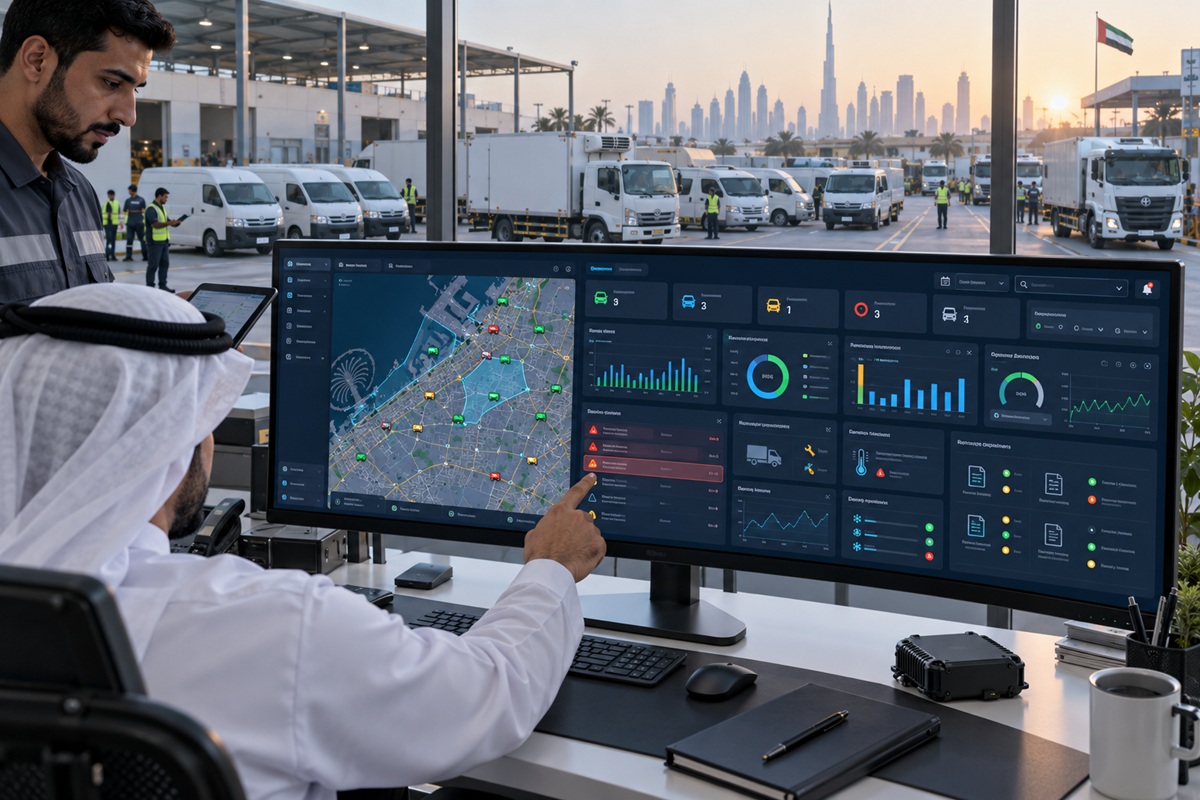
TL;DR Three Things to Know 1. Fleet management is the discipline; a fleet management system is the technology that makes it scalable. 2. The core modules are GPS tracking, driver behaviour monitoring, fuel analytics, and maintenance scheduling integrated on one platform. 3. UAE fleets typically recover the system’s cost within 3 to 5 months from fuel savings, insurance reduction, and compliance penalty avoidance alone. |
Fleet management is the operational discipline of overseeing a company’s vehicles, drivers, fuel, maintenance, and compliance. A fleet management system is the software platform that makes that discipline scalable replacing spreadsheets, phone calls, and manual fuel reconciliation with GPS-powered data that updates in real time and generates the reports that fleet managers, finance teams, and compliance officers each need, automatically.
The distinction matters because organisations that deploy a fleet management system without a fleet management strategy without coaching programmes, compliance procedures, and operational workflows built around the data recover less value than those who treat the technology as a tool for an already-defined operational discipline. This guide explains both: what a fleet management system does technically, and what fleet management as an organisational capability requires to deliver the cost, safety, and compliance outcomes that justify the investment.
Key Takeaways
- A fleet management system is not the same as a GPS tracker. A GPS tracker shows where vehicles are. A fleet management system adds driver behaviour scoring, fuel monitoring, maintenance scheduling, compliance reporting, and ERP integration turning location data into operational intelligence.
- Fleet management as a discipline requires both technology and process: the platform generates the data; the organisation must act on it through driver coaching programmes, maintenance procedures, and compliance workflows to realise the financial returns.
- UAE fleet operators face compliance requirements that most global fleet management benchmarks do not account for: ITC Asateel mandatory GPS submission for Abu Dhabi commercial vehicles, ADNOC IVMS driver behaviour monitoring for contractor fleets, and RTA SecurePath for Dubai rental cars and school buses. A fleet management system that does not manage these submissions is insufficient for UAE commercial operations.
- The financial return from a fleet management system comes from five simultaneous saving categories: fuel cost reduction (10 to 25 percent), accident cost reduction (30 to 40 percent fewer at-fault incidents), insurance premium reduction (10 to 20 percent at first renewal), maintenance cost reduction (30 to 50 percent fewer unplanned breakdowns), and compliance penalty avoidance (ITC Asateel, ADNOC IVMS, RTA SecurePath).
- Implementation timeline for a UAE commercial fleet: device installation and compliance registration in Week 1, baseline data and first insights in Month 1, measurable coaching impact and cost reduction by Month 3, full ROI realised and compounding from Month 6.
Fleet Management vs. Fleet Management System The Concept and the Tool
Fleet management is the organisational practice of controlling a company’s vehicles as productive assets ensuring they are in the right place at the right time, operated safely and efficiently, maintained to prevent breakdown, compliant with applicable regulations, and accounted for in the company’s financial records as accurately as possible. Large organisations have practised fleet management for decades using whatever tools were available: vehicle log books, odometer readings, paper fuel receipts, and periodic maintenance schedules based on time intervals rather than actual usage.
A fleet management system is the technology platform that replaces these manual tools with GPS-verified data, automated alerts, and integrated reporting. It does not change what fleet management requires it changes how well those requirements can be met, at what scale, and with what accuracy. The most important insight for organisations evaluating fleet management systems is that the technology amplifies whatever operational discipline the organisation already has: a fleet management system deployed in an organisation with no coaching programme, no compliance procedures, and no process for acting on maintenance alerts produces significantly less return than the same system in an organisation that uses the data systematically.
| Fleet Management (discipline) | Fleet Management System (technology) |
| Ensuring vehicles are deployed efficiently | GPS tracking and dispatch integration that shows vehicle locations and enables optimal assignment |
| Monitoring driver conduct and safety | AI driver behaviour scoring from GPS accelerometer and dashcam per-driver scorecards weekly |
| Controlling fuel expenditure | Fuel sensor monitoring, idle alerts, eco-driving coaching data, card reconciliation |
| Scheduling and tracking maintenance | GPS mileage triggers, OBD diagnostic alerts, maintenance history records |
| Ensuring regulatory compliance | Automated Asateel, IVMS, SecurePath, SIRA, OPAL portal data submission and status monitoring |
| Reporting costs to finance | Per-vehicle monthly cost reports exported in ERP-import format (SAP, Oracle, Odoo, Zoho) |
Core Modules of a Fleet Management System
GPS Tracking, Fuel Monitoring, and Maintenance Scheduling
The GPS vehicle tracking module is the data foundation: a GPS device in each vehicle transmits real-time position, speed, and heading to the cloud platform at 10 to 60 second intervals. This position data is simultaneously the live operational map for the fleet manager, the compliance data stream for Asateel or IVMS submission, the route record for delivery proof and customer ETA, and the mileage input for maintenance interval calculations. GPS tracking alone does not produce fleet management intelligence it produces location data that the platform’s other modules transform into operational insight.
Fuel monitoring integrates with in-vehicle fuel level sensors to measure actual tank consumption rather than estimating consumption from GPS distance. Actual fuel measurement is the difference between detecting a siphoning event (sensor shows a rapid tank level drop) and missing it (GPS distance shows normal consumption). UAE fleet operators using sensor-based fuel monitoring consistently identify 3 to 8 percent of fuel spend attributable to theft or fill-up fraud that GPS-distance-only monitoring cannot detect. Fleet operators using integrated fuel monitoring report an average fuel cost reduction of 12 percent within 12 months of deployment.
Maintenance scheduling uses GPS-verified mileage not driver-reported odometer readings to trigger service interval alerts at the configured service threshold, with advance warning at 80 percent of interval to allow scheduling flexibility. OBD-II diagnostic integration adds real-time engine fault code monitoring: when the vehicle’s engine management system generates a diagnostic trouble code, the fleet management system transmits it to the platform immediately, enabling maintenance scheduling before the fault progresses to a breakdown. Fleets with GPS mileage-triggered maintenance scheduling experience 35 percent fewer unplanned vehicle breakdowns than fleets using time-based or self-reported mileage service scheduling.
Driver Behaviour and Compliance Reporting
Driver behaviour monitoring uses the GPS device’s three-axis accelerometer to detect and record harsh braking, rapid acceleration, sharp cornering, and speeding events scoring each driver per trip and generating weekly safety scorecards. The score is the coaching input: it identifies which drivers need which specific coaching conversations, with GPS location context showing where on the route the events occurred. UAE commercial fleets that implement systematic driver coaching from GPS behaviour data report a 30 to 40 percent reduction in at-fault accident frequency within 12 months a result that requires both the data (provided by the fleet management system) and the coaching programme (implemented by the organisation). AI dashcam integration adds the fatigue detection and distraction monitoring layer that GPS accelerometer alone cannot provide: driver-facing infrared camera analysis detects eye closure patterns (microsleep risk), phone use, and seatbelt non-compliance in real time.
Compliance reporting is the module that distinguishes a UAE-specific fleet management system from a global GPS tracking platform. UAE commercial vehicle operators face mandatory GPS data submission requirements that most global fleet management vendors do not natively support: ITC Asateel (all Abu Dhabi commercial vehicles must submit continuous GPS data to the ITC portal), ADNOC IVMS (contractor vehicles require driver behaviour event data in ADNOC-specified format for weekly HSE reports), and RTA SecurePath (rental cars, taxis, and school buses in Dubai require continuous GPS submission to the RTA portal). A fleet management system that does not manage these submissions automatically or that requires manual data export and re-upload to each portal is not a compliant system for UAE commercial operations.
Benefits of Fleet Management for Logistics, Construction, and Oil and Gas Fleets
Logistics and Last-Mile Delivery
For logistics operators, a fleet management system delivers value across three dimensions simultaneously. Route optimisation from GPS trip data reduces kilometres per delivery stop by 15 to 20 percent on multi-stop urban routes the same distance reduction that reduces fuel, reduces vehicle wear, and increases the number of stops each vehicle can complete per shift. Customer-facing ETA visibility from GPS position sharing live tracking links with customers whose deliveries are approaching has shifted from a competitive differentiator to a commercial baseline expectation in UAE’s B2B and e-commerce logistics market. Electronic proof of delivery (ePOD) integration with GPS location verification creates a GPS-timestamped delivery record that defends against ‘not delivered’ customer disputes without requiring paper signature collection.
| 20% | Average reduction in kilometres per delivery stop from GPS-informed route optimisation on UAE urban multi-stop delivery routes equivalent to one additional delivery stop per vehicle per day at no additional fuel cost. |
Construction and Heavy Equipment Fleets
Construction fleet management centres on three specific problems that GPS tracking enables: equipment theft prevention through after-hours geofence alerts (after-hours equipment movement on a construction site is the primary indicator of theft risk); site access compliance documentation (GPS-verified entry and exit timestamps for ADNOC contractor compliance, HSE headcount verification, and contractor billing validation); and heavy vehicle maintenance from GPS mileage and OBD diagnostics (heavy construction vehicles have specific service intervals based on engine hours and distance that self-reporting consistently understates, leading to delayed maintenance and accelerated component wear).
| 35% | Reduction in unplanned vehicle breakdowns for UAE construction fleets using GPS mileage-triggered maintenance scheduling compared to time-based or driver-reported odometer service scheduling. |
Oil and Gas Contractor Fleets
ADNOC contractor fleet management is the most compliance-intensive fleet management context in UAE. ADNOC IVMS requirements add driver behaviour event monitoring, multi-tier speed monitoring, seatbelt compliance, and driver identification to the GPS location requirement that Asateel already mandates. ADNOC HSE management systems require weekly driver behaviour reports and monthly fleet performance summaries in ADNOC-specified formats reports that a fleet management system without IVMS integration cannot generate automatically, requiring manual data extraction and formatting that represents 4 to 8 hours of safety officer time per month per fleet. The commercial consequence of IVMS non-compliance vehicle site access suspension means that for ADNOC-dependent contractors, IVMS-compliant fleet management is a revenue protection measure as much as a compliance one.
| AED 180,000 | Estimated annual saving for a 45-vehicle UAE construction contractor from combined GPS fleet management deployment fuel monitoring, maintenance scheduling, insurance reduction, and compliance penalty avoidance based on VZone International deployment data. |
How Much Does a Fleet Management System Cost?
Fleet management system costs in UAE have three components that must all be included in the total cost of ownership calculation: hardware, installation, and monthly platform subscription. Evaluating only the subscription cost the most common mistake in fleet management technology procurement understates the total investment by 30 to 50 percent and overstates the ROI percentage that finance committees will challenge.
| Cost Component | Entry-Level (Basic GPS Tracking) | Vehicle Tracking System | Full Fleet Management System |
| Hardware per vehicle | AED 150-400 | AED 350-700 | AED 600-1,200 |
| Installation per vehicle | AED 0-150 | AED 150-250 | AED 200-350 |
| Monthly subscription per vehicle | AED 30-60 | AED 60-100 | AED 80-150 |
| 24-month total per vehicle | AED 870-1,840 | AED 1,940-3,350 | AED 2,720-5,750 |
| UAE compliance managed? | No significant risk | Basic verify | Yes all five programmes |
| Typical annual saving per vehicle | AED 800-2,000 | AED 3,000-6,000 | AED 8,000-18,000 |
| Payback period | 6-12 months | 3-6 months | 2-5 months |
The counterintuitive result: the full fleet management system achieves the fastest ROI payback despite the highest absolute cost, because the additional modules fuel sensor monitoring, maintenance scheduling, compliance management, insurance telematics generate proportionally larger savings that recover the higher investment more quickly. A fleet management system at AED 80 to AED 150 per vehicle per month saves AED 8,000 to AED 18,000 per vehicle per year; an entry-level GPS tracker at AED 30 to AED 60 saves AED 800 to AED 2,000. The cost difference is AED 50 to AED 90 per vehicle per month; the saving difference is AED 600 to AED 1,333 per vehicle per month.
Fleet Management System Implementation What to Expect
UAE commercial fleet management system implementation follows a consistent timeline when managed by an experienced provider. Understanding what to expect at each stage prevents the most common implementation failures: premature live expectations in Week 1 before baseline data is established, coaching programme launch before drivers understand the scoring system, and compliance portal registration delays that create a gap between device installation and active compliance status.
| Implementation Stage | Timeline | What Happens | What You Get |
| Device installation and compliance registration | Week 1 | Certified installation team deploys GPS devices across all vehicles during depot downtime slots. Asateel, IVMS, SIRA portal registration completed. Platform user accounts configured. | Every vehicle live on dashboard. Compliance status confirmed active. Driver ID configured. |
| Baseline establishment | Month 1 | Platform collects first month of uninterrupted operational data fuel consumption per vehicle, driver event frequency, idle patterns, route distances vs planned routes. | Baseline report identifying top 3-5 operational issues: typically fuel waste, high harsh event drivers, after-hours vehicle use patterns. |
| Driver coaching launch | Month 1-2 | First weekly scorecards issued to drivers and supervisors. Coaching conversations scheduled for highest-risk drivers. Safety score targets communicated. | Initial 15-20% reduction in harsh event frequency as drivers respond to scoring awareness. |
| First ROI visible | Month 3 | Fuel consumption 5-8% below baseline from eco-driving coaching. Idle time reduced 25-35% from alerts. First at-fault incident rate reduction visible. | AED saving figure calculable against baseline typically AED 400-800 per vehicle per month at Month 3. |
| Insurance renewal preparation | Month 9-11 | 12-month telematics data package generated automatically for insurer submission. Driver safety score trend, harsh event frequency by category, coaching programme records. | Insurance telematics package submitted to broker for renewal negotiation. |
| Full ROI realised and compounding | Month 12+ | Coaching impact mature. Claims history improvement feeding through to renewal pricing. Maintenance savings from avoided breakdowns accumulating. | Full 10-25% fuel reduction, 30-40% incident reduction, 10-20% insurance premium reduction all active simultaneously. |
Conclusion
A fleet management system is the operational infrastructure that makes commercial fleet management scalable, measurable, and financially accountable at any fleet size above 10 vehicles. The technology itself GPS tracking, AI driver scoring, fuel sensor monitoring, maintenance scheduling, compliance portal management is well-established and consistently delivers the financial returns summarised throughout this guide. What differentiates successful implementations from underperforming ones is not the technology but the operational discipline: coaching programmes that act on the safety data, maintenance procedures that act on the diagnostic alerts, and finance processes that integrate GPS cost data with the ERP systems where budget management actually happens.
VZone International’s fleet management system brings the full capability stack Teltonika enterprise hardware across all UAE compliance programme approved lists, Wialon platform with 3,400+ supported device types, AI Fleet Assistant trained on 300M+ km of UAE and GCC driving data, and all five UAE GPS compliance certifications to UAE and GCC fleet operators across every industry vertical and fleet size. The system is the tool; the free AI Fleet Audit is the starting point for understanding what your fleet’s specific data will show.
Book a VZone Fleet Management Platform Demo
See VZone International’s fleet management system in action GPS live map, AI driver scoring, fuel sensor monitoring, UAE compliance dashboard, and the Wialon analytics platform with a demo configured for your fleet size, industry, and UAE compliance profile. Contact our team to book your platform demo.
Frequently Asked Questions
A fleet management system integrates GPS vehicle tracking, driver behaviour monitoring, fuel consumption analytics, maintenance scheduling, and compliance reporting into a single software platform. It collects data from GPS devices installed in each vehicle, processes that data through analytics and alert engines, and presents actionable reports and real-time notifications to fleet managers, drivers, safety officers, and finance teams through a web dashboard and mobile app. In UAE, a fleet management system also manages mandatory GPS compliance data submission to government portals ITC Asateel, ADNOC IVMS, RTA SecurePath, SIRA, and OPAL Oman automatically, without requiring manual data export and re-upload to each programme's portal.
In UAE, the industries with the highest operational and financial return from fleet management system deployment are: oil and gas contractor operations (ADNOC IVMS compliance is mandatory; non-compliance means site access suspension the highest-stakes compliance requirement in UAE fleet management); logistics and last-mile delivery (route optimisation, ePOD, and Salik toll monitoring all have direct revenue protection value); construction and engineering (equipment theft prevention, site access documentation, and heavy vehicle maintenance scheduling address the three highest-cost fleet management failures in the sector); pharmaceutical and food distribution (cold chain monitoring for temperature-sensitive cargo compliance is a regulatory requirement under MOHAP and Dubai Municipality food safety frameworks); and school and staff transport (RTA SecurePath compliance, route monitoring, and passenger welfare documentation are all mandatory or commercially expected).
Fleet management reduces fuel costs through five simultaneous mechanisms: eco-driving coaching from GPS driver behaviour scores reduces aggressive acceleration and deceleration (8 to 12 percent fuel saving); idle time monitoring and alerts reduce UAE summer air-conditioning idle waste (3 to 8 percent fuel saving, amplified by UAE's 45°C+ summer conditions where idle fuel consumption is 1.5 to 2.5 litres per hour); route optimisation from GPS trip data reduces total kilometres per delivery or service run (8 to 15 percent combined fuel and distance saving on multi-stop routes); fuel theft and fill-up fraud detection from sensor-based tank monitoring recovers 2 to 5 percent of fuel spend; and Salik toll schedule optimisation shifts crossings from peak-rate (AED 6) to off-peak rate (AED 4) windows. Combined fleet management fuel cost reduction in UAE commercial fleet deployments averages 12 to 20 percent within 12 months.
GPS tracking shows where vehicles are real-time position, trip history, and basic speed alerts. Full fleet management integrates GPS tracking with driver behaviour monitoring (safety scoring, harsh event detection, fatigue alerts), fuel analytics (sensor-based consumption monitoring, theft detection, idle alerts), maintenance management (mileage-triggered service scheduling, OBD fault code alerts), compliance reporting (automated data submission to UAE regulatory portals), and ERP integration (per-vehicle cost data pushed to SAP, Oracle, or Odoo). GPS tracking tells you where the fleet is; fleet management tells you how efficiently, safely, and cost-effectively it is operating and generates the reports that allow management decisions to be based on data rather than estimates.