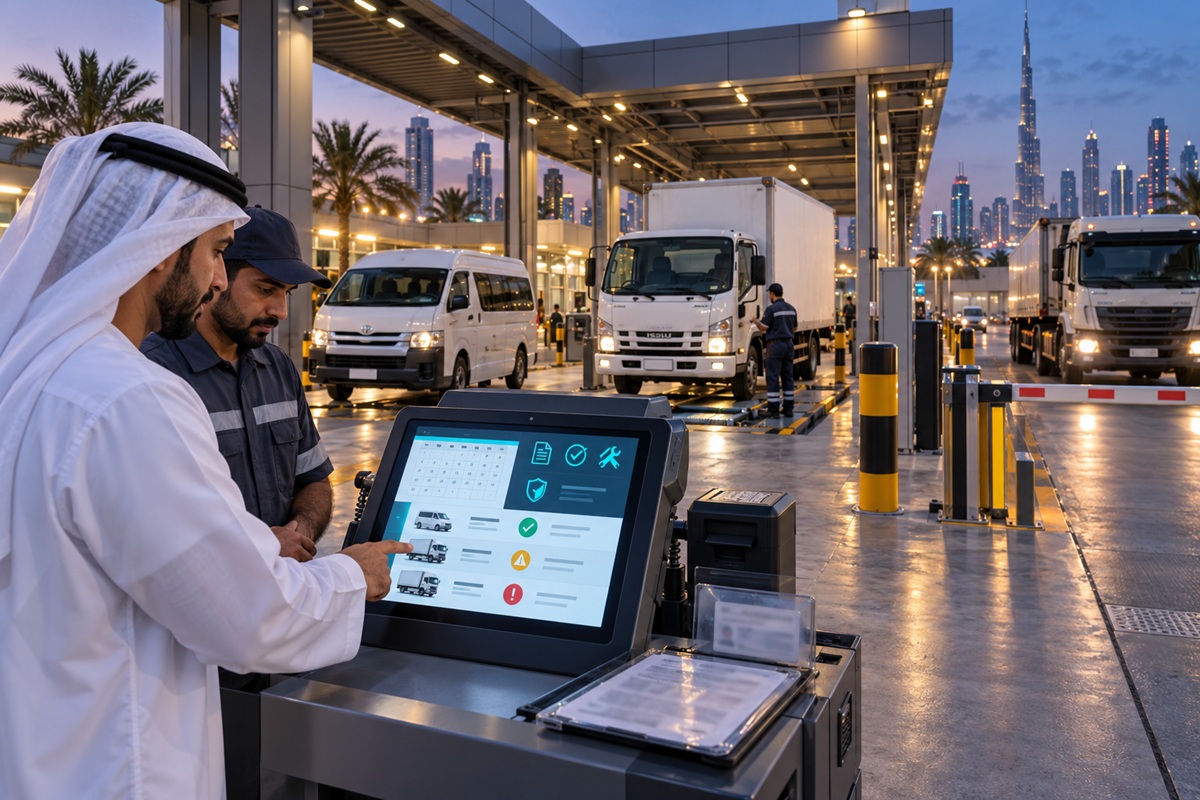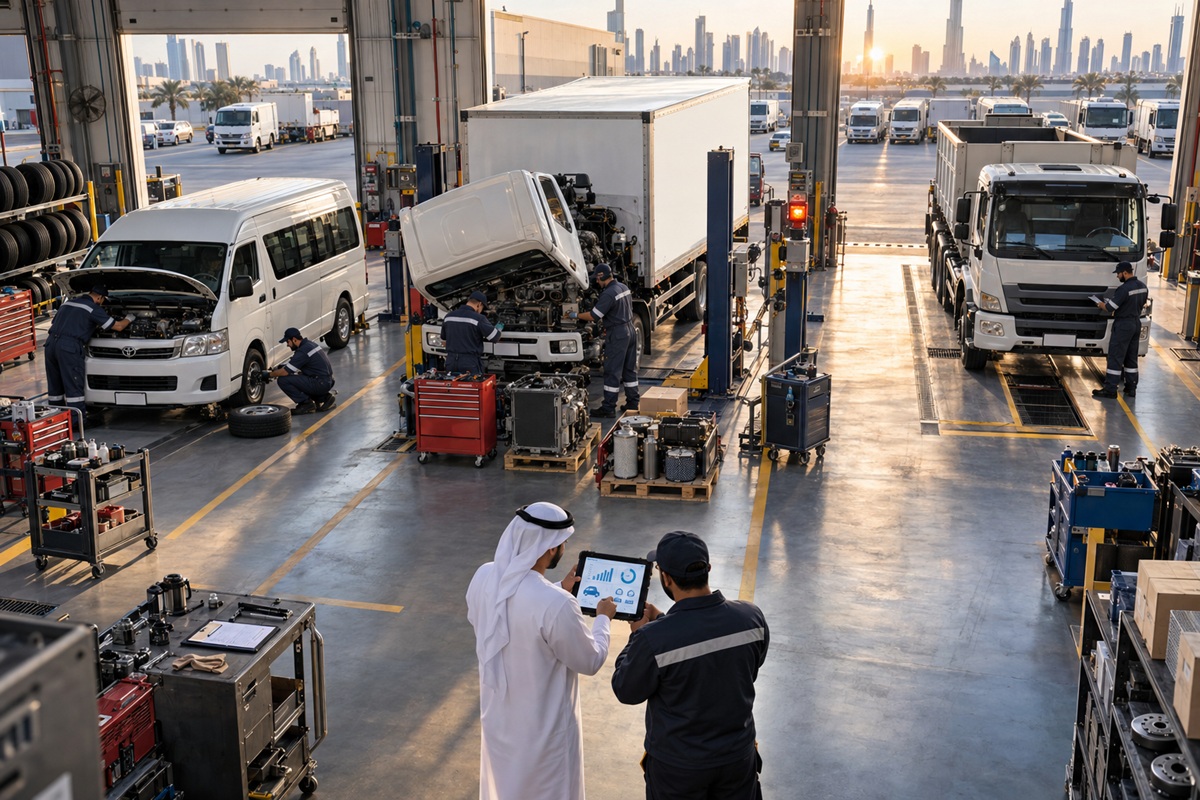
A fleet preventive maintenance schedule is the structured plan that determines when each vehicle in the fleet receives each category of service oil changes, tyre inspections, brake checks, filter replacements, cooling system service and the process that ensures those services happen at the right time rather than being deferred, forgotten, or triggered only after a breakdown has made the oversight visible. For UAE commercial fleets, the maintenance schedule is the operational document that separates a managed fleet from a reactive one.
The challenge with building a maintenance schedule for UAE conditions is that the standard intervals published in manufacturer service guides are written for temperate European climates and are consistently inappropriate for UAE operating conditions. An oil change every 15,000 km that works for a van operating at 20°C in Germany creates an under-maintained engine in a van operating at 47°C in Dubai’s summer traffic. Building a UAE fleet maintenance schedule requires starting from the manufacturer’s baseline and applying local condition adjustments that reflect UAE’s heat, dust, and operating patterns. This guide provides the step-by-step process.
Key Takeaways
- A UAE fleet preventive maintenance schedule must adjust manufacturer-specified service intervals for UAE’s extreme summer heat, heavy dust loading, and stop-start urban traffic patterns these conditions accelerate component wear significantly beyond European baseline assumptions.
- GPS-verified mileage is the only reliable trigger for mileage-based service intervals in UAE fleets driver-reported odometer readings are systematically understated, causing missed services that the fleet manager discovers only after a component failure.
- Fleet maintenance software automates the scheduling logic: when a vehicle’s GPS-tracked mileage approaches a service threshold, the platform generates an alert to the fleet manager and workshop, with the specific service tasks and parts required at that interval no manual tracking required.
- The maintenance schedule should differentiate between vehicle types and operating profiles a construction site pickup truck operating on dusty access roads needs shorter air filter intervals than an urban delivery van; a heavy truck covering highway kilometres accumulates component wear differently from a city delivery vehicle.
- Regular schedule review using actual service completion data what components were found worn at each service, what failed between services is the mechanism that improves schedule accuracy over time, calibrating intervals to actual UAE fleet experience rather than European factory specifications.
Step-by-Step: Building Your UAE Fleet Maintenance Schedule
| 1 | Categorise Your Fleet by Vehicle Type and Operating Profile The maintenance schedule is not one-size-fits-all different vehicle types and different operating conditions require different service intervals. Create vehicle categories that reflect actual operating differences: light commercial vans (urban delivery, mostly tarmac routes), pickup trucks (construction site access, dust and rough surface exposure), heavy trucks (highway and inter-city routes, high annual mileage), refrigerated vehicles (continuous A/C compressor load, temperature-sensitive components), and heavy equipment (hours-based rather than mileage-based service intervals). Within each category, note the operating environment: city-only vs mixed city/highway vs predominantly highway; low-dust vs high-dust exposure; UAE-only vs cross-border GCC operations. These distinctions drive the interval calibration in Step 2. |
| 2 | Establish UAE-Calibrated Service Intervals for Each Category Start from the manufacturer’s service guide for each vehicle model and apply UAE condition adjustments. The adjustments are significant and non-optional for summer operations. Use the UAE-specific interval reference table in Section 1 of this guide as your calibration starting point, then adjust based on your fleet’s specific operating conditions a vehicle on desert construction sites in the Western Region needs shorter air filter intervals than the table’s general recommendation; a vehicle on Abu Dhabi’s main arterials may be closer to the general interval. For vehicles without UAE-specific service guidance from the manufacturer, reduce oil change intervals by 30 to 40 percent from European specifications as a conservative starting point, and monitor oil condition at each service to validate whether the interval is appropriate. |
| 3 | Choose GPS Mileage as the Primary Trigger (Not Driver-Reported Odometer) Configure your maintenance schedule to trigger from GPS-verified mileage rather than driver-reported odometer readings. GPS-verified mileage is accurate and immune to distortion; driver-reported mileage in UAE fleets is consistently understated by 15 to 25 percent, causing systematic late-trigger of mileage-based service intervals. If your fleet management software supports GPS mileage integration with the maintenance schedule module as VZone International’s Wialon platform does the trigger is automatic and requires no manual input. If you are using a manual or spreadsheet-based tracking system, use GPS trip data from the fleet platform to calculate actual mileage per vehicle rather than accepting driver odometer submissions. |
| 4 | Define Maintenance Tasks and Parts Required at Each Interval For each service interval threshold (e.g. every 5,000 km, 10,000 km, 20,000 km), define the specific maintenance tasks to be performed and the parts or consumables required. A structured task list at each interval enables the workshop to prepare parts in advance reducing vehicle downtime from parts availability delays. Standard task list structure by interval: Minor service (5,000 km / 3 months): oil and filter change, tyre pressure check, fluid level check, visual inspection for visible damage or leaks. Intermediate service (10,000 km / 6 months): all minor tasks plus air filter inspection, brake pad measurement, battery condition check, cooling system visual inspection. Major service (20,000 km / 12 months): all intermediate tasks plus cooling system flush and refill, brake fluid change, transmission service, comprehensive electrical check, tyre rotation or replacement decision. Adjust tasks by vehicle category refrigerated vehicles add A/C compressor service; heavy trucks add transmission and differential service; construction equipment adds hydraulic fluid and filter service. |
| 5 | Configure Service Alerts in Fleet Maintenance Software Enter the service schedule into fleet maintenance software with alert trigger points at 80 percent and 95 percent of each interval threshold. The 80 percent alert (advance warning) gives the workshop sufficient lead time to schedule the appointment and order parts typically 7 to 14 days ahead for a minor service. The 95 percent alert (urgent warning) indicates the service is imminent and should be scheduled for the current week. An overdue alert at 100 percent flags any vehicle that has exceeded its service threshold without a completed service record. Configure alerts to notify both the fleet manager (who manages the vehicle schedule and driver) and the workshop supervisor (who manages workshop capacity and parts ordering). For fleets using VZone International’s platform, service alerts are configured in the maintenance module with automatic link to the vehicle’s GPS mileage tracker no manual odometer entry required. |
| 6 | Track Completion and Review Intervals Based on Actual Data Log every completed service in the fleet maintenance software with the actual mileage at service, the specific parts replaced, and any additional work performed beyond the scheduled tasks including any component conditions noted by the technician (brake pad thickness at service, tyre tread depth, belt condition). This completion record builds the service history that enables schedule improvement: if brake pads are consistently reaching replacement threshold 2,000 km before the scheduled brake inspection, the brake inspection interval should be shortened. If oil consistently shows good condition at the 5,000 km change interval, the interval may be extendable to 7,000 km for that vehicle operating profile reducing service frequency without increasing risk. Annual schedule review using the accumulated service data produces a UAE-validated maintenance schedule that improves year on year. |
UAE-Specific Service Interval Reference Table
The following intervals are starting-point recommendations for UAE-registered commercial vehicles. Apply these as the baseline and adjust based on actual fleet experience, vehicle condition findings at service, and specific operating environment factors.
| Service Item | European Standard Interval | UAE Recommended Interval (Summer Operation) | UAE Adjustment Rationale |
| Engine oil and filter | 10,000-15,000 km or 12 months | 5,000-8,000 km or 3-4 months (whichever first) | Sustained high engine bay temperatures accelerate oil oxidation and viscosity breakdown shorter interval maintains lubrication quality |
| Air filter | 15,000-30,000 km or 12 months | 5,000-10,000 km or condition-based (differential pressure check) | UAE desert dust loads air filters significantly faster than clean-air environments filter-loading rate varies by route type |
| Cabin air filter | 12-24 months | 6-12 months | UAE dust and sand ingress through HVAC system more frequent replacement maintains A/C efficiency and cabin air quality |
| Tyre inspection and rotation | 15,000-20,000 km | 10,000 km or monthly pressure check | UAE summer heat raises tyre pressure and accelerates rubber degradation monthly pressure checks are essential; rotation should follow wear pattern, not just interval |
| Brake pads (commercial vehicles) | 30,000-50,000 km (operating dependent) | 20,000-30,000 km (UAE urban routes) | UAE urban stop-start traffic and heavy braking from speed creates higher pad wear than European highway-dominant patterns |
| Cooling system inspection | Annual | Every 6 months (summer pre-season inspection mandatory) | UAE summer places cooling system at continuous high load pre-summer inspection catches degrading coolant, worn water pump, and failing thermostat before the system is under peak stress |
| Cooling system flush and refill | Every 2-4 years | Every 2 years maximum | Heat and mineral content in UAE water supplies degrade coolant chemistry faster biennial flush maintains corrosion protection |
| Battery condition check | Annual | Every 6 months (pre-summer) | UAE summer heat is the primary cause of battery failure internal heat accelerates electrolyte evaporation and plate degradation; pre-summer check avoids in-service failure at peak temperature |
| A/C system inspection (refrigerant, compressor) | As needed | Annual pre-summer inspection | A/C compressor failure peaks in UAE July-August when system is at maximum load pre-summer inspection and refrigerant top-up prevents the most common UAE summer vehicle breakdown |
| Fuel filter | Every 30,000-40,000 km | Every 20,000-25,000 km | UAE fuel quality variations and desert dust contamination shorter intervals maintain fuel system cleanliness |
| Brake fluid | Every 2 years | Annually | Heat accelerates brake fluid moisture absorption and boiling point reduction annual change maintains braking performance in UAE summer operating temperatures |
| Transmission service (auto) | Every 60,000-80,000 km | Every 40,000-50,000 km | UAE summer heat and stop-start traffic increase transmission heat load beyond European assumptions |
Maintenance Schedule for Different UAE Fleet Types
Light Commercial Van (Urban Delivery, UAE Cities)
Urban delivery vans accumulate high annual mileage (80,000 to 120,000 km) in stop-start Dubai and Abu Dhabi traffic, with high brake pad consumption, frequent A/C compressor cycling, and moderate dust exposure on paved routes. Minor service every 5,000 km, major service every 20,000 km with pre-summer A/C inspection in April and battery check in September as seasonal additions to the standard schedule. Tyre rotation at 10,000 km intervals and monthly tyre pressure checks during summer months are essential for this vehicle category.
Construction Site Pickup Truck (Dust and Rough Surface)
Construction site vehicles accumulate moderate mileage (40,000 to 70,000 km) but operate in high-dust environments on rough access roads that significantly accelerate air filter loading, tyre wear, and suspension component wear. Air filter inspection at 5,000 km with condition-based replacement (not fixed interval), tyre inspection at 7,500 km (construction site tyre damage from debris), suspension and steering inspection at 20,000 km, and oil change at 5,000 km are the key schedule adjustments for this category. Drive belt and underbody protection inspection at each service due to rough road exposure.
Heavy Truck (Inter-City Highway Routes, UAE and GCC)
Long-haul heavy trucks accumulate high annual mileage (150,000 to 250,000 km) on UAE and GCC highways with sustained high engine load, heavy tyre wear, and significant brake system loading on UAE mountain routes (Hatta, Fujairah). The oil change interval at 7,500 to 10,000 km reflects the higher capacity engine sumps on heavy trucks vs light vehicles; transmission and rear axle service at 50,000 km; tyre inspection at each fuel stop for long-haul routes; and front/rear brake inspection at 40,000 km intervals. Pre-trip inspection documentation (digital, via driver app) is essential for ADNOC IVMS journey management compliance for trucks accessing ADNOC facilities.
Refrigerated Vehicle (Cold Chain Transport)
Refrigerated vehicles add the refrigeration unit maintenance schedule to the standard vehicle maintenance programme. Refrigeration unit service (compressor oil, filter dryer, condenser coil cleaning) every 2,000 hours of unit operation or annually; door seal inspection at every vehicle service (door seal degradation is the primary cause of refrigeration efficiency loss and cold chain excursions); and temperature sensor calibration annually for pharmaceutical GDP compliance. The vehicle’s A/C compressor and refrigeration compressor both require pre-summer inspection two cooling systems under high UAE summer load simultaneously.
Implementing the Schedule in Fleet Maintenance Software
Manual maintenance schedules spreadsheets, paper service logs, WhatsApp reminders work for fleets of up to 5 vehicles where the fleet manager has direct daily contact with every vehicle. Beyond that scale, the failure modes of manual scheduling (missed alerts, driver mileage under-reporting, service deferred without record, no workshop pre-notification for parts) accumulate faster than the fleet manager can manage. Fleet maintenance software integrated with GPS mileage data from the fleet tracking platform automates the scheduling logic and generates the alerts, workshop notifications, and parts orders that manual scheduling requires human attention for every service event.
VZone International’s Wialon fleet maintenance module integrates directly with the GPS tracking data for every vehicle service thresholds are set by GPS-verified mileage and time, alerts fire automatically to configured recipients, and completed service records are logged in the platform with parts replaced and next service threshold recalculated. The service history for every vehicle is accessible from the fleet manager’s dashboard without requiring paper records, workshop calls, or manual database queries. Workshop supervisors receive advance service notifications with the scheduled tasks and parts list enabling parts ordering before the vehicle arrives, reducing the turnaround time and vehicle downtime that parts availability delays create.
VZone International Fleet Maintenance Software Automated UAE-Calibrated Scheduling
VZone International’s fleet management platform includes GPS mileage-triggered maintenance scheduling, UAE-condition service interval templates, OBD diagnostic alert monitoring, service history management, and workshop notification all integrated with the GPS fleet tracking that manages the same vehicles. Contact our team for a fleet maintenance schedule review and software configuration for your UAE fleet.
Frequently Asked Questions
UAE fleet vehicle service intervals depend on the vehicle type and operating profile. As a starting-point reference: light commercial vans in UAE urban delivery should receive oil and filter changes every 5,000 to 8,000 km (vs European 10,000 to 15,000 km baseline); major service every 20,000 km. Construction site vehicles should have oil changes every 5,000 km and air filter inspection every 5,000 km with condition-based replacement. Heavy trucks in GCC long-haul service should service every 7,500 to 10,000 km. All UAE vehicles should have a pre-summer inspection in March to April covering cooling system, battery, A/C compressor, and tyres before peak summer load begins. Refrigerated vehicles add refrigeration unit service every 2,000 hours of operation. All intervals should be reviewed annually against actual service data what was worn, what failed between services to calibrate the schedule to actual UAE fleet experience.
The most reliable fleet maintenance tracking for UAE commercial fleets uses GPS-integrated fleet maintenance software that triggers service alerts from GPS-verified mileage rather than driver-reported odometer readings. GPS mileage tracking eliminates the systematic under-reporting that causes missed services in manually tracked UAE fleets (drivers consistently enter lower mileage figures to defer service appointments). Fleet maintenance software generates advance service alerts (at 80% of interval) and urgent alerts (at 95% of interval) to both the fleet manager and workshop, with the service task list and parts requirements at each interval pre-loaded enabling parts ordering before the vehicle arrives and reducing workshop turnaround time. VZone International's platform integrates GPS mileage-triggered maintenance scheduling with OBD diagnostic monitoring for a complete preventive-plus-predictive maintenance management solution.
Yes significantly shorter for several service items. Engine oil change intervals should be 30 to 40 percent shorter than European manufacturer specifications in UAE summer conditions: a European 15,000 km oil change interval should be reduced to 9,000 to 10,500 km for UAE summer operation. Air filter replacement intervals are highly variable in UAE a vehicle on clean urban roads may approach European intervals, while a construction site vehicle may need replacement at 5,000 km or less. Battery condition checks should move from annual to semi-annual with a mandatory pre-summer check UAE summer heat is the primary cause of battery failure in commercial vehicles. Cooling system inspection should occur every 6 months with a pre-summer inspection in March to April as the most important single preventive maintenance action for UAE commercial vehicles. A/C compressor inspection before summer is specific to UAE's climate and rarely referenced in European service guides but is the most cost-effective single preventive action for UAE fleet operators.
Preventing missed services in UAE commercial fleets requires removing the human dependency from the alert process. Maintenance schedules that rely on the driver reporting their mileage, the fleet manager remembering to check the log, or a reminder calendar entry being noticed are systematically missed especially during busy operational periods when deferred services accumulate fastest. GPS-integrated fleet maintenance software eliminates these dependencies: service alerts fire automatically at the configured GPS mileage threshold, regardless of whether anyone is actively monitoring. The alert reaches the fleet manager and workshop supervisor simultaneously by mobile push notification and email no one needs to remember to check. For multi-vehicle fleets, a maintenance dashboard showing all vehicles' current mileage vs next service threshold gives the fleet manager instant visibility of which vehicles are approaching service without requiring individual vehicle checks.