In frozen distribution, “close enough” does not exist. Product must hold at -18°C or below from cold store to final drop, and the damage when it does not is often invisible a load can look perfect on the pallet and still be compromised by freeze-thaw. That invisibility is exactly why frozen operators cannot rely on inspection at delivery; they need a system that prevents excursions and documents that they were prevented.
A zero-excursion strategy is not a hope that the reefer holds. It is a repeatable discipline: pre-cool properly, run the right mode and set-point, monitor continuously with location context, control the doors at every stop, and close each trip with a record. Here is how UAE distributors build one that survives a 45°C summer and a ten-drop route.
Key Takeaways
- Frozen damage is often invisible freeze-thaw degrades product that still looks perfect on the pallet.
- A reefer maintains temperature rather than creating it: pre-cool the box and load product already at temperature.
- Run frozen loads in continuous mode, not cycle mode, and protect airflow through load configuration.
- Set alert bands inside the limit to create an intervention window instead of a post-mortem.
- Door exposure accumulates across multi-drop routes; door sensors and drop sequencing keep it controlled.
- Close every trip with an audit-ready record, and log each excursion with duration, cause, and corrective action.
What ‘Zero-Excursion’ Really Means
Defining an Excursion for Frozen Cargo
An excursion is any period where product drifts outside its required range. For frozen goods the risk is freeze-thaw damage: partial thawing followed by refreezing degrades texture and quality permanently, even though the pallet may arrive looking untouched. A deviation of only a few degrees sustained across a multi-hour haul is enough to do it.
Why UAE Distribution Raises the Stakes
Gulf ambient conditions compress every margin. A trailer left warm at the dock, a unit that trips offline in traffic, or a rear door held open through a long unload each has far less thermal buffer here than in a temperate market. Zero-excursion in the UAE is therefore a design decision, not a default outcome.
The Pillars of a Zero-Excursion Strategy
1. Pre-Cool the Reefer and Verify It
A reefer maintains temperature; it does not chill warm cargo after the doors close. Loading frozen product into a warm trailer risks partial thawing before the unit can compensate, and frozen pre-cooling is slow it can take several hours to bring an empty box down to a deep-freeze set-point. Pre-cooling must therefore be planned into the schedule and verified on the dashboard before loading, not assumed.
2. Load Product Already at Temperature
Every pallet should arrive at the loading point already at its required temperature. Warm product placed into a properly pre-cooled trailer raises the internal ambient and can trigger an excursion before the unit recovers. Verifying product temperature at pickup is as important as verifying the box.
3. Correct Set-Points and Continuous Run Mode
Frozen loads should run in continuous mode rather than cycle mode. Cycling saves fuel and suits some fresh produce, but for deep-frozen cargo it allows the box to drift between cycles. Continuous operation holds a stable environment and avoids the slow warm creep that cycling can introduce on a long haul.
4. Airflow and Load Configuration
Cold air must circulate. Pallets spaced away from walls and vents, no overpacking, no blocked floor channels these keep the whole box at temperature rather than just the nose. Product staged near the doors experiences far more air exchange than pallets deeper in the trailer, so load configuration should account for drop order.
5. Real-Time GPS-Linked Temperature Monitoring
Continuous monitoring with location context turns data into intervention. Alert thresholds should sit slightly above set-point rather than at the absolute limit, so degrading unit performance is caught while there is still an intervention window not once the load is already out of range.
6. Door-Event Control at Every Stop
On a multi-drop route, door exposure accumulates. Six or ten openings across a shift add up to a substantial heat load, and the doors are where warm air enters fastest. Door sensors with geofenced stop detection make each opening visible and flag the ones that run long.
7. Equipment Integrity: Seals, Gaskets, and Maintenance
Damaged door gaskets, cracked seals, or compromised insulation let cold air escape continuously, forcing the unit to work harder and burn more fuel while still losing ground. Pre-trip inspection of seals and a structured maintenance programme are part of the excursion strategy, not separate from it.
8. Audit-Ready Records for Every Trip
Because frozen damage is invisible, documentation is the proof of proper handling. Each trip should close with a complete record, and any excursion should be logged with its duration, cause, and the corrective action taken which also feeds continuous improvement.
Excursion Risk Points → Control Measure
| Trip Stage | Excursion Risk | Control Measure |
| Pre-load | Warm trailer, slow pull-down | Scheduled pre-cool, verified on dashboard |
| Loading | Warm product, dock heat | Verify product temp, fast load, strip curtains |
| Transit | Unit fault, traffic delay | Continuous mode + real-time GPS alerts |
| Multi-drop | Accumulated door exposure | Door sensors, geofenced stop alerts |
| Handoff | No proof of range | One-click trip report at delivery |
Monitoring the Strategy in Practice
Set Alert Bands With a Safety Margin
Thresholds set at the regulatory or spec limit leave no room to act. Placing the alert a few degrees inside the limit creates an intervention window enough time for a driver to close a door, a dispatcher to reroute, or a technician to be called before the load is condemned.
Catch Unit Faults Before They Become Losses
Most catastrophic frozen losses begin as a small performance drift: a unit running longer to hold set-point, fuel running low, a coil losing efficiency. Continuous monitoring surfaces that trend early, when it is still a maintenance issue rather than a written-off load.
Multi-Drop Routes Without Losing the Chain
Route sequencing matters as much as hardware. Ordering drops so the most sensitive product is delivered first, staging pallets to match that order, and keeping dwell short at each stop all reduce cumulative exposure and the monitoring data shows whether the plan is actually holding.
VZone International’s Frozen Distribution Monitoring
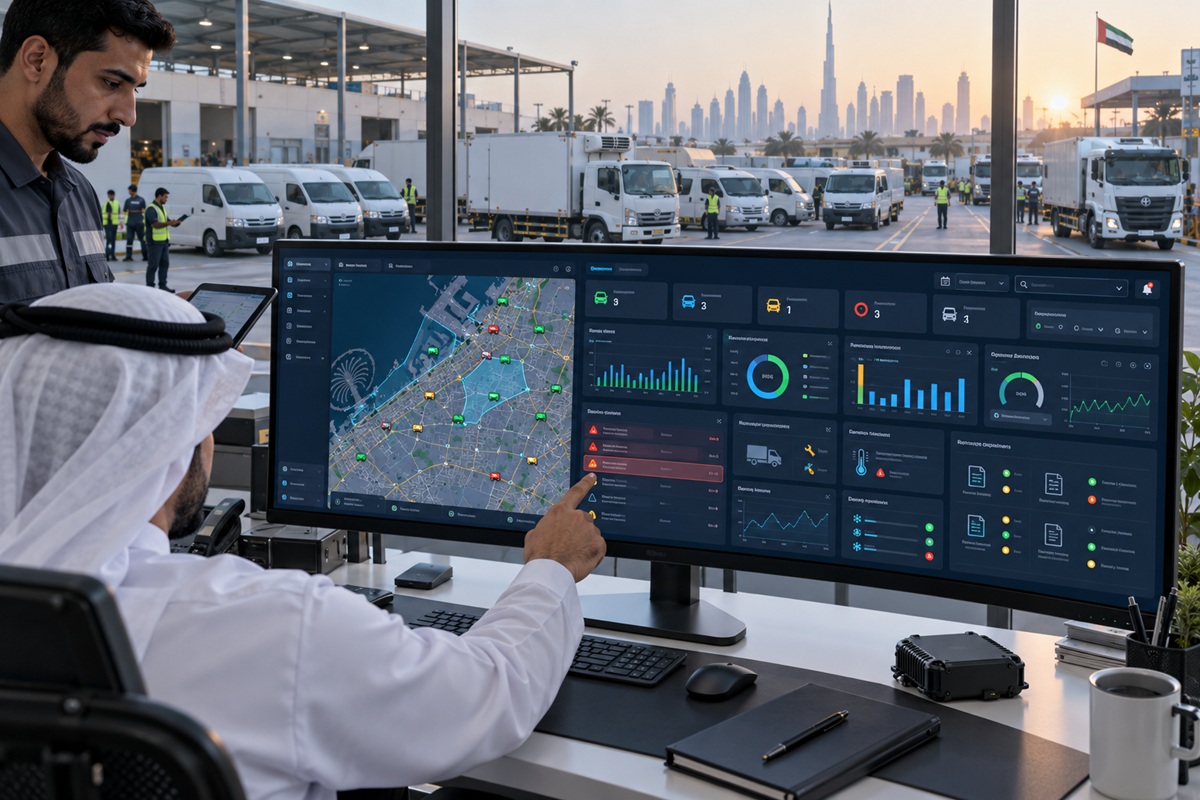
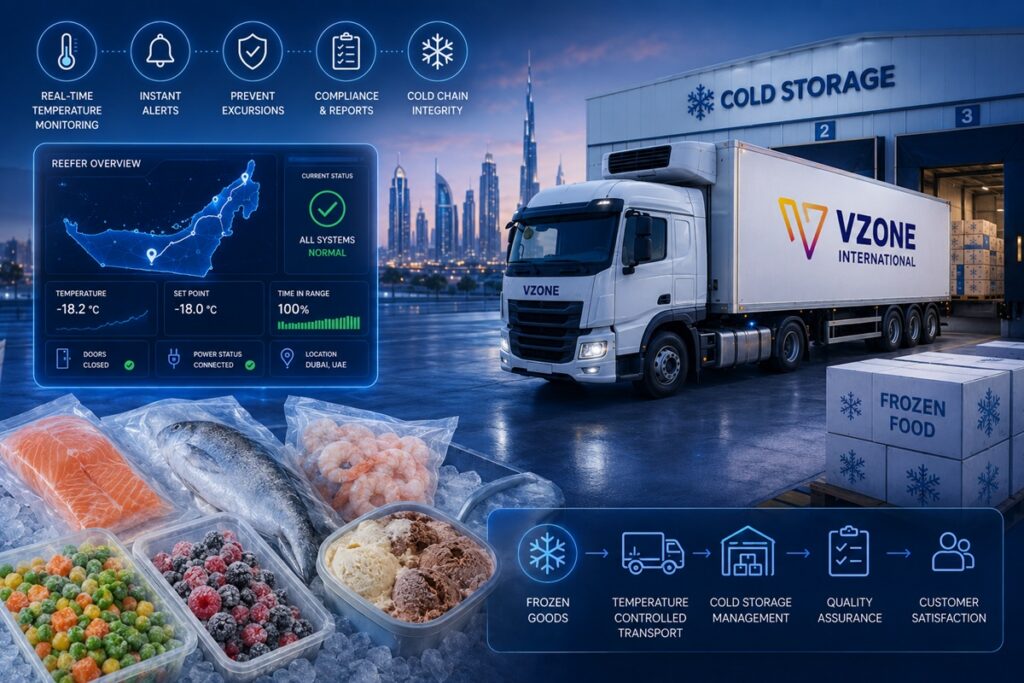
VZone International’s platform gives frozen distributors continuous temperature data with GPS location, door-event detection, and configurable alert bands set with a safety margin, so drift is caught while it is still recoverable. Every trip closes with an audit-ready record for the receiver or a Dubai Municipality inspection.
Refined across more than 300 million kilometres of regional driving data and more than twenty years of UAE and MENA operation, the platform integrates natively with ERP systems such as SAP, Odoo, Oracle, and Zoho. It is trusted in demanding food distribution and logistics operations across the UAE, including deployments with organisations such as Al Ain Farms, NRTC, and RAK Ports.
Make zero excursions your standard, not your goal.
VZone International’s reefer monitoring gives UAE frozen distributors real-time alerts, door-event control, and audit-ready proof on every trip. Book a frozen distribution demo.
Frequently Asked Questions
By treating it as a system rather than luck: pre-cool and verify the trailer, load product already at temperature, run continuous mode at the correct set-point, protect airflow, monitor in real time with GPS context, control door openings at every stop, and close each trip with an audit-ready record.
Considerably longer than for chilled loads deep-freeze set-points can take several hours from an ambient start, compared with roughly an hour or two for fresh produce ranges. Pre-cooling must be scheduled in advance and verified before loading begins.
Continuous mode. Cycle mode is more fuel-efficient and suits some fresh produce, but it lets the box drift between cycles a risk deep-frozen cargo cannot absorb, especially in UAE ambient conditions.
Frozen goods are generally held at -18°C or below, with some products such as ice cream requiring colder set-points. Always follow the shipper specification and any applicable food-safety requirement, and set alert thresholds slightly inside that limit.