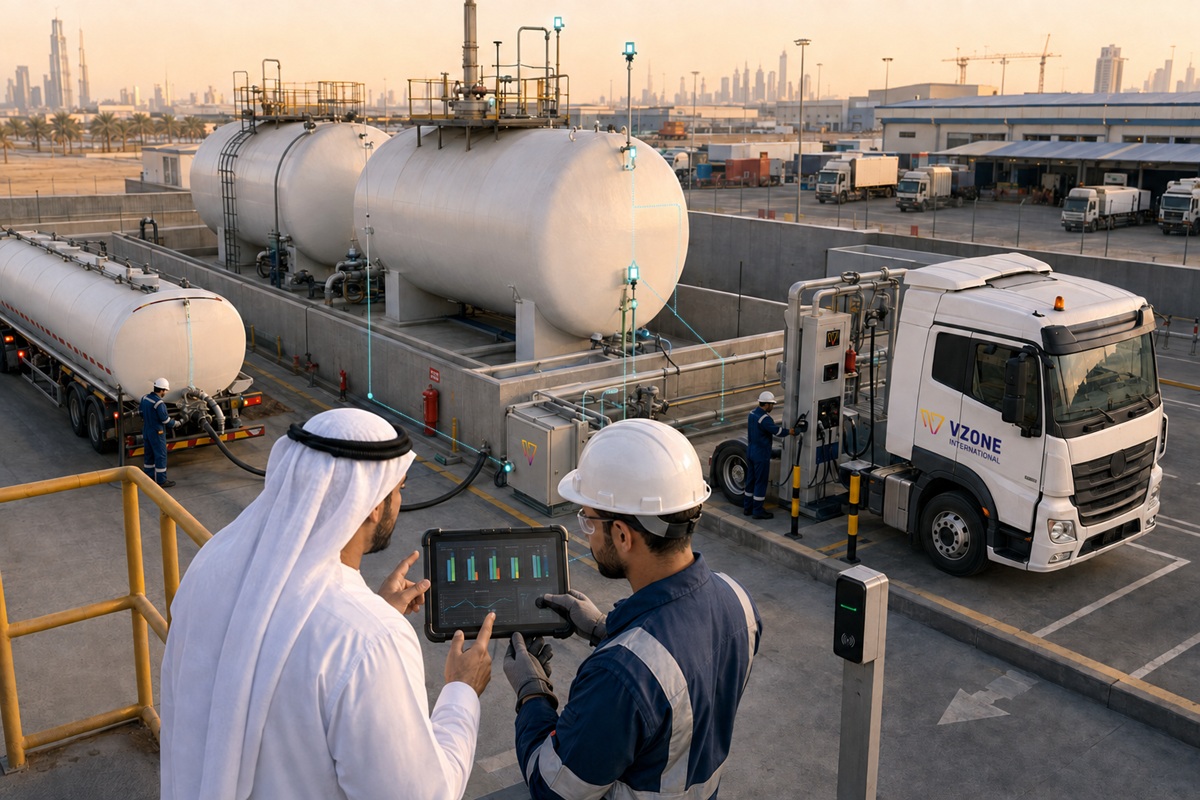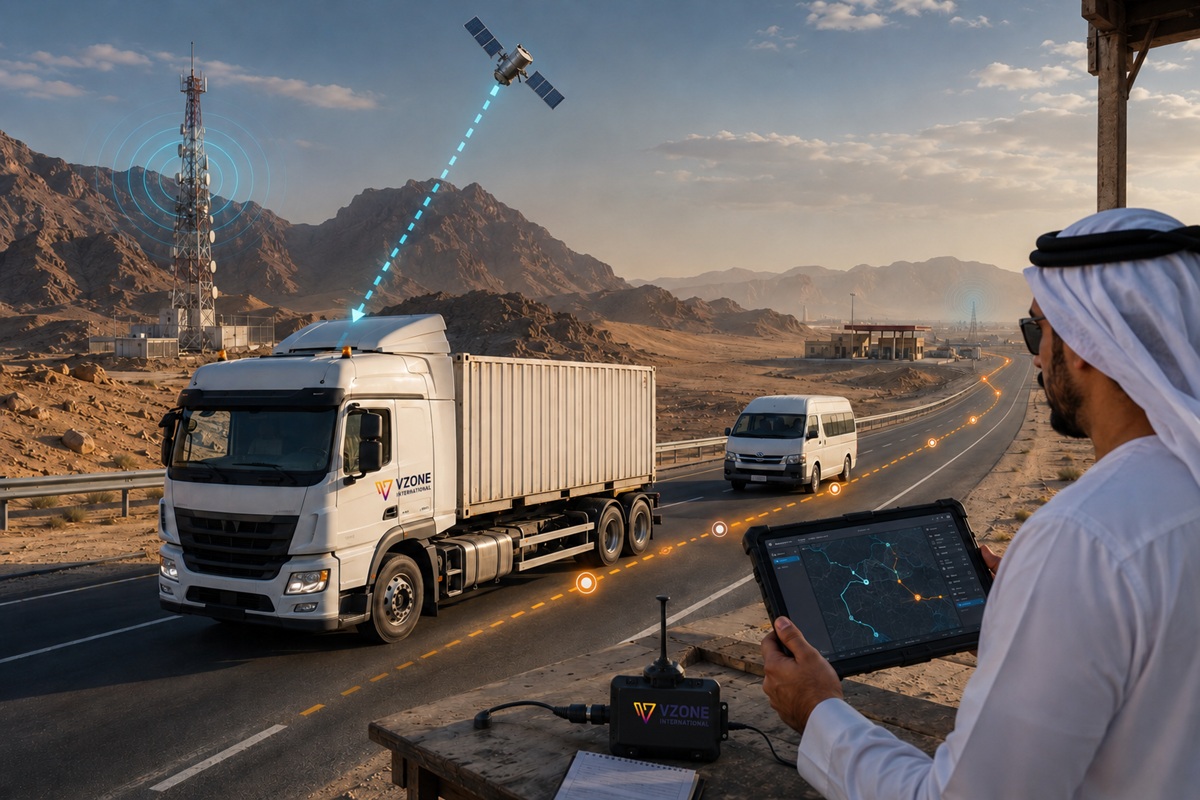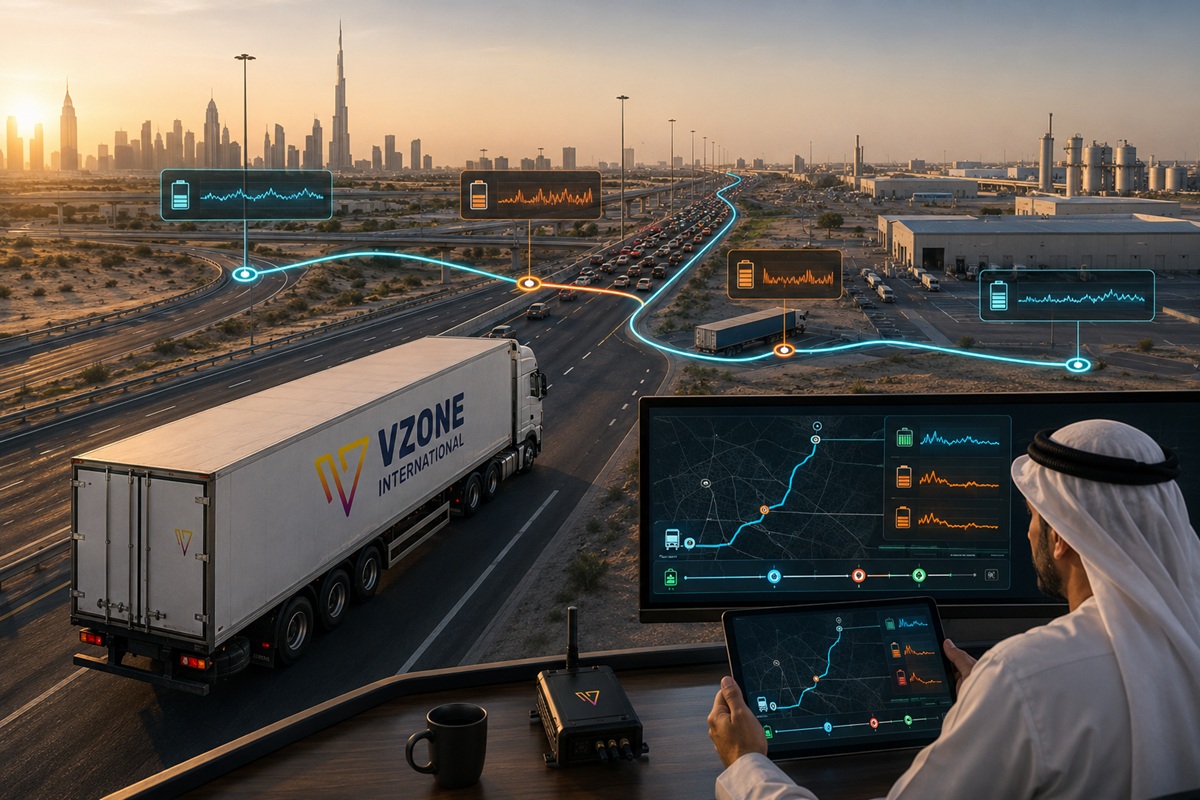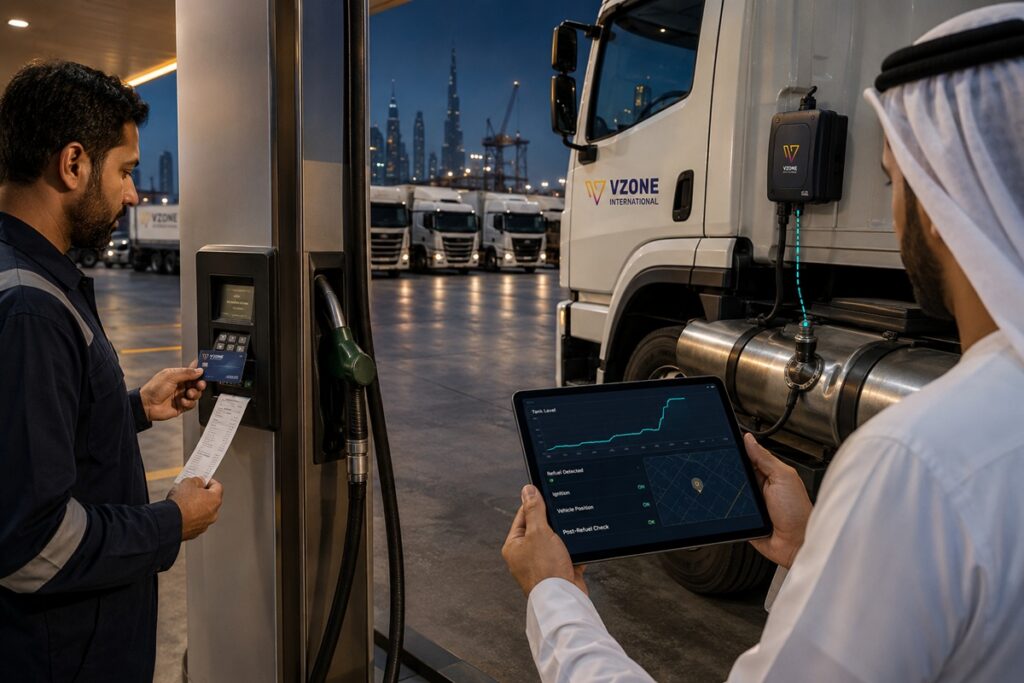
The fuel management question that UAE fleet managers most commonly face when building a fuel cost control programme is whether to start with fuel cards, GPS monitoring, or both. The framing of the question card vs GPS implies a competition between two alternatives. The reality is that fuel cards and GPS fuel monitoring solve different problems, have different blind spots, and deliver the most value when integrated rather than used independently.
Fuel cards control the purchasing transaction what fuel is bought, where, at what time, and by which card. GPS fuel monitoring controls the usage equation how the fuel is driven, whether it leaves the tank without powering the vehicle, and whether the consumption makes sense for the distance driven. Neither system alone provides complete fuel management visibility. A fleet running fuel cards without GPS monitoring has good purchasing control but no consumption insight. A fleet running GPS monitoring without fuel cards has good consumption visibility but limited purchasing control. A fleet running both with card transactions reconciled against GPS vehicle locations has complete fuel management visibility and the highest total fuel cost reduction. This guide explains what each tool does, where each falls short, and how the integrated approach delivers results neither achieves independently.
Key Takeaways
- Fuel cards control the purchasing side of fuel management transaction location restrictions, volume limits, time restrictions, and itemised per-vehicle purchase records. They are effective at preventing unauthorised purchases at unapproved locations and providing financial visibility of fuel spend by vehicle.
- GPS fuel monitoring controls the usage side driving behaviour that determines consumption efficiency, real-time fuel level that detects siphoning between fill events, and consumption-per-kilometre analysis that identifies vehicles and drivers with above-baseline waste. GPS monitoring catches waste and theft that occur after the fuel is legitimately purchased and in the tank.
- The critical blind spot of fuel cards alone is that they cannot detect what happens to fuel after it enters the tank a driver who purchases fuel legitimately through the card and then siphons it overnight creates a perfect card record but a significant theft. GPS fuel monitoring’s real-time sensor data is the only detection mechanism for this scenario.
- The critical blind spot of GPS monitoring alone is that it cannot prevent purchasing fraud at the transaction level a driver without a fuel card can still find ways to purchase fuel on company account through cash reimbursement systems or informal arrangements that GPS monitoring cannot directly prevent.
- For UAE commercial fleets with 10 or more vehicles, the integrated fuel management approach fuel card API connected to the GPS fleet management platform enables automatic reconciliation of every card transaction against the vehicle’s GPS location and fuel level, providing both purchasing control and consumption visibility from a single management dashboard.
Section 1 What Fuel Cards Do and Where They Fall Short
What Fuel Cards Control
Fuel cards for UAE commercial fleets issued by ENOC, ADNOC Distribution, or international fuel card networks provide purchasing controls that cash or petty cash reimbursement systems cannot replicate. The core controls available on UAE commercial fuel card programmes are: merchant category restriction (card can only be used at fuel stations not at restaurants, retail outlets, or other merchant categories), specific station restriction (card can only be used at approved fuel stations from the issuer’s network ENOC card works at ENOC stations; ADNOC card works at ADNOC stations), per-transaction volume limit (maximum litres per transaction prevents a driver from filling multiple vehicles or containers with a single card swipe), daily or weekly spend limit (maximum AED spend within the period caps total card exposure), and time-of-day restrictions (card only active during configured operating hours prevents after-hours card use).
These controls address the purchasing fraud scenarios where a driver uses a company card for non-fleet purposes at the point of sale: personal retail purchases at a combined fuel station convenience store, using the card at a non-fuel merchant, or purchasing an implausibly large volume at a single transaction. The card controls make these scenarios impossible the transaction is declined at the point of sale rather than requiring after-the-fact detection and investigation.
What Fuel Cards Cannot Control
Despite their purchasing controls, fuel cards have three systematic limitations that leave significant fuel waste and theft undetected. First, they cannot verify that the vehicle being fuelled is the fleet vehicle assigned to the card any vehicle can be physically presented at the fuel pump when the fleet card is swiped, and the transaction processing system has no mechanism to confirm it is the correct vehicle. A driver who drives their personal car to an ENOC station and uses the fleet card to fill it completes a transaction that passes all card controls: correct merchant category, correct station, within volume limits, within time restrictions. The card record shows a legitimate fuel purchase. Only GPS location reconciliation showing that the fleet vehicle was not at the station at the time identifies the misuse.
Second, fuel cards have no visibility into what happens to fuel after it enters the fleet vehicle’s tank. Physical siphoning the removal of fuel from the tank between fill events creates a card record of legitimate purchases (the tank was correctly filled through the card) while the fuel subsequently disappears without engine operation. The monthly card statement shows fuel purchased and fuel consumed in broadly expected proportions, but the siphoned fuel is invisible because it was purchased legitimately. Third, fuel cards provide no consumption efficiency data the card statement shows litres purchased but not the driving behaviour that determined whether those litres were used efficiently or wastefully. Two vehicles purchasing the same volume of fuel may have driven very different distances with it, but the card statement cannot identify which vehicle is inefficient.
Section 2 What GPS Fuel Monitoring Does and Where It Falls Short
What GPS Fuel Monitoring Controls
GPS fuel monitoring addresses the consumption and post-purchase side of fleet fuel management the aspects that fuel cards cannot reach. Real-time fuel level data from calibrated tank sensors provides continuous visibility of the fuel in each vehicle’s tank: when the level drops without the engine running, a siphoning alert fires immediately. When the level increases (a fill event), the volume added is recorded and compared against the card transaction record for reconciliation. GPS driving behaviour data idling duration, speed profiles, harsh acceleration frequency explains the consumption rate: why a vehicle is using more fuel per kilometre than its baseline predicts.
Consumption-per-kilometre analysis per vehicle and per driver is the GPS monitoring capability that most directly translates to actionable cost reduction. When the fleet management platform shows that Driver A consistently achieves 9.2L/100km and Driver B consistently achieves 13.8L/100km on the same route with the same vehicle model, the 50 percent consumption difference is explained by GPS driving behaviour data harsh acceleration frequency, speed profile, idling time and the coaching conversation targets the specific behaviours generating the gap. This consumption insight is entirely invisible to fuel card management, which sees only total litres purchased rather than litres consumed per kilometre per driver.
What GPS Monitoring Cannot Prevent Alone
GPS monitoring without fuel card integration has two limitations at the purchasing control level. It cannot prevent a driver from purchasing fuel for a non-fleet vehicle using cash and claiming reimbursement there is no card transaction to reconcile against the GPS vehicle location, and the cash purchase appears as an expense claim rather than a card transaction. It cannot enforce station network restrictions at the point of sale a driver who prefers a specific non-network station can purchase fuel there and submit an expense claim without any GPS mechanism to prevent the transaction before it occurs. For fleets that have eliminated cash fuel reimbursement and require all fuel to be purchased through fleet cards, GPS monitoring closes the remaining theft and waste gaps that card controls leave open.
Section 3 Head-to-Head Comparison: Fuel Card vs GPS Monitoring
| Capability | Fuel Card Only | GPS Monitoring Only | Integrated (Card + GPS) |
| Purchasing location control | Strong station network restriction at point of sale | None cannot prevent purchase at unapproved location | Strong card prevents unauthorised purchases; GPS confirms vehicle location at card purchase |
| Per-transaction volume limit | Strong card declined above configured limit | None at point of sale | Strong card enforces limit; GPS consumption analysis validates volume reasonableness |
| Siphoning detection | None card shows fuel legitimately purchased; cannot see what happens after | Strong real-time sensor detects level drop without ignition; fires within 2-5 minutes | Complete sensor detects siphoning; card record confirms fuel was legitimately added |
| Card misuse / personal vehicle fuelling | Partial correct station and volume but wrong vehicle; card cannot detect | Strong GPS location mismatch vs card transaction location identifies misuse | Complete GPS reconciliation confirms vehicle was at station at purchase time |
| Driving efficiency / consumption per km | None card shows litres purchased, not consumption efficiency | Strong GPS behaviour data explains consumption; driver coaching targets specific behaviours | Complete same GPS data; card provides the purchase volume for consumption calculation |
| Idling waste detection | None | Strong GPS ignition-on with speed = 0 for idling duration | Complete |
| Over-speed fuel waste | None | Strong GPS speed vs posted limit identifies over-speed fuel impact | Complete |
| Fuel cost reporting per vehicle | Partial purchase cost per card; requires card-to-vehicle mapping | Partial consumption per vehicle; requires fuel price to calculate AED cost | Complete card cost + GPS consumption = cost per km per vehicle |
| Monthly statement / finance reporting | Strong itemised card statement per vehicle for ERP upload | Partial consumption data requires conversion to cost for finance reporting | Complete card AED spend + GPS consumption data in unified finance report |
| Implementation cost | Low card issuance only; no hardware | Medium GPS device + fuel sensor installation | Medium GPS + sensor hardware; card API integration configuration |
Section 4 UAE Fuel Card Options for Commercial Fleets
ENOC Fleet Card
ENOC (Emirates National Oil Company) fleet cards are the most widely used commercial fleet fuel card in Dubai and the northern Emirates. ENOC’s fleet card programme provides: per-vehicle card issuance with individual controls per card (volume limits, time restrictions, station restrictions from the ENOC network), monthly consolidated billing with itemised transaction records per vehicle, and online fleet management portal for real-time transaction monitoring and limit adjustments. ENOC’s network covers Dubai, Sharjah, Ajman, Umm Al Quwain, Ras Al Khaimah, and Fujairah. For fleets operating in Abu Dhabi, ADNOC Distribution fuel cards provide equivalent coverage of the Abu Dhabi Emirate network. Many UAE commercial fleets carry both ENOC and ADNOC cards ENOC primary for Dubai/northern routes, ADNOC primary for Abu Dhabi routes or use an international fleet card network that negotiates multi-network access.
ADNOC Distribution Fleet Card
ADNOC Distribution fleet cards provide equivalent purchasing controls to ENOC but across the ADNOC network which covers Abu Dhabi, Al Ain, and extends into some Dubai and northern Emirates locations. For fleets whose primary operations are in Abu Dhabi ADNOC contractor vehicles, Western Region operations, Abu Dhabi urban delivery the ADNOC Distribution fleet card is the natural primary card. Fleet card management for ADNOC is accessible through the ADNOC Distribution fleet portal with API integration available for ERP and fleet management platform connection. For fleets subject to ADNOC IVMS compliance, the ADNOC fuel card transaction data integrates naturally with IVMS fuel reporting requirements.
International Fleet Card Networks
International fleet card networks including WEX, Fleetcor, and regional GCC fuel card networks provide multi-country fuel card coverage that single-country ENOC or ADNOC cards do not. For UAE fleets with cross-border GCC operations (UAE-Oman routes, UAE-Saudi Arabia routes), an international fleet card provides consistent purchasing control and consolidated billing across multiple fuel station networks in different countries. International fleet cards typically provide API integration with major fleet management platforms enabling automatic card-to-GPS reconciliation in the fleet management software without requiring a custom integration. The per-transaction cost of international fleet cards may be slightly higher than domestic cards, but the consolidated billing and cross-border coverage simplify the financial management of cross-border fuel spend significantly.
Section 5 Integrating Fuel Cards with GPS Fleet Monitoring
The integrated fuel management approach connects the fuel card’s transaction data with the GPS platform’s vehicle location and consumption data through a card API or data import enabling automatic reconciliation of every card transaction against the fleet vehicle’s GPS record without manual cross-referencing.
How Card API Integration Works
Fuel card API integration connects the card issuer’s transaction data feed directly to the fleet management platform typically delivering transaction records within 15 to 60 minutes of each purchase. For each incoming card transaction, the platform automatically queries the GPS position history for the vehicle assigned to the card at the transaction timestamp and compares the GPS position against the fuel station location from the transaction record. Matching transactions vehicle at station at purchase time are logged as normal. Non-matching transactions vehicle not at station at purchase time generate a card misuse alert for fleet manager review. For vehicles with fuel sensors, the transaction volume is also compared against the sensor-recorded fill event volume a discrepancy (card shows 60L purchased; sensor shows 40L fill event) flags a volume anomaly for investigation.
VZone International’s Wialon platform supports fuel card API integration for ENOC, ADNOC Distribution, and major international fleet card networks. The integration is configured during platform setup fleet managers enter the card API credentials, vehicle-to-card mapping is confirmed, and automatic reconciliation begins immediately with no ongoing manual step required. The fleet fuel dashboard shows both card transaction data and GPS consumption data in a unified view, with reconciliation exceptions highlighted for fleet manager action.
What the Integrated Dashboard Shows
The integrated fuel management dashboard provides the unified view that neither fuel card management nor GPS monitoring delivers independently. Per vehicle: fuel purchased (from card), fuel consumed (from GPS odometer and consumption calculation), consumption per 100 km (calculated), and any reconciliation exceptions (card-GPS location mismatches, volume anomalies, sensor-detected siphoning events). Per driver: fuel efficiency score (consumption per 100 km normalised for route type), harsh event frequency affecting consumption, idling duration, and comparison to fleet average. Fleet level: total fuel spend (from card), total km driven (from GPS), fleet-average consumption per 100 km, total idling cost, and monthly trend vs budget. This integrated view replaces the monthly manual exercise of extracting fuel card data, extracting GPS distance data, and attempting to reconcile them in a spreadsheet a process that most UAE fleet managers either perform imperfectly or abandon in favour of monitoring only the card total.
VZone International Integrated Fuel Management GPS Monitoring and Card Reconciliation for UAE Fleets
VZone International’s fleet management platform integrates ENOC, ADNOC Distribution, and international fleet card transaction data with GPS vehicle tracking, fuel sensor level monitoring, and AI consumption analysis providing complete fuel management visibility from a single dashboard. Card-to-GPS reconciliation is automatic. Siphoning alerts fire within minutes. Fuel efficiency scores are per driver and per vehicle. Contact our team for a fuel management integration assessment for your UAE fleet.
Frequently Asked Questions
For UAE commercial fleets with 10 or more vehicles, the integrated approach fuel card with GPS fuel monitoring delivers significantly better fuel cost control than either tool alone. Fuel cards prevent purchasing fraud at the point of sale but cannot detect siphoning, driving inefficiency, or card misuse where the vehicle physically presents at the correct station. GPS monitoring detects all three but cannot prevent unauthorised purchases before they occur. The combination closes both gaps: card controls prevent purchasing fraud; GPS monitoring catches siphoning, driving waste, and the card misuse that card controls alone miss. For very small fleets (under 5 vehicles) where the fleet manager has direct daily visibility of every vehicle, fuel cards alone may be adequate the scale does not justify the GPS fuel monitoring investment. Above 10 vehicles, the integrated approach consistently delivers better ROI than either tool independently.
The best UAE fuel card for a commercial fleet depends primarily on the fleet's geographic operating area. For fleets operating primarily in Dubai and the northern Emirates, the ENOC fleet card provides the widest network coverage and the most direct purchasing controls. For fleets operating primarily in Abu Dhabi including ADNOC contractor vehicles the ADNOC Distribution fleet card is the natural choice with additional ADNOC IVMS data integration. For fleets operating across multiple Emirates or with cross-border GCC routes, carrying both an ENOC and ADNOC card (or an international fleet card with multi-network coverage) ensures the widest geographic coverage without network gaps. Card selection should also consider the API integration capability for GPS fleet management platform connection cards with well-documented APIs enable automatic transaction reconciliation without manual data export and import.
GPS fuel monitoring cannot replace fuel cards for UAE commercial fleets the two tools address different aspects of fuel management and the absence of either creates a specific gap. GPS monitoring provides consumption visibility, siphoning detection, and driving behaviour coaching but it cannot prevent unauthorised fuel purchases at the point of sale the way fuel card purchasing controls do. A fleet without fuel cards but with GPS monitoring could have drivers purchasing fuel for personal vehicles on cash reimbursement claims that GPS monitoring cannot directly prevent or detect. The correct framing is not whether GPS monitoring replaces fuel cards, but that the integrated approach both tools, connected through API provides complete fuel management coverage that neither delivers independently.
Fuel card reconciliation with GPS in practice works through the fleet management platform's automatic matching of card transaction records against GPS vehicle position history. When a fuel card transaction arrives from the card API vehicle registration, fuel station location, transaction time, volume purchased the platform queries the GPS position of that vehicle at the transaction time. If the vehicle's GPS position was within 300 to 500 metres of the fuel station location, the transaction is confirmed as matching and logged normally. If the GPS position was more than 500 metres from the fuel station at the transaction time, the platform generates a reconciliation exception alert for fleet manager review. The fleet manager sees: which vehicle, which card, which fuel station, what time, vehicle GPS location at that time, and the distance between vehicle and station all the information needed to determine whether the mismatch represents card misuse or a GPS positioning anomaly. Over 95 percent of mismatches in practice represent genuine card misuse rather than GPS error.