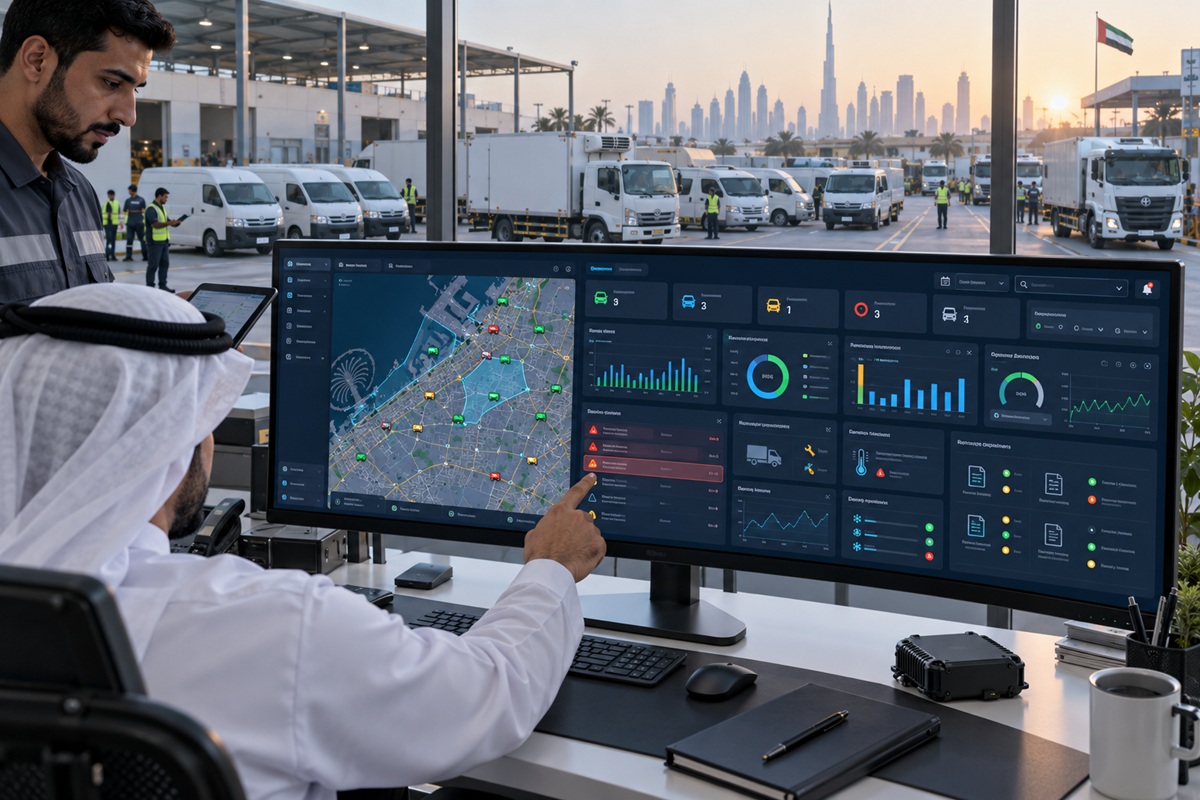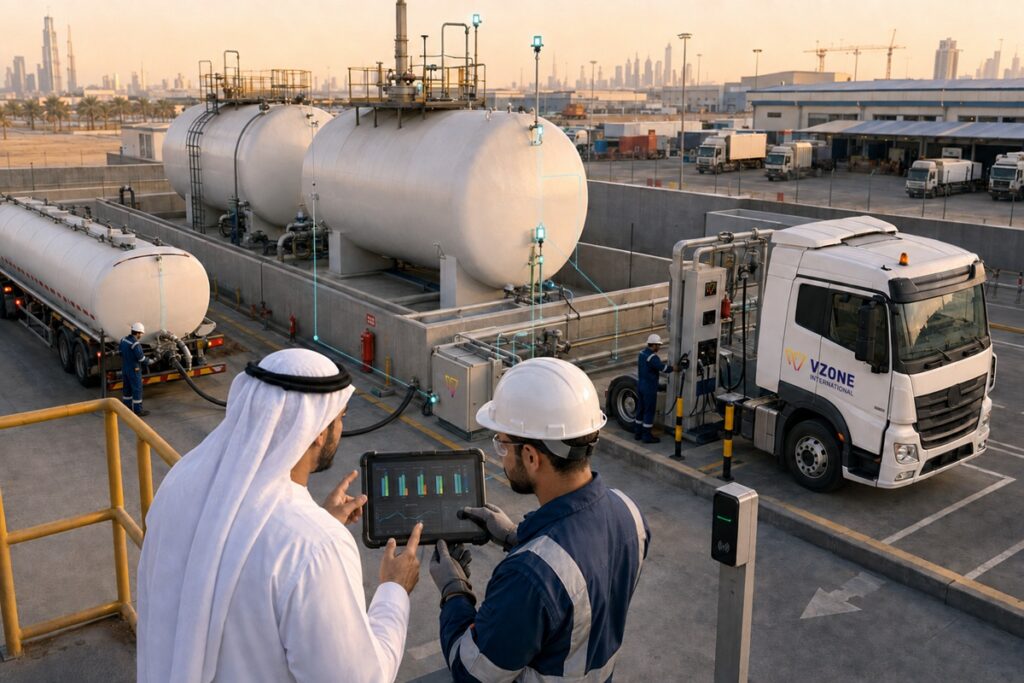
Many UAE commercial fleet operators who have deployed vehicle-level GPS fuel monitoring tracking per-vehicle consumption and detecting vehicle-level siphoning still have a significant fuel loss point that vehicle monitoring cannot address: the bulk diesel storage tank at the depot, construction site, or remote facility from which vehicles are filled. The bulk tank is the starting point of the fleet’s fuel supply chain diesel is delivered to the tank by a tanker truck, stored, and dispensed to fleet vehicles through a pump or nozzle. Between delivery in and dispensing out, several loss mechanisms can operate without detection: unauthorised dispensing by non-fleet vehicles or individuals, delivery shortfalls where the tanker delivers less than the invoice shows, tank leakage from corrosion or fitting failures, and organised theft by individuals with access to the tank or its dispensing equipment.
Bulk fuel tank monitoring addresses these losses with the same approach that vehicle-level monitoring applies to individual tanks: a calibrated IoT level sensor installed in the bulk tank transmits real-time fuel level data to the fleet management platform, enabling continuous comparison between expected stock (deliveries in minus authorised dispensing out) and actual stock (sensor reading). Any gap between expected and actual is a loss event that generates an alert regardless of whether the loss is from theft, leakage, or delivery shortfall. For UAE depots and construction sites where bulk diesel tanks hold 10,000 to 50,000 litres of diesel worth AED 18,000 to AED 90,000, this monitoring is the difference between visible fuel asset management and uncontrolled loss.
Key Takeaways
- Bulk fuel tank monitoring uses calibrated IoT level sensors to track fuel volume in depot storage tanks continuously detecting deliveries in, dispensing out, and unexplained level drops that indicate theft, leakage, or delivery shortfalls in real time.
- UAE depot fuel tanks without monitoring typically lose 5 to 12 percent of fuel throughput to theft and unmeasured losses invisible in vehicle-level fuel card statements because the loss occurs before fuel reaches individual vehicles. For a depot dispensing 50,000 litres per month, a 8 percent loss is 4,000 litres = AED 7,200 per month = AED 86,400 per year.
- Delivery reconciliation comparing the tanker truck’s delivery volume against the tank level increase measured by the IoT sensor detects delivery shortfalls where the invoice shows a full delivery but the tank sensor shows a lower-than-expected level increase. Delivery shortfalls of 3 to 8 percent are occasionally discovered at first reconciliation in depots that have not previously measured deliveries against a tank sensor.
- Dispensing records from the tank’s flow meter, reconciled against vehicle GPS fill events, provide the per-vehicle dispensing record that replaces manual dip measurement and dispensing logs enabling fuel cost allocation per vehicle from the depot tank with the same granularity as fuel card transactions at commercial stations.
- UAE summer heat creates a specific bulk tank monitoring consideration: diesel fuel expands with temperature increase, so a tank that appears fuller in the morning (when fuel is cool and contracted) will show a lower reading by afternoon (when fuel has expanded and the volume-to-level relationship changes). Calibrated temperature-compensated sensors provide volume readings corrected for temperature, preventing false level drop alerts from thermal expansion and contraction cycles.
Section 1 The Bulk Fuel Loss Problem in UAE Fleet Operations
The bulk fuel tank is the fuel loss point most often overlooked in UAE fleet fuel management programmes because it sits upstream of the vehicle-level monitoring that fleet managers focus on. A fleet manager who has deployed per-vehicle fuel sensors and fuel card reconciliation addressing vehicle-level siphoning and card misuse may still be losing significant fuel at the depot tank before it reaches any vehicle’s fuel sensor.
Loss Mechanism 1 Unauthorised Dispensing
Unauthorised dispensing from depot bulk tanks is the most common form of depot-level fuel loss. It occurs when individuals with physical access to the tank drivers who fill their personal vehicles at the depot pump, non-fleet vehicles from adjacent businesses sharing a site, or third-party contractors who find the pump unlocked dispense fuel from the bulk tank without any record in the dispensing log. In busy depots where the pump is in use throughout the day and the dispensing log is paper-based, individual unauthorised dispenses of 20 to 60 litres are difficult to detect without a tank sensor showing total dispensing volume versus individual log entries. A tank monitoring system that records every dispensing event the time, the volume, and (where the pump has a vehicle identification interface) the vehicle dispensed to makes unauthorised dispensing immediately visible as a discrepancy between sensor-measured total dispensing and log-recorded authorised dispensing.
Loss Mechanism 2 Delivery Shortfalls
Delivery shortfalls occur when a fuel tanker delivers less diesel than the invoice quantity either through equipment calibration error, deliberate under-delivery, or delivery to the wrong specification (lower energy density fuel substituted for the invoiced grade). In the absence of tank level monitoring, a depot manager has no practical way to verify the delivered volume: the tanker driver presents an invoice showing 20,000 litres delivered, the depot manager signs the delivery receipt, and the actual volume in the tank is never independently measured. Tank monitoring that records the level before and after delivery enables calculation of the actual delivered volume which can then be compared against the invoice. Even a 3 percent shortfall on a 20,000-litre delivery is 600 litres = AED 1,080 per delivery. For a depot receiving 4 deliveries per month, a consistent 3 percent shortfall costs AED 4,320 per month = AED 51,840 per year a loss that is completely invisible without tank monitoring.
Loss Mechanism 3 Tank Leakage
Bulk diesel storage tanks in UAE depots are typically above-ground steel tanks with capacities of 10,000 to 100,000 litres. Tank leakage from corrosion at welds, fitting failures at the inlet, outlet, or vent connections, or damage to the tank body can produce slow losses that are difficult to distinguish from consumption without continuous level monitoring. A tank losing 50 litres per day through a slow leak visible as rust staining or damp soil around the tank base loses 1,500 litres per month = AED 2,700 per month before the leak is visually detected. Tank monitoring that flags consistent overnight level drops in excess of expected evaporation (typically less than 0.1 percent per day for diesel) identifies leakage as a maintenance issue before the cumulative volume loss becomes significant, and before a leak of hydrocarbon into the ground creates the environmental liability that accompanies undetected underground diesel leakage in UAE.
Section 2 How Bulk Tank Monitoring Works
IoT Level Sensor Installation
Bulk fuel tank monitoring is implemented by installing a calibrated IoT level sensor in the tank inserted through the tank’s measurement port (typically a 2-inch BSP or NPT threaded fitting on the tank top) and suspended to the tank bottom. The sensor measures the fuel depth continuously using one of two measurement technologies: magnetostrictive sensors (a metal float on a magnetic rod, providing accurate depth measurement to within 1mm) or ultrasonic sensors (sound wave reflection from the fuel surface, slightly less accurate but suitable for tanks where a physical float cannot be inserted). The sensor’s depth measurement is converted to volume using the tank’s calibration table a table that maps depth readings to fuel volumes accounting for the tank’s specific shape, which is particularly important for horizontal cylindrical tanks where the depth-to-volume relationship is non-linear.
The sensor transmits level data to an IoT gateway or directly to a cellular-connected data logger that sends the level reading to the fleet management platform typically every 5 to 15 minutes for routine monitoring, with immediate transmission when a rapid level change (delivery or fast dispensing) is detected. VZone International’s bulk tank monitoring integrates the tank level data into the same Wialon fleet management platform that manages vehicle GPS tracking and vehicle-level fuel sensors providing a unified fuel supply chain view from bulk tank storage through to per-vehicle consumption.
Temperature Compensation for UAE Conditions
UAE summer creates a specific measurement challenge for bulk diesel tank monitoring: diesel fuel volume changes with temperature at approximately 0.065 percent per degree Celsius a 20°C temperature change (UAE summer diurnal range) produces a 1.3 percent volume change in a 20,000-litre tank, equivalent to 260 litres of apparent volume change that is entirely due to thermal expansion rather than actual delivery or consumption. An uncompensated tank sensor will show the tank level rising during the hottest part of the afternoon and falling in the pre-dawn cool which would generate false low-stock alerts and confuse delivery reconciliation calculations.
Temperature-compensated sensors measure both fuel depth and fuel temperature, converting the raw depth-to-volume figure to a temperature-corrected volume at a reference temperature (typically 15°C or 20°C per UAE petroleum standards). This temperature-corrected volume reading eliminates the diurnal fluctuation signal from the data, leaving only real fuel movements (deliveries in, dispensing out, leaks) visible in the level trend. For UAE bulk tank monitoring, temperature compensation is not optional it is a prerequisite for alert accuracy and delivery reconciliation integrity.
Dispensing Records and Vehicle Reconciliation
Bulk tank dispensing records the volume, time, and vehicle identity for each dispensing event from the depot pump are the data layer that reconciles bulk tank monitoring with vehicle-level fuel monitoring. Two integration approaches are used in UAE depot fuel management: flow meter integration (a calibrated flow meter on the pump outlet records the volume of each dispensing event and transmits it to the fleet platform alongside the tank level data the most accurate dispensing record) and vehicle identification integration (an iButton or RFID reader at the pump records the driver identity and vehicle for each dispensing event, enabling per-vehicle fuel allocation from the bulk tank). The combination of tank level data (total dispensed volume), flow meter data (individual dispensing event volumes), and vehicle identification (which vehicle received each dispensing) provides the complete depot fuel management record that manual dip measurement and paper dispensing logs cannot replicate.
Section 3 Alerts and Reports from Bulk Tank Monitoring
| Alert / Report Type | Trigger Condition | Response Required | UAE-Specific Application |
| Rapid level drop alert | Tank level drops more than X litres in less than Y minutes without a dispensing event recorded (theft or leak) | Immediate investigation security check at tank; check for leakage; review CCTV if available | Construction site bulk tanks: primary theft detection mechanism; fire during weekend or overnight when site is unmanned |
| Low stock reorder alert | Tank level falls below configured reorder threshold (e.g. 20% of capacity) | Initiate fuel delivery order; ensure sufficient stock for fleet operational requirements | UAE: delivery lead times from ENOC/ADNOC can be 24-72 hours reorder threshold should reflect fleet daily consumption × lead time |
| Delivery arrival confirmation | Significant rapid level increase detected tanker delivery beginning | Record delivery start; monitor level increase; confirm volume on completion | First step in delivery reconciliation system records pre-delivery level for comparison |
| Delivery shortfall alert | Actual delivered volume (post-delivery level increase) is more than X% below the invoiced volume | Query delivery with tanker operator; withhold payment pending investigation | 3-8% shortfalls discovered at first reconciliation in previously unmonitored UAE depots |
| Overnight loss alert | Level drops more than expected evaporation rate overnight without a dispensing event | Leak investigation; visual inspection of tank fittings and surrounding ground | Slow leak detection before cumulative volume loss and environmental contamination become significant |
| Temperature anomaly | Fuel temperature reading exceeds safe storage threshold (>60°C) | Shade tank if possible; check for direct sun exposure; alert ADNOC/ENOC if fuel quality concern | UAE summer direct sun on steel tank can raise fuel temperature above storage specification |
| Monthly fuel balance report | Automated monthly reconciliation: deliveries in vs authorised dispensing out vs actual stock change | Finance team review; identify and investigate any unexplained variance | Core accountability document for fuel asset management replaces manual dip log reconciliation |
Section 4 Bulk Tank Monitoring for UAE Construction Sites
Construction site bulk fuel tanks have a higher theft risk profile than depot tanks because construction sites are typically unmanned overnight and on weekends, have lower physical security than managed depots, and often have multiple workers with legitimate fuel access during operating hours who are aware of the tank’s location and filling procedures. The fuel stored on construction sites diesel for generators, construction equipment, and site vehicles can represent AED 20,000 to AED 100,000 in value at any given time, making it a target for organised theft as well as opportunistic pilferage.
Weekend and After-Hours Monitoring
The highest-risk periods for construction site tank theft are Friday and Saturday (UAE weekend), public holidays, and overnight periods when the site is empty. Bulk tank monitoring with immediate rapid-drop alerts and SMS notification to the site manager and security contact provides the response window that static physical security alone cannot. When a theft attempt begins the tank level starts falling at 11:00 PM on a Thursday the fleet manager and security contact receive an alert within 5 to 10 minutes. If Police are notified immediately and the tank’s GPS-tagged location is provided (for remote desert sites), the intervention window before the tank is depleted or the thieves depart is meaningful.
Delivery Management at Remote Sites
Construction sites in UAE’s Western Region, Al Ain desert areas, and Hajar Mountain zone often receive fuel deliveries from tanker trucks that travel significant distances to the site making in-person delivery supervision impractical. Bulk tank monitoring enables remote delivery supervision: the site manager sees the tank level rising in real time as the delivery proceeds, receives a delivery completion notification when the level stabilises, and compares the delivered volume against the invoice without being physically present at the site. This remote supervision capability addresses the delivery shortfall risk that is higher for remote site deliveries (where there is less accountability than at managed depot locations) without requiring the site manager to be present for every fuel delivery.
Section 5 Integration with Fleet Fuel Management
Bulk tank monitoring delivers its maximum value when integrated with the vehicle-level fleet fuel management system creating a complete fuel supply chain view from tanker delivery through to kilometres driven per vehicle. The integration links:
- Bulk tank deliveries in → total diesel received per month per tank
- Bulk tank dispensing records → per-vehicle depot fills from the bulk tank
- Vehicle fuel sensors → per-vehicle consumption between fills
- GPS distance data → consumption per 100 km per vehicle
- Fuel card transactions → per-vehicle fills at commercial stations
With all five data layers connected, the fleet manager sees the complete fuel balance: diesel delivered to the depot tank (from tanker invoices confirmed by sensor data) minus diesel dispensed to vehicles (from depot dispensing records) minus diesel consumed by vehicles (from consumption calculation) minus diesel purchased at commercial stations (from fuel card data) equals the closing stock in the depot tank (confirmed by sensor reading). Any unexplained variance at any step in this chain is immediately visible unlike the manual reconciliation that most UAE fleet fuel managers perform monthly with partial data and significant reconciliation gaps.
VZone International Bulk Tank Monitoring Integrated with Fleet GPS Fuel Management
VZone International installs calibrated IoT fuel level sensors for UAE depot and construction site bulk tanks, integrating bulk tank monitoring with the Wialon fleet management platform. Rapid loss alerts, delivery reconciliation, dispensing records, and monthly fuel balance reports are all accessible from the same dashboard as vehicle GPS tracking and per-vehicle fuel sensors. Contact our team for a depot fuel monitoring assessment.
Frequently Asked Questions
Bulk fuel tank monitoring is the continuous measurement and remote reporting of fuel levels in large storage tanks at fleet depots, construction sites, generator facilities, or remote operational bases using IoT level sensors that transmit data to a cloud-based management platform. The sensor measures the fuel depth in the tank at regular intervals (every 5 to 15 minutes), converts the depth reading to a volume using the tank's calibration table, and transmits the volume reading to the fleet management platform. Fleet managers see the current fuel level, historical level trend, delivery events (level increases from tanker fills), and dispensing events (level decreases from vehicle fills) enabling real-time stock visibility, delivery reconciliation, theft detection, and reorder management from a remote dashboard rather than requiring physical dip measurement at the tank.
UAE depot bulk fuel tanks without monitoring typically lose 5 to 12 percent of total throughput to theft, delivery shortfalls, and unmeasured dispensing. For a depot dispensing 30,000 litres per month, a 8 percent loss represents 2,400 litres = AED 4,320 per month = AED 51,840 per year. This loss is invisible in monthly fuel card statements because it occurs at the depot tank level before fuel reaches individual vehicles the card statements show fuel legitimately purchased at commercial stations without any record of the depot tank loss. Construction site tanks face higher loss rates 10 to 15 percent from the combination of lower physical security, unmanned overnight periods, and multiple worker access during operating hours. First-time deployment of tank monitoring at UAE sites consistently reveals losses above what the depot manager estimated from stock discrepancies alone.
Bulk tank monitoring detects fuel theft by continuously comparing the expected tank level against the measured level. Expected level is calculated from: the previous measurement, minus any authorised dispensing recorded by the flow meter or dispensing log, plus any deliveries recorded during the period. When the measured level is significantly below the expected level indicating more fuel left the tank than was recorded as authorised dispensing the system generates a rapid level drop alert that fires to the fleet manager and security contact within 5 to 10 minutes of the theft beginning. The alert includes the estimated volume removed, the time the drop began, and where the tank has a GPS-tagged location the tank's position for security response. For theft occurring overnight when the site is unmanned, the alert fires to the security contact's mobile regardless of time, providing the immediate notification that enables a Police response before the thieves complete the tank drain.
Yes delivery shortfall detection is one of the primary financial benefits of bulk tank monitoring for UAE depot operators. The process: before the tanker arrives, the system records the current tank level (pre-delivery reading). During the delivery, the system tracks the level increase in real time. When the delivery is complete and the level stabilises, the system calculates the actual delivered volume (post-delivery level minus pre-delivery level, temperature-corrected to the reference temperature). This actual delivered volume is compared against the invoiced volume. If the actual delivered volume is more than the configured tolerance (typically 1 to 2 percent for equipment calibration variation) below the invoiced volume, the system generates a delivery shortfall alert. The fleet manager can then query the delivery with the tanker operator before signing the delivery receipt or before processing payment. UAE depot operators who deploy tank monitoring for the first time occasionally discover consistent shortfalls of 3 to 6 percent on all deliveries from the same supplier a pattern that suggests systematic under-delivery rather than occasional measurement variation.