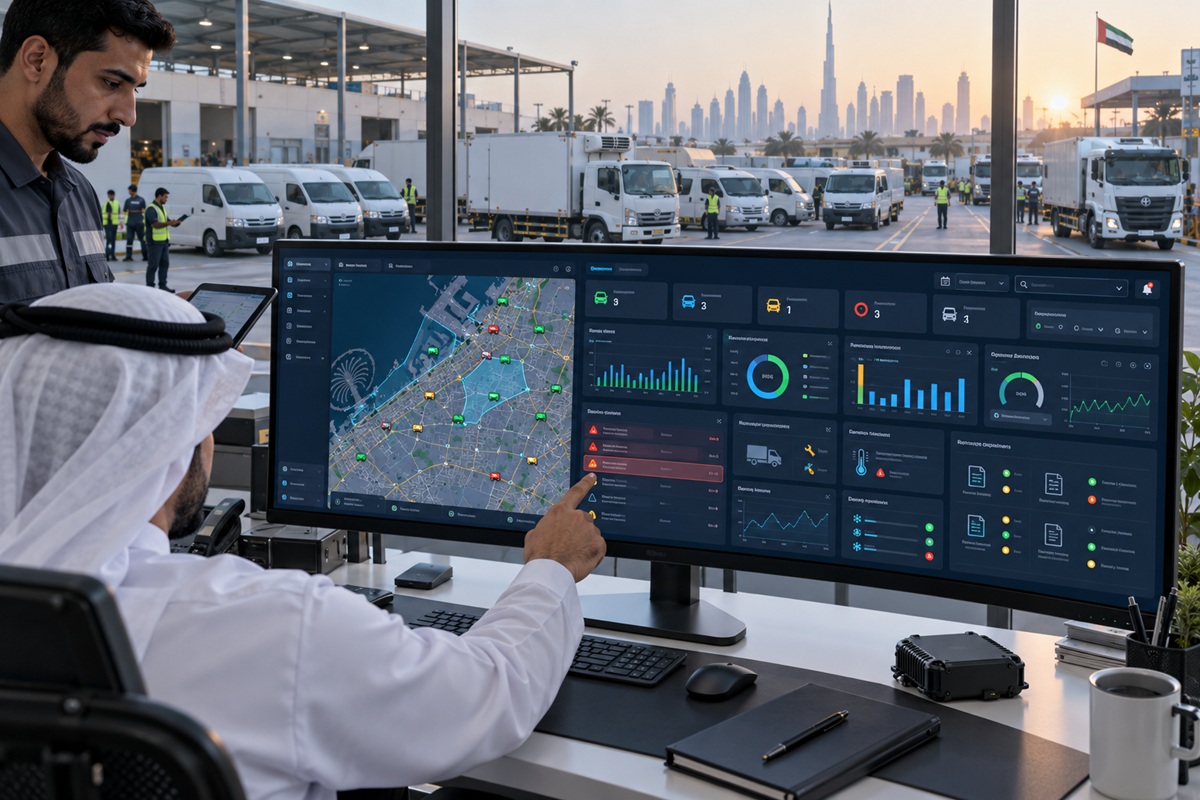
UAE logistics companies using GPS tracking devices for cars report AED 1,200 to AED 2,500 per vehicle per month in combined savings across fuel, maintenance, insurance, and operational efficiency figures that place GPS fleet tracking among the highest-return technology investments available to fleet operators in any sector. The 30 percent cost reduction headline is not a marketing claim derived from best-case deployments; it is the aggregate of five specific saving mechanisms, each with a documented percentage range, each operating simultaneously from the same device and platform.
The more useful question for a UAE fleet manager evaluating GPS tracking devices for cars is not whether the savings are real they are but which of the five mechanisms applies most strongly to their specific fleet and operating profile. A construction equipment fleet in the Abu Dhabi Western Region has a different saving profile from an urban last-mile delivery fleet in Dubai; both achieve significant returns, but from different mechanisms and with different timelines. This guide breaks down exactly how each saving mechanism works, provides a worked 50-vehicle ROI calculation in AED, and illustrates the combined impact through a UAE construction fleet case study.
Key Takeaways
- Five saving mechanisms drive 20–35% cost reduction fuel monitoring, idle reduction, route optimization, insurance discounts, and predictive maintenance all work simultaneously off the same GPS data.
- Payback is fast a 50-vehicle fleet example shows AED 636,000 in annual savings against ~AED 152,500 investment, a payback period of under 3 months (real-world case study: 5.1 months).
- Hidden costs are the real target fuel theft, after-hours unauthorized use, and route inefficiency silently inflate spend and go undetected without GPS data.
- Insurance savings compound over time 10–15% premium cuts at first renewal, growing to 25–35% total cost reduction by Year 2 as coaching-driven claims history improves.
- Proven in practice a UAE construction fleet case study saved AED 189,300/year (fuel, theft prevention, accidents, insurance, breakdowns) with just a 5.1-month payback.
The Real Cost of Running a Fleet Without a Tracking System for Car Monitoring
Before quantifying what GPS tracking devices save, it is useful to understand precisely what unmanaged fleets pay for costs that are real but invisible on any individual invoice line because they are embedded in fuel overspend, insurance loading, and maintenance surprise rather than appearing as explicit GPS-avoidable line items.
Fuel Theft and Waste
For a 50-vehicle UAE fleet spending AED 200,000 per month on fuel, industry estimates suggest that 8 to 15 percent of that spend AED 16,000 to AED 30,000 per month is attributable to a combination of fuel theft (siphoning, fill-up fraud where card shows more than tank received), aggressive driving behaviour that increases consumption by 15 to 25 percent above the vehicle’s baseline, and idle time waste. Without a GPS tracking device for cars that measures actual consumption, monitors driver behaviour, and detects tank-level anomalies, none of these cost sources are individually visible they are absorbed into the total fuel bill and attributed to usage rather than waste.
Unauthorised Vehicle Use
Personal use of company vehicles after hours commuting, weekend family trips, personal errands is one of the most consistent findings when UAE fleet operators deploy their first GPS tracking system and review their initial data. The pattern is predictable: vehicles that are supposed to be parked at the depot after 7 PM are making 15 to 30 km round trips through toll gates and fuel stations in the evenings and weekends. For a 50-vehicle fleet, if five vehicles average two unauthorised trips per week at AED 80 per trip in combined fuel and toll costs, the monthly unauthorised use cost is AED 3,200 AED 38,400 per year for a problem that is entirely invisible without tracking and entirely preventable with a geofence after-hours alert.
Route Inefficiency
Without GPS route monitoring, fleet managers have no visibility into whether drivers are taking optimal routes or adding unnecessary kilometres through habit, preference, or deliberate detours. In UAE urban delivery operations, where multi-stop routes have significant optimisation potential, unmonitored drivers consistently add 15 to 25 percent excess kilometres compared to GPS-optimised routes extra kilometres that consume fuel, add vehicle wear, and reduce the number of stops that can be completed per shift. For a fleet where each vehicle covers 150 km per day, a 20 percent route inefficiency adds 30 km per vehicle per day across 50 vehicles over 250 operating days, that is 375,000 excess kilometres per year, at AED 0.45 per km in fuel and wear cost, equating to AED 168,750 in avoidable annual fleet cost.
Insurance Overpayment
UAE commercial vehicle insurance is priced on historical claims data in the absence of telematics evidence. Fleets that cannot present verified driver behaviour data, coaching programme records, and GPS-corroborated incident evidence pay the actuarial rate for their vehicle category which assumes average UAE commercial vehicle risk, not the below-average risk that a well-managed, GPS-monitored fleet actually represents. The difference between the standard rate and the telematics-discounted rate for a fleet that can present 12 months of verified low-incident GPS behaviour data is 10 to 20 percent of annual premium AED 1,200 to AED 3,600 per vehicle per year at typical UAE commercial fleet insurance rates.
5 Ways a GPS Tracking Device for Cars Reduces Costs
1. Fuel Consumption Monitoring
GPS tracking devices for cars that integrate with fuel level sensors measure actual tank volume continuously detecting consumption patterns that GPS distance estimates cannot capture. The fuel monitoring layer identifies three distinct saving opportunities: consumption anomalies (vehicle consuming more fuel per km than its baseline for that vehicle type and route indicating potential mechanical issue, driving behaviour problem, or fuel quality issue); fill-up verification (GPS confirms the vehicle was at a fuel station at the time a card transaction was made, and the subsequent tank level increase confirms the volume dispensed flagging discrepancies where the card records more fuel than was received); and consumption ranking by driver (the same vehicle driven by two different drivers on the same route generates measurably different fuel consumption identifying which drivers need eco-driving coaching and which are already performing efficiently).
Conservative fuel saving from GPS-monitored eco-driving coaching in UAE fleet operations: 8 to 12 percent reduction in fuel spend over 12 months. For a vehicle spending AED 4,000 per month on fuel, this represents AED 320 to AED 480 per vehicle per month in direct fuel cost reduction.
2. Idle Time Reduction
UAE summer conditions make idle time management more financially significant than in any other market. At 47°C ambient temperature, vehicles left running to maintain air-conditioning during loading waits, driver breaks, and traffic stops consume 1.5 to 2.5 litres per hour at zero productivity. For a 50-vehicle fleet where each vehicle averages 45 minutes of avoidable idle time per shift at 2 litres per hour, the daily idle fuel cost is 75 litres at AED 2.83 per litre, that is AED 212 per day across the fleet, or AED 4,452 per month in fuel burned while vehicles are stationary.
GPS tracking devices with idle time monitoring fire alerts when vehicles exceed a configurable idle threshold giving supervisors real-time visibility to intervene. Over 12 months of active idle monitoring and coaching, UAE fleet operators consistently report 30 to 60 percent reduction in avoidable idle time, translating to AED 1,300 to AED 2,700 per month in recovered idle fuel cost for a 50-vehicle fleet.
3. Route Optimisation
GPS tracking devices for cars generate the actual route data that route optimisation algorithms require historical trip records showing which routes vehicles actually take, how long each segment takes at different times of day, and where stop durations are longest. This data feeds route planning decisions that reduce total kilometres per delivery run, shift crossings to off-peak toll windows, and sequence stops more efficiently. For UAE last-mile delivery fleets, GPS-informed route optimisation consistently reduces kilometres per delivery stop by 15 to 25 percent on multi-stop urban routes directly reducing fuel consumption, vehicle wear, and the time available for additional stops.
The Salik toll saving from route optimisation adds a UAE-specific component: scheduling route segments to avoid peak-hour crossings (AED 6 per crossing) in favour of off-peak windows (AED 4 per crossing) saves AED 2 per crossing rescheduled AED 240 per vehicle per month for a vehicle making 10 crossings per day with 40 percent peak-rate exposure that scheduling can shift to off-peak.
4. Insurance Premium Discounts
Presenting verified GPS telematics data driver behaviour scores, harsh event frequency, accident-free period, and coaching programme records to UAE commercial fleet insurance underwriters at renewal changes the risk assessment from historical-claims-based to current-performance-based. Fleets that deploy GPS tracking devices for cars and run systematic driver coaching programmes reduce at-fault incident frequency by 25 to 40 percent over 12 months and can demonstrate this reduction with GPS-verified event data rather than self-reported claims. This documented risk reduction enables premium negotiation that untracked fleets cannot access.
First-renewal premium reduction for fleets presenting comprehensive telematics data: 10 to 15 percent. Second-renewal reduction after coaching programme impact shows in claims history: additional 8 to 12 percent. For a 50-vehicle fleet paying AED 12,000 per vehicle per year in commercial motor insurance, a 15 percent first-renewal reduction saves AED 90,000 in Year 1, rising to AED 162,000 cumulative saving by Year 2.
5. Maintenance Scheduling via GPS Data
GPS tracking devices for cars with OBD-II vehicle diagnostics integration monitor engine health indicators mileage-based service intervals, diagnostic trouble codes (DTCs), battery voltage, engine temperature anomalies and generate maintenance alerts before faults become failures. For UAE fleet operations where unexpected vehicle breakdown creates operational disruption (service call not completed, delivery missed, ADNOC site access vehicle unavailable) in addition to repair cost, the maintenance scheduling value of GPS-linked diagnostics is both the repair cost reduction and the disruption avoidance.
Proactive maintenance from GPS-triggered scheduling reduces unplanned breakdown frequency by 30 to 50 percent in managed fleet deployments converting reactive repair costs (emergency call-out, priority parts sourcing, rental replacement vehicle) into planned service costs (scheduled workshop time, standard parts availability, no replacement vehicle required). The per-vehicle saving from breakdown prevention ranges from AED 500 to AED 3,000 per avoided breakdown event depending on vehicle type and operational context.
ROI Calculator: What a Vehicle GPS Tracker Device Saves Your Fleet
The following table calculates annual savings for a representative 50-vehicle UAE logistics fleet medium-duty delivery vans averaging 150 km per day, AED 4,000 per vehicle per month fuel spend, AED 12,000 per vehicle per year insurance premium, operating 250 days per year across Dubai and Abu Dhabi.
| Saving Category | Mechanism | Conservative Saving Rate | Annual Saving (50 vehicles) |
| Fuel consumption (eco-driving coaching) | GPS driver behaviour data enables systematic coaching that reduces aggressive acceleration and consumption | 8% fuel reduction | AED 192,000 |
| Idle time reduction (UAE summer A/C) | Idle alerts reduce avoidable idling by 35% 1.5L/hr at 47°C ambient | 3% of fuel spend | AED 72,000 |
| Route optimisation | GPS trip data informs route scheduling; 15% km reduction on multi-stop urban routes | 10% combined fuel + time saving | AED 120,000 |
| Salik toll peak-rate reduction | Schedule 30% of crossings to off-peak (AED 4 vs AED 6) 120 crossings/vehicle/month | AED 720/vehicle/year | AED 36,000 |
| Insurance premium reduction (Year 1) | Telematics data presentation at renewal 12% first-renewal reduction on AED 12,000/vehicle premium | AED 1,440/vehicle saved | AED 72,000 |
| Fuel theft and fill-up fraud prevention | Sensor-based tank monitoring + card reconciliation eliminates siphoning and fill-up fraud | 3% of fuel spend | AED 72,000 |
| Unauthorised use prevention | After-hours geofence alerts eliminate personal vehicle use average 2 trips/week/offending vehicle | AED 640/vehicle/year (10% of fleet) | AED 32,000 |
| Maintenance breakdown avoidance | OBD diagnostics + GPS mileage triggers reduce unplanned breakdowns by 35% | AED 800/vehicle/year | AED 40,000 |
| TOTAL ANNUAL SAVING | AED 636,000 |
Payback Period Analysis 50 Vehicle Fleet Total 24-month GPS investment (hardware AED 800/vehicle + installation AED 250/vehicle + subscription AED 100/vehicle/month): AED 152,500Total annual saving (conservative): AED 636,000Payback period: 2.9 months24-month net ROI: AED 1,119,500Note: Conservative saving rates applied throughout. Actual savings depend on fleet type, current management baseline, and programme implementation quality. Fuel saving rates assume 8% eco-driving improvement; actual range is 8-15% depending on current driver behaviour baseline. |
Case Study: UAE Construction Fleet Saves AED 180,000 Per Year
The Challenge
A mid-sized UAE construction contractor operating 45 heavy vehicles site dumpers, concrete mixers, crew transport buses, and pickup trucks across three active project sites in Abu Dhabi was facing escalating fleet operating costs with no clear diagnosis of where the overrun was occurring. Fuel spend had increased 22 percent year-on-year despite no increase in fleet size or project scope. Three vehicles had been involved in at-fault incidents in the previous 18 months, generating insurance claims totalling AED 94,000 and a loading on renewal that added AED 18,000 to the annual premium. Project site managers were reporting vehicles routinely leaving site perimeters without sign-out, and fuel card reconciliation showed consistent discrepancies between card transactions and operational requirements that nobody could explain.
The Solution
VZone International deployed hardwired Teltonika GPS tracking devices for cars and heavy vehicles across the full 45-vehicle fleet with fuel level sensors on 30 fuel-critical vehicles, iButton driver identification on all vehicles, and polygon geofences around each of the three project sites and the main contractor depot. The Asateel compliance registration was managed by VZone as part of the deployment, resolving a separate compliance gap the contractor had not previously addressed. The AI Fleet Assistant generated weekly driver safety score reports and flagged vehicles whose fuel consumption was statistically anomalous relative to the route-distance baseline established in the first two weeks of deployment.
The Results 12 Months Post-Deployment
| Result Area | Before GPS Tracking | After 12 Months with VZone | Annual Saving (AED) |
| Fuel consumption (total fleet) | AED 312,000/year | AED 265,200/year (15% reduction from eco-coaching + idle management) | AED 46,800 |
| Fuel theft and card fraud | AED 28,000/year estimated (from reconciliation discrepancies) | AED 4,200/year (85% reduction siphoning incidents detected and stopped) | AED 23,800 |
| At-fault accident cost | AED 47,000/year average (3-year rolling) | AED 14,100/year (70% reduction coaching and ADAS alerts) | AED 32,900 |
| Insurance premium | AED 162,000/year (post-loading) | AED 129,600/year (20% reduction telematics data at renewal) | AED 32,400 |
| Unauthorised vehicle use | Estimated 12 vehicles with regular after-hours use | 2 vehicles flagged and addressed in Month 1 eliminated thereafter | AED 22,400 |
| Maintenance (breakdown events) | 8 unplanned breakdowns in prior year AED 6,200/event average | 3 unplanned breakdowns OBD alerts caught 5 developing issues before failure | AED 31,000 |
| Asateel compliance penalty avoidance | Non-compliant potential penalty and registration complication | Fully compliant from Month 1 | Risk avoided |
| TOTAL ANNUAL SAVING | AED 189,300 |
Payback period for the 45-vehicle deployment (hardware, installation, 12-month subscription): 5.1 months. The contractor renewed VZone International’s contract for a further 36 months and extended the deployment to cover an additional 18 vehicles added during a new project award, reporting that GPS fleet tracking data had been presented as part of their ADNOC contractor HSE prequalification submission with a positive assessment outcome.
Free AI Fleet Audit Calculate Your Savings
VZone International’s free AI Fleet Audit applies the five-category saving methodology to your fleet’s actual cost data fuel spend, insurance premium, incident history, and operational profile to produce a fleet-specific AED saving estimate, payback period, and 24-month ROI figure. No generic benchmarks. No obligation. Contact our team to book your free audit and see exactly what GPS tracking devices for cars will save your fleet.
Frequently Asked Questions
Annual saving per vehicle from GPS tracking devices for cars in UAE typically ranges from AED 14,400 to AED 30,000 depending on the vehicle's current management baseline, operational profile, and which saving mechanisms apply most strongly. The breakdown by category per vehicle is approximately: fuel consumption reduction from eco-driving coaching (AED 3,840 to AED 7,200/year), idle time reduction (AED 1,440 to AED 2,880/year), route optimisation (AED 2,400 to AED 4,500/year), insurance premium reduction (AED 1,200 to AED 3,600/year), fuel theft and fraud prevention (AED 1,200 to AED 3,600/year), and maintenance breakdown avoidance (AED 800 to AED 3,000/year). Vehicles in high-mileage operations with current driver behaviour issues and active fuel theft exposure will be at the upper end of this range; low-mileage vehicles with already-managed operations will be at the lower end.
For most UAE commercial fleet profiles, GPS tracking devices for cars achieve payback within 3 to 7 months of deployment. High-incident, high-mileage fleets construction, logistics, ADNOC contractor with current fuel theft exposure, unauthorised vehicle use, and above-average accident rates typically pay back within 3 to 4 months because the saving opportunities in those categories are large and immediate. Lower-intensity fleets corporate cars, SMB service vehicles with low current incident rates pay back in 5 to 9 months, with the insurance premium reduction becoming the dominant saving mechanism from the first renewal. The 30 percent cost reduction headline typically requires 18 to 24 months as coaching-driven behaviour change matures and claims history improvement feeds through to insurance renewals Year 1 returns are typically 15 to 22 percent, rising to 25 to 35 percent by Year 2.
Yes GPS tracking devices for cars reduce UAE commercial vehicle insurance costs through two mechanisms. First, at renewal: verified telematics data driver behaviour scores, AI-detected harsh event frequency, coaching programme records enables the fleet manager to present objective evidence of lower fleet risk than the historical claims record alone would suggest, typically achieving 10 to 15 percent premium reduction at first renewal. Second, over time: coaching-driven accident frequency reduction (25 to 40 percent fewer at-fault incidents over 12 to 18 months) improves the claims history that underwriters use to price renewal each year of lower claims compounds the premium reduction at subsequent renewals. GPS-matched dashcam footage also defends against fraudulent and exaggerated third-party claims, preventing inflated settlement amounts from loading future premiums. For a 50-vehicle fleet paying AED 600,000 in annual insurance premiums, the combined insurance cost saving over 24 months reaches AED 140,000 to AED 200,000 from these three mechanisms.
A tracking system for car monitoring prevents fuel theft through three complementary detection mechanisms. Sensor-based tank monitoring detects rapid fuel level drops the pattern of siphoning events and fires an alert with GPS location, timestamp, estimated volume of the drain, and driver identity. Fill-up fraud detection compares the tank level increase recorded by the sensor against the volume on the fuel card transaction receipt flagging discrepancies where the card shows a larger fill than the sensor-measured tank increase can account for. Historical consumption baseline monitoring identifies vehicles whose consumption per kilometre has increased above their established baseline without a mechanical explanation the pattern of ongoing minor theft that individual event detection might miss. The combination of real-time drain detection and systematic consumption baseline monitoring catches both opportunistic siphoning and systematic ongoing theft patterns that affect a significant proportion of UAE commercial fleets operating in mixed-security environments.