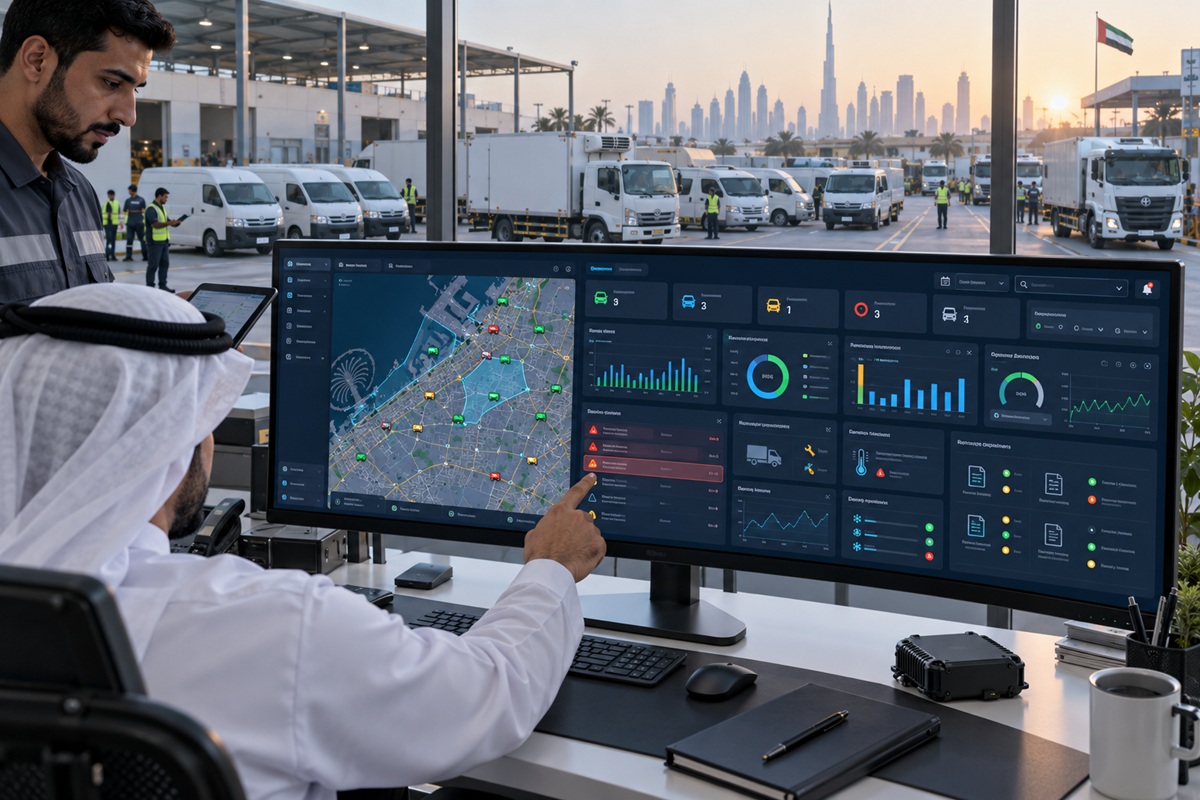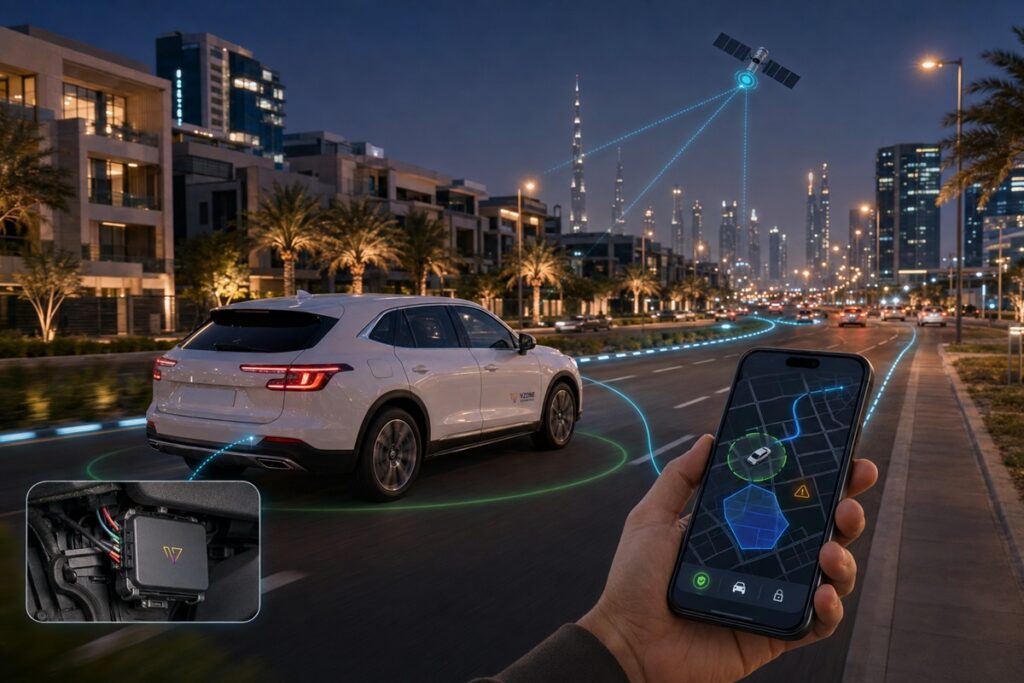
A GPS tracking system for cars is no longer a luxury tool reserved for large logistics companies. In the UAE, where summer temperatures regularly exceed 48°C, fuel costs remain a significant operational burden, and RTA and ITC compliance requirements mandate vehicle monitoring for specific categories, GPS tracking devices for cars have become standard equipment for fleets of every size from a three-vehicle maintenance company in Sharjah to a 400-vehicle logistics operation serving ADNOC facilities in the Western Region.
VZone International has deployed GPS tracking systems for cars and commercial vehicles across 4,000+ UAE fleets over 20+ years. The most common question from fleet managers evaluating a tracking system for car monitoring is not ‘does GPS tracking work?’ they already know it does. The question is: which features matter for UAE conditions, which hardware survives the heat, and which platform turns raw position data into decisions that reduce costs. This guide answers all three.
Key Takeaways
- Active tracking is the UAE standard real-time cellular-based GPS (updates every 10–60 sec) is required for Asateel/IVMS compliance; passive (store-and-retrieve) tracking has no compliance use case.
- Heat resistance is non-negotiable in-car temps exceed 70°C, so devices need a 70°C-rated build; consumer-grade trackers (60°C or below) fail in UAE conditions.
- Compliance is mandatory, not optional Abu Dhabi commercial vehicles need ITC Asateel, Dubai rental/taxi/school buses need RTA SecurePath, and ADNOC contractors need IVMS-certified telematics.
- ROI is measurable and significant fleets typically see 20–30% fuel savings, 25–35% fewer at-fault accidents, and 10–20% insurance premium reductions from GPS + driver behavior data.
- Hardware choice depends on fleet size and use case OBD-II plug-ins suit small/rental fleets, hardwired units are required for compliance and sensor integration (10+ vehicles), and portable/magnetic trackers fit short-term or covert monitoring only.
What Is a GPS Tracking System for Cars?
A GPS tracking system for cars is a combination of hardware, connectivity, and software that determines a vehicle’s real-time location and transmits that data to a monitoring platform accessible to the fleet manager or vehicle owner. The hardware a GPS tracking device is typically a compact unit installed inside or underneath the vehicle that receives signals from the Global Positioning System satellite network, calculates the vehicle’s precise coordinates, and sends that data over a cellular connection (du or Etisalat in the UAE) to a cloud server.
The fleet manager or owner accesses the data through a web dashboard or mobile app, seeing each car’s live location, speed, heading, and status on a map updated every 10 to 60 seconds depending on the platform’s configuration. Alerts fire automatically when defined events occur: the car exceeds a speed limit, leaves a defined zone, idles for too long, or makes a harsh braking event.
Active vs Passive GPS Tracking Devices for Cars
There are two fundamental architectures for GPS tracking devices for cars: active and passive. Active GPS tracking devices transmit location data in real time over a cellular network the fleet manager sees the car’s position live, receives alerts as events occur, and can access the full trip history at any time. This is the standard for fleet management in UAE. Passive GPS tracking devices store location data in the device’s internal memory and only upload it when the vehicle returns to a base station or the SD card is manually extracted. Passive tracking produces a historical record but no real-time visibility it is rarely used in commercial fleet management and has no compliance application in UAE’s Asateel or IVMS programmes, both of which require continuous active data submission.
| Feature | Active GPS Tracking | Passive GPS Tracking |
| Real-time location | Yes updates every 10-60 seconds | No data available only after retrieval |
| Alerts and notifications | Yes speed, geofence, idle, harsh event | No post-trip review only |
| UAE compliance (Asateel/IVMS) | Yes required by both programmes | No cannot satisfy continuous submission requirement |
| Cellular SIM required | Yes du or Etisalat UAE SIM | No stores data locally |
| Best application | Fleet management, compliance, theft recovery | Personal trip logging, retrospective analysis |
How Does a GPS Tracker for Cars Actually Work?
Understanding the data flow from device to dashboard helps fleet managers evaluate what can go wrong and why connectivity matters in UAE’s remote operating environments.
Step 1 Satellite Signal Acquisition
The GPS device in the car connects to multiple satellites in the Global Navigation Satellite System (GNSS) typically the US GPS constellation, and in advanced devices also Russia’s GLONASS and Europe’s Galileo. Signals from at least four satellites are required to calculate a three-dimensional position fix (latitude, longitude, altitude). In urban UAE environments with clear sky visibility, a quality GPS device achieves a position fix within 30 to 60 seconds of startup; in covered parking, underground structures, or areas with significant building obstruction, fix time increases and accuracy may reduce.
Step 2 Position Calculation and Data Recording
The device’s onboard processor calculates the vehicle’s coordinates from the satellite signals and records the position alongside speed, heading, timestamp, and any sensor data from connected vehicle systems (fuel level sensor, driver ID input, engine OBD data). This position record is stored in the device’s buffer memory, ready for transmission.
Step 3 Cellular Data Transmission
The device transmits the position record to VZone International’s cloud server over the UAE cellular network using a SIM card from du or Etisalat providing 4G LTE data. The transmission occurs at the configured reporting interval (every 10 to 60 seconds for active fleet tracking) regardless of whether the fleet manager is watching the dashboard. In areas of weak cellular coverage UAE Western Region desert routes, some remote construction sites the device stores data locally and uploads in bulk when connectivity is restored.
Step 4 Cloud Processing and Dashboard Display
VZone International’s Wialon-powered cloud platform receives the position data, processes it against configured alert rules (geofences, speed limits, idle thresholds), and updates the fleet dashboard map in real time. The fleet manager sees each car’s position as a moving icon on the map, with colour or icon changes indicating status (moving, idle, stopped, alert condition). Historical trip replay, driver reports, fuel analytics, and compliance data are all accessible from the same dashboard.
Key Features to Look For in a GPS Tracking Device for Cars
Real-Time Location Tracking
The core function of any GPS tracking system for cars is real-time position visibility seeing where each car is right now, how fast it is moving, and in which direction. For fleet management in UAE, real-time tracking enables immediate response to vehicle incidents, dispatch optimisation based on actual vehicle positions rather than scheduled positions, and customer-facing ETA accuracy for delivery and service operations. Look for a reporting interval of 30 seconds or less for active fleet operations; 60-second intervals are adequate for lower-activity vehicle categories.
Geofencing and Route Monitoring
Geofencing creates virtual boundaries around depots, client sites, delivery zones, or restricted areas and fires alerts when vehicles enter or exit. For UAE fleet managers, the most commercially valuable geofence applications are after-hours departure alerts (vehicle leaves depot outside scheduled hours indicating unauthorised personal use), client site arrival and departure recording (GPS-verified time-on-site for billing and service verification), and ADNOC facility access logging (entry and exit timestamps for contractor HSE compliance documentation). Route monitoring extends geofencing to corridor zones alerting when vehicles deviate from their assigned routes.
Driver Behaviour Scoring
A GPS tracking system for cars that monitors driver behaviour harsh braking, harsh acceleration, sharp cornering, speeding, and extended idling produces the data that fleet coaching programmes need to reduce accident rates and fuel consumption simultaneously. For UAE commercial fleets, driver behaviour scoring typically reduces fuel consumption by 8 to 12 percent as coaching brings aggressive acceleration patterns under control, and reduces at-fault accident frequency by 25 to 35 percent over 12 months as the feedback loop between behaviour data and coaching conversations produces sustained change. The score should be per-driver (not per-vehicle) to enable individual accountability which requires driver ID integration via iButton, RFID, or driver app login alongside the GPS tracking device.
Fuel Monitoring and Idle Alerts
Fuel is the largest controllable operating cost for most UAE fleets, and GPS tracking devices for cars that integrate with fuel level sensors add the consumption measurement layer that GPS-only tracking cannot provide. In UAE summer conditions, vehicles left idling to maintain air-conditioning consume 1.5 to 2.5 litres per hour at zero productivity idle alerts that fire after a configured idle threshold give supervisors the real-time tool to intervene. Integrated fuel and GPS data also enables cost-per-kilometre reporting, the financial metric that fleet managers use to identify which vehicles and routes are profitable and which are eroding margin.
UAE Heat-Resistant Hardware
This feature is not optional for UAE deployments it is a prerequisite. Dashboard-mounted GPS tracking devices inside vehicles parked in UAE summer sun reach internal temperatures exceeding 70°C within minutes of engine shutdown. Consumer-grade GPS trackers rated to 60°C or below will fail, produce inaccurate readings, or develop shortened hardware lifespans in UAE conditions. Enterprise-grade GPS tracking devices for cars in UAE should be rated for continuous operation at 70°C ambient and designed with heat dissipation features that prevent thermal throttling during the afternoon operating hours when temperature peaks. VZone International deploys Teltonika devices rated for UAE climate conditions as standard specifically selected for demonstrated performance reliability in GCC operating temperatures across large fleet deployments.
Why UAE Fleet Operators Need a Vehicle GPS Tracker Device
UAE Heat and Vehicle Stress
Extreme heat in UAE creates vehicle operating conditions that amplify every management problem a GPS tracking system addresses. Engine idling to maintain cabin air-conditioning generates fuel waste at rates that temperate-market fleet managers do not encounter. Tyre pressure loss from heat increases tyre wear and failure risk GPS-integrated tyre pressure monitoring addresses this directly. Engine and transmission stress from sustained high-ambient-temperature operation accelerates maintenance intervals GPS-linked engine diagnostic monitoring from OBD-II interface provides early warning of developing mechanical issues before they become costly failures.
RTA, ITC Asateel, and ADNOC Compliance
UAE commercial vehicle GPS compliance is not optional. All commercial vehicles registered in Abu Dhabi must submit continuous GPS data to the ITC Asateel portal. Rental cars, taxis, and school buses in Dubai must comply with RTA SecurePath GPS requirements. ADNOC contractor vehicles require IVMS-certified telematics including GPS and driver behaviour monitoring. Installing a GPS tracking device for cars that appears on the applicable programme’s certified hardware list and connecting it to a platform that manages portal data submission is a legal operating requirement for these vehicle categories, not a management enhancement.
Insurance Premium Reduction
UAE commercial vehicle insurance carriers increasingly recognise GPS telematics data as evidence of reduced fleet risk, enabling telematics-verified fleet safety data to support premium reduction requests at renewal. Fleets that present structured GPS safety event reports driver behaviour scores, harsh event frequency, speeding incident rate alongside a coaching programme documentation record typically achieve 10 to 20 percent premium reduction at first renewal and additional reduction at subsequent renewals as the coaching programme’s impact on claims history compounds.
Vehicle Theft Recovery in GCC
Vehicle theft recovery in UAE and across the GCC is significantly faster when the vehicle has an active GPS tracking device law enforcement and recovery services can access the vehicle’s live location rather than relying on camera network searches and informant reports. Recovery rates for GPS-tracked vehicles in GCC are substantially higher than for untracked vehicles, and insurance policies for GPS-tracked fleets typically reflect this lower theft risk in the premium calculation. For high-value commercial vehicles refrigerated trucks, specialised construction equipment, luxury corporate vehicles GPS tracking is effectively mandatory for insurance coverage at reasonable rates.
How to Choose the Right GPS Device for Car Tracking
Fleet Size Considerations
For fleets of fewer than 10 vehicles, a cloud-based SaaS GPS tracking system with a monthly subscription per vehicle and a plug-and-play OBD-II device is operationally appropriate low implementation overhead, no server management, and a predictable monthly cost. For fleets of 10 to 50 vehicles, hardwired devices with a managed fleet platform (like VZone International’s Wialon deployment) provide the additional sensor integration, driver ID, and compliance reporting that growing fleets require. For fleets above 50 vehicles, enterprise platform deployment with full API integration to ERP systems, dedicated account management, and multi-site compliance management is the appropriate configuration.
OBD-II vs Hardwired vs Portable
OBD-II plug-in GPS trackers connect to the vehicle’s diagnostic port and require no installation a 30-second plug-in provides GPS tracking and basic engine data. They are easily transferred between vehicles, making them appropriate for rental fleets, leased vehicles, or temporary tracking needs. Their limitation is that they can be easily removed (intentionally or accidentally) and do not provide the secure, tamper-evident installation that compliance programmes require. Hardwired GPS tracking devices are professionally installed with direct vehicle power connection more secure, tamper-evident, and capable of connecting to additional sensors (fuel level, temperature, driver ID reader). Hardwired installation is required for Asateel, IVMS, and SIRA compliance. Portable/magnetic GPS trackers operate on an internal battery and can be placed anywhere on or in the vehicle appropriate for short-term asset monitoring, covert tracking investigations, or temporary deployments but not for primary fleet management.
SIM Connectivity in UAE
GPS tracking devices for cars in UAE require a local SIM card from du or Etisalat to transmit data over the UAE cellular network. Some devices support dual-SIM or network-switching to automatically select the strongest signal useful for vehicles that operate across multiple Emirates where network coverage varies. For UAE-Oman cross-border vehicles, the SIM must provide GCC roaming data or the device must support a separate Oman SIM, as UAE SIM roaming costs in Oman can be substantial for continuous GPS data transmission over a full month. VZone International manages SIM procurement, configuration, and ongoing connectivity monitoring as part of the deployment service fleet managers do not manage SIM plans or data usage separately.
VZone International’s AI-Powered GPS Solution
VZone International’s GPS tracking system for cars and commercial fleets combines Teltonika hardware (heat-rated, multi-compliance-certified), the Wialon fleet management platform (3,400+ supported device types, enterprise-grade reliability), and an AI Fleet Assistant trained on 300M+ km of UAE and GCC driving data providing fleet-specific recommendations calibrated for UAE road conditions, summer heat, and compliance requirements rather than generic global benchmarks. With 20+ years of UAE fleet operations and 4,000+ fleets served across every industry vertical, VZone provides the compliance certifications (Asateel, SecurePath, IVMS, SIRA, OPAL), the local installation team, and the account management that fleet GPS deployment in UAE requires.
Free AI Fleet Audit VZone International
Not sure which GPS tracking system is right for your UAE fleet? VZone International’s free AI Fleet Audit reviews your current fleet size, vehicle categories, compliance obligations (Asateel, IVMS, SIRA, SecurePath), and operational profile to recommend the exact GPS hardware, platform configuration, and compliance registration pathway your fleet needs. No commitment required. Contact our team to book your free audit today.
Frequently Asked Questions
The best GPS tracking system for cars in UAE depends on the vehicle category and compliance requirement. For commercial vehicles in Abu Dhabi, the system must use ITC Asateel certified hardware. For rental cars and school buses in Dubai, RTA SecurePath-approved devices are required. For ADNOC contractor vehicles, IVMS-certified telematics with driver behaviour monitoring is mandatory. VZone International is one of the very few providers holding all five UAE GPS compliance certifications simultaneously Asateel, SecurePath, IVMS, SIRA, and OPAL Oman making it the most comprehensively certified GPS tracking system provider for UAE fleets across all vehicle categories and operating programmes.
GPS tracking devices for cars in UAE range from AED 200 to AED 1,200 per vehicle for hardware depending on the device type and capability OBD-II plug-in devices at the lower end, hardwired AI dashcam-integrated devices at the upper end. Installation adds AED 150 to AED 350 per vehicle for professional hardwired installation. Platform subscription for the fleet management software runs AED 60 to AED 150 per vehicle per month depending on the feature set basic GPS tracking at the lower end, full AI dashcam integration, driver behaviour monitoring, and compliance reporting at the upper end. Total 24-month cost for a standard hardwired GPS tracking system for cars in UAE runs approximately AED 2,000 to AED 5,500 per vehicle, against typical annual savings of AED 4,000 to AED 12,000 per vehicle from fuel reduction, incident cost avoidance, and insurance premium reduction.
A GPS tracking device for cars can calculate its position without internet the GPS position fix uses satellite signals that do not require cellular connectivity. However, transmitting that position to the fleet management dashboard requires a cellular data connection. Without connectivity, the device stores position records in its internal buffer memory and uploads them in bulk when connectivity is restored producing a historical record but no real-time visibility or live alerts during the connectivity gap. For UAE-Oman cross-border routes and Western Region desert operations where cellular coverage is intermittent, devices with adequate buffer memory and satellite fallback capability (Iridium SBD for remote areas) maintain compliance-quality data records throughout the route without real-time dashboard visibility during coverage gaps.
Yes GPS tracking device installation in vehicles is legal in UAE and is actively mandated by law for multiple commercial vehicle categories. ITC Asateel makes GPS tracking mandatory for all commercial vehicles registered in Abu Dhabi. RTA SecurePath mandates GPS for rental cars, taxis, and school buses in Dubai. ADNOC requires IVMS telematics for all contractor vehicles accessing its facilities. For private vehicles, the vehicle owner may install a GPS tracking device in their own vehicle without restriction. For employer-installed GPS tracking on employee-operated fleet vehicles, UAE employment law requires that employees are informed that vehicle tracking is in operation a standard practice satisfied by including GPS monitoring in the fleet policy and employment contract.
Modern GPS tracking devices for cars achieve horizontal position accuracy of 2 to 5 metres under clear sky conditions sufficient to identify which lane of a road a vehicle is in, confirm arrival at a specific delivery address, and verify gate entry at a facility. In urban canyon environments with tall buildings on both sides (common in Downtown Dubai and Abu Dhabi CBD areas), multi-path signal reflection can reduce accuracy to 10 to 20 metres. Devices that use multi-constellation GNSS (GPS + GLONASS + Galileo) achieve better accuracy in partially obscured environments than single-constellation GPS-only devices. For compliance applications (Asateel portal submission, IVMS data records), the accuracy of enterprise-grade devices is sufficient for all UAE regulatory requirements.