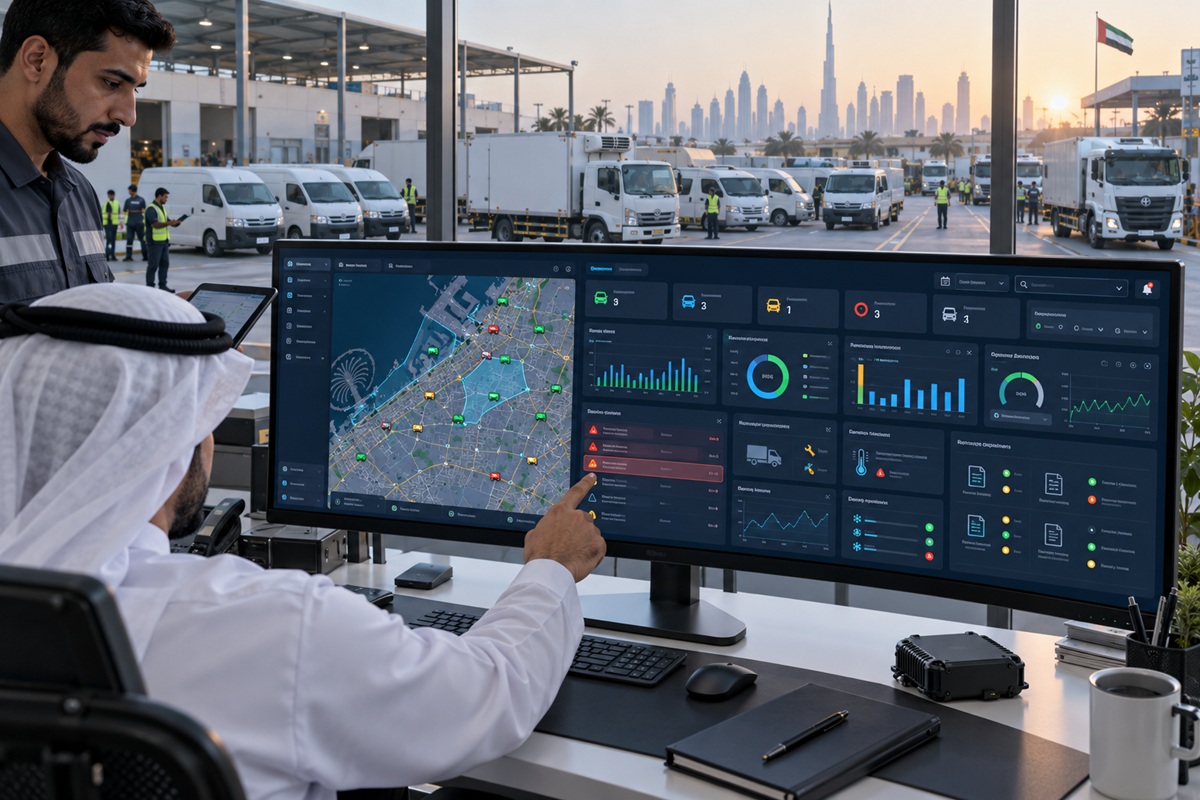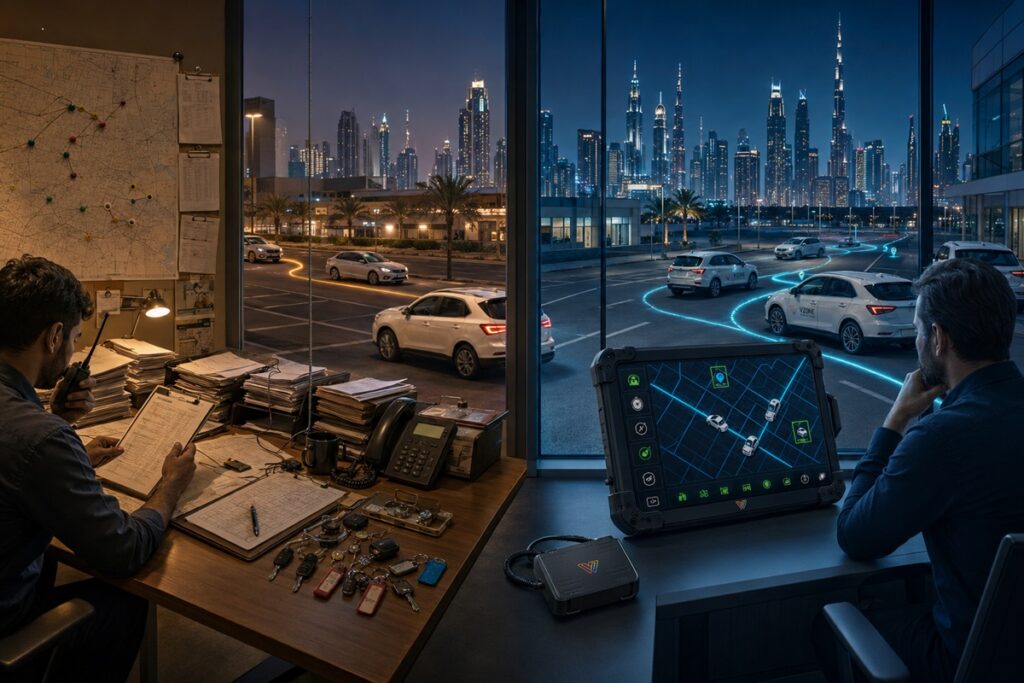
Approximately 65 percent of UAE fleet operators particularly SMBs in construction, maintenance, and service sectors still rely on WhatsApp groups, Excel sheets, and phone calls as their primary fleet management tools. The fleet manager calls the driver to ask where they are. The driver sends a WhatsApp message with their location. The fuel receipt is photographed and sent to a group. The mileage is entered into a spreadsheet at the end of the week. This system works in the same way that writing letters works for communication. It produces an outcome. It just produces it more slowly, less accurately, and at significantly higher hidden cost than the alternative.
This guide compares GPS tracking systems for cars against manual fleet management methods on every dimension that matters for UAE fleet operators in 2026: real-time visibility, driver accountability, fuel management, compliance documentation, reporting overhead, and scalability. It also includes an honest assessment of when manual management is genuinely adequate because a one-vehicle sole trader has different needs from a 50-vehicle logistics company, and the comparison should reflect that.
Key Takeaways
- Manual fleet management hides real costs: ~AED 11,320/month idle fuel waste on a 20-vehicle fleet, plus 10-20% insurance overpayment
- UAE compliance (Asateel, IVMS, SecurePath) requires GPS data WhatsApp/Excel fleets are often non-compliant without knowing it
- GPS beats manual on 6 fronts: visibility, reporting, driver accountability, fuel tracking, compliance, and scalability
- Manual still fine for: 1-3 vehicle owner-operator fleets, personal vehicles, fixed routes, or sub-3-month deployments
- Fast rollout: 2-5 days install, no downtime, but full habit shift takes 4-6 weeks
What Does Manual Fleet Management Actually Look Like?
Manual fleet management in UAE typically relies on a combination of four tools that have not fundamentally changed in 20 years: the mobile phone (calls and WhatsApp) for real-time communication, Excel or Google Sheets for record-keeping, paper fuel receipts and odometer logs for consumption tracking, and the driver’s self-reported location and activity for operational visibility. Each of these tools works individually and fails systematically when the fleet grows beyond the point where a single manager can hold the entire operation in their head.
The Hidden Costs of Manual Management
The costs that manual fleet management generates are almost entirely invisible on any individual invoice or budget line they accumulate in the space between what drivers report and what actually happened, between what fuel cards record and what tanks received, between what the insurance policy charges and what a GPS-verified safety record would have negotiated.
- Fuel waste from unmonitored idle time: a driver who sits in an air-conditioned van for 40 minutes during a break in UAE July heat consumes approximately 1.3 litres of fuel invisible in the fuel card statement, undetectable without GPS idle monitoring. Across a 20-vehicle fleet, if each vehicle averages 30 minutes of avoidable daily idle, the monthly idle fuel cost at AED 2.83 per litre is approximately AED 11,320 appearing on the fuel invoice as normal usage.
- Unauthorised personal vehicle use: without GPS monitoring, drivers who use company vehicles for personal errands after hours generate fuel costs, wear, and potential incident risk with no management awareness until the pattern becomes egregious enough to notice from fuel consumption anomalies typically months later.
- Compliance gaps generating penalties: UAE Asateel compliance requires continuous GPS data submission. A fleet manager using WhatsApp to track vehicles is not submitting data to ITC the fleet is non-compliant, potentially facing penalties and vehicle registration complications that can cost more than a full year of GPS subscription in a single non-compliance event.
- Insurance overpayment: without GPS-verified driver behaviour data, UAE commercial vehicle insurers price policies on actuarial averages. A fleet with genuinely good driver safety record pays the same premium as the actuarial average unless it can present verified telematics evidence typically 10-20% overpayment relative to what a GPS-monitored fleet with documented safety data would pay.
- Management time cost: a fleet manager manually calling 20 drivers twice per day to establish vehicle locations spends approximately 90 minutes per day on location check-ins alone time that GPS monitoring eliminates entirely and redirects to operational management.
What a GPS Tracking System for Cars Replaces
The following table maps every significant manual fleet management task to its GPS equivalent showing what the manual method produces and what the GPS tracking system for cars produces instead.
| Fleet Management Task | Manual Method | GPS Tracking System for Cars |
| Real-time vehicle location | Phone call or WhatsApp message to driver response time 2-10 minutes, accuracy depends on driver’s description | Live GPS map position updated every 30 seconds, accurate to 2-5 metres, no driver interruption required |
| Driver location at end of shift | Driver reports return to depot by WhatsApp or phone | Geofence depot return alert fires automatically when vehicle enters depot zone timestamped, GPS-verified |
| Fuel consumption tracking | Fuel card statement reconciled against odometer at month end discrepancies investigated retrospectively | Fuel sensor monitoring shows actual consumption per trip and per driver in real time discrepancies detected within hours |
| Driver behaviour monitoring | Manager’s subjective assessment from occasional ride-alongs inconsistent and non-scalable | AI-scored events per driver: harsh braking, acceleration, speeding, idle per-trip, per-week, comparative ranking |
| Mileage and trip recording | Driver self-reports trip purpose and mileage in paper or spreadsheet log no independent verification | GPS trip log records actual start/end points, route taken, distance, duration automatically, for every trip |
| Maintenance scheduling | Odometer-based service reminders tracked in spreadsheet missed when drivers fail to report readings accurately | GPS mileage tracking triggers maintenance alerts at precise service intervals driver self-reporting not required |
| Compliance reporting (Asateel/IVMS) | Not possible manual tracking cannot submit data to ITC or ADNOC portals | Automatic continuous data submission to Asateel portal compliance status visible on fleet dashboard |
| Insurance claim evidence | Driver statement and police report no independent evidence of vehicle speed or conduct before incident | GPS speed log + dashcam footage objective, timestamped, GPS-corroborated incident evidence |
| Unauthorised vehicle use detection | Discovered retrospectively from fuel or mileage anomalies weeks or months after the fact | After-hours geofence alert fires within minutes of departure investigation possible same day |
| Fleet-wide reporting | Manual compilation from multiple spreadsheets 3-6 hours per month per fleet manager | Automated weekly and monthly reports generated by platform fleet manager reviews, not compiles |
6 Areas Where a Tracking System for Car Monitoring Wins
1. Real-Time Visibility vs. Delayed Check-Ins
The fundamental difference between a GPS tracking system for cars and manual fleet management is the difference between knowing and asking. Manual management requires a fleet manager to interrupt a driver’s work to establish their location an interruption that takes the driver’s attention off the road for the duration of the call, produces a location description that is approximate at best, and provides no information about the vehicle’s speed, route, or upcoming position. GPS tracking eliminates the question entirely: the fleet manager opens the dashboard and sees every vehicle’s exact position, speed, and status without any driver interaction.
For UAE fleet operations where drivers cover multi-emirate routes, operate in areas with variable mobile reception, or work across multiple shifts with different supervisors, the visibility gap created by manual check-ins is operationally material. A logistics supervisor who has to call every driver individually to establish route progress before making a customer ETA commitment is producing imprecise estimates subject to driver interpretation; a supervisor who sees every vehicle’s GPS position in real time is making commitments from fact.
2. Automated Reports vs. Manual Data Entry
Manual fleet management’s reporting overhead is one of its most significant but least-discussed costs. A fleet manager responsible for 30 vehicles who manually compiles monthly mileage, fuel consumption, trip purpose, maintenance records, and driver performance data spends 4 to 8 hours every month on data compilation before any analysis can begin. The reports produced are as accurate as the data entered which is as accurate as driver self-reporting, which is systematically biased toward underreporting anomalies.
A GPS tracking system for cars generates every report automatically from GPS data that does not require driver input: trip logs with verified distances and routes, fuel consumption reports from sensor data, driver behaviour scores from AI event detection, maintenance alerts from GPS mileage triggers, and compliance data in the format each UAE programme requires. The fleet manager’s role shifts from data compiler to data user reviewing the reports the platform generates rather than constructing them from raw inputs.
3. Driver Accountability via Vehicle GPS Tracker Device
Manual fleet management creates an accountability gap that experienced drivers quickly identify and exploit: without independent verification, the driver’s account of what happened is the primary record. A driver who takes a personal detour, uses the vehicle after hours, or sits idle for an extended break has no reason to report these behaviours because there is no independent record against which their account can be checked. The fleet manager who relies on driver self-reporting is not managing driver behaviour they are managing driver communication.
A GPS tracking device for cars creates independent verification for every trip: where the vehicle went, what route it took, how fast it was driven, when it stopped and for how long, and whether the driver’s account matches the GPS record. This independent verification does not require confrontation or accusation the data speaks for itself, and drivers who know their vehicles are GPS-tracked consistently self-correct behaviours that they would otherwise continue. The deterrent effect of GPS monitoring operates continuously once drivers are aware of it.
4. Fuel Management with GPS Tracking Device for Cars
Fuel management under manual systems is fundamentally retrospective: the fleet manager reviews the monthly fuel card statement, notes the total spend, compares it to the prior month, and investigates if the variance is large enough to trigger concern. By the time a fuel anomaly is large enough to notice from a monthly statement review, the underlying cause siphoning, fill-up fraud, excessive idling, aggressive driving has been generating cost for weeks or months.
GPS tracking devices for cars with fuel sensor integration make fuel management real-time: consumption per vehicle per trip is monitored continuously, tank level changes are compared against expected consumption for the route distance, fill-up volumes are reconciled against card transactions, and idle time fuel waste is quantified for each driver on each shift. Anomalies are detected within hours rather than weeks and the specific vehicle, driver, and location context provided by the GPS record enables targeted investigation rather than diffuse concern about a higher-than-expected monthly total.
5. Compliance Documentation
UAE GPS compliance programmes ITC Asateel for Abu Dhabi commercial vehicles, ADNOC IVMS for contractor fleets, RTA SecurePath for Dubai rental cars and school buses require continuous GPS data submission to government portals. Manual fleet management cannot satisfy these requirements. There is no manual process that produces the continuous timestamped position data that Asateel requires; there is no self-reporting system that generates the driver behaviour event data that IVMS requires. A UAE commercial fleet operator using WhatsApp and Excel as their primary management tools is non-compliant with mandatory GPS requirements and may not be aware of it.
Beyond the mandatory compliance programmes, GPS tracking produces the compliance documentation that voluntary but commercially valuable programmes require: ADNOC HSE contractor prequalification submissions that include GPS monitoring evidence, insurance telematics data packages for premium negotiation, and journey management records for ADNOC-connected operations that journal management plans require GPS verification to complete credibly.
6. Scalability 10 Cars vs. 500 Cars
Manual fleet management scales with manager headcount the system’s capacity is determined by how many drivers one manager can call, how many spreadsheet rows one person can update, and how many fuel receipts one administrator can reconcile per month. At 5 vehicles, one manager can cover all of this. At 20 vehicles, the manual overhead occupies most of a fleet manager’s working week. At 50 vehicles, the manual workload requires a dedicated administrative team. At 200 vehicles, manual management is not a fleet management system it is organised chaos.
A GPS tracking system for cars scales without additional management headcount: the platform monitors 5 vehicles and 500 vehicles with identical per-vehicle oversight quality. Adding 50 vehicles to a GPS-managed fleet adds 50 device registrations and 50 additional data points on the dashboard no additional phone calls, no additional spreadsheet rows, no additional reconciliation hours. The scalability difference is the primary reason that every fleet above a certain size eventually migrates to GPS tracking not because manual management becomes intolerable all at once, but because each vehicle added to a manual fleet adds overhead that each vehicle added to a GPS fleet does not.
When Manual Management Still Works
The comparison above is heavily weighted toward GPS tracking because for most UAE fleet operators above a certain scale, GPS is objectively better on every operational dimension. But an honest comparison requires acknowledging where manual management is adequate and where adding GPS tracking would add cost without proportionate operational benefit.
- Very small fleets of 1 to 3 vehicles where the owner is also the primary driver: if you are the only person who drives the vehicle, you already know where it is. GPS adds monitoring capability that is redundant when the fleet manager and the driver are the same person.
- Personal vehicles with no commercial or compliance requirement: a privately-owned car with no fleet management, insurance telematics, or compliance obligation does not benefit from fleet GPS tracking in the way commercial fleet vehicles do.
- Fleets with extremely stable, unchanging daily routes: a vehicle that makes the same three stops in the same order every working day with a fixed driver has limited visibility value from GPS the route is already known, the stops are predictable, and there is no optimisation opportunity to identify. GPS still provides insurance telematics value and theft protection, but the operational management benefit is lower than for variable-route operations.
- Temporary or very short-term deployments (under 3 months): the hardware investment and setup time for GPS deployment may not be recovered in a deployment shorter than one quarter. For temporary projects, a portable GPS tracker or a short-term platform subscription is more appropriate than a full fleet installation.
If your fleet does not fit any of these categories if you operate 5 or more commercial vehicles, have UAE compliance obligations, carry high-value cargo, or incur significant monthly fuel costs the honest assessment is that manual management is costing you more than GPS deployment would, beginning in the first quarter of deployment.
Making the Switch: From Spreadsheets to GPS Device for Car Tracking
Migration from manual fleet management to GPS tracking does not require operational disruption. VZone International’s standard fleet onboarding process deploys devices across an entire fleet without removing vehicles from service installation is completed during scheduled downtime (overnight, at shift change, or during maintenance slots) with no interruption to daily operations.
| Week 1 | Device Installation and Platform Setup VZone’s certified installation team deploys hardwired GPS devices across all vehicles during scheduled downtime slots typical installation time 45-90 minutes per vehicle. Vehicles are registered on the Wialon platform, geofences are configured for depot and key locations, driver ID (iButton or app) is activated, and Asateel/IVMS/SIRA compliance portal registration is completed. By end of Week 1, every vehicle is live on the dashboard and submitting compliance data. |
| Month 1 | Baseline Establishment and First Insights The first month’s GPS data establishes the baseline for every subsequent comparison: actual fuel consumption per vehicle, driver behaviour event frequency, trip distance vs reported mileage, idle time patterns, and route compliance. Most fleets discover 3-5 significant operational insights in Month 1 that were invisible under manual management specific drivers with high harsh event rates, vehicles with consumption anomalies indicating mechanical issues, after-hours movement patterns on specific vehicles. The fleet manager reviews automated weekly reports rather than compiling data manually for the first time. |
| Month 3 | Coaching Impact and Cost Reduction Visible By Month 3, the driver coaching programme using AI safety score data is showing measurable results: harsh event frequency has typically reduced 20-35% from Month 1 baseline as drivers respond to scored feedback. Fuel consumption has decreased 5-8% from eco-driving improvement. The first compliance report has been generated for Asateel or IVMS in automated format. The fleet manager is spending 60-70% less time on manual fleet administration than pre-GPS, redirecting that time to operational optimisation. Insurance renewal is approaching, and the telematics data package for premium negotiation is already generated and waiting. |
| Month 6+ | Full ROI Realised and Compounding By Month 6, the coaching-driven behaviour improvement has compounded into a measurable incident rate reduction. The first insurance renewal with GPS data submitted is producing 10-15% premium saving. Fuel cost reduction is running at 10-15% vs pre-GPS baseline. The fleet manager has full operational visibility that manual management never provided and cannot imagine returning to WhatsApp and Excel as the primary fleet management tools. |
Free AI Fleet Audit See What Manual Management Is Costing You
VZone International’s free AI Fleet Audit reviews your current fleet size, management tools, compliance obligations, fuel spend, and incident history to calculate exactly what manual management is costing you versus what GPS deployment would save in AED, with a specific payback timeline. Most UAE fleet operators who complete the audit discover they are leaving AED 50,000 to AED 200,000 on the table annually. No obligation. Contact our team to book your free audit today.
Frequently Asked Questions
For UAE commercial fleets of 5 or more vehicles, yes the ROI calculation is consistently positive within 3 to 6 months even for small fleets, because the saving mechanisms (fuel monitoring, idle reduction, insurance telematics, compliance avoidance) operate regardless of fleet size. The per-vehicle economics do not change materially between a 5-vehicle fleet and a 50-vehicle fleet. For fleets of 1 to 3 vehicles, the assessment depends on the specific situation: Asateel compliance requirement (mandatory regardless of fleet size for Abu Dhabi commercial vehicles), current fuel spend level, and whether the fleet has experienced insurance loading from prior incidents. VZone International's free AI Fleet Audit provides a fleet-specific ROI calculation before any commitment is made.
Physical deployment device installation, platform setup, driver ID activation, and compliance registration takes 2 to 5 business days for a fleet of 20 to 50 vehicles when VZone International's installation team manages the rollout. Larger fleets (100+ vehicles) are typically deployed in batches over 2 to 4 weeks to manage installer scheduling and per-depot rollout logistics. The platform is operational from the first installed vehicle the fleet manager does not wait for the entire fleet to be deployed before starting to use the dashboard. Operationally, there is no disruption: vehicles remain in service throughout installation, which is completed during depot downtime. The transition from manual management practices to GPS-based workflows typically takes 4 to 6 weeks as fleet managers build new habits around the dashboard rather than phone calls the technology is ready immediately; the behavioural change takes a few weeks longer.
Yes VZone International's fleet management platform provides native API connectors for SAP, Oracle, Odoo, and Zoho, enabling GPS fleet data (vehicle mileage, fuel cost per vehicle, trip records, and maintenance alerts) to feed directly into the ERP's cost centre and asset management modules without manual data re-entry. For ERP systems not on the standard connector list, the platform's open API enables custom integration development. The typical integration use case for UAE mid-market companies is pushing monthly per-vehicle fuel cost, mileage, and Salik toll data to the finance module for cost centre allocation replacing the manual Excel export and ERP import that many fleet-adjacent finance teams perform monthly. ERP integration is configured during the VZone onboarding process and does not require ongoing management once established.
The minimum fleet size where GPS tracking produces a clearly positive ROI is generally 3 to 5 vehicles for UAE commercial operations but the more accurate answer is that fleet size is the wrong variable. The correct variables are: whether any vehicle in the fleet has a UAE compliance requirement (even a single Asateel-required vehicle makes GPS deployment mandatory, regardless of total fleet size); whether the fleet has significant fuel spend (even 3 vehicles spending AED 3,000 per month in fuel have meaningful GPS fuel monitoring ROI); and whether any vehicle has had an at-fault accident or insurance loading in the past 24 months (GPS insurance telematics value starts from vehicle 1). For a sole trader with one personal vehicle and no commercial or compliance requirement, GPS fleet tracking does not make sense. For a sole trader operating one commercial van in Abu Dhabi, Asateel compliance makes it mandatory.