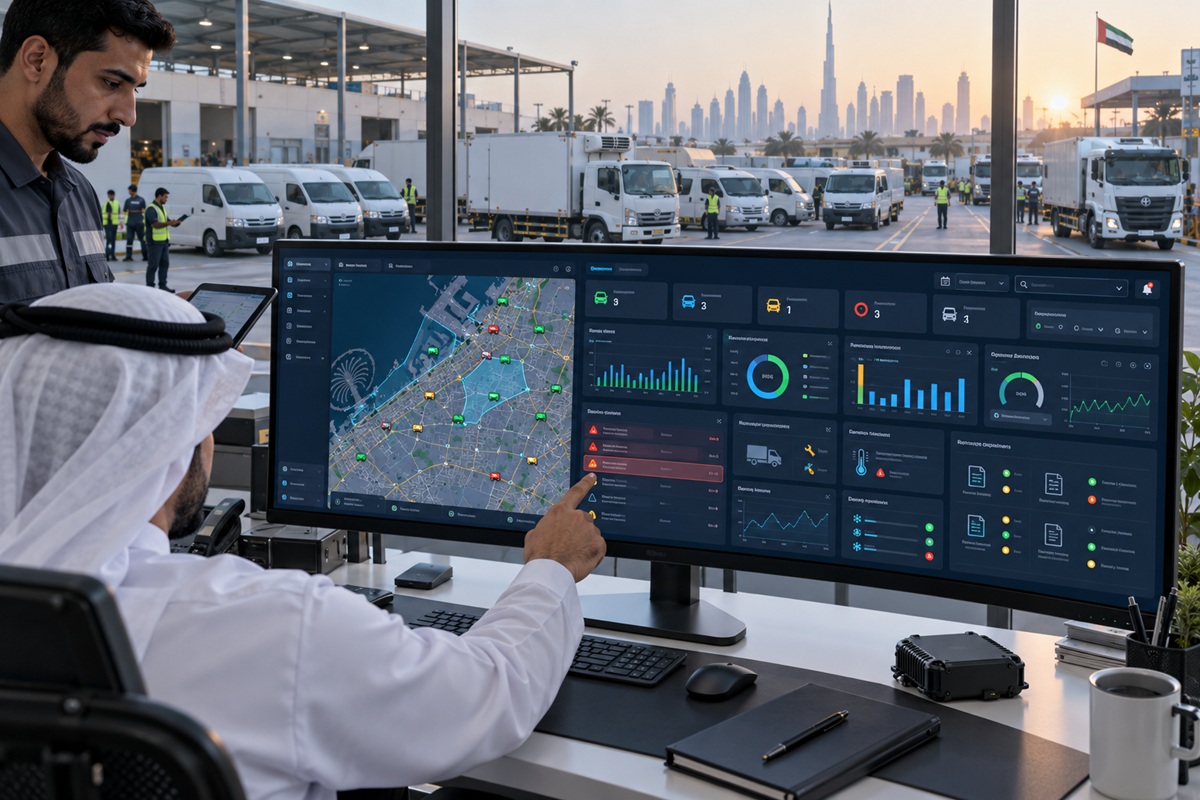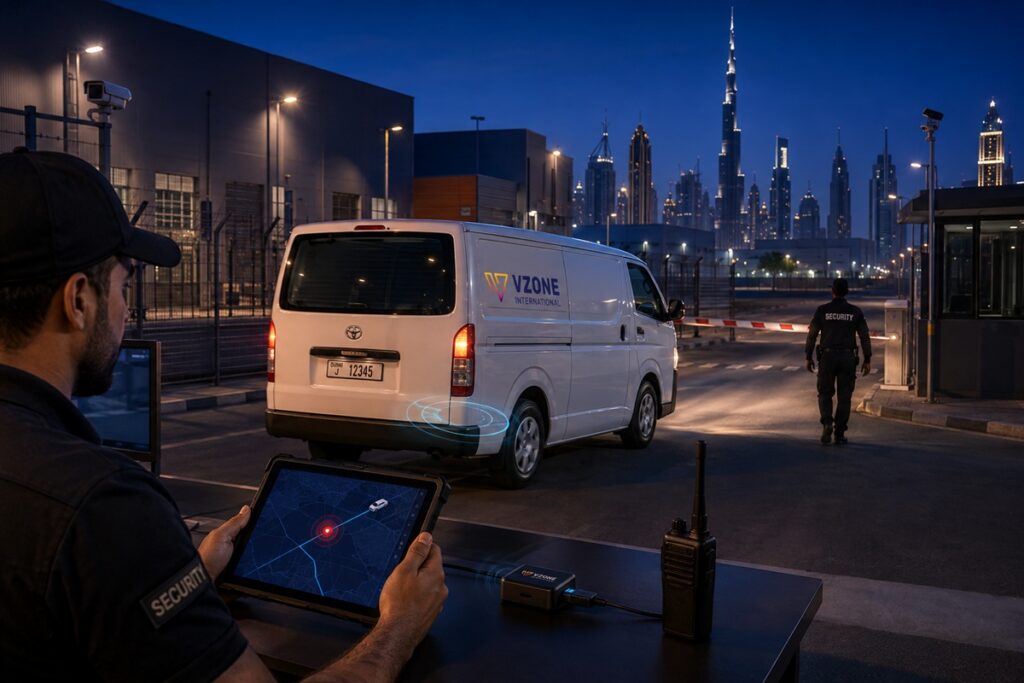
Vehicle theft is not a negligible risk for UAE commercial fleet operators. Construction equipment theft excavators, mobile cranes, compaction equipment represents one of the highest-value single-asset theft categories in the region, with individual equipment items worth AED 500,000 to AED 5,000,000 routinely stored on open construction sites with minimal physical security during night hours and weekends. Commercial truck theft, while less frequent than equipment theft, creates significant operational disruption for logistics and distribution operators whose vehicles are loaded with cargo as well as the truck itself. Even for lighter commercial vehicles delivery vans, service vehicles, corporate cars theft creates an immediate operational gap alongside the financial loss.
GPS tracking prevents vehicle theft not through a single mechanism but through four interacting effects: deterrence (reducing the probability of theft attempt), immediate detection (minimising the time between theft initiation and alert), real-time recovery support (enabling law enforcement to locate the vehicle while it is still accessible), and insurance cost management (reducing the financial consequence when theft does occur). This guide explains how each mechanism works in UAE conditions and what GPS tracking configuration choices maximise theft prevention effectiveness for different vehicle and asset categories.
Key Takeaways
- GPS tracking deters vehicle theft through the deterrence effect: thieves who know a vehicle is GPS-tracked assess the risk of rapid detection and recovery as too high for the reward, particularly for high-value commercial vehicles where the theft is commercially motivated and the expected resale requires time that GPS recovery support collapses.
- After-hours movement alerts a geofence exit event outside configured operating hours are the primary GPS theft detection mechanism for fleet vehicles stored at depot or construction site overnight. An alert firing within 2 to 5 minutes of vehicle departure gives fleet managers and law enforcement the intervention window that unmonitored theft does not provide.
- Tamper detection alerts generated when the GPS device is physically disturbed, disconnected from power, or removed from its mount closes the gap that sophisticated thieves attempt to exploit by locating and disabling the GPS device before moving the vehicle. VZone International’s Teltonika devices generate tamper alerts within seconds of physical interference.
- Recovery rates for GPS-tracked commercial vehicles in GCC are substantially higher than for untracked vehicles live position data enables Police rapid response teams to intercept the vehicle while it is still in transit to a storage or dismantling location, rather than conducting a retrospective search from the last-known location.
- GPS theft prevention integrates with fleet insurance: UAE commercial vehicle insurers recognise GPS tracking evidence as a theft risk reduction factor, offering lower theft excess and, in some cases, lower comprehensive premiums for fleets with active GPS monitoring particularly for high-value vehicles where the insurer’s exposure from a single theft claim is significant.
Section 1 How GPS Tracking Deters Vehicle Theft
Deterrence is the GPS theft prevention effect that is hardest to measure but most valuable in practice: if a potential thief does not attempt to steal a GPS-tracked vehicle because they assess the theft-to-recovery risk as too high, there is no theft event to record. The deterrence effect operates through two channels.
The visible deterrent channel applies when GPS tracking is known or visible a GPS tracking sticker on the vehicle window, a warning decal on the cab door, or industry knowledge that a particular fleet operator uses active GPS monitoring. For commercial vehicle thieves operating in UAE who target specific vehicle categories (refrigerated trucks for their cargo value, specific construction equipment models with known resale markets in neighbouring countries), the knowledge that a fleet uses GPS tracking changes the risk assessment. A theft that requires 48 to 72 hours to move a vehicle across a border before GPS recovery becomes difficult is a commercially unacceptable risk if the GPS alert fires within minutes and law enforcement response is active within the first hour.
The concealed deterrent channel applies when GPS tracking is installed but not disclosed to drivers or publicly visible. Even without a visible sticker, an after-hours alert that fires within minutes of vehicle departure creates a response timeline that makes commercially motivated theft significantly riskier. The thief who believes the vehicle is unmonitored plans for the overnight window before anyone notices it is missing; the same thief who correctly anticipates a GPS alert in the first 5 minutes faces a different risk calculation entirely.
Section 2 GPS Theft Detection Mechanisms for UAE Fleets
After-Hours Geofence Exit Alerts
The primary GPS theft detection mechanism for fleet vehicles is the after-hours geofence exit alert: a geofence defined around the vehicle’s overnight storage location (depot, construction site, equipment yard), with an alert rule that fires when any vehicle exits the geofence outside configured operating hours. For a fleet with operating hours of 6:00 AM to 8:00 PM, an after-hours exit alert fires any time a vehicle moves outside the geofence between 8:00 PM and 6:00 AM regardless of whether it is an authorised after-hours movement (rare and should require advance notification) or an unauthorised departure (the pattern of theft initiation).
The alert fires within 2 to 5 minutes of the geofence boundary being crossed, depending on the GPS update interval and cellular transmission time. This 2 to 5 minute window is the critical advantage over unmonitored theft: without GPS tracking, vehicle theft at a construction site at 2:00 AM may not be discovered until the site supervisor arrives at 6:00 AM a 4-hour head start during which the vehicle can travel 300 to 400 km. With GPS tracking and an immediate alert, the fleet manager has the vehicle’s live GPS position within 5 minutes of the theft beginning, law enforcement can be notified with current position data within the first 15 minutes, and interception is possible while the vehicle is still within UAE borders.
Tamper Detection When Thieves Try to Disable GPS
Sophisticated vehicle thieves particularly those targeting high-value construction equipment with known resale markets may attempt to locate and disable the GPS device before moving the vehicle, to prevent the position from being tracked during transit. GPS devices with tamper detection address this by generating an alert when: the device is physically moved from its mount (accelerometer-detected movement without vehicle ignition), the device’s power connection is interrupted (sudden loss of vehicle power to the device), or the device is physically opened or subjected to signal jamming attempts (some enterprise devices detect jamming signals and alert before the jamming succeeds).
Tamper alerts fire immediately within seconds of the physical interference giving the fleet manager and law enforcement notification that someone is attempting to disable the GPS device at the vehicle’s location, before the vehicle has moved. The GPS position at the time of the tamper alert is the vehicle’s current location, enabling a pre-emptive response rather than a post-movement search. VZone International configures tamper detection on all fleet deployments with high-value vehicle categories, with the alert routed to both the fleet manager and for pre-arranged high-value assets directly to a designated security response contact.
Movement Detection on Parked Vehicles
Movement detection without ignition detecting when a vehicle is being towed, pushed, or loaded onto a truck without the engine running is the GPS capability that addresses the theft method of moving a vehicle without starting its engine. Standard GPS tracking detects movement when the vehicle’s ignition is on (normal operation) or when the accelerometer detects movement while the device is in parking mode (vehicle stationary with ignition off). Heavy equipment that can be loaded onto a low-loader trailer and driven away without its own engine starting is the primary target for this detection mode.
Parking mode GPS monitoring where the device continues to monitor accelerometer data with reduced power consumption when the vehicle’s ignition is off fires a movement alert when the device detects significant motion while nominally parked. For a stationary excavator on a construction site, movement detected at 3:00 AM while the ignition is off is unambiguously anomalous the alert fires immediately, providing the current GPS position of the asset while it is still on or near the site.
GPS Jamming Detection
Signal jamming using a GPS jamming device to block the GPS device’s ability to acquire satellite signals and transmit position data is a theft countermeasure used by some sophisticated commercial vehicle thieves. Enterprise GPS tracking devices respond to jamming attempts in two ways: by detecting the characteristic radio frequency signature of GPS jamming signals and firing a jamming-detected alert before the jammer achieves full signal suppression; and by recording the last-known GPS position and cellular transmission before jamming begins, giving law enforcement a starting position for the search even if the live tracking is interrupted.
GPS jamming devices are illegal in UAE under Telecommunications Regulatory Authority (TRA) rules their use constitutes a criminal offence in addition to the vehicle theft itself. For fleet operators with high-value vehicles, the combination of jamming-detection alerts, last-known position recording, and an alternative GSM/LTE data transmission channel (some enterprise devices can continue cellular transmission even when GPS signal is jammed, transmitting the jamming detection alert and cell tower triangulation position estimate) provides multi-layer protection against jamming-assisted theft.
Section 3 GPS-Assisted Recovery for Stolen UAE Fleet Vehicles
When vehicle theft occurs despite deterrence and detection either because the theft was very rapid, the GPS alert was not acted on immediately, or the alert reached the fleet manager outside business hours GPS tracking enables real-time recovery support that untracked vehicle theft investigations cannot replicate.
Providing Live Position to UAE Police
The UAE Police rapid response capability for vehicle theft is most effective when it can respond to a live GPS position rather than a last-known location from hours ago. A fleet manager who contacts Dubai Police or Abu Dhabi Police vehicle theft unit with a live GPS URL showing the stolen vehicle’s real-time position, current speed, and direction of travel enables a targeted interception response rather than a broad area search. The time advantage from live GPS data is most significant in the first 30 to 90 minutes after theft: if the vehicle has not crossed UAE borders during this window, it is still within the jurisdiction where the GPS position is actionable for interception.
VZone International’s Wialon platform generates a shareable live tracking link for any vehicle a URL that shows the selected vehicle’s real-time GPS position to anyone with the link, without requiring the recipient to have a platform login. Fleet managers can share this link directly with the Police responding officer, enabling them to see the vehicle’s current position on their own device without requiring technical briefing on the fleet management system. The link updates in real time as the vehicle moves.
Cross-Border Alert Capability
UAE’s land borders with Oman and Saudi Arabia are GPS-accessible with appropriate device configuration a vehicle crossing into Oman from the Al Ain or Hatta border points or into Saudi Arabia from the Al Ghuwaifat crossing continues to transmit GPS position if the device has a SIM with GCC roaming data or a dual-SIM configuration with an Oman or Saudi SIM as secondary. For fleet operators with vehicle categories that represent cross-border theft risk (heavy construction equipment with active markets in Oman and Saudi Arabia; commercial trucks with identifiable cargo value), cross-border tracking capability is a specific configuration requirement VZone International manages dual-SIM configuration and GCC roaming setup for clients with high-value assets in border-proximity operations.
For Oman cross-border operations where VZone International already manages OPAL GPS compliance data submission, the same Teltonika device handles both cross-border compliance tracking and theft recovery tracking the OPAL compliance submission position data is also the live recovery position data in the event of theft on the UAE-Oman route.
Section 4 High-Value Vehicle Categories and Theft Risk in UAE
Vehicle / Asset Category | UAE Theft Risk Profile | GPS Theft Prevention Priority | Key GPS Configuration |
Heavy construction equipment (excavators, cranes, graders) | High high resale value; stored on open sites with minimal overnight security; cross-border market in Oman and KSA | Critical after-hours movement alert + tamper detection + parking mode movement + cross-border capability | Geofence site perimeter; parking mode accelerometer; dual-SIM for GCC roaming; tamper alert to security contact |
Refrigerated trucks | Medium-High cargo value (AED 50,000-200,000+) adds to vehicle value; targeted for both vehicle and cargo | High after-hours geofence + cold chain integration (cargo spoilage alert if refrigeration disabled) | Depot geofence after-hours; cargo temperature alert integration; engine immobiliser if available |
Commercial vans (delivery, service) | Medium opportunistic theft; high vehicle density makes individual loss less operationally critical | Standard depot geofence + ignition-on alert outside hours | After-hours ignition-on alert; depot geofence exit alert; standard tamper detection |
Corporate and executive vehicles | Medium high resale value; targeted for parts or whole-vehicle export | Standard geofence + ignition alert; optional engine immobiliser integration | Address geofence for overnight storage; ignition-on without driver ID alert |
Fuel tankers | High cargo has immediate black market value; vehicle itself is high-value | Critical fuel level monitoring (sudden tank drain = siphoning or cargo theft) + after-hours geofence | Fuel sensor integration; after-hours movement alert; route corridor for authorised routes only |
Specialised construction plant (generators, pumps, compressors) | High portable, high-value, easy to transport on flatbed; no ignition required to steal | Critical parking mode movement detection is primary mechanism (no ignition to detect) | Parking mode accelerometer sensitivity maximised; solar-powered GPS for remote sites without vehicle power; asset tag integration |
Section 5 GPS Theft Prevention and UAE Insurance
UAE commercial vehicle insurance for fleet operators recognises GPS tracking as a theft risk mitigation factor in two ways: underwriting premium reduction for GPS-monitored fleets (typically 5 to 15 percent reduction in the theft component of comprehensive premiums for vehicles with active GPS tracking), and claims process support (GPS position data at the time of theft provides objective evidence for the insurance claim that improves processing speed and reduces contested claim risk).
For high-value vehicle categories where the theft insurance exposure is significant construction equipment with replacement values of AED 500,000 to AED 5,000,000, specialist fleet vehicles with limited supply and long lead times insurance carriers increasingly require GPS monitoring as a condition of coverage at acceptable premium rates. A fleet operator who self-insures or accepts high excess levels for construction equipment because GPS monitoring is absent is absorbing theft risk that GPS monitoring would transfer to the insurer at a manageable premium cost.
The insurance premium calculation for GPS-monitored fleets should include: the theft component reduction from GPS monitoring evidence, the lower excess applicable to GPS-tracked vehicles in some policy structures, and the faster claims resolution that GPS position data enables (reducing the period of operational disruption from a stolen vehicle before settlement). VZone International generates the GPS monitoring evidence documentation active tracking history, tamper detection log, geofence configuration that insurance claims adjusters request when processing theft claims for GPS-tracked fleet vehicles.
Section 6 Configuring GPS for Maximum Theft Prevention
GPS tracking configured specifically for theft prevention requires four elements beyond standard fleet tracking configuration:
After-Hours Geofence Configuration
Define a geofence around each vehicle’s overnight storage location depot, construction site perimeter, equipment yard and configure an exit alert that fires outside the fleet’s operating hours. The geofence should be drawn precisely around the storage area rather than generically around the property: a geofence drawn too large may miss vehicles that are moved within the property boundary to a transport vehicle before leaving the geofence; a geofence drawn to match the actual storage area is crossed as soon as any unauthorised movement begins. Set the alert to notify the fleet manager immediately by mobile push notification and SMS after-hours alerts require immediate response capability, not daily-summary review.
Tamper Detection Activation
Activate tamper detection alerts on all high-value vehicles particularly construction equipment and fuel tankers where thieves may attempt to locate and disable the GPS device before moving the asset. Configure tamper alerts to a separate notification recipient (security manager or duty manager) in addition to the fleet manager, ensuring that a tamper event is responded to even if the fleet manager is unavailable. VZone International activates tamper detection as standard for all deployments with vehicle categories in the high-theft-risk categories identified in Section 4.
Parking Mode and Movement Detection
Enable parking mode on all equipment and vehicles stored in locations without continuous human supervision overnight. Parking mode keeps the GPS device’s accelerometer active while the vehicle is stationary with ignition off detecting movement of the asset without engine start, which is the primary theft method for construction equipment loaded onto transport vehicles. Configure parking mode sensitivity for the vehicle type: lower sensitivity (higher threshold g-force) for construction equipment in vibration-prone environments (adjacent to active machinery, on vibrating site surfaces); higher sensitivity for vehicles stored in calm depot environments where any movement is anomalous.
Engine Immobiliser Integration
GPS devices with engine immobiliser relay output can interrupt the vehicle’s ignition circuit remotely preventing the stolen vehicle from being started or continuing to run after the theft alert fires. Engine immobiliser integration via GPS is available on compatible vehicles and provides the most direct theft prevention capability: rather than alerting and waiting for Police response, the fleet manager can interrupt the vehicle’s engine from the fleet management platform, forcing it to stop in a location where it can be recovered. Engine immobiliser activation should be used with care activating the immobiliser while a vehicle is travelling at highway speed is dangerous; the appropriate protocol is to activate after confirming the vehicle is stopped or at very low speed in a safe location. VZone International configures immobiliser capability where the vehicle’s electrical system supports it, with the activation function reserved for fleet managers and subject to operating protocol documentation.
Protect Your UAE Fleet From Vehicle Theft VZone International GPS Anti-Theft Configuration
VZone International configures GPS tracking specifically for theft prevention across all UAE commercial vehicle and equipment categories after-hours geofence alerts, tamper detection, parking mode movement monitoring, engine immobiliser integration, and live recovery tracking. Contact our team for a theft prevention configuration assessment for your fleet.
Frequently Asked Questions
GPS tracking enables stolen vehicle recovery in UAE by providing the live position data that law enforcement needs to locate and intercept the vehicle while it is still accessible. When a theft alert fires from an after-hours geofence exit, tamper detection, or movement-without-ignition event the fleet manager has the vehicle's current GPS coordinates within minutes. This position can be shared directly with UAE Police as a live tracking link, enabling the responding officer to see the vehicle's real-time position on their own device without requiring technical system access. Recovery rates for GPS-tracked commercial vehicles in GCC are substantially higher than for untracked vehicles because the Police response is directed by live position data rather than a retrospective area search from the last-known location hours later.
GPS tracking is the most effective anti-theft technology for UAE construction equipment because most equipment theft occurs at night on unmanned sites exactly the scenario where after-hours geofence exit alerts, parking mode movement detection, and tamper detection provide the earliest possible warning. A site geofence around a construction site perimeter fires an alert the moment an excavator or crane is moved outside the boundary, giving the fleet manager and security response team the current position while the equipment is still on or near the site. For equipment that is stolen onto a transport vehicle without its own ignition being started, parking mode accelerometer detection fires the alert when the equipment moves even before the transport vehicle has left the site. VZone International deploys GPS tracking on construction equipment for UAE clients with site-perimeter geofences, parking mode movement detection, and tamper alerts as the standard anti-theft configuration for the sector.
Yes for theft component premiums specifically. UAE commercial vehicle insurers recognise active GPS tracking as a theft risk mitigation factor, reflecting the higher recovery rates and lower net claim costs for GPS-tracked vehicles. The typical reduction in the theft-related component of comprehensive premiums for GPS-monitored fleets is 5 to 15 percent, with larger reductions available for high-value vehicles where GPS monitoring significantly changes the theft risk profile. For construction equipment and specialist vehicles where the theft insurance exposure is very high, some UAE insurers make GPS monitoring a coverage condition rather than a premium reduction factor meaning coverage at standard rates requires GPS tracking to be active. VZone International provides the GPS monitoring documentation that insurers request: active tracking confirmation, geofence configuration records, alert history, and tamper detection evidence.
Enterprise GPS tracking devices generate tamper alerts when interference is detected typically within seconds of physical interference with the device, power disconnection, or jamming signal detection. The tamper alert fires before the thief has successfully disabled the device, giving the fleet manager and law enforcement a notification that interference is occurring at the vehicle's current location enabling a pre-emptive response rather than a post-movement search. VZone International's Teltonika devices include physical tamper detection (accelerometer-detected device movement), power interruption detection (alert on sudden loss of vehicle power), and on compatible models, jamming signal detection (alert when GPS jamming radio frequency is detected near the device). Devices are installed in concealed locations to reduce the probability of discovery and interference reducing the tamper scenario risk before it arises.