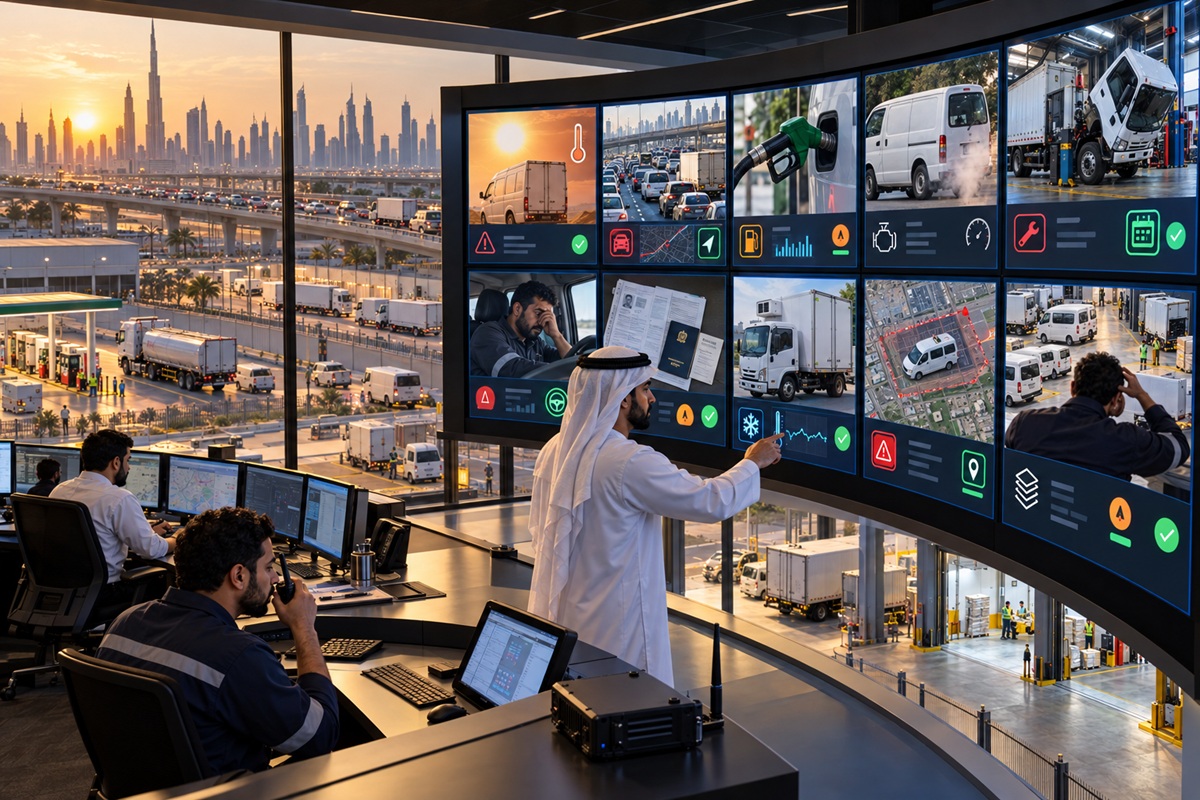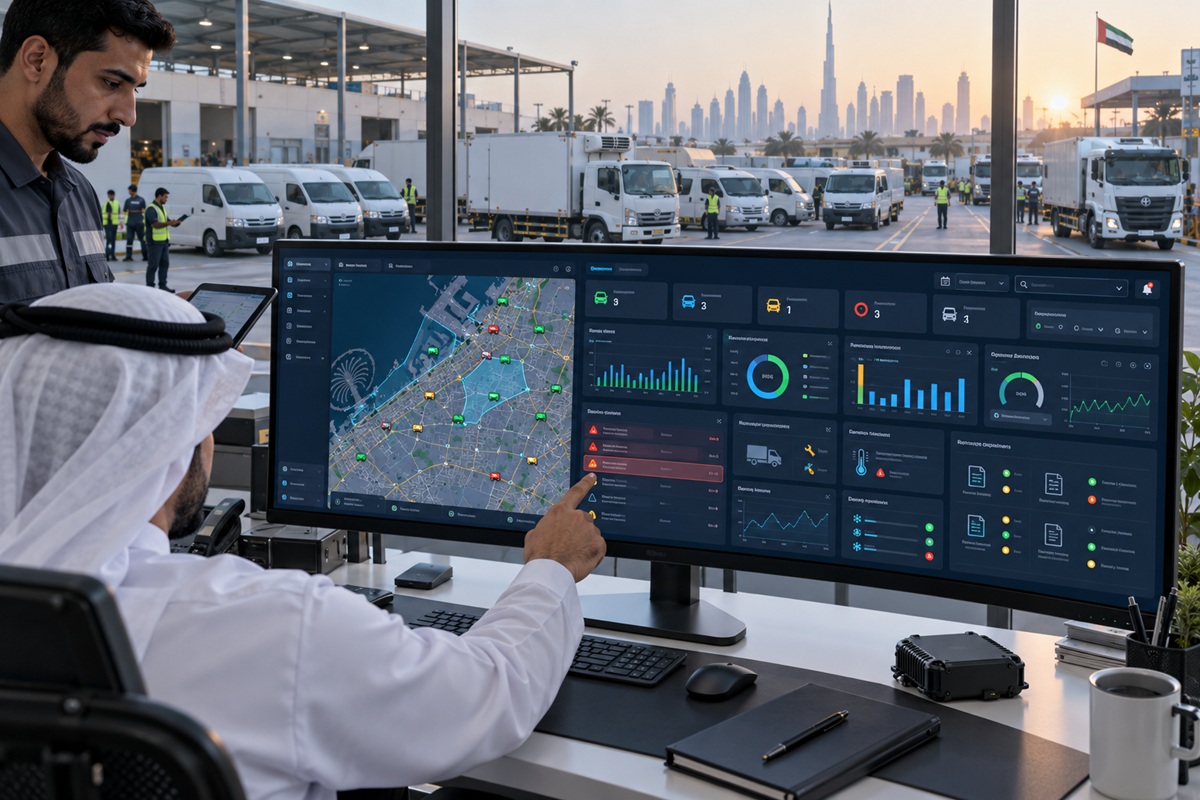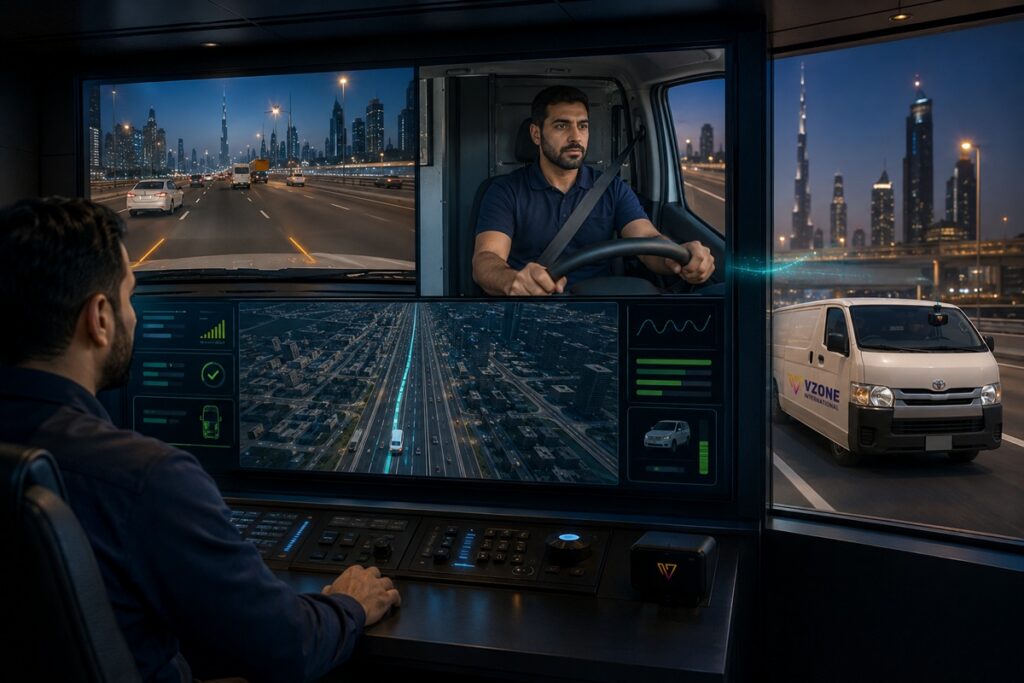
When a fleet manager opens their monitoring platform and clicks on Vehicle 23 to see a live video feed of exactly what the driver is doing right now the road ahead, the driver’s face, the cargo area that capability is live streaming dashcam monitoring. It is fundamentally different from event-based AI dashcam recording, which captures and stores footage triggered by detected behaviours or incidents. Live streaming provides continuous or on-demand video visibility regardless of whether any alert event has occurred.
The distinction matters operationally because live streaming and event-based recording serve different management purposes and have substantially different data consumption profiles, infrastructure requirements, and privacy implications. Understanding when live streaming adds genuine value over event-based recording and when it does not is the starting point for any UAE fleet operator evaluating dashcam investment decisions.
This guide explains how live streaming dashcam monitoring works technically, when it is the appropriate choice over event-based AI recording, what data costs and infrastructure requirements it creates for UAE fleet deployments, the privacy and consent considerations relevant to UAE employment law, and which fleet types and operational scenarios benefit most from live monitoring capability.
Key Takeaways
- Live streaming dashcams transmit continuous or on-demand video from vehicle cameras to a remote platform over 4G cellular providing operations managers with a real-time view into any vehicle at any time, without needing an alert event to trigger footage capture.
- Event-based AI recording which captures footage triggered by detected driver behaviour events or impacts is the more appropriate choice for systematic driver safety management because it provides structured, searchable event data that coaching programmes can act on. Live streaming provides operational visibility, not systematic behaviour data.
- Data consumption is the primary operational constraint on live streaming deployments: continuous 1080p live streaming consumes 3 to 6 GB per vehicle per hour making fleet-wide continuous streaming impractical on standard data plans, and pointing to targeted deployment on specific vehicles or on-demand activation as the operationally appropriate model.
- UAE fleet live streaming use cases are concentrated in three categories: remote driver welfare monitoring (long-haul desert routes where a driver check-in confirms wellbeing without requiring a stop), high-value cargo security (ability to verify cargo area visually during transit), and incident verification (activating live view immediately after a reported incident to assess the situation before dispatching a response).
- Driver privacy and consent requirements under UAE employment law apply to dashcam monitoring including live streaming. Employees must be informed that vehicle cameras may be monitored remotely, and monitoring must be proportionate to the operational purpose. Driver-facing cameras used for welfare monitoring create different consent considerations than forward-facing cargo security cameras.
What Is Live Streaming for Fleet Dashcams?
Live streaming in fleet dashcam systems is the capability to transmit video from one or more vehicle-mounted cameras to a remote monitoring platform in real time over a cellular data connection allowing an operations manager, supervisor, or control room operator to view a live video feed from any equipped vehicle on demand, regardless of whether any alert event has occurred in that vehicle.
The technology uses the same 4G LTE cellular connection that the vehicle’s GPS telematics device uses for data transmission, with video encoded at a configurable resolution and bitrate and streamed to the cloud platform using standard video streaming protocols (RTSP, WebRTC, or HLS depending on the platform implementation). The platform receives the video stream and makes it accessible through a web dashboard or mobile app interface where the operator can select any vehicle and open a live view window showing the current camera feed.
Live streaming can be configured in several operational modes depending on the fleet’s requirements and data budget: always-on streaming (continuous transmission from selected vehicles at all times), on-demand streaming (transmission activated by an operator opening the live view in the dashboard), event-triggered live view (live feed activates automatically when a defined event occurs panic button press, harsh event, geofence exit), and scheduled streaming (live view active during defined time windows for example, during school run periods for school bus monitoring).
Live Streaming vs Event-Based AI Recording When to Use Which
The most important evaluation decision in fleet dashcam deployment is not which specific camera hardware to purchase but which recording and transmission architecture to deploy and live streaming and event-based AI recording serve fundamentally different operational purposes that determine which is appropriate for a given fleet use case.
| Dimension | Live Streaming Dashcam | Event-Based AI Recording |
| What triggers recording/transmission | Continuous or on-demand no event required | AI-detected behaviour event (fatigue, distraction, harsh event, impact) |
| Data consumption | 3–6 GB/vehicle/hour at 1080p very high | 200–500 MB/vehicle/day manageable on standard data plan |
| Operational purpose | Real-time visibility and oversight ‘what is happening now’ | Systematic behaviour detection and coaching ‘what has been happening over time’ |
| Driver coaching value | Low live view provides no structured event data for coaching | High event frequency reports drive specific, evidence-based coaching conversations |
| Incident response use | High activate live view immediately after reported incident | Medium review tagged event clip after alert notification |
| Remote welfare check | High confirm driver condition visually without requiring stop | Low no on-demand view capability without event trigger |
| Privacy sensitivity | High continuous monitoring creates significant privacy implications | Lower recording only when specific behaviours detected |
| Infrastructure requirement | High data plan + reliable 4G coverage + streaming server capacity | Standard telematics data plan; event clips upload asynchronously |
| Alert fatigue risk | High if always-on operators cannot watch continuous feeds from large fleets | Low alerts fire only on detected events, not continuously |
| Best fleet application | Remote single-vehicle or small-fleet oversight; high-risk cargo; welfare checks | Large fleet systematic safety management; driver coaching programmes |
For most UAE commercial fleet deployments, event-based AI recording is the primary dashcam architecture providing the systematic driver safety data that coaching programmes, insurance submissions, and ADNOC IVMS fatigue monitoring require. Live streaming is a supplementary capability that adds value in specific operational contexts where on-demand visibility has a defined purpose not a replacement for event-based recording and not an appropriate primary architecture for fleet-wide driver safety management.
How Live Streaming Dashcams Work Technically
Camera Hardware and Cellular Transmission
Live streaming dashcam hardware for fleet vehicles consists of one or more cameras with onboard video encoders that compress the video feed to a streaming-appropriate bitrate and transmit over the vehicle’s 4G cellular connection. Enterprise-grade live streaming cameras for fleet use typically support configurable resolution and bitrate higher resolution (1080p at 2 to 4 Mbps) for detailed driver or cargo visibility, lower resolution (480p at 0.5 to 1 Mbps) for continuous background streaming where bandwidth conservation is a priority.
The transmission protocol determines the streaming latency and compatibility with different platform architectures. RTSP (Real Time Streaming Protocol) is the most common protocol for vehicle-to-platform streaming, providing low latency (typically 1 to 3 seconds) suitable for real-time monitoring. WebRTC is increasingly used for browser-based live view applications where end-to-end encrypted peer-to-peer streaming through the cloud platform is preferred. HLS (HTTP Live Streaming) is used for recorded-live hybrid implementations where a rolling buffer of the live stream is retained for post-event review.
4G Connectivity Requirements for UAE Fleet Streaming
Live streaming quality in UAE fleet deployments is directly dependent on 4G cellular signal strength and consistency. At 1080p streaming, the camera requires a sustained 2 to 4 Mbps uplink a requirement that UAE’s urban cellular networks (Dubai, Abu Dhabi, Sharjah) generally satisfy on Etisalat and du networks during normal operating hours. On highway routes in the UAE Western Region, remote desert areas, and the UAE-Oman border corridor, cellular coverage becomes intermittent and streaming will buffer or drop when signal falls below 1 Mbps sustained uplink.
UAE fleet operators deploying live streaming on vehicles that operate on remote routes should expect intermittent streaming quality on those route segments and configure their monitoring workflow accordingly using live streaming for urban and highway sections where coverage is reliable, and accepting connectivity-dependent streaming quality on remote segments. The event-based AI recording architecture is more resilient to connectivity variation because it stores events locally and uploads clips when connectivity is restored, while live streaming requires continuous connectivity to function.
Data Consumption and Cost Management
Data consumption is the primary operational and financial constraint on live streaming deployments. At 1080p (2 Mbps), a vehicle streaming continuously for a 10-hour operating day consumes approximately 9 GB of cellular data. At 480p (0.5 Mbps), the same 10-hour day consumes approximately 2.25 GB. For a 30-vehicle fleet with continuous 1080p streaming, the daily data consumption is 270 GB an amount that exceeds most commercial data plan allocations and adds AED 3,000 to AED 8,000 per day in excess data charges at standard UAE cellular rates.
Practical data cost management for UAE fleet live streaming typically involves one of three approaches: on-demand-only streaming (live view is activated by operator action for specific vehicles, not streaming continuously from all vehicles limiting data consumption to the specific check-in or incident verification sessions that require live view); event-triggered short-clip streaming (live feed activates for 60 to 120 seconds when a defined event occurs, providing a brief situational window without continuous data consumption); or dedicated IoT data plan with unlimited or high-cap data allocation for specifically designated live streaming vehicles appropriate for high-value cargo or specialist monitoring applications where the operational value justifies the data cost.
UAE Fleet Use Cases Where Live Streaming Adds Genuine Value
Live streaming dashcam capability adds operational value in specific UAE fleet contexts where on-demand real-time visibility has a defined purpose that event-based recording cannot serve. The following use cases represent the highest-value live streaming applications in the UAE market.
Remote Driver Welfare Monitoring Long-Haul Desert Routes
UAE long-haul drivers operating the Abu Dhabi–Riyadh highway, the Western Region oilfield supply routes, and the Dubai–Muscat corridor can be 200 to 600 km from their depot with limited roadside support infrastructure. A driver who has a medical episode, vehicle breakdown, or welfare concern in these remote segments faces a significant response time challenge and the standard check-in call that many operations use for remote route welfare management is easily answered by a driver who is in distress but functional enough to make the call.
Live streaming welfare checks provide visual confirmation of driver condition without requiring the driver to stop or make a call. An operations supervisor who can activate a 60-second live view from Vehicle 31 and see that the driver is alert, in normal operating posture, and progressing along the route as expected has performed a welfare check in 60 seconds that provides substantially more assurance than a phone call that took 3 minutes and interrupted the driver’s concentration. For ADNOC contractor fleet operators whose HSE programmes include remote worker welfare monitoring requirements, live streaming welfare checks provide documented evidence of the welfare monitoring that HSE management systems require.
High-Value Cargo Security Verification
Pharmaceutical distribution vehicles carrying high-value medicine shipments, cash-in-transit vehicles, and luxury goods transport operations use live streaming cargo area cameras to enable remote security verification during transit. An operations manager who can activate a live view of the cargo compartment in a pharmaceutical vehicle that has been stationary at a delivery stop for longer than expected can confirm whether the extended stop is a loading dock queue (cargo intact and vehicle secure) or a security concern (cargo area accessed, vehicle condition abnormal) without dispatching a security response that may be unnecessary.
The use of live streaming for cargo security monitoring creates specific data governance requirements: the cargo area footage captures the delivery recipient’s premises and personnel, creating potential third-party privacy implications that the fleet operator should address in their data handling policy. Camera angle and activation policy should be documented to confirm that cargo area monitoring is proportionate to the security purpose and does not capture unnecessary personal data of third parties at delivery locations.
Incident Verification and Emergency Response
When a driver activates a panic button or when a high-severity harsh event alert fires, live streaming enables the operations centre to immediately assess the situation before deciding on a response. An operations manager who can open a live view of the vehicle within 30 seconds of a panic button press can see whether the situation requires emergency services dispatch, security response, or a reassuring check-in call providing the situational context that makes the response proportionate and timely rather than defaulting to maximum response for every alert regardless of actual severity.
For fleet operators with SIRA-licensed security patrol vehicles where every patrol incident response requires documentation live streaming incident footage provides contemporaneous visual evidence of the situation at the time of the response, supplementing the event-tagged AI recording that covers the period before the incident and the GPS route record that confirms vehicle location throughout.
School Bus Route Monitoring
School bus live streaming enables the monitoring of student welfare during routes parents and school administrators can request live view access from specific route buses to verify student conduct and driver behaviour in real time. Dubai RTA’s school transport regulations and MOE safety standards create an increasing expectation for accountability mechanisms that go beyond GPS route compliance to include in-vehicle monitoring. Live streaming school bus cameras provide the transparency layer that satisfies parent and school administrator expectations for visibility into the journey their students are experiencing.
For school bus operators, the data governance requirements of live streaming to parents or school administrators who are third parties outside the operator’s employment relationship require specific consent and access control frameworks. Live view access should be controlled by driver-specific session tokens that expire after the route period, preventing unrestricted historical access to footage that may capture children’s personal data beyond the proportionate monitoring purpose.
Privacy, Consent, and Legal Considerations for UAE Fleet Live Streaming
Live streaming driver-facing cameras creates more significant privacy implications than event-based recording because it enables continuous monitoring rather than recording only when specific behaviours are detected. UAE employers deploying live streaming dashcam monitoring must address the following considerations to ensure compliance with UAE employment law and the UAE Personal Data Protection Law (PDPL).
Employee Notice and Consent
UAE employment law requires that employees be informed when they are subject to monitoring in the workplace including vehicle monitoring. Fleet operators deploying live streaming dashcams must notify drivers through written employment contract clauses, fleet policy documents, or specific camera monitoring notices that vehicle cameras may be monitored remotely during operating hours. The notice should specify the types of cameras deployed (forward-facing, driver-facing, cargo area), the circumstances under which live monitoring may be activated (welfare checks, incident response, supervisory oversight), and the data retention period for any footage that is recorded during live monitoring sessions.
Consent for driver-facing camera monitoring is a more sensitive requirement than for forward-facing road cameras. UAE employment law does not require employee consent for monitoring conducted for legitimate business purposes with proper notice but the notice must be clear about what is being monitored and why. Driver-facing live streaming monitoring for welfare and safety purposes, clearly communicated in writing before deployment, satisfies the notice requirement under UAE employment law.
Data Retention and Access Control
Any video footage recorded during live streaming sessions must be subject to defined retention periods and access control policies consistent with the UAE PDPL’s proportionality principle: data should be retained for no longer than necessary for the stated purpose and should be accessible only to persons with a legitimate need. Live streaming footage captured during a welfare check that confirms normal driver condition should not be retained unless the check revealed an anomaly requiring investigation. Incident footage should be retained for the period required to resolve any insurance, legal, or disciplinary proceedings arising from the incident.
Access control for live streaming platforms should restrict live view capability to defined roles operations supervisors, safety managers, and fleet managers rather than providing open access to all platform users. Audit logs recording who activated live view for which vehicle and at what time provide the accountability evidence that demonstrates monitoring was conducted for legitimate operational purposes rather than excessive surveillance.
VZone International’s Live Streaming Dashcam Capability
VZone International’s video telematics platform supports live streaming from equipped vehicles on demand operations managers can activate a live view of any streaming-capable vehicle from the Wialon dashboard, receiving a real-time video feed within 5 to 10 seconds of activation on 4G cellular. Live streaming is available as a supplementary capability alongside VZone’s primary AI event-based recording deployment enabling fleet operators to use AI detection for systematic driver safety management while maintaining on-demand live view for the specific use cases where real-time visual verification adds operational value.
On-Demand Live View with Data Management
VZone configures live streaming as an on-demand activation rather than continuous streaming for most UAE fleet deployments limiting data consumption to the specific monitoring sessions that require live visual verification rather than streaming continuously from all vehicles. Data usage reporting by vehicle shows monthly live streaming data consumption per vehicle, enabling fleet managers to track whether live view activation is proportionate to operational need and manage the data plan accordingly. For vehicles deployed in high-value cargo or welfare monitoring roles where continuous streaming is operationally justified, VZone supports dedicated high-data-cap SIM configuration for those specific vehicles.
Integration with AI Event Recording
VZone’s live streaming capability integrates with the AI event recording system so that fleet managers can switch between live view and historical event clip review for the same vehicle on the same platform interface. When a panic button alert fires or a high-severity AI event is detected, the platform can simultaneously display the AI event clip (showing the 30-second period leading up to the event) and offer live view activation (showing the current situation after the event) giving the operations manager both the historical context and the current situation in a single response interface without platform switching.
Conclusion: Live Streaming Is a Targeted Tool, Not a Fleet-Wide Architecture
Live streaming dashcam capability is a genuinely valuable fleet monitoring tool for the specific use cases where on-demand real-time visual access has a defined operational purpose. Remote driver welfare checks on UAE desert highways, high-value cargo security verification during transit, incident situational assessment after a panic button press, and school bus transparency for parents and administrators are all operational contexts where live streaming provides capability that event-based recording cannot.
The data consumption reality of live streaming 3 to 9 GB per vehicle per day at operational resolutions means that fleet-wide continuous live streaming is neither practically manageable nor operationally necessary for most UAE fleet profiles. The data is consumed whether or not anything operationally meaningful is happening in the vehicle, and the operations team watching 30 continuous video feeds simultaneously cannot realistically monitor them all. On-demand activation for specific vehicles in defined circumstances is the operationally appropriate live streaming model for most UAE fleet deployments.
Event-based AI recording remains the primary dashcam architecture for systematic fleet safety management providing the structured event data that driver coaching, insurance premium negotiation, and ADNOC fatigue monitoring compliance require. Live streaming supplements this capability rather than replacing it, and the fleet operators who deploy both in their appropriate roles get the full operational benefit of video telematics: systematic safety data from AI recording and real-time situational awareness from live streaming, without paying the data cost of streaming everything continuously.
Add live streaming to your fleet’s AI dashcam deployment where it actually matters.
VZone International’s video telematics platform supports on-demand live streaming from equipped vehicles alongside AI event recording giving fleet managers real-time visual access for welfare checks, incident verification, and cargo security monitoring without continuous data consumption. Contact our team to discuss the right live streaming configuration for your fleet’s specific use cases.
Frequently Asked Questions
Live streaming for fleet dashcams is the capability to transmit continuous or on-demand video from vehicle-mounted cameras to a remote monitoring platform over 4G cellular, enabling operations managers to view a real-time video feed from any equipped vehicle at any time without needing a detected event to trigger footage capture. It differs from event-based AI recording which captures footage when specific driver behaviours are detected by providing on-demand visibility regardless of whether any alert event has occurred. Live streaming is most valuable for remote driver welfare checks, high-value cargo monitoring, and incident verification; event-based AI recording is more appropriate for systematic driver safety management and coaching programmes.
Live fleet dashcam streaming data consumption depends on video resolution and bitrate. At 1080p (2 Mbps uplink), streaming for one hour consumes approximately 900 MB per camera. At 480p (0.5 Mbps), the same hour consumes approximately 225 MB. For continuous 1080p streaming across a 10-hour operating day, a single vehicle consumes approximately 9 GB making fleet-wide continuous streaming impractical on standard data plans. Most UAE fleet deployments use on-demand streaming (activated by operator for specific sessions) or event-triggered streaming (short clips on alert events) to manage data consumption within practical limits. VZone configures live streaming on an on-demand basis for most UAE clients, with dedicated high-data SIMs for vehicles requiring sustained streaming capability.
For systematic driver safety management, AI event recording is more appropriate than live streaming because it provides structured, searchable event data fatigue events, distraction events, harsh behaviour events that coaching programmes can act on systematically. Live streaming provides real-time visual access but no structured event data, requires continuous operator attention to identify safety concerns, and cannot generate the AI event frequency reports that driver coaching, insurance submissions, and ADNOC IVMS fatigue monitoring require. Live streaming adds value as a supplementary capability for specific use cases welfare checks, incident verification, cargo security while AI event recording is the primary architecture for fleet safety management.
No UAE employment law requires that employees are informed when they are subject to workplace monitoring, including vehicle camera monitoring. Fleet operators must notify drivers through employment contract clauses, fleet policy documents, or specific camera monitoring notices that vehicle cameras may be monitored remotely, specifying what is monitored (forward-facing road, driver-facing, cargo area), under what circumstances live monitoring may be activated (welfare checks, incident response, supervisory oversight), and data retention periods. Covert monitoring of drivers using live streaming cameras without proper notice does not satisfy UAE employment law requirements and creates legal exposure for the fleet operator.