For parents in the UAE, a school bus that operates without GPS tracking and parent notifications is a daily source of uncertainty not knowing whether the bus has arrived, whether their child has boarded safely, or whether the vehicle is running on time in Dubai’s unpredictable morning traffic. For school transport operators, the same bus without certified GPS tracking is a compliance liability and a customer satisfaction risk in a market where parent expectations for transparency have risen substantially.
smart school bus tracking system address both problems simultaneously. They provide parents with real-time visibility automated notifications when the bus is approaching, when their child boards, and when their child safely alights while giving school administrators complete fleet visibility, route adherence monitoring, driver behaviour data, and the attendance records that feed into daily student safety management. The same platform that satisfies UAE Ministry of Education and RTA compliance requirements also delivers the parent experience that distinguishes competitive school transport programmes in the UAE’s international school market.
This guide explains how smart school bus tracking works technically, what the UAE regulatory requirements actually specify, what parent notification features look like in practice, and what school transport operators need in a fleet management platform to run a safe, efficient, and compliant school bus operation.
Key Takeaways
- GPS tracking is legally mandatory for school buses in UAE required under the Ministry of Education transport standards and enforced by the RTA in Dubai and the ITC in Abu Dhabi.
- Smart school bus systems combine GPS vehicle tracking with RFID student boarding technology, creating a two-layer record: where the bus is and which students are on it simultaneously.
- Parent notification is a core feature of UAE school bus systems, not an optional add-on parents receive automated alerts for bus approach, child boarding, child alighting, and route deviations.
- Driver behaviour monitoring on school buses carries additional weight compared to commercial fleet monitoring: the duty of care for child passengers makes aggressive driving, speeding, and distraction events subject to heightened scrutiny from school administration and parents.
- School transport operators who provide transparent GPS and boarding data to parents consistently report higher contract renewal rates and fewer parent complaints than those relying on manual attendance recording and reactive communication.
- RTA Dubai and ITC Abu Dhabi have separate school bus GPS requirements operators running routes across both emirates need provider solutions certified under both programmes.
What Is a Smart School Bus Tracking System?
A smart school bus tracking system is a purpose-built fleet management platform that combines GPS vehicle tracking with student-specific features RFID boarding detection, parent notification, route management, and attendance recording in a single integrated solution. It is distinct from standard commercial fleet GPS in that its primary output is not operational efficiency data for fleet managers alone but safety confirmation data for three distinct stakeholder groups simultaneously: parents, school administrators, and the transport operator.
The ‘smart’ designation reflects the integration of multiple data layers: the GPS device tracks the bus location and the driver’s behaviour; the RFID reader at the bus door records each student’s boarding and alighting event; the parent notification module connects student-level boarding data to the parent’s mobile phone; and the platform’s reporting layer aggregates all of this into attendance logs, route compliance records, and driver performance data that school administrators use for both operational management and regulatory documentation.
GPS Vehicle Tracking + RFID Student Boarding System
The GPS component of a smart school bus system is conceptually identical to commercial fleet tracking: a GPS telematics device installed in the bus transmits real-time location, speed, and route data to the cloud platform at 10 to 30-second intervals. What differentiates the school bus application is the RFID boarding detection layer added on top of the GPS foundation.
Each student is assigned an RFID card a contactless card similar to a transport card which they tap on a reader mounted at the bus entrance as they board and exit. The reader logs the tap event with a timestamp, the student’s identity, and the bus’s GPS-confirmed location at that moment. This creates an unambiguous electronic record of which student boarded which bus at which stop and at what time the attendance data that replaces manual headcounts and paper registers, and the boarding confirmation that triggers the automated parent notification.
The practical value extends beyond parent peace of mind. RFID boarding logs create an authoritative attendance record that resolves disputes about whether a student was on a bus on a particular day relevant in safeguarding investigations, insurance events, and parent complaints about missed stops. The electronic record is substantially more reliable than a driver’s recollection or a paper register that may have been completed retrospectively.
How Smart School Bus Systems Differ from Basic Fleet GPS
A basic fleet GPS tracker installed on a school bus satisfies the vehicle location tracking component of regulatory requirements but provides none of the student safety features that make a smart school bus system operationally useful. It cannot confirm which students are on the bus, cannot send boarding notifications to parents, cannot generate per-student attendance logs, and does not provide the parent-facing visibility that UAE schools increasingly specify in transport contract requirements.
| Capability | Basic GPS Tracker | Smart School Bus System |
| Real-time bus location for school admin | Yes | Yes |
| Driver behaviour monitoring (speed, braking) | Yes | Yes with enhanced school context alerts |
| Route deviation alerts | Yes to admin | Yes to admin AND parents instantly |
| RFID student boarding confirmation | No | Yes each boarding/alighting recorded |
| Automated parent boarding notification | No | Yes push app / SMS / WhatsApp |
| Automated parent arrival-at-stop notification | No | Yes ETA alert 5–10 min before arrival |
| Per-student attendance log generation | No | Yes daily, exportable for school records |
| Student-level alighting confirmation | No | Yes notifies parent when child exits bus |
| Missed boarding alert (absent student) | No | Yes alerts admin if expected student doesn’t board |
| RTA / MOE compliance documentation | Partial | Yes full certified compliance records |
How Parent Notification Works in UAE School Bus Systems
Parent notification is the feature that most directly shapes the parent experience of school transport and in the UAE’s competitive international school market, where parents pay significant transport fees and hold high service expectations, the quality of that experience directly affects school contract renewals and parent satisfaction surveys. Understanding exactly how notification works helps both school administrators evaluating systems and parents understanding what to expect.
RFID Card or Mobile App How Students Are Tracked
Student identification in smart school bus systems uses one of two methods, or a combination of both. RFID physical cards similar to the Nol card used on Dubai’s public transport are the most widely deployed method in UAE school transport: low cost per student, no smartphone requirement, durable and replaceable. Students tap their card on the bus reader as they board and exit; the system records the event instantly.
Mobile app-based student identification is an alternative increasingly used in schools with older student cohorts secondary school students carry their own smartphones and can use a parent-linked app to confirm their boarding status. Some systems combine both methods: a physical RFID card for primary students, app-based confirmation for secondary students. The choice of identification method does not affect the parent notification capability both methods trigger the same automated notification sequence.
Automated WhatsApp and App Notifications What Parents Receive
In the UAE context, where WhatsApp is the dominant communication channel for school-parent communication, smart school bus systems that integrate WhatsApp Business API notifications alongside mobile app push notifications achieve substantially higher parent engagement than those relying on push notifications alone. Parents who already receive all school communications via WhatsApp do not need to download a separate app to receive bus notifications the boarding confirmation arrives in the same channel as the school newsletter and homework reminders.
The notification sequence for a standard UAE school bus route delivers four automated messages to each parent. In the morning: a bus-approaching-stop notification (typically 5 to 10 minutes before arrival, calculated from GPS position and real-time traffic data) and a boarding confirmation when the child’s RFID card is tapped. In the afternoon: an arriving-at-school notification when the bus reaches the school gate, and an alighting confirmation when the child taps off the bus at their home stop. Each notification includes the bus name or number, the timestamp, and the GPS location of the event.
| Trigger Event | Notification Type | Recipient | Timing | Content Included |
| Bus approaching child’s stop | Push notification + WhatsApp | Parent | 5–10 min before arrival | Bus name, ETA, live map link |
| Child boards bus (RFID tap) | Boarding confirmation | Parent | Instantly | Child name, bus, timestamp, location |
| Child alights bus (RFID tap) | Alighting confirmation | Parent | Instantly | Child name, bus, stop location, timestamp |
| Route deviation detected | Alert notification | Parent + school admin | Instantly | Current location, deviation details |
| Bus speeding event | Safety alert | School admin + transport manager | Instantly | Speed, location, driver identity |
| Expected student does not board | Absence alert | School admin + parent | After bus departs stop | Student name, stop, timestamp |
| Bus arrives at school gate | Arrival confirmation | School admin + transport manager | Automatically | Bus name, arrival time, GPS confirmation |
| Bus delayed beyond schedule | Delay notification | Parent + admin | At threshold (e.g. 10 min late) | Estimated revised arrival time |
Route Deviation Alerts When the Bus Goes Off-Route
Route deviation alerts are one of the most safety-critical features in a school bus GPS system. A bus that deviates from its planned route whether due to a driver taking an unauthorised shortcut, a vehicle breakdown requiring a route change, or in the most serious cases, an unauthorised stop or diversion triggers an immediate alert to both the school transport administrator and the parents of all students on that bus. The GPS confirmation of where the bus is at the moment of deviation, combined with the planned route overlay, gives administrators immediately actionable information.
In practice, the majority of route deviation alerts in UAE school bus operations have benign explanations: traffic diversions around accidents or construction, emergency vehicle avoidance, or driver decision-making at roadworks. But the alert mechanism ensures that any deviation is immediately visible to school management rather than discovered retrospectively, and it creates the accountability framework that prevents the small proportion of cases where deviation is not benign from going undetected.
School Bus Fleet Management The Operator View
While parent notification is the most visible feature of smart school bus systems from a customer perspective, the operator view the fleet management dashboard used by transport managers, school administrators, and route coordinators is where the operational efficiency and compliance documentation value is generated.
Route Planning and Optimisation for School Runs
School bus route planning is a complex optimisation problem: maximising the number of students served by each bus while minimising total route time and distance, respecting the scheduling constraints of different school start and end times, and accommodating the geographic distribution of student home locations across Dubai’s or Abu Dhabi’s suburban residential spread. Manual route planning rarely produces optimal solutions experienced route planners using spreadsheets typically achieve routes that are 15 to 25 percent longer than algorithm-optimised routes covering the same student stops.
GPS fleet platforms with built-in route optimisation tools enable transport managers to recalculate routes automatically when new students enrol, when students change addresses, or when traffic pattern changes affect optimal routing. Route optimisation at the start of each academic year or at mid-year when new students join consistently reduces total fleet mileage, fuel costs, and driver overtime compared to manually planned routes carried over from the previous year.
Driver Behaviour Monitoring for School Bus Drivers
Driver behaviour monitoring for school bus drivers carries a heightened duty of care compared to commercial fleet monitoring. A delivery driver who brakes harshly injures nobody if the vehicle is empty; a school bus driver who brakes harshly while carrying 40 children creates injury risk for passengers who may not all be properly secured. The combination of GPS behavioral monitoring and AI dashcam integration for school bus fleets serves a dual purpose: ADNOC-style performance management for the driver, and a duty of care evidence record for the school operator.
UAE schools and transport operators are increasingly required to demonstrate proactive safety management of school bus drivers not just reactive response to incidents. A school that can show a parent its GPS-backed driver scorecard programme, demonstrate that harsh braking events are followed up with coaching conversations, and present a declining trend in driver safety events over an academic year is in a substantially stronger position than one that can only describe general training programmes without behavioral data evidence.
Speed monitoring for school bus drivers requires configuration that reflects school zone speed limits 25 to 40 km/h in designated school zones across UAE as well as urban and highway limits. A driver who maintains safe highway speeds but consistently accelerates to 50 km/h within school zone boundaries needs a specific, location-based alert configuration that a single fleet-wide speed threshold cannot provide.
Attendance Reporting Daily Student Boarding Logs
RFID-based student attendance reporting generates a daily log for each school bus showing every student who boarded, the time and GPS location of each boarding event, and the corresponding alighting records. This log is exported to the school’s student management system, providing an attendance record that is more detailed and more reliable than paper registers, and that is available to school administration in real time rather than after the bus returns.
The attendance log serves a safeguarding function beyond administrative convenience. If a student is reported missing, the RFID boarding log immediately confirms whether the child boarded the school bus that morning, at which stop, and at what time providing the first piece of information that school safeguarding teams and parents need to initiate an appropriate response. This is not a hypothetical scenario in UAE school transport management; it is a capability that school safeguarding policies increasingly specify as a minimum standard.
Regulatory Requirements for School Bus GPS in UAE
School bus GPS tracking in UAE is governed by three distinct regulatory frameworks that apply to different operating contexts and all three require GPS tracking as a mandatory standard, not a recommended practice.
Ministry of Education (MOE) UAE Requirements
The UAE Ministry of Education sets national standards for school transport safety, including GPS tracking requirements for all school buses operating under MOE-licensed schools. MOE’s transport standards specify that school buses must carry certified GPS tracking devices, that the tracking data must be accessible to school administration, and that a parent notification capability must be in place. MOE transport audits conducted as part of school licensing inspections examine GPS tracking compliance alongside vehicle condition, driver licensing, and route safety standards.
MOE requirements represent the national baseline. Individual emirate authorities the RTA in Dubai and the ITC in Abu Dhabi apply additional requirements on top of this baseline for their respective jurisdictions. A school transport operator whose buses run routes in Dubai must satisfy both MOE national standards and RTA Dubai-specific requirements; a bus operating in Abu Dhabi must satisfy both MOE standards and ITC Abu Dhabi requirements.
Dubai RTA School Bus Tracking Mandates
The RTA Dubai regulates school bus operations under its broader commercial transport framework, requiring school buses operating in Dubai to use RTA-approved GPS tracking hardware with data transmission to the RTA’s monitoring systems. The RTA’s school bus requirements extend beyond basic GPS tracking to include specific provisions for route adherence monitoring, driver behaviour data, and in some categories, the parent notification capability that smart school bus systems provide as standard.
School transport operators running routes across both Dubai and other emirates face the standard multi-emirate compliance challenge: RTA Dubai compliance does not satisfy ITC Abu Dhabi requirements, and a provider approved under one programme is not automatically approved under the other. Bus operators whose routes cross emirate boundaries picking up students in Sharjah or Ajman for Dubai schools, or in Al Ain for Abu Dhabi schools need to understand which regulatory framework applies at each point in the route.
Abu Dhabi ITC Requirements for School Transport
The Integrated Transport Centre (ITC) Abu Dhabi governs school bus GPS requirements for vehicles operating in Abu Dhabi, requiring ITC-certified GPS devices registered on the Asateel platform. School buses in Abu Dhabi are subject to the same Asateel registration requirements as commercial fleet vehicles, with the addition of the MOE-mandated parent notification and student tracking capabilities. The ITC’s school transport compliance framework is audited as part of both vehicle licensing renewals and school transport operator licence assessments.
| Regulator | Jurisdiction | Core GPS Requirement | Additional School-Specific Requirement |
| Ministry of Education (MOE) | All UAE | Certified GPS on all school buses | Parent notification capability; student attendance tracking |
| RTA Dubai | Dubai | RTA-approved GPS hardware; data to RTA portal | Route adherence monitoring; driver behaviour data |
| ITC Abu Dhabi | Abu Dhabi | Asateel-certified GPS; registered on Asateel platform | MOE notification capability; ITC compliance documentation |
| KHDA Dubai | Dubai private schools | Aligned with RTA requirements | School inspection includes transport safety review |
| ADEK Abu Dhabi | Abu Dhabi private schools | Aligned with ITC requirements | School licensing includes transport compliance review |
VZone International’s Smart School Bus Solution
VZone International provides a complete smart school bus tracking solution for UAE school transport operators combining RTA-compatible and ITC Asateel-certified GPS hardware with RFID student boarding technology, parent notification via mobile app and WhatsApp Business, driver behaviour monitoring, and fleet management reporting on the Wialon enterprise platform.
Hardware GPS Device, RFID Reader, and Parent App
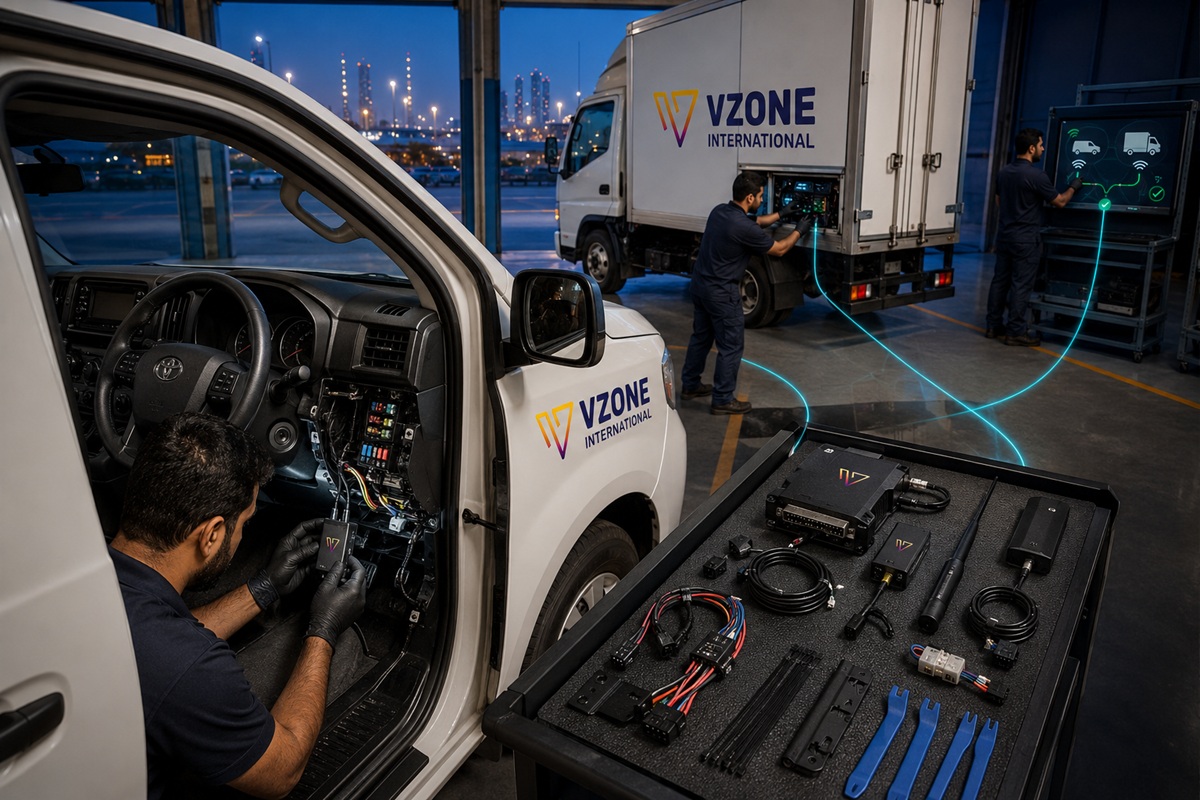
VZone’s school bus installation covers three hardware components per bus: the GPS telematics device (RTA-compatible and Asateel-certified depending on operating emirate), the RFID reader unit mounted at the bus entrance, and a driver-facing display showing route status and student boarding counts. The RFID reader supports both standard RFID cards issued by the school and NFC-enabled smartphones for secondary school students using app-based identification. Post-installation, VZone configures each student’s RFID card or app profile, links each student to their parent’s contact details, and tests the full notification sequence before the system goes live.
Parent App and WhatsApp Notification Integration
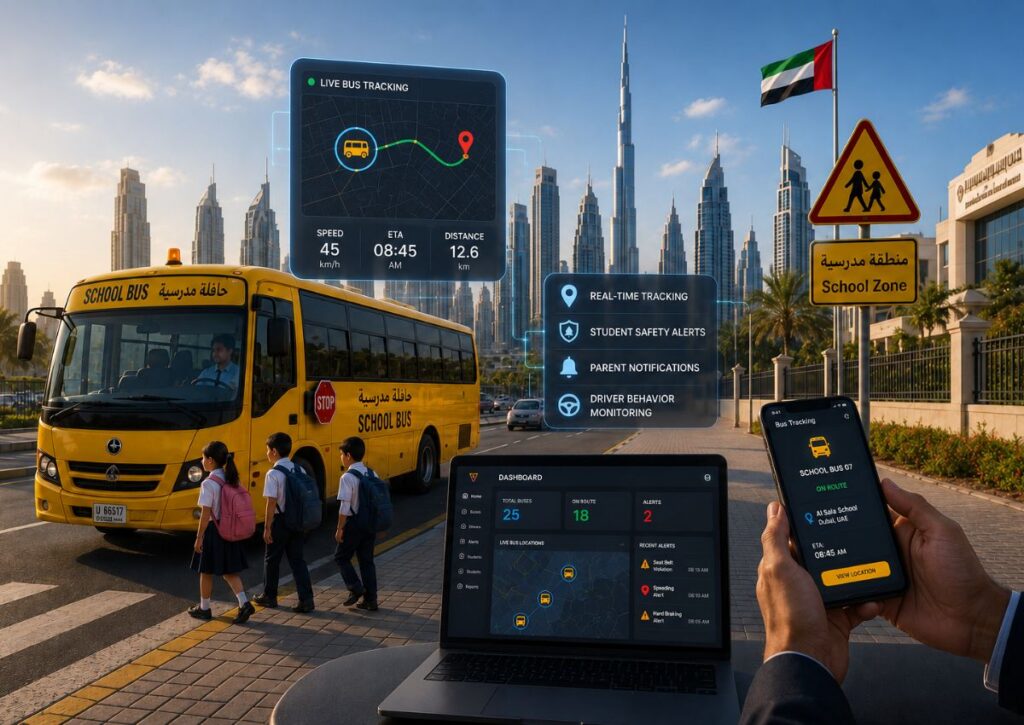
VZone’s parent-facing app provides a live map showing the bus location in real time, the estimated arrival time at the child’s stop, and the boarding status of the child. Notifications are delivered via both the app and WhatsApp covering parents who prefer not to monitor a separate app and ensuring that critical boarding alerts are received even when the parent app is not open. The notification language is configurable Arabic and English as standard, with additional language options available for schools with diverse parent communities, addressing the multilingual communication requirement that many UAE schools face.
Fleet Management and Compliance Reporting
The transport manager’s dashboard provides live visibility over the entire school bus fleet bus locations, route adherence status, active alerts, and driver behaviour events with role-based access for transport managers, school principals, and route supervisors. Daily attendance logs are automatically generated and available for export to school student management systems. Monthly driver behaviour reports, route adherence statistics, and compliance documentation for MOE, RTA, and ITC audit purposes are generated automatically from platform data without requiring manual compilation.
Conclusion: Smart School Bus Tracking Serves Three Stakeholders Simultaneously
The value of a smart school bus tracking system in the UAE is not singular it serves three distinct stakeholder groups with different but overlapping needs. Parents get the real-time visibility and automated notifications that reduce daily anxiety about their children’s journey. School administrators get the fleet visibility, compliance documentation, and attendance records that regulatory requirements and safeguarding standards demand. Transport operators get the route efficiency data, driver behaviour monitoring, and compliance proof that protects their licence and differentiates their service in a competitive market.
The regulatory environment makes GPS tracking mandatory, but the competitive environment makes smart school bus systems with RFID boarding, parent notification, and route optimisation the expected standard rather than a premium option. UAE schools and parents have rapidly adjusted their expectations: a school transport service that cannot tell parents in real time where the bus is and whether their child has boarded is increasingly seen as below the standard of care rather than a reasonable baseline.
For school transport operators choosing a system, the selection criteria are clear: certified hardware for the relevant emirate’s regulatory programme, a parent notification capability that covers both app and WhatsApp channels, driver behaviour monitoring configured for school zone speed limits, and a fleet management platform that generates the compliance documentation that MOE, RTA, and ITC audits require without manual compilation overhead.
Protect your students and achieve full UAE compliance with VZone’s smart school bus tracking system.
VZone International provides complete school bus GPS tracking with RFID student boarding, parent app and WhatsApp notifications, driver behaviour monitoring, and full compliance for MOE, RTA Dubai, and ITC Abu Dhabi requirements. Get a free demo we will show parents and school administrators exactly how the system works from their perspective.
Frequently Asked Questions
Yes. GPS tracking is mandatory for all school buses operating in UAE under Ministry of Education transport standards, enforced additionally by the RTA in Dubai and the ITC in Abu Dhabi. All three regulatory frameworks require certified GPS hardware, and the RTA and ITC require specific approved or certified devices standard commercial GPS trackers that are not on the relevant approved lists do not satisfy the regulatory requirement.
Smart school bus systems send automated notifications to parents at four key moments: when the bus is approaching the child's stop (5 to 10 minutes before arrival), when the child boards the bus (RFID card tap confirmation), when the child alights at their home stop (RFID tap confirmation), and if the bus deviates from its planned route. Notifications are delivered via push notification on a parent mobile app, WhatsApp message, or SMS depending on the platform configuration and the parent's preference.
RFID student tracking uses a contactless card issued to each student that they tap on a reader mounted at the bus entrance when boarding and exiting. Each tap is logged with the student's identity, a timestamp, and the bus's GPS-confirmed location. This creates an electronic attendance record that confirms which students are on the bus at any moment, triggers automated parent boarding notifications, and generates the daily attendance logs that school administrators use for student management and safeguarding records.
If an expected student one whose RFID card is registered on the bus route does not tap their card when the bus departs their stop, the system generates an absence alert to both the school administrator and the parent. This missed boarding alert is sent after the bus departs the stop, giving the school the opportunity to contact the parent to confirm whether the absence is known or unexpected. The alert enables a proactive safeguarding response rather than discovering a child's non-attendance only when the school register is taken in class.
School bus route optimisation software calculates the most efficient sequence of stops for each bus, minimising total route time and distance while respecting student pick-up and drop-off windows and school start and end time constraints. When students enrol or change addresses, the optimisation algorithm recalculates affected routes automatically. In UAE school transport deployments, route optimisation at the start of each academic year typically reduces total fleet mileage by 15 to 25 percent compared to manually carried-over routes delivering fuel savings and allowing the same fleet to serve more students without additional vehicles.
VZone International provides complete smart school bus tracking solutions for UAE school transport operators covering GPS vehicle tracking, RFID student boarding, parent mobile app and WhatsApp notifications, driver behaviour monitoring, and compliance reporting for MOE, RTA Dubai, and ITC Abu Dhabi requirements. VZone's solution covers both Dubai (RTA-compatible) and Abu Dhabi (Asateel-certified) school bus operations from a single platform.