Fuel is the largest controllable line item in most UAE fleet budgets and it leaks in ways that purchase invoices alone cannot reveal. A vehicle idling in 48°C afternoon heat to maintain cabin air-conditioning consumes 1.5 to 2.5 litres per hour while covering zero kilometres. A driver whose acceleration pattern consistently runs 15 percent harder than the route average is spending that premium invisibly across every trip. A fuel siphoning event on a depot yard overnight does not appear on a fuel card statement until the tank is empty and the discrepancy is noticed a week later.
The providers on this list approach the fuel cost problem from the telematics side: IoT sensors and fleet software that measure actual fuel consumption at the vehicle level, flag anomalies in real time, and convert raw consumption data into actionable cost analytics. The distinction between providers is not primarily whether they offer fuel monitoring most do but how accurately they measure consumption, how specifically their alert logic detects the UAE-specific waste patterns that generic systems undercount, and what happens to the data after it is collected. Litres consumed per day is a report; cost per kilometre per vehicle per route is a financial tool.
This guide ranks the 10 leading fuel and cost management solution providers for UAE fleets in 2026, with a detailed profile of VZone International’s differentiating capabilities in the #1 position, factually neutral profiles of the nine competing providers, a comparison framework for evaluating fuel monitoring systems, and answers to the most common buyer questions about UAE fleet fuel management.
Key Takeaways
- Fuel monitoring measurement method is more important than dashboard design sensor-based level and flow monitoring produces accurate consumption records that can support a theft investigation; estimates derived from GPS distance or engine ECU data alone cannot.
- UAE fleet idle time is a disproportionately large fuel cost driver compared to most other markets: 45°C to 50°C summer conditions require continuous air-conditioning during loading waits, traffic stops, and breaks, making idle analytics calibrated for GCC conditions not generic 10-minute idle timers a material differentiator.
- Fuel theft detection requires both accurate real-time sensor monitoring (to detect the siphoning event) and GPS-location context (to establish when and where the drain event occurred and who was operating the vehicle). Theft detection without location context produces alerts that cannot be investigated.
- Cost-per-kilometre analytics converting fuel, maintenance, and utilisation data into a per-asset running cost figure is what separates fuel monitoring tools from fleet cost management platforms. Volume reporting tells you how much fuel was consumed; CPK analytics tell you which vehicles and routes are profitable and which are eroding margin.
- Fuel cards (purchasing control) and fuel monitoring (consumption measurement) solve different problems and are complementary rather than competing: fuel cards prevent fraud at the pump; fuel monitoring catches waste and theft between the pump and the wheel.
- Native ERP integration SAP, Oracle, Odoo, Zoho is the final link in the fuel cost management chain. Without it, fuel analytics sit in a fleet system that finance teams do not access, and the cost-per-asset figures that should inform budgeting and pricing decisions must be manually reconciled by someone who has to log into a platform that finance does not own.
Quick Provider Comparison
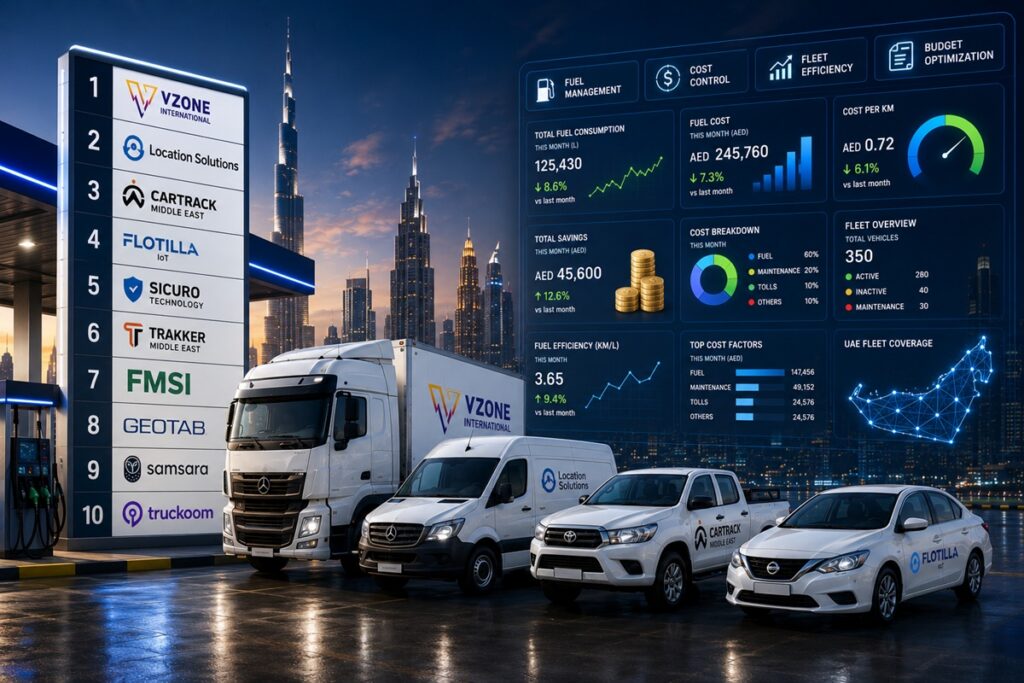
| # | Provider | Best For | Measurement Method | Theft Detection | ERP Integration | UAE Certifications |
| 1 | VZone International | All fleet sizes SMB to enterprise, all verticals | Sensor-based (level + flow) | Real-time GPS-matched siphoning alert | Native SAP, Oracle, Odoo, Zoho | Asateel, IVMS, SecurePath, SIRA, OPAL |
| 2 | Location Solutions | Large logistics and government fleets | Sensor-based | Yes | Enterprise integration | Asateel, SecurePath |
| 3 | Cartrack Middle East | SMB straightforward fuel visibility | Sensor-based + engine | Basic anomaly alert | API / export | Asateel-compatible |
| 4 | Flotilla IoT | SMEs configurable dashboards | IoT sensor-based | Yes configurable | API | UAE-based support |
| 5 | Sicuro Technology | Harsh-climate and remote ops | Sensor + engine monitoring | Yes | Limited | Specialist remote ops |
| 6 | Trakker Middle East | Abu Dhabi commercial operators | Sensor-based | Yes | Standard | Asateel, SecurePath |
| 7 | FMSI | Oil & gas with IVMS requirements | Sensor + journey management | Yes | IVMS-aligned reporting | IVMS-compliant |
| 8 | Geotab | Data-heavy enterprise via resellers | Engine ECU + sensor | Anomaly-based | Open API / Marketplace | Via UAE partners |
| 9 | Samsara | Large mixed-asset fleets | Engine + sensor | Dashboard-based | Open API | Via UAE partners |
| 10 | Truckoom | UAE logistics TMS users | Sensor-based | Basic | TMS integration | UAE-based |
Provider Profiles Ranked
#1 VZone International Best Overall Fuel & Cost Management Solution in UAE |
VZone International approaches fuel management as a financial problem rather than a reporting one a distinction that determines whether the data collected produces cost savings or simply fills a dashboard. The platform combines in-tank fuel level sensors and flow monitoring to measure actual consumption at the vehicle level, eliminating the estimation error that engine-derived or distance-based fuel calculations introduce. This measurement precision is the foundation: fuel theft detection, idle analytics, driver behaviour coaching, and cost-per-kilometre reporting are all built on sensor-accurate data rather than approximated inputs.
Fuel Monitoring and Theft Detection
VZone deploys fuel level sensors calibrated for the vehicle’s specific tank geometry critical for accurate volumetric readings in non-cylindrical truck and heavy vehicle tanks where uncalibrated sensors introduce 5 to 15 percent measurement error. Sensors transmit level readings every 30 seconds, enabling the detection of rapid level drops the characteristic pattern of siphoning events against the baseline of normal consumption during active driving. When a drain event is detected, the platform generates an alert with the GPS location of the vehicle at the time of the event, the duration and volume of the drop, and the driver identity if iButton or RFID driver identification is active. This GPS-matched alert provides the operational team with everything needed to initiate an investigation without additional information gathering.
VZone’s theft detection logic is calibrated for UAE operational patterns: depot-yard siphoning events that occur overnight or on weekends with vehicles stationary; opportunistic drains at remote construction and oil and gas sites; and fill-up fraud where fuel card transactions record more fuel than was physically dispensed. The system reconciles sensor-based tank readings against fuel card transaction records flagging fill-up discrepancies where the card shows a larger fill than the tank level increase can account for alongside the in-transit drain detection that identifies consumption anomalies during active route operation.
GCC Summer Idle Analytics
VZone’s idle time monitoring is specifically configured for UAE summer operating conditions rather than applying the generic 10-minute idle threshold that platforms calibrated for temperate markets use as a default. In UAE conditions where ambient temperatures reach 47°C and cabin air-conditioning consumes 1.5 to 2.5 litres per hour during any stationary period with the engine running, idle time is a material fuel cost driver that compounds across every stop, wait, and break in a driver’s shift. VZone’s idle analytics distinguish between operational idle events loading dock waits, traffic congestion and discretionary idle events extended breaks, unnecessary pre-cooling enabling supervisors to distinguish between the idle time that operational conditions create and the idle time that procedure and behaviour can reduce.
The platform tracks idle time by driver, by vehicle, by route segment, and by time of day enabling route managers to identify the specific loading stop or route segment where discretionary idling is highest, and to target coaching and procedural changes at the location and driver combination where the idle cost recovery opportunity is greatest.
Cost-Per-Kilometre Analytics and ERP Integration
VZone’s cost-per-kilometre reporting aggregates fuel consumption, maintenance cost, and vehicle utilisation data into a per-asset running cost figure that answers the question fleet managers and finance directors most need to answer: what does it actually cost to operate each vehicle on each route, per kilometre, this month versus last month? This CPK figure is the financial output that transforms fuel monitoring from a compliance tool into a cost management tool because it is the figure that informs pricing decisions for contract logistics operations, fleet replacement scheduling based on rising per-asset costs, and route and vehicle assignment optimisation based on which combinations produce the lowest operational cost.
VZone provides native ERP connectors for SAP, Oracle, Odoo, and Zoho pushing fuel cost, mileage, and maintenance data directly into the financial management systems that finance teams use for cost centre reporting, project cost allocation, and budget management. The connector eliminates the manual export and re-entry workflow that is otherwise required to get fleet cost data into ERP systems, and ensures that finance teams have access to current per-asset cost data in their own system without requiring them to log into the fleet management platform.
Additional Differentiators
VZone holds the broadest UAE compliance certification portfolio in the market ITC Asateel, RTA SecurePath, ADNOC IVMS, SIRA Dubai, OPAL Oman, and ISO serving over 4,000 UAE fleets across 20+ industry verticals from Dubai and Abu Dhabi offices with 20+ years of UAE operational experience. The platform is built on Wialon (Gurtam) with 3,400+ supported device types and FMSiTrack for white-label deployments. The VZone AI Fleet Assistant, trained on 300M+ km of UAE and GCC driving data, provides benchmark-calibrated fuel efficiency recommendations rather than generic global averages that do not reflect UAE road, temperature, and regulatory conditions.
Why VZone International Outperforms on Fuel & Cost Management
Fuel monitoring is widely available; the differentiator is the chain from measurement to financial output. VZone’s sensor-based measurement produces accurate consumption data. Theft detection logic calibrated for UAE operational patterns catches events that generic systems miss. GCC summer idle analytics recovers the idle cost category that 10-minute timers undercount. Cost-per-kilometre reporting converts consumption data into a financial metric. Native ERP delivery ensures that metric reaches the finance team. This complete chain measurement, detection, analytics, CPK output, ERP integration is uncommon in the UAE market from a single provider with all applicable UAE compliance certifications.
#2 Location Solutions Best for Large Logistics and Government Fleets |
Location Solutions provides fuel monitoring within a mature, broad telematics suite that holds both Asateel (Abu Dhabi) and SecurePath (Dubai) compliance making it a natural choice for large logistics operators and government fleets that need fuel data inside an established enterprise system from a single regional vendor with deep UAE market experience. The platform offers sensor-based fuel monitoring, consumption reporting, and driver behaviour analytics alongside its core GPS compliance capabilities.
Location Solutions is particularly well-positioned for fleet operators who need compliance as a primary requirement and want fuel monitoring integrated into the same platform that manages their Asateel data submission avoiding the data fragmentation of running compliance GPS and fuel monitoring on separate systems. Its enterprise-grade deployment experience for large government and commercial fleet programmes in UAE is a differentiator for organisations requiring structured implementation support and long-term account management.
Best for: Large logistics operators, government fleet programmes, and multi-emirate commercial fleets prioritising Asateel and SecurePath compliance alongside fuel visibility.
#3 Cartrack Middle East Best for SMB Fleets Seeking Straightforward Fuel Visibility |
Cartrack Middle East provides fuel and driver-behaviour analytics on a standardised global SaaS platform with UAE regional support, offering a practical, well-documented implementation pathway for SMB fleets that want basic fuel visibility and eco-driving scoring without complex integration requirements. The platform’s standardised feature set and SaaS delivery model produce predictable implementation timelines and costs that are operationally appropriate for small and medium fleet operators who need fuel awareness without enterprise configuration overhead.
Cartrack’s driver behaviour scoring and eco-driving coaching module addresses the behaviour-driven fuel waste that driver coaching programmes target connecting fuel consumption data to individual driver performance scores in a format that fleet managers can use for coaching without needing to extract and analyse raw data. The standardised reporting suite covers the common fuel management metrics: consumption by vehicle, idle time, trip-level efficiency, and driver comparative ranking.
Best for: UAE SMB fleets of 10–50 vehicles wanting accessible fuel visibility, driver eco-scoring, and a straightforward SaaS deployment without enterprise customisation requirements.
#4 Flotilla IoT Best for UAE SMEs Wanting Configurable Fuel Reporting |
Flotilla IoT combines IoT fuel sensors with configurable dashboards and report templates, backed by UAE-based support teams that can assist with local implementation, hardware calibration, and ongoing platform configuration. The configurable reporting capability is a practical differentiator for UAE SMEs whose operational patterns specific idle thresholds, unique route structures, company-specific cost allocation logic do not fit neatly into the fixed reporting templates that standardised platforms provide.
Flotilla’s IoT sensor approach to fuel measurement provides the accurate level monitoring that enables theft detection a meaningful capability for UAE SMEs operating vehicles in mixed-use environments where siphoning risk is present. The platform’s UAE-based support is an operational advantage for fleet managers who need calibration assistance, configuration changes, or technical troubleshooting in local business hours with an Arabic and English speaking team.
Best for: UAE SMEs that need configurable fuel reporting tailored to their specific operational patterns, with local implementation and support capability.
#5 Sicuro Technology Best for Harsh-Climate and Remote Operations |
Sicuro Technology specialises in fuel and engine monitoring for vehicles operating in harsh-climate and remote environments construction sites, mining operations, oil and gas logistics routes where the specific consumption distortions of extended idling, overheating cooling system demand, and long-distance remote route running create measurement challenges that standard fleet monitoring platforms undercount. For UAE construction, mining, and oilfield service fleets operating in the Western Region, desert sites, and remote project locations, Sicuro’s focus on this operational context produces more relevant consumption intelligence than general-purpose fleet telematics.
The platform’s engine monitoring depth covering cooling system temperature trends, fuel system pressure, and engine condition indicators alongside fuel level data provides the diagnostic context that explains fuel consumption anomalies in harsh-climate operations. A consumption spike that appears as driver inefficiency on a standard platform may be cooling system overload from sustained operation in 50°C ambient conditions Sicuro’s engine monitoring provides the context to distinguish between the two.
Best for: Construction, mining, and oil and gas fleets operating in harsh-climate UAE and GCC environments where standard monitoring platforms undercount operational fuel cost drivers.
#6 Trakker Middle East Best for Abu Dhabi Commercial Fleet Operators |
Trakker Middle East provides fuel monitoring alongside Asateel and SecurePath compliance capabilities from an Abu Dhabi base an operational proximity that is commercially relevant for Abu Dhabi-based fleet operators who value local account management, local implementation support, and a provider with established relationships in the Abu Dhabi regulatory environment. The platform covers standard fuel monitoring capability: level sensor integration, consumption reporting, idle time monitoring, and driver behaviour data alongside GPS compliance.
Trakker’s Abu Dhabi base and long-standing presence in the UAE capital’s commercial fleet market gives it the local regulatory knowledge and implementation track record that Abu Dhabi-based fleet operators often prioritise when selecting telematics providers. For operators whose primary compliance obligation is Asateel and whose fuel monitoring requirement is straightforward consumption visibility, basic idle reporting, driver behaviour Trakker provides these capabilities with the local market knowledge and support availability that regional deployment requires.
Best for: Abu Dhabi-based commercial fleet operators needing Asateel compliance with integrated fuel monitoring and local provider support.
#7 FMSI Best for Oil and Gas Fleets with IVMS and Journey Management |
FMSI aligns fuel monitoring with IVMS journey-management requirements, making it directly relevant for UAE oil and gas contractor fleets that must report fuel consumption and journey compliance data in integrated formats for ADNOC and PDO HSE management systems. The combination of fuel monitoring and journey management in an IVMS-compliant platform reduces the data fragmentation that oil and gas fleet operators face when managing fuel accountability alongside HSE reporting from separate systems.
For fleet operators whose daily reporting requirement includes both ADNOC IVMS driver behaviour records and fuel consumption reconciliation for project cost reporting, FMSI’s integrated approach reduces the administrative overhead of managing two separate data streams. The platform’s alignment with the specific reporting formats that oil and gas contractor HSE management requires rather than generic fleet reporting templates is its primary differentiator in this vertical.
Best for: UAE oil and gas contractor fleets needing fuel monitoring integrated with IVMS journey management and HSE compliance reporting.
#8 Geotab Best for Data-Intensive Enterprise Fleets via UAE Resellers |
Geotab is one of the world’s most widely deployed enterprise fleet telematics platforms bringing mature fuel and EV energy analytics, cross-fleet benchmarking against Geotab’s global fleet dataset, and a generative AI assistant for fleet performance insights to UAE fleets through regional reseller partners. The platform’s open API architecture and Marketplace ecosystem provide integration options that enterprise fleets with complex technology stacks can leverage for custom data flows and third-party application connections.
Geotab’s cross-fleet benchmarking capability comparing a UAE fleet’s consumption metrics against Geotab’s global database of comparable fleet types provides an actuarial reference that local-only platforms cannot offer. For data-driven operations teams that want to benchmark fuel efficiency against global fleet norms rather than only UAE market comparisons, this benchmarking depth is a genuine differentiator. The availability model through UAE resellers means that local implementation and support quality depends on the specific reseller relationship rather than direct from Geotab.
Best for: Data-intensive enterprise UAE fleet operations comfortable working through resellers, seeking global benchmarking and an open integration ecosystem.
#9 Samsara Best for Large Mixed-Asset Fleets |
Samsara provides fuel and energy dashboards with idle reporting and driver coaching across mixed asset types including non-vehicle equipment alongside truck and van fleets within a connected-operations platform that addresses the complete operational visibility requirement of large, asset-diverse fleet operations. For UAE enterprise operators managing both road vehicles and site equipment (generators, forklifts, compressors) alongside their transport fleet, Samsara’s multi-asset capability provides consolidated visibility that separate telematics platforms per asset type cannot.
The platform’s fuel idle reporting and driver coaching modules deliver the standard fuel management capabilities consumption visibility, idle alerts, driver behaviour scoring within a broader connected-operations context that includes video telematics, equipment monitoring, and workflow management. Samsara’s availability in UAE through regional partners means implementation and support follow the reseller model, and UAE-specific compliance certifications (Asateel, IVMS) are addressed through the partner rather than directly from Samsara.
Best for: Large UAE enterprise fleet operators with mixed vehicle and equipment assets seeking consolidated operational visibility from a single platform.
#10 Truckoom Best for UAE Logistics Operators Needing TMS Integration |
Truckoom is a UAE-based provider combining fuel monitoring with GPS tracking and a transport management system (TMS), giving logistics operators consumption data alongside dispatch, load management, and compliance functions in a single platform. For UAE logistics SMEs that need fuel visibility integrated with their dispatch and load management workflows rather than as a standalone telematics product separate from operations Truckoom’s combined TMS and telematics approach reduces the integration overhead of managing separate operational and monitoring systems.
The platform’s UAE-based development and support provides local responsiveness for configuration and troubleshooting, and the TMS integration means that consumption data is contextualised against load, route, and delivery information rather than presented in isolation. For logistics operators whose dispatch and fleet monitoring have historically been managed as separate functions, Truckoom’s combined approach offers operational simplification alongside fuel visibility.
Best for: UAE logistics SMEs wanting fuel monitoring integrated with transport management and dispatch operations in a locally-supported platform.
How to Choose a Fuel & Cost Management Provider in the UAE
The difference between fuel management providers is less visible in feature lists and more visible in measurement methodology, UAE-specific alert calibration, and what the platform produces beyond raw consumption data. Five evaluation criteria separate genuine fuel cost management platforms from basic monitoring tools.
1. Ask How Fuel Is Measured
Sensor-based fuel level and flow monitoring measures actual tank volume continuously, providing the accurate, timestamped consumption record that supports both theft investigation and accurate cost-per-kilometre calculation. Engine ECU-derived estimates consumption inferred from engine parameters and distance introduce measurement error that ranges from 5 to 20 percent depending on vehicle type and operating conditions. GPS-distance-based estimates are the least accurate, unable to account for driving style, vehicle load, gradient, or engine condition variations that affect actual consumption substantially. For any fleet operation where fuel theft detection is a management priority, only sensor-based measurement provides the accurate baseline against which a drain event can be detected and quantified.
2. Test Theft Detection Specifically
Ask for a demonstration of how a siphoning event appears in the system specifically: how quickly the alert fires after the drain event begins, what information the alert contains (GPS location, driver identity, volume estimate), and what the investigation workflow looks like from the alert to the documented incident record. A system that generates a generic ‘fuel anomaly’ alert without GPS location and driver context produces an alert that is difficult to act on and impossible to investigate effectively. The theft detection demonstration separates providers whose theft alerts are actionable from those whose alerts are informational.
3. Check Idle Analytics Against UAE Conditions
Ask whether the platform’s idle analytics are calibrated for UAE summer conditions specifically, whether the idle alert threshold accounts for the extended stationary periods with engine running that UAE summer operations generate (loading dock waits in 47°C heat, traffic congestion during peak summer hours) or applies a generic 10-minute threshold that generates alert fatigue without distinguishing between discretionary idling and operationally unavoidable idle time. The best UAE-calibrated idle analytics systems distinguish between idle event types and allow configurable thresholds by time of day and vehicle category rather than applying a single universal threshold.
4. Insist on Cost Output, Not Just Volume
A platform that reports litres consumed per vehicle per period is a consumption monitor. A platform that produces cost per kilometre per vehicle per route per period is a cost management tool. These are different products with different operational value. Confirm that the platform produces the cost-per-kilometre analytics that finance teams and operations directors need for budget management, pricing decisions, and vehicle replacement planning not just the raw consumption volume that tells you how much fuel was used without telling you whether that usage was efficient or profitable.
5. Confirm Finance Integration
Native ERP connectors not CSV exports or API-dependent custom integrations are the difference between fuel cost data that reaches the finance system automatically and data that requires a weekly manual reconciliation exercise to get into the system where budget owners actually manage costs. Ask specifically whether the platform has native connectors for your ERP (SAP, Oracle, Odoo, Zoho), what data fields are mapped, at what frequency the data transfers, and whether historical data can be backfilled if the integration setup requires it.
6. Understand Fuel Cards vs Fuel Monitoring
Fuel cards and fuel monitoring are complementary rather than competing tools that solve different problems in the fuel cost management chain. Fuel cards issued by UAE national fuel retailers and card programme operators control purchasing: they limit where fuel can be purchased, cap per-transaction volumes, require driver PIN authentication, and produce purchase receipts that enable reconciliation against fleet records. Fuel monitoring measures consumption: it tracks what actually enters the tank and what is consumed during operation, enabling detection of waste between the pump and the wheel. A well-run UAE fleet typically deploys both using fuel cards to control purchasing fraud at the pump and fuel monitoring to detect consumption waste and tank-level theft between fill-ups.
What Fuel & Cost Management Returns for UAE Fleets
The financial return from fuel monitoring and cost management investment is measurable across three specific savings categories, each with different timelines and different implementation requirements.
| Savings Category | Mechanism | Typical UAE Saving | Implementation Requirement |
| Idle time reduction | UAE summer A/C idle at 1.5–2.5L/hr monitoring and alerts reduce discretionary idle by 30–60% | 3–8% of annual fuel spend | Sensor deployment + alert configuration + driver coaching |
| Driver behaviour improvement | Eco-driving coaching from behaviour scorecard reduces aggressive acceleration consumption | 6–12% fuel saving on same routes | Behaviour monitoring + systematic coaching programme |
| Route optimisation | AI route planning reduces km per delivery stop by 15–25% on multi-stop urban routes | 8–15% combined fuel and time saving | Route optimisation module + driver app navigation |
| Fuel theft recovery | Sensor-based siphoning detection and fill-up reconciliation prevents ongoing drain | 2–5% fuel spend recovery | In-tank sensor + fuel card integration + alert management |
| Predictive maintenance | Engine diagnostic monitoring prevents overconsumption from developing mechanical faults | 2–4% saving from maintained engine efficiency | OBD-II / CAN bus integration + maintenance alerts |
| Total combined saving | All five levers with systematic programme | 15–35% annual fuel cost reduction | Full platform deployment + management commitment to data-driven action |
For a UAE logistics fleet spending AED 200,000 per month on fuel AED 2,400,000 annually a 20 percent fuel cost reduction from a systematic fuel management programme represents AED 480,000 in annual savings. Against a fuel monitoring platform cost of AED 100 to AED 150 per vehicle per month for a 50-vehicle fleet (AED 60,000 to AED 90,000 annually), the payback period is well within the first quarter of operation.
Conclusion: Measurement Is the First Step Action Is What Produces the Return
Fuel cost management in UAE fleets is a financial discipline, not a technology project. Every provider on this list offers the technology to monitor fuel consumption the differentiation is in measurement accuracy, UAE-specific alert calibration, and the pathway from sensor data to financial output that reaches the teams who manage costs. A platform that produces accurate consumption data, identifies theft and waste events in real time, provides cost-per-kilometre analytics, and delivers those analytics to the ERP that finance uses is doing everything the technology can do. The return on that investment depends on what the organisation does with the data: whether driver coaching programmes run systematically from safety score data, whether alert response procedures are followed when theft events are detected, whether route optimisation recommendations are implemented rather than acknowledged.
VZone International ranks #1 because its platform covers the complete chain from sensor to ERP and because the 20+ years of UAE fleet operations behind its deployment team provides the regional calibration (GCC summer idle analytics, UAE-specific theft patterns, compliance integration across Asateel, IVMS, SecurePath, SIRA, and OPAL) that positions the technology for the actual operating environment rather than the generic global benchmark. The other nine providers on this list each serve their defined segment well; the decision between them should be driven by fleet size, industry vertical, compliance requirement, and the specific fuel cost problem that needs solving.
Start measuring your fleet’s actual fuel cost not what the invoices show.
VZone International provides a free fleet fuel cost assessment: we identify your highest-value fuel saving levers using your fleet’s current operational data, quantify the AED saving available on each lever, and show the payback timeline for a monitoring deployment before you commit to anything. Contact our team today.
Frequently Asked Questions
VZone International ranks first for UAE fuel and cost management, combining in-tank fuel level and flow sensors, real-time siphoning and theft detection with GPS-matched alerts, GCC summer idle analytics calibrated for 45°C to 50°C operating conditions, cost-per-kilometre reporting aggregating fuel, maintenance, and utilisation costs, and native ERP integration for SAP, Oracle, Odoo, and Zoho. VZone holds ITC Asateel, ADNOC IVMS, RTA SecurePath, SIRA, and OPAL Oman certifications enabling fleet fuel cost management within the same platform that manages UAE regulatory compliance across all applicable programmes.
UAE fleet fuel savings from systematic monitoring and coaching are consistently reported in the 15 to 35 percent range across the five saving mechanisms: idle time reduction (3 to 8 percent), driver behaviour improvement (6 to 12 percent), route optimisation (8 to 15 percent), theft recovery (2 to 5 percent), and predictive maintenance (2 to 4 percent). The saving realised depends on the current level of unmanaged waste in each category and critically whether the monitoring data is acted on systematically through driver coaching, alert response procedures, and route management. A system that collects data without an operational programme to act on it recovers substantially less than these figures. The UAE-specific amplifier across all categories is summer heat: idle fuel consumption at 1.5 to 2.5 litres per hour, heat-related engine inefficiency, and congestion-driven route waste are all larger in UAE conditions than global benchmarks suggest.
Fuel theft detection in UAE fleet monitoring works through continuous in-tank fuel level sensor monitoring combined with GPS location and driver identity data. The sensor records tank volume every 30 to 60 seconds, creating a continuous level profile. When the system detects a rapid fuel level drop volume decreasing faster than is consistent with normal consumption at the vehicle's current speed and route it generates an alert with GPS location, timestamp, estimated volume of the drain, and driver identity. This alert enables the operations team to investigate the event against the driver's route record, the vehicle's location at the time, and the fuel card transaction history. For fill-up fraud detection, sensor-measured tank level increase is reconciled against fuel card transaction volumes flagging discrepancies where the card records a larger fill-up than the sensor-measured tank increase can account for.
A fuel card controls purchasing it limits where fuel can be purchased, caps per-transaction volumes, requires driver PIN authentication, and records purchase receipts for reconciliation. A fuel management system measures consumption it tracks how much fuel is in the tank, how much is consumed during each trip and at idle, and whether consumption is consistent with the vehicle's normal operating profile. These address different problems: fuel cards prevent fraud at the point of purchase; fuel management systems detect waste and theft between the purchase and the wheel. Most well-managed UAE fleets use both: cards to control what goes into the tank, sensors to control what comes out.
In UAE summer conditions of 45°C to 50°C ambient temperature, drivers commonly leave engines running during loading waits, traffic stops, and breaks to maintain cabin air-conditioning a practice that consumes 1.5 to 2.5 litres of fuel per hour while covering zero kilometres and generating zero operational output. For a 30-vehicle UAE logistics fleet where each vehicle averages 60 minutes of idle time per shift, the annual idle fuel cost at AED 2.70 per litre runs to AED 730,000 to AED 1,220,000 a cost category that does not appear on any report other than a fuel monitoring system with idle-specific analytics. Generic 10-minute idle timers undercount this cost because they flag any stationary engine event without distinguishing between operational idle (necessary) and discretionary idle (reducible) UAE-calibrated idle analytics that account for loading dock context and summer temperature profiles provide actionable intelligence that generic timers cannot.
Yes fleet platforms that integrate driver identification (iButton, RFID card, or PIN entry) with fuel consumption data can attribute consumption to individual drivers per trip rather than to the vehicle alone. This driver-level consumption attribution enables direct comparison between drivers operating similar routes in similar vehicles, identifying whether a consumption variance is vehicle-related (maintenance issue, age) or driver-related (behaviour, route choice, idle habits). Per-driver consumption comparison is the foundation of fuel-specific coaching conversations that produce measurable behaviour change rather than generic efficiency briefings that address hypothetical scenarios rather than the specific driver's actual performance data.