LEGAL DISCLAIMER This article provides general information about using dashcam footage in UAE accident claims. It does not constitute legal advice. Consult a qualified UAE legal practitioner and your insurer for guidance specific to your situation. |
Having dashcam footage after a fleet accident is not the same as using it effectively. UAE fleet managers who know that their vehicle had a dashcam but do not have a clear procedure for preserving, reviewing, and submitting the footage frequently fail to extract the full evidentiary value from footage that could have resolved the claim in their favour sometimes because the footage was overwritten before it was secured, sometimes because it was voluntarily shared before legal review revealed that it was adverse, and sometimes because it was submitted to the insurer in a format that the claims team could not integrate into their investigation workflow.
This guide provides the operational step-by-step process for using dashcam footage effectively in UAE fleet accident claims covering the immediate post-incident actions that preserve the footage, the review and triage process that determines how to use it, the submission pathways to UAE police and insurers, the specific value dashcam footage delivers in fraudulent claim defence, and the claim timeline impact of footage versus no-footage claims in the UAE market.
It complements the legal framework covered in the dashcam legal evidence guide (Cat-14) with the operational specifics that fleet managers and operations teams need to act on immediately after an incident occurs.
Key Takeaways
- The 30-minute window after a fleet accident is the most operationally critical period for dashcam evidence preservation footage that is not secured from cloud storage or protected from SD card overwrite within this window may be lost before it can be used.
- Review before disclose is the non-negotiable rule for dashcam footage in UAE fleet accident claims. Footage that favours the fleet vehicle should be submitted proactively. Footage that shows fleet driver fault should be reviewed by legal counsel before any disclosure decision is made.
- The combination of dashcam footage and GPS telematics data is substantially more persuasive in UAE claims proceedings than footage alone GPS speed at impact, brake event timing, and driver identity independently corroborate the video record and resist challenge.
- UAE fleet insurance claims with supporting dashcam footage typically resolve in 30 to 60 percent less time than no-footage claims, because the objective evidence reduces the factual disputes that extend investigation and negotiation timelines.
- Fraudulent and exaggerated third-party claims a significant cost driver in UAE commercial fleet insurance are most effectively challenged with GPS-matched dashcam footage showing actual impact speed, vehicle positions, and third-party conduct. Individual defended claims avoid AED 15,000 to AED 80,000 in inflated settlements.
The 8-Step Dashcam Claims Process for UAE Fleet Operators
Step 1 Driver Protocol at the Scene (First 10 Minutes)
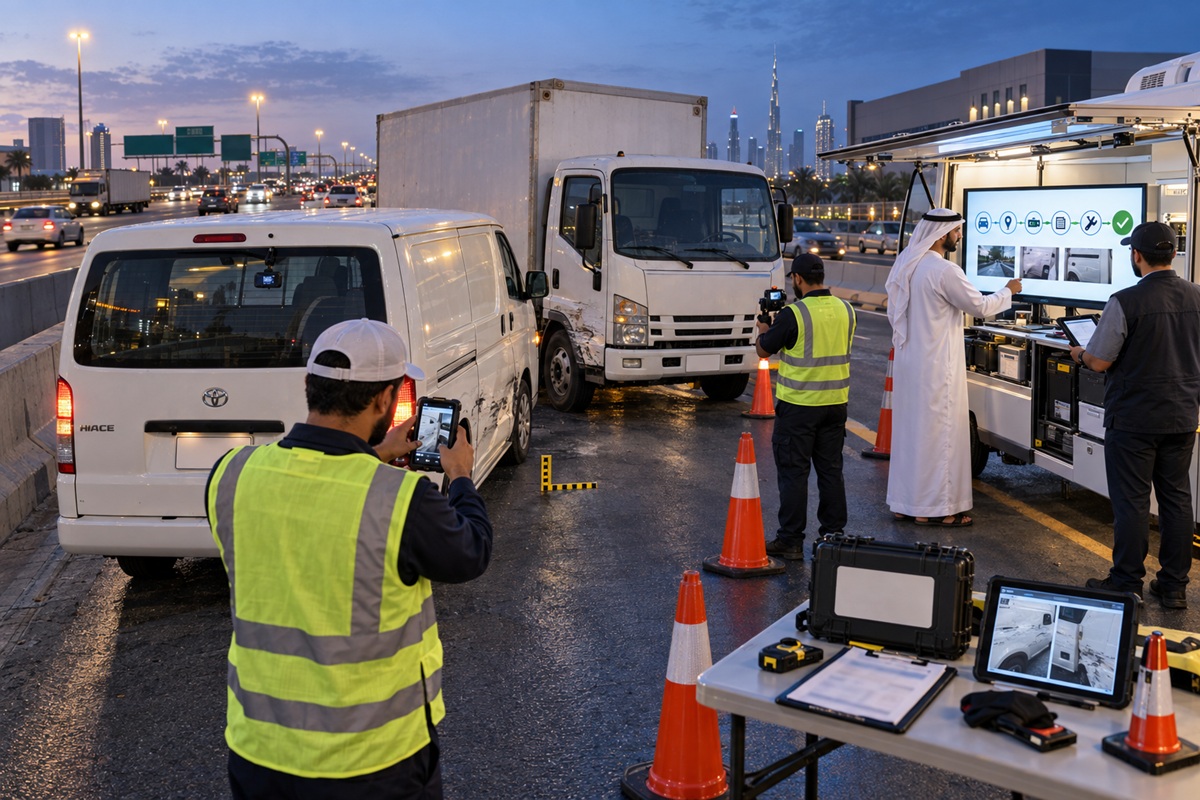
The driver’s conduct in the first 10 minutes after an accident determines whether the dashcam footage is preserved or compromised. Fleet operators must train drivers on three non-negotiable rules for post-accident dashcam protocol: do not remove the SD card or USB device from the dashcam; do not show the footage on the dashcam’s screen to the other party, bystanders, or police at the scene; and call the fleet manager immediately before taking any other action regarding the vehicle or the dashcam. These three rules are simple enough to deliver in a 30-second pre-hire briefing and a laminated card on the dashboard and their absence is the most common cause of avoidable footage compromise.
The reason for not showing footage at the scene is both evidentiary and strategic. An uninstructed driver who shows dashcam footage to the other party at the scene is revealing the fleet’s evidence position before any legal assessment has occurred, potentially revealing adverse footage that should not be voluntarily disclosed, and creating an informal evidence disclosure that may affect the chain of custody record. Police requests to view the device at the scene should be politely deferred to the fleet manager who will be arriving or calling shortly.
Step 2 Fleet Manager Footage Preservation (Within 30 Minutes)
The fleet manager, notified by the driver, must secure the dashcam footage within 30 minutes of the incident. The standard loop-recording dashcam at 1080p on a 64 GB SD card retains approximately 8 to 12 hours of footage before overwriting. For most UAE fleet incidents that occur during operating hours, 30-minute preservation is achievable before overwrite risk is material. For vehicles without cloud storage, the manager should dispatch a team member to the vehicle to remove the SD card before it can be overwritten which happens automatically and silently as the device continues recording.
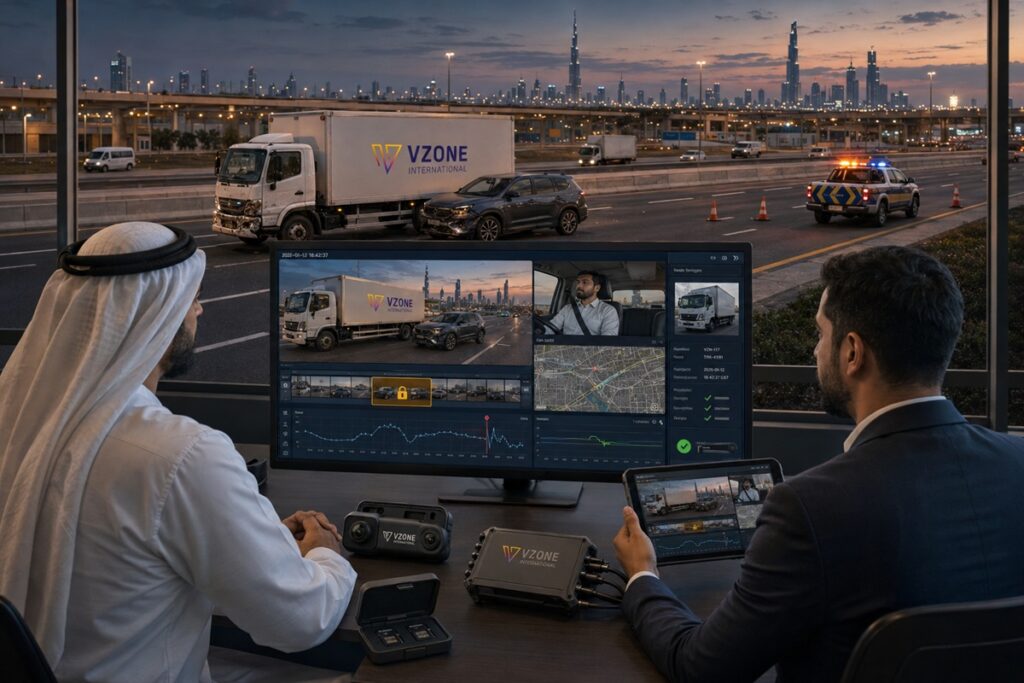
For fleets using VZone International’s cloud-stored dashcam system, footage is uploaded to cloud storage continuously as events are tagged and at configurable intervals for general footage. The fleet manager can remotely lock the footage from the incident period through the Wialon platform dashboard preventing overwrite and preserving the complete pre- and post-incident record without requiring physical access to the vehicle. This cloud preservation is the most reliable method because it removes the human intervention dependency that SD card preservation requires.
Step 3 Internal Footage Review (Within 2 Hours)
Before any disclosure to police, insurers, or third parties, the fleet manager or designated safety officer must review the preserved footage and make a structured assessment of its evidentiary value. The review should address four specific questions:
- Does the footage clearly show the incident and the events leading up to it, or is there a gap, obstruction, or quality issue that reduces its usefulness?
- Does the footage support the fleet driver’s account of the incident, or does it contradict it in any material respect?
- Does the footage show any conduct by the third party lane change without indicating, red light running, wrong-way driving, or sudden stop that supports a third-party fault claim?
- Does the footage show any conduct by the fleet driver distraction, excessive speed, insufficient following distance, phone use that could be used as evidence against the fleet vehicle?
The output of this review is a disclosure decision framework: footage that clearly supports the fleet’s position is prioritised for proactive submission to police and insurers; footage that is adverse or mixed should be reviewed by legal counsel before any submission decision is made. Attempting to ‘sit on’ adverse footage while submitting selected favourable footage to the same proceedings carries legal risk a fully documented disclosure obligation exists once proceedings are initiated, and selective disclosure can worsen the fleet operator’s position significantly.
Step 4 GPS Telematics Data Extraction (Within 2 Hours)
Simultaneously with footage review, the fleet manager should extract the GPS telematics data record for the vehicle at the time of the incident. This data accessible from the fleet management platform for any vehicle and any time period provides the objective measurements that transform dashcam footage from a qualitative record into a corroborated evidence package:
- Speed at the moment of impact: GPS speed log showing km/h at the exact second the incident occurred the most persuasive single data point for disputing inflated speed claims by the third party
- Brake event record: accelerometer-detected brake application events in the 30 to 60 seconds before the incident showing if and when the fleet driver braked and at what rate
- Route history: complete route record for the day showing the vehicle’s path, timestamps, and stops confirming the vehicle was where the driver claims and at the time claimed
- Driver identity: iButton or RFID driver identification linking the trip to a named driver connecting the footage and telematics record to the specific individual operating the vehicle
This four-element data package speed, braking, route, driver should be exported from the fleet management platform as a PDF report or structured data export and attached to every dashcam footage submission. The combination is substantially more difficult for opposing parties to challenge than footage alone.
Step 5 Notify Your Insurer (Within 24 Hours)
UAE commercial fleet insurance policies typically require notification of any accident within 24 to 48 hours of the incident failure to notify within the policy period may affect coverage. The notification call or email to your insurer’s claims team should include: vehicle details and policy reference, date, time, and location of the incident, the driver’s name and licence number, a brief factual description of the incident, and critically the statement that dashcam footage and GPS telematics data have been preserved and are available for the claims investigation. This advance notice of available footage signals to the claims team that the claim is actively defended and that objective evidence exists, which typically accelerates the claims assessment process.
Do not provide the footage to your insurer at the initial notification call without internal review and, where the footage is mixed or adverse, legal counsel input. The notification establishes that footage exists; the submission comes after the review process confirms the disclosure position.
Step 6 Police Report Submission (Within 48 Hours or as Required)
UAE traffic accidents involving injury, significant property damage, or factual dispute require a police traffic report filed at the relevant emirate’s traffic police department (Dubai Police Traffic department for Dubai incidents, Abu Dhabi Police traffic department for Abu Dhabi incidents). The police traffic investigator’s report establishes the official at-fault percentage that insurers use for liability assessment and that courts reference if proceedings escalate.
If the internal footage review has determined that the footage supports the fleet vehicle’s position, it should be provided to the traffic police investigator as part of the report process. The submission format varies by emirate Dubai Police accepts footage on USB drive or email to the investigating officer; Abu Dhabi Police has a dedicated digital evidence submission process. Provide the footage with a written covering note that describes what the footage shows, the timestamp and GPS reference for the incident, and the fleet operator’s contact details for investigator follow-up. Do not simply hand over a USB drive without context the investigator needs to know what to look for and where in the footage.
Step 7 Insurer Claims Submission (Within 5 Business Days)
Once the footage review is complete and the disclosure position is determined, the full claims submission package should be provided to your insurer’s claims team. The submission package should include:
- Dashcam footage file in a standard format (MP4 or MOV) that the insurer’s claims system can access without specialist equipment; cloud-stored footage should be provided as a secure download link with defined access period rather than a physical storage device
- GPS telematics data report the four-element report (speed, braking, route, driver identity) exported from the fleet management platform in PDF or structured data format
- Written footage description a one-to-two page document describing what the footage shows, with timestamps referenced to specific events (e.g., ‘at 00:14, the third party’s vehicle is visible in the right lane; at 00:17, the third party initiates the lane change without indicating’), written by the fleet manager or safety officer who reviewed the footage
- Incident statement the driver’s written account of the incident, signed and dated, which should be cross-referenced against the footage description for consistency
- Police report reference if a police traffic report has been filed, the report reference number and the name of the investigating officer
The written footage description is the most underused element of UAE fleet dashcam claim submissions. Insurers’ claims teams review dozens of incidents; a bare footage file without context requires them to watch the entire clip and form their own interpretation. A written description that directs the reviewer to specific timestamps, describes what each timestamp shows, and connects the footage to the legal question (who had right of way, what was the relative speed, who was in whose lane) accelerates the claims assessment significantly and ensures the footage is interpreted in the context most favourable to the fleet’s position.
Step 8 Monitor, Follow Up, and Use for Renewal
Once the footage and data package has been submitted, the fleet manager should monitor the claim status with the broker and insurer following up if the investigation extends beyond 30 days without update, and maintaining a record of the claim outcome (at-fault percentage, settlement amount, and whether the dashcam footage was cited by the insurer as influencing the outcome). This outcome record is valuable for two reasons: it provides the performance evidence that demonstrates the operational value of the dashcam programme to fleet management and finance stakeholders, and it provides the documented claim history that the broker uses in the renewal telematics premium negotiation.
Claim Outcomes What to Expect With and Without Dashcam Footage
| Scenario | Without Dashcam Footage | With Dashcam + GPS Data | Financial Difference (AED) |
| Fleet vehicle rear-ends stationary vehicle (fleet driver distracted) | Fleet vehicle likely 100% at fault; full third-party repair + injury claim | Footage may show third party sudden stop; fault split possible. Driver-facing camera distraction data adds risk | Outcome depends on footage may reduce settlement by AED 5,000-20,000 if partial fault established |
| Third party lane-changes into fleet vehicle (fleet driver not at fault) | Factual dispute likely 50/50 fault split without evidence | Forward footage shows third party lane change without indicating; fleet vehicle in lane throughout. Likely 80-100% third party fault | AED 20,000-60,000 differential in insurance settlement and fault loading |
| Third party claims high-speed collision causing serious injury (fleet vehicle was driving slowly) | Third party account determines settlement basis inflated injury claim settles at face value | GPS speed confirms 18 km/h at impact; forward footage shows low-speed contact; injury claim significantly reduced | AED 30,000-80,000 avoided on inflated settlement |
| Fleet vehicle involved in roundabout dispute (right of way contested) | 50/50 split likely without definitive evidence | Forward footage and GPS entry timing confirm fleet vehicle’s priority position; third party found 70-100% at fault | AED 10,000-30,000 differential |
| Parked fleet vehicle hit while unoccupied (hit-and-run or disputed damage) | No evidence; claim may not be recoverable without responsible party | Parking/idle footage may capture the incident; GPS confirms vehicle was parked; dashcam timestamp establishes time | Full damage recovery possible vs none without footage |
Fraudulent Claim Defence Where Dashcam Footage Delivers the Most Value
The single highest-value use of dashcam footage in UAE fleet insurance claims is defence against fraudulent or exaggerated third-party claims where a genuine minor incident is followed by a disproportionate injury or damage claim. This pattern is well-documented in UAE commercial fleet insurance: a low-speed contact that causes minor vehicle damage generates a third-party claim for significant personal injury, with medical reports and vehicle repair estimates that bear limited relationship to the actual incident severity.
How Footage Defeats Exaggerated Claims
The effectiveness of dashcam footage against exaggerated claims comes from the combination of GPS-verified impact speed and forward footage showing the incident. An impact at 12 km/h which GPS data confirms and which forward footage shows as a minor contact creates a factual basis for challenging a third-party claim that describes ‘severe whiplash injury requiring six months of treatment’ in a way that word against word cannot. The insurer’s claims assessor, medical assessor, and if necessary the civil court can assess the claimed injury against the biomechanically plausible injury profile for a 12 km/h impact and the third party’s claim for AED 45,000 in injury compensation becomes significantly less tenable.
UAE fleet operators who have successfully defended exaggerated claims with dashcam footage consistently report avoided settlements of AED 15,000 to AED 80,000 per defended claim amounts that significantly exceed the annual cost of the dashcam system for even a modest-sized fleet. The insurance premium compound effect of these defended claims is equally significant: each avoided settlement prevents that amount from appearing in the three-year claims history that determines renewal premium loading, creating a compounding benefit that accumulates over multiple policy cycles.
Building the Fraud Defence Submission
A dashcam footage submission specifically intended to defend against an exaggerated claim should include four elements that directly address the third party’s claims: the GPS speed log showing actual vehicle speed in the 60 seconds before and at the moment of impact (addressing speed-based injury severity claims); forward footage timestamped at impact showing the physical contact and its nature (addressing damage extent claims); driver-facing footage if available showing the fleet driver’s posture and alertness at the time of impact (addressing negligence claims); and the vehicle’s accelerometer data showing the impact g-force (a physics-based indicator of impact severity that cross-validates what the GPS speed and footage show).
This four-element package should be presented to the insurer’s claims team with a written covering document that explicitly connects each element to the third party’s claim not as raw data for the claims team to interpret, but as a directed evidence submission that makes the argument: claimed impact speed of 60 km/h vs GPS-verified 12 km/h; claimed injury consistent with high-speed collision vs footage showing minor contact; claimed vehicle damage consistent with significant impact vs footage showing the actual contact. The more explicitly the submission connects the objective data to the specific claims being disputed, the more effectively it enables the insurer’s team to challenge the third party’s account.
UAE Claim Timeline Footage vs No Footage
| Claim Stage | No Dashcam Footage | With Dashcam + GPS Data |
| Initial police report | Investigation may take 2-4 weeks with conflicting accounts requiring witness search | Investigation typically resolves in 3-7 days with objective footage; at-fault percentage determined faster |
| Insurer assessment | 2-6 weeks of investigation including driver and witness interviews | 1-2 weeks footage reduces factual investigation requirement significantly |
| Third-party claim assessment | 4-12 weeks if injury and damage quantum are disputed | 2-6 weeks GPS speed data enables faster medical assessment and damage quantum challenge |
| Settlement negotiation | Extended if fault is disputed; may involve legal proceedings | Typically settled without legal proceedings when footage clearly establishes fault position |
| Total resolution timeline | 3-9 months for contested claims | 4-8 weeks for footage-supported claims with clear liability |
| Impact on renewal premium | At-fault claim loading based on settlement amount regardless of actual fault | Defended claims or favourable fault determination reduces loading; telematics data reduces rate |
Common Mistakes That Undermine Dashcam Evidence in UAE Claims
- Overwriting footage by not securing it within 30 minutes of the incident the most common and most preventable evidence loss in UAE fleet accidents
- Showing footage to the third party at the scene reveals the fleet’s evidence position before legal review and may constitute informal disclosure that affects later proceedings
- Submitting footage without GPS telematics data loses the corroboration layer that makes footage most persuasive
- Submitting footage without a written description leaves the insurer’s claims team to interpret the footage without directional context, reducing the effectiveness of the submission
- Disclosing adverse footage voluntarily to the third party’s insurer without legal counsel review providing the opposing party with evidence that weakens the fleet’s own claims position
- Failing to use the incident footage in the insurer renewal submission missing the premium reduction opportunity that a successfully defended claim or favourable fault determination creates
Conclusion: Footage Is Evidence But the Process Is What Makes It Work
The gap between having dashcam footage and using it effectively in UAE fleet accident claims is not technical it is procedural. Fleet operators who have invested in dashcam hardware but have not established a clear post-incident footage preservation and submission procedure are carrying the cost of the equipment without capturing the full evidentiary value it provides. A dashcam footage file that sits on a cloud platform without being attached to the insurer’s claim submission, or that is handed over on a USB drive without a written footage description, produces a fraction of the claim outcome impact that a structured, directed evidence submission produces.
The eight-step process in this guide from driver protocol at the scene through footage review, GPS data extraction, insurer notification, police submission, insurer claims package, and renewal use is the operational framework that converts dashcam hardware investment into claim outcomes. The framework is not complex and does not require legal expertise to implement; it requires the fleet manager’s consistent application of the same structured process to every incident, regardless of apparent severity, because the incidents that appear minor at the scene are frequently the ones that generate the most significant third-party claims in the weeks that follow.
VZone International’s cloud-stored dashcam and GPS telematics platform provides the technical foundation for this process instant footage access from any device, GPS data export in insurer-ready formats, and driver identity linking every event to a named driver. The process converts that foundation into claim outcomes.
Build your fleet’s accident claim process before the next incident not after it.
VZone International’s fleet specialists help UAE fleet operators establish dashcam evidence procedures, GPS telematics data export workflows, and insurer submission formats that maximise claim outcomes from day one. Contact our team to review your current incident response process and identify the gaps that cost your fleet in the next claim.
Frequently Asked Questions
Use dashcam footage in a UAE insurance claim through eight steps: secure the footage within 30 minutes of the incident (cloud download or SD card protection); review the footage internally before any disclosure; extract the GPS telematics data (speed, braking, route, driver identity) from the fleet platform; notify your insurer within 24 to 48 hours confirming footage is available; submit footage with GPS data and a written description to the traffic police investigator if the report process supports it; submit the full evidence package (footage, GPS data, written description, incident statement, police report reference) to your insurer within five business days; monitor the claim outcome; and use the outcome in the next insurance renewal submission. General information only consult your insurer and a UAE legal practitioner for advice specific to your situation.
Yes dashcam footage combined with GPS telematics data can significantly reduce or eliminate a fleet vehicle's at-fault percentage when the footage shows that the incident was primarily or entirely caused by the third party's conduct. UAE traffic police accident investigators use a percentage-based fault contribution system footage that clearly shows a third party changing lanes without indicating, running a red light, or making an illegal manoeuvre provides the objective evidence that shifts the fault attribution toward the third party. Without footage, contested fault determinations often default to partial fault for both parties. The magnitude of reduction depends on what the footage shows complete exoneration is achievable when footage clearly establishes third-party sole fault.
UAE fleet accident claims supported by dashcam footage and GPS telematics data typically resolve in 4 to 8 weeks compared to 3 to 9 months for contested claims without footage. The reduction comes from three sources: police investigations resolve faster when footage provides objective fact rather than conflicting driver accounts; insurer assessments require less investigation time when footage and GPS data establish the factual basis; and third-party settlement negotiations resolve more quickly when footage undermines the third party's account or injury claim. Fraudulent and exaggerated claims specifically are most effectively challenged with footage reducing both the settlement amount and the negotiation duration.
No. Do not show dashcam footage to the other driver, their passengers, bystanders, or police at the scene without fleet manager direction and legal review. Showing footage at the scene reveals the fleet's evidence position before any legal assessment has occurred, may inadvertently disclose footage that is adverse to the fleet's own claim position, and creates an informal evidence disclosure outside the controlled submission process that affects chain of custody. The other driver has no entitlement to view your fleet vehicle's dashcam footage at the scene. Direct all requests for footage to your fleet manager and legal counsel through the formal claims process. This is general guidance only your specific situation should be reviewed by a UAE legal practitioner.