Whether you manage a 200-truck logistics fleet or simply want to know where your car is at any given moment, the technology behind a vehicle tracking system is the same: GPS determines the position; GSM transmits it. What varies is the sophistication of the software layer that turns raw location data into actionable insight live maps, route history, driver behaviour scores, maintenance alerts, and compliance reports.
This guide explains how GPS vehicle tracking systems work, what separates a basic car tracker from a commercial fleet management solution, which features matter most for different use cases, and how to choose the right system for your needs. All examples and benchmarks reflect UAE operating conditions.
Key Takeaways
- A vehicle tracking system combines a GPS receiver (determines position from satellite signals) with a GSM cellular modem (transmits position data to a cloud server) and a software platform (displays the data as live maps, reports, and alerts). All three components must work together for the system to function.
- GPS accuracy in open UAE desert and highway conditions is 2 to 5 metres sufficient to confirm which lane a vehicle is in. Urban canyon and basement parking accuracy is lower (10 to 30 metres) due to satellite signal reflection from buildings, but still adequate for practical fleet management purposes.
- The most important distinction between consumer car trackers and commercial fleet tracking systems is the software layer: a car tracker shows a dot on a map; a commercial fleet system adds driver behaviour scoring, maintenance scheduling, compliance reporting, fuel monitoring, and multi-vehicle management capabilities that transform location data into fleet management tools.
- GPS vehicle tracking is legal in UAE for company-owned vehicles and personal vehicles with owner consent. Employers must disclose GPS monitoring to drivers under UAE PDPL (Personal Data Protection Law, Federal Decree Law No. 45 of 2021) disclosure is required; individual driver consent is not.
- VZone International supports 3,400+ GPS device types across the Wialon platform from basic car trackers to advanced CAN bus commercial fleet devices giving UAE fleet operators hardware flexibility without software switching costs.
What Is a Vehicle Tracking System?
A vehicle tracking system is a technology solution that records and transmits a vehicle’s location, movement, and operational data in real time. The system has three components that must work together: a hardware device installed in or on the vehicle, a communication network that carries data from the device to a server, and a software platform that receives, stores, and displays the data.
The hardware device the GPS tracker contains a GNSS (Global Navigation Satellite System) receiver that calculates the device’s position by measuring the time delay of signals received from multiple satellites orbiting approximately 20,000 km above the Earth. The device also contains a cellular modem (2G, 3G, or 4G LTE depending on the device generation) that transmits the calculated position, along with other vehicle data, to the fleet management cloud server via the mobile network. The cloud server processes incoming data and makes it available through a web browser or mobile app the interface that the vehicle owner, fleet manager, or driver uses to see live positions, access historical routes, configure alerts, and generate reports.
| Component | Function | Technology Used | UAE Consideration |
| GPS/GNSS receiver | Calculates vehicle position from satellite signals | Multi-constellation GNSS (GPS + GLONASS + Galileo + BeiDou for best accuracy) | Multi-constellation devices maintain accuracy in UAE urban canyons better than single-GPS devices |
| Cellular modem | Transmits position and data to cloud server | 4G LTE (primary), 3G fallback; SIM card from du or Etisalat | UAE 4G coverage is excellent in cities and on major highways; remote Western Region routes use store-and-forward |
| Power connection | Powers the device | Hardwired to vehicle 12V/24V circuit (most reliable) or OBD-II port plug-in (easiest install) | UAE heat requires devices rated for 85°C+ ambient operating temperature |
| Cloud platform | Receives, stores, and displays data | Web-based software (Wialon, FMSiTrack) accessible via browser and mobile app | VZone International uses Wialon supports 3,400+ device types; UAE-specific compliance reports |
| Mobile/web interface | User access to live map, reports, alerts | iOS and Android apps; web browser dashboard | Arabic and English interface; push notifications for alert delivery |
GPS Vehicle Tracking System How It Works
Understanding how GPS vehicle tracking works helps fleet managers evaluate system capability claims and identify why specific performance characteristics (update interval, accuracy, offline resilience) matter for their use case.
The GPS receiver in the tracking device continuously receives signals from GNSS satellites. Each satellite broadcasts its position and a precise timestamp; the receiver measures the time for the signal to arrive and calculates the distance to that satellite. By triangulating distances from at least four satellites simultaneously, the receiver calculates its position in three dimensions (latitude, longitude, and altitude) with typical open-sky accuracy of 2 to 5 metres for civilian GPS. Multi-constellation receivers (using GPS, GLONASS, Galileo, and BeiDou satellites simultaneously) achieve better position fix availability and accuracy in environments where some satellite signals are blocked relevant for UAE urban areas where buildings obstruct part of the sky view.
Once the position is calculated typically every second internally, with the configured reporting interval determining how often it is transmitted the device packages the position data alongside other sensor readings (vehicle speed from GNSS, ignition status, OBD diagnostic data where connected, accelerometer readings for harsh events) and transmits the package to the cloud server via the cellular network. The server logs the data point, updates the vehicle’s live position on the map, and evaluates whether any configured alert conditions (geofence crossing, speed threshold, idling duration) have been triggered.
GPS Tracking System for Cars vs Commercial Vehicles
The technical mechanism is identical for personal car trackers and commercial fleet tracking devices both use GPS for position and cellular for transmission. The differences are in hardware durability, software depth, and integration capability.
| Feature | Consumer Car Tracker | Commercial Fleet GPS System |
| Hardware installation | OBD-II plug-in (2 minutes, no wiring) or magnetic self-contained unit | Hardwired to vehicle power and ignition circuit (30-60 minutes, professional installation) |
| Operating temperature | 0°C to 60°C typical consumer rating | −40°C to +85°C industrial rating essential for UAE summer conditions |
| Update interval | 30 to 60 seconds typical (to conserve data cost) | 10 to 30 seconds configurable faster for high-value asset tracking |
| Driver behaviour monitoring | Basic speed alerts; no event scoring | Full harsh braking, acceleration, cornering scoring; driver safety scorecards; ADNOC IVMS event reporting |
| Fuel monitoring | None | CAN bus or OBD fuel level; fuel sensor integration; idling cost calculation |
| Compliance reporting | None | Asateel, IVMS, SecurePath, OPAL data submission; Mulkia expiry tracking |
| Multi-vehicle management | Single vehicle view | Fleet-wide live map; vehicle grouping; role-based access for managers, supervisors, drivers |
| OBD diagnostics | None or basic fault code reading | Full OBD-II DTC monitoring; pending fault code alerts; engine health trending |
| API / ERP integration | None | SAP, Oracle, Odoo, Zoho native connectors; dispatch system integration |
| UAE certification | Not relevant | Teltonika Asateel and OPAL certified devices required for commercial vehicle compliance |
For UAE personal vehicle owners tracking a family car, monitoring a domestic worker’s vehicle usage, or recovering a stolen vehicle a consumer tracker provides adequate location visibility at low cost and with minimal installation effort. For UAE commercial fleets, even small ones (5 to 10 vehicles), the compliance requirements (Asateel, IVMS), management depth (driver behaviour, maintenance alerts), and data quality requirements (GPS mileage for service scheduling, OBD diagnostics) make a commercial fleet GPS system the correct choice from day one.
Key Features of a GPS Vehicle Tracking System
Live Location and Real-Time Map
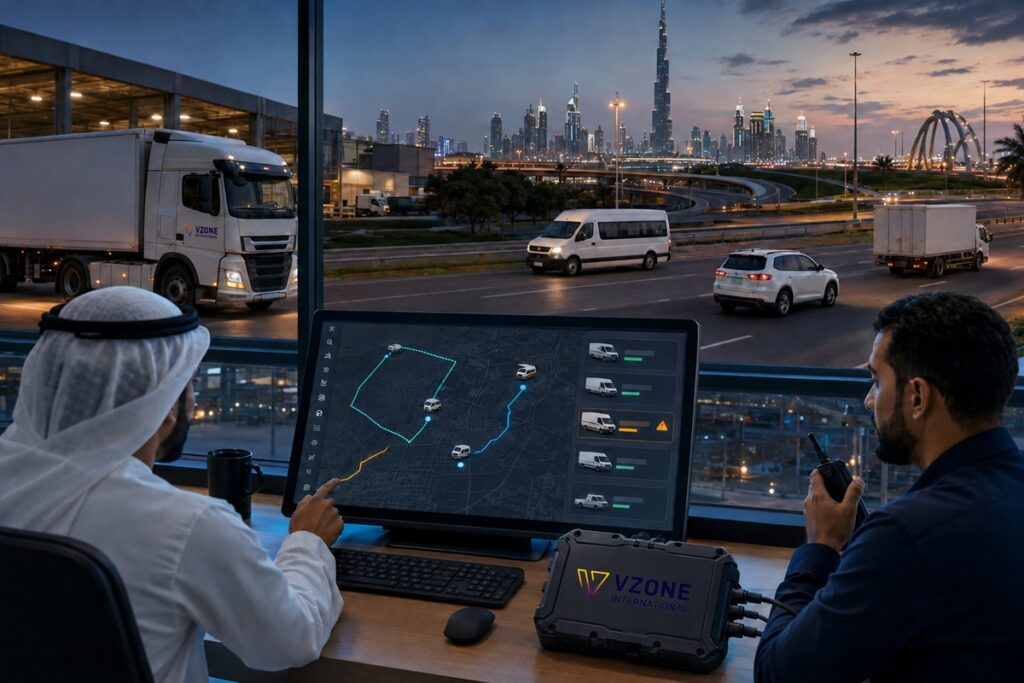
The live map showing every vehicle’s current GPS position, heading, speed, and status on an interactive map is the foundation of any vehicle tracking system. For UAE fleet operators, the live map enables the dispatch decisions that manual phone-call location checks cannot: identifying the nearest available vehicle for a new job, confirming that all vehicles have departed the depot for the morning shift, and locating a vehicle that a customer reports is late for a delivery. VZone International’s Wialon platform displays up to 500+ vehicles simultaneously on the live map with vehicle identity, current speed, and last event visible without clicking into each vehicle individually.
Geofencing and Zone Alerts
Geofencing allows fleet managers to draw virtual boundaries on the map depot perimeters, customer site boundaries, restricted zones, or delivery areas and configure alerts that fire when vehicles enter or exit those zones. For UAE fleet management, geofencing serves multiple purposes: after-hours exit alerts from the depot (detecting unauthorised vehicle use overnight), customer arrival and departure time recording (automatic proof of service window compliance), restricted zone monitoring (ensuring vehicles do not enter ADNOC security perimeters without authorisation), and school bus route boundary alerts (confirming buses stay on approved routes). Alerts are delivered as mobile push notifications, SMS, and email configurable per alert type and per recipient.
Route History and Trip Replay
Route history stores every completed trip as a time-stamped GPS track showing the exact path driven, stops made, speeds at each point, and events triggered (harsh braking, speeding, geofence crossings). Trip replay allows the fleet manager to watch any historical trip as an animated playback, with the vehicle moving along its actual route at the recorded speed. For UAE fleet operators, route history serves as the objective record for dispute resolution (delivery time verification, incident location confirmation, driver route compliance checking), insurance claim evidence, and coaching material for driver safety conversations.
Driver Behaviour Monitoring and Scoring
The GPS device’s three-axis accelerometer detects and records harsh braking, rapid acceleration, sharp cornering, and speeding events on every trip. These events are aggregated into a weekly driver safety score distance-normalised to enable fair comparison between high-mileage and low-mileage drivers. The driver safety scorecard, visible to fleet managers in the platform and to drivers through the driver app, is the data foundation of the coaching programme that reduces at-fault incident rates by 30 to 40 percent within 12 months. For UAE ADNOC contractor fleets, driver behaviour data is also submitted to the ADNOC IVMS portal as part of the mandatory HSE reporting programme.
Maintenance Scheduling and OBD Alerts
Fleet management platforms integrate GPS-verified mileage with configurable service interval thresholds to generate automatic maintenance alerts 30 days before the next oil change, 7 days before a tyre rotation, immediately when an OBD fault code is detected. For UAE fleets, GPS mileage-triggered maintenance scheduling eliminates the systematic driver odometer under-reporting that causes missed services in manually tracked fleets. OBD integration adds the predictive layer detecting developing engine faults between scheduled services before they cause roadside breakdowns.
Compliance and Document Tracking
For UAE commercial vehicles, GPS vehicle tracking systems integrate with the compliance management functions that manual administration cannot consistently maintain: Asateel data submission (continuous GPS data transmission to the ITC portal required for all Abu Dhabi commercial vehicles), Mulkia and insurance expiry alerts (advance notification before vehicle registration lapses), driver licence expiry tracking, and ADNOC IVMS HSE report generation. VZone International manages all UAE GPS compliance certifications Asateel, SecurePath, IVMS, SIRA, OPAL from the same Wialon platform deployment that handles fleet GPS tracking.
Choosing a Vehicle Tracking System Checklist
The right vehicle tracking system depends on your use case, vehicle type, fleet size, and compliance requirements. Use this checklist to evaluate any GPS vehicle tracking system before committing.
| ✓ | Checklist Item | What to Look For |
| ☐ | UAE compliance certification | Asateel certified (ITC Abu Dhabi) for all Abu Dhabi commercial vehicles; SecurePath (RTA Dubai) for school buses and rental cars; OPAL for UAE-Oman cross-border routes. Confirm the specific device model is on the certified list not all devices from a certified brand are individually certified. |
| ☐ | Device operating temperature | Minimum +85°C ambient rating for UAE summer conditions. Devices rated to +70°C may fail or give inaccurate readings in UAE summer engine bay temperatures. Ask for the device’s MTBF (mean time between failures) data for high-temperature environments. |
| ☐ | Cellular network compatibility | 4G LTE with UAE network compatibility (du and Etisalat bands). Confirm store-and-forward capability for remote routes (Western Region, UAE-Oman) devices that lose data when cellular signal is unavailable are inadequate for UAE remote operations. |
| ☐ | GPS update interval | Configurable 10 to 30 seconds for commercial fleet use. Intervals longer than 60 seconds miss short stops, reduce driving behaviour event accuracy, and make live position useful only for approximate location rather than precise dispatch management. |
| ☐ | Driver behaviour monitoring | Full three-axis accelerometer for harsh braking, acceleration, and cornering detection. Speed-vs-posted-limit comparison (not just fixed speed thresholds). ADNOC IVMS multi-tier speed event classification if ADNOC contractor fleet compliance is required. |
| ☐ | OBD-II or CAN bus integration | OBD-II for light commercial vehicles and passenger cars. CAN bus for heavy trucks (required for accurate fuel level, transmission speed, and engine load data). Confirm the specific vehicle make/model CAN database is supported. |
| ☐ | Software platform depth | Live map, route history, geofencing, and driver scoring are minimum. For fleet management: maintenance scheduling, fuel monitoring, compliance tracking, ERP integration, and Arabic/English interface are required for UAE operations. |
| ☐ | Mobile app quality | iOS and Android manager app (live map, push alerts, reports) and driver app (inspection checklist, safety score, ePOD) with Arabic language support. Offline functionality for remote route operations. |
| ☐ | Hardware warranty and support | Minimum 2-year hardware warranty with UAE-based support. Installation by Teltonika certified installer (VZone International is a certified Teltonika installer) for warranty validity and correct configuration. |
| ☐ | Scalability | Platform can accommodate fleet growth without system replacement. VZone International’s Wialon platform supports 3,400+ device types adding new vehicle categories, expanding to GCC countries, and integrating new data sources does not require switching platforms. |
Conclusion
A vehicle tracking system is one of the highest-ROI technology investments available to UAE fleet operators for fleets of any size, from a single company car to a 500-vehicle logistics operation. The combination of real-time visibility, driver behaviour coaching, maintenance automation, and compliance management that a well-deployed GPS vehicle tracking system provides reduces total fleet operating cost by 20 to 30 percent within 12 months, while simultaneously improving safety performance and regulatory compliance.
The checklist above applies to any GPS tracking system evaluation. For UAE commercial fleets specifically, the non-negotiable requirements are UAE compliance certification (Asateel, IVMS, or SecurePath as applicable to the vehicle category), high-temperature device rating for UAE summer conditions, and a software platform that supports the compliance, maintenance, and fuel management functions that UAE fleet regulations and operating conditions require. VZone International’s deployment of 3,400+ supported device types on the Wialon platform, with 20+ years of UAE fleet operations experience and certified Teltonika installer status, satisfies all three requirements for UAE commercial fleet operators.
Try VZone International’s GPS Vehicle Tracking System Free Demo
VZone International provides GPS vehicle tracking for UAE commercial fleets from a single vehicle to 500+. Teltonika certified installer. Asateel, IVMS, SecurePath, and OPAL certified devices. 20+ years UAE operations. 4,000+ UAE fleets served. Contact our team for a live platform demo and a fleet assessment for your vehicle type and compliance requirements.
Frequently Asked Questions
A vehicle tracking system is used for five primary purposes. First, real-time location visibility knowing where every vehicle is at any moment, enabling efficient dispatch decisions and customer ETA communication. Second, driver behaviour monitoring detecting and scoring harsh driving events (braking, acceleration, cornering, speeding) to identify drivers who need coaching and reduce accident rates. Third, route history and compliance documentation maintaining a permanent GPS record of every trip for dispute resolution, insurance claims, and regulatory compliance. Fourth, maintenance management using GPS-verified mileage to trigger service alerts and OBD diagnostics to detect developing faults before they cause breakdowns. Fifth, cost management monitoring idling time, fuel consumption, and route efficiency to identify and eliminate the waste that drives fleet operating costs above efficient benchmarks. For UAE commercial vehicle operators, vehicle tracking systems also serve a sixth purpose: regulatory compliance Asateel, IVMS, SecurePath, and OPAL data submission requirements that are legal obligations for specific vehicle categories.
GPS vehicle tracking accuracy in UAE open-sky conditions (highways, open desert, suburban areas) is typically 2 to 5 metres sufficient to determine which lane a vehicle is in or confirm its position within a specific property. In UAE urban canyon environments (dense Dubai and Abu Dhabi city centre areas with tall buildings on both sides of the road), GPS accuracy reduces to 10 to 25 metres as satellite signals are reflected and blocked by buildings. This reduced accuracy is still adequate for fleet management purposes confirming the vehicle's general location, route, and speed but is less precise than open-sky performance. Multi-constellation GNSS devices (receiving GPS, GLONASS, Galileo, and BeiDou signals simultaneously) maintain better accuracy in urban environments than single-GPS devices by using more satellites from multiple orbital planes, reducing the impact of individual signal blockages.
GPS tracking of company-owned vehicles by employers is legal in UAE and for many commercial vehicle categories (Abu Dhabi commercial vehicles under Asateel, ADNOC contractor vehicles under IVMS, Dubai school buses under SecurePath) it is legally mandatory. Employers do not need individual driver consent to install GPS tracking on company vehicles. However, UAE PDPL (Personal Data Protection Law, Federal Decree Law No. 45 of 2021) requires that employees are informed that GPS monitoring is active on company vehicles disclosure is required, not consent. The disclosure should be made in writing in employment contracts or fleet policy documents. For personal vehicles, GPS tracking by the vehicle owner is legal. Tracking another person's vehicle without their knowledge or consent is illegal under UAE law any GPS tracking of a vehicle must be authorised by the vehicle's registered owner.
GPS tracker installation for UAE commercial vehicles involves three steps. First, device selection choosing the correct device for the vehicle type (OBD-II plug-in for light vehicles, hardwired for commercial vehicles, CAN bus for heavy trucks) and confirming UAE compliance certification status if required for the vehicle category. Second, physical installation hardwired GPS devices are connected to the vehicle's constant power supply, switched ignition circuit, and ground; the device is typically installed in a concealed location (under the dashboard, in the engine bay, or in the vehicle's cargo area). Third, platform configuration the device is added to the fleet management platform with the vehicle's registration details, the driver assignment, and the alert and compliance configuration for the vehicle type. VZone International installs all GPS devices as a Teltonika certified installer the installation is covered by both the device warranty and VZone's service guarantee, with full configuration on the Wialon platform included in the deployment. Installation typically takes 30 to 90 minutes per vehicle depending on vehicle type and complexity.