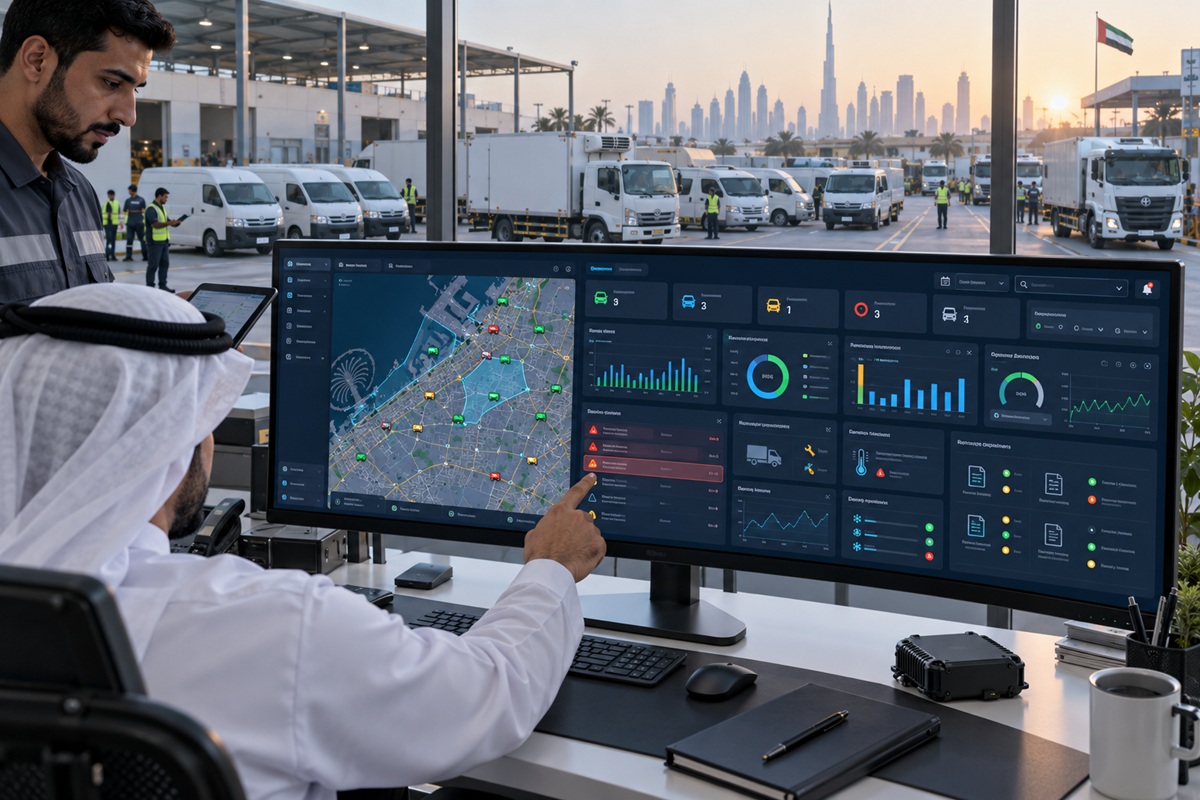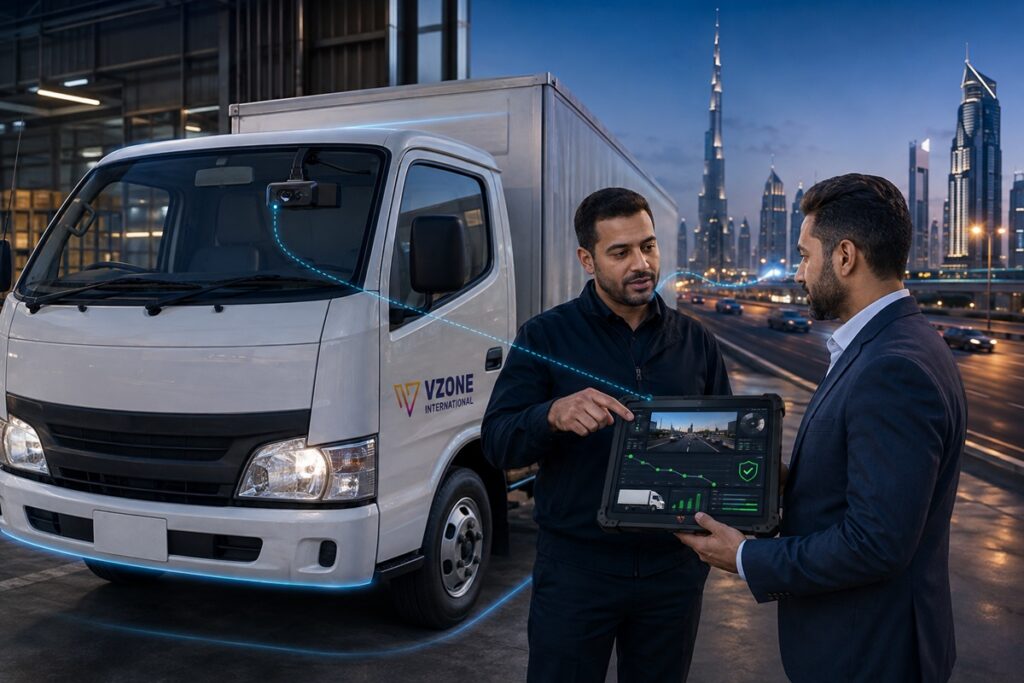
UAE commercial fleet insurance is priced on two variables that fleet operators can directly influence: claims history and demonstrated risk. A fleet with three at-fault accidents in the past 24 months pays materially more than a fleet with one not because the insurer is penalising the fleet manager, but because claims history is the most reliable predictor of future claims that actuarial models have access to. And a fleet that presents its insurer with verified telematics data showing driver safety scores, event frequency by type, and a sustained driver coaching programme is presenting evidence that its demonstrated risk is lower than its claims history suggests which is exactly the argument that shifts premium rates.
Video telematics changes the fleet insurance conversation in three distinct ways. It gives insurers the structured safety data they need to price risk more precisely. It gives fleet operators the documented evidence to defend against fraudulent and exaggerated third-party claims one of the most significant cost drivers in UAE commercial fleet insurance. And it gives both parties a coaching programme that demonstrably reduces accident frequency over time, improving the claims history that determines renewal pricing.
This guide explains how each mechanism works, what data UAE insurers actually require to apply telematics-based premium reductions, how much reduction is realistic at different fleet sizes and safety performance levels, and how to present telematics data to your insurer to capture the maximum available premium reduction at renewal.
Key Takeaways
- Video telematics reduces UAE fleet insurance premiums through three mechanisms: actuarial risk differentiation from structured safety data (10–20% reduction), fraudulent claim defence from dashcam footage (avoided claims cost rather than premium reduction), and claims history improvement from coaching-driven accident reduction (15–25% reduction over 24 months).
- UAE commercial fleet insurance fraud where third-party claimants exaggerate or fabricate injury and damage claims after genuine minor incidents is a significant cost driver. Dashcam footage with GPS-matched speed and impact data provides the objective evidence to defend against fraudulent escalation, with individual defended claims avoiding AED 15,000 to AED 80,000 in inflated settlement costs.
- The telematics data that UAE insurers require for premium reduction is not raw dashcam footage it is structured safety event data: AI-generated event frequency reports by driver and event type, fleet safety score trends, coaching programme documentation, and accident frequency vs industry benchmark comparison.
- Premium reduction timelines in UAE fleet insurance follow a two-phase pattern: immediate reduction (10–15%) at first renewal after telematics deployment from safety data presentation; accelerated reduction (additional 10–15%) at second renewal after 12+ months of demonstrated low-event-rate performance.
- The financial case for video telematics in UAE fleet operations should include three components: direct premium savings, avoided claim settlement costs from fraud defence, and avoided repair and operational disruption costs from reduced accident frequency not just the premium line.
How UAE Fleet Insurance Is Priced and Where Telematics Fits
UAE commercial fleet insurance underwriters price motor fleet policies using a combination of historical claims data, fleet composition data (vehicle types, ages, and values), driver demographics (licence ages, nationalities, previous accident history), and operational profile (route types, annual mileage, operating hours). Traditional underwriting without telematics data relies heavily on historical claims a backward-looking variable that captures the fleet’s risk as it was in the past, not as it is today after a driver coaching programme has run for 12 months.
Telematics data introduces a forward-looking variable: current demonstrated driving behaviour. A fleet that had four at-fault accidents 18 months ago but has run an AI dashcam driver coaching programme for 12 months and can demonstrate a 40 percent reduction in harsh event rates is demonstrably a different risk from the historical claims data alone. Telematics data gives the underwriter the evidence to price that improvement and the fleet operator the ability to present that evidence systematically rather than relying on the underwriter to accept an unsupported assertion.
The Three Telematics Mechanisms How Each Reduces Insurance Cost
It is important to distinguish between the three mechanisms through which telematics reduces fleet insurance cost because each operates on a different timeline, requires different data, and produces a different financial output. Conflating them into a single ‘telematics saves 30 percent’ claim both overstates the immediate first-renewal impact and understates the total long-term value.
| Mechanism | Financial Output | Timeline | Data Required from Telematics | Typical UAE Impact |
| Actuarial risk differentiation | Direct premium reduction at renewal insurer accepts lower rate based on verified low-risk driving data | First renewal (6–12 months after deployment) | Structured AI safety event report: event frequency by type, fleet safety score trend, comparison to non-telematics fleet benchmark | 10–20% premium reduction vs non-telematics fleet rate |
| Fraudulent claim defence | Avoided claim settlement not a premium line item, but prevented loss that would otherwise appear in claims history and load future premiums | Immediate any incident produces usable footage | GPS-timestamped dashcam footage showing vehicle speed at impact, driver behaviour before collision, third-party position and conduct | AED 15,000–80,000 avoided per successfully defended fraudulent or exaggerated claim |
| Claims history improvement | Progressive premium reduction at second and third renewal as reduced accident frequency improves 3-year claims record | Second renewal (18–24 months after coaching programme begins) | Accident frequency trend data; coaching programme attendance records; safety score improvement documentation | Additional 10–15% premium reduction at second renewal on top of first-renewal reduction |
Fraudulent and Exaggerated Claims The UAE-Specific Insurance Problem
Third-party fraud and claim exaggeration in UAE commercial fleet insurance is a more significant cost driver than in most other markets and one that fleet operators frequently underestimate because the inflated settlement amounts are absorbed into claims history rather than appearing as an explicit fraud cost. The pattern is consistent: a minor genuine incident (low-speed collision, door contact, minor scrape) is followed by a third-party claim that escalates the injury or damage description substantially above what the actual incident warrants.
Without dashcam footage, the fleet operator’s insurer has no objective basis to challenge the third-party’s account of the incident. The claim goes to assessment on the basis of the third-party’s description, their medical reports, and their vehicle repair estimates and the settlement reflects the described rather than the actual incident. With GPS-matched dashcam footage showing vehicle speed at the moment of impact, driver behaviour in the seconds before the collision, and the road environment context, the insurer can objectively assess the claim against the actual incident rather than the described one.
What UAE Dashcam Footage Can Prove in an Insurance Claim
The combination of forward-facing dashcam footage and GPS telematics data provides the objective evidence package that transforms a third-party-word-against-fleet-operator situation into a documented factual record. Specifically, the footage and data combination can demonstrate:
- Vehicle speed at the moment of impact (GPS speed log with video corroboration) establishing whether a claimant’s assertion of ‘high-speed collision causing significant injury’ is consistent with GPS-verified speed at impact
- Driver behaviour in the 30 to 60 seconds before the incident demonstrating that no harsh event occurred before the collision point, ruling out aggressive driving as a contributing factor
- Third-party vehicle position and conduct (forward camera) showing whether the third party contributed to the incident through lane violation, sudden stop, or illegal manoeuvre
- Environmental conditions at the time of the incident lighting, weather, road markings, and signage visible in forward footage, relevant to claims involving visibility as a factor
- Whether the incident actually occurred as claimed dashcam timestamps and GPS location data can confirm or refute a claimant’s account of where and when the incident occurred
For UAE fleet operators whose at-fault accident rate is materially affected by claims where third-party conduct was the primary or contributing cause a pattern that UAE insurance practitioners report as common dashcam evidence that successfully defends against fraudulent or exaggerated claims has an impact on claims history that compounds at every subsequent renewal cycle.
What Data UAE Insurers Actually Require for Telematics Premium Reduction
The most common mistake fleet operators make when attempting to leverage telematics data for insurance premium reduction is presenting the wrong data in the wrong format. UAE commercial fleet insurers are not interested in viewing dashcam footage to assess driver quality they are interested in structured, statistically summarised data that their actuarial models can process to validate a risk assessment. Raw footage is evidence; structured event reports are actuarial input.
The Telematics Data Package UAE Insurers Accept
The following data package, presented at renewal, gives UAE commercial fleet underwriters the actuarial evidence they need to apply telematics-based premium reductions. The data should cover the full policy period ideally 12 months and be presented in a structured report format rather than as raw platform exports.
| Data Element | What It Shows the Insurer | Format Required | Source from VZone Platform |
| Fleet safety score monthly trend | Whether driver behaviour has improved, deteriorated, or remained stable over the policy period | Chart showing monthly average fleet safety score with start and end values | VZone fleet safety score trend report |
| AI event frequency by category | Harsh braking, acceleration, cornering, speeding, fatigue, distraction events per vehicle per month | Table: event type × monthly count × trend direction | VZone AI event frequency report by category |
| Driver safety score distribution | Percentage of drivers in high, medium, and low risk score bands showing improvement over programme period | Histogram: driver count by score band (start vs end of period) | VZone driver safety distribution report |
| Accident frequency vs benchmark | Fleet’s at-fault accident rate per 100,000 km vs UK/UAE industry benchmark for fleet type | Single metric comparison with source benchmark reference | VZone accident frequency report + industry benchmark |
| Coaching programme documentation | Evidence that the telematics data was used for systematic driver coaching, not just collected | Coaching session records: date, driver, events discussed, outcome | VZone driver coaching assignment and completion log |
| Incident footage availability confirmation | Statement that dashcam footage is retained for all incidents and available for claim investigation | Letter from fleet manager confirming retention period and access process | VZone cloud footage retention policy document |
How Much Can Video Telematics Reduce UAE Fleet Insurance Premiums?
Premium reduction figures for telematics-based fleet insurance in UAE vary with fleet size, vehicle category, current claims history, and the quality of the telematics data package presented at renewal. The following ranges represent realistic outcomes for UAE fleet operators based on the three mechanism model above.
| Fleet Profile | Current Claims Status | First Renewal Reduction (12 months telematics) | Second Renewal Reduction (24 months) | Annual Saving (50-vehicle fleet, AED 600k premium) |
| Heavy transport / logistics (high mileage) | Average claims 2–4 at-fault pa | 10–15% (safety data presentation) | Additional 10–12% (claims history improvement) | AED 60,000–81,000/year by Year 2 |
| Urban delivery fleet (multi-stop) | Above-average claims 4–6 at-fault pa | 12–18% (safety data + some claims history) | Additional 8–12% (coaching impact clear) | AED 72,000–108,000/year by Year 2 |
| Long-haul contractor fleet (ADNOC) | High mileage variable claims | 15–20% (fatigue data + safety score) | Additional 8–10% (fatigue event reduction) | AED 90,000–120,000/year by Year 2 |
| School bus fleet (controlled routes) | Low claims controlled environment | 8–12% (safety data confirmation) | Additional 5–8% (sustained low events) | AED 48,000–60,000/year by Year 2 |
| Mixed fleet delivery + heavy | Average 3–5 at-fault pa | 10–15% (fleet-wide safety data) | Additional 10–15% (coaching evidence) | AED 60,000–90,000/year by Year 2 |
These estimates use an illustrative AED 600,000 annual premium for a 50-vehicle fleet approximately AED 12,000 per vehicle per year, a representative rate for a mixed commercial van and light truck fleet in UAE. Actual premiums vary significantly with vehicle category, age, driver demographics, and current claims loading. The premium reduction percentages are conservative fleets that present strong telematics packages with sustained coaching evidence have achieved 25 to 30 percent reductions in UAE.
How to Present Telematics Data to Your UAE Insurer at Renewal
The renewal conversation is the moment when telematics investment converts to premium reduction. Most fleet operators underperform this conversation because they do not present their telematics data in the format that underwriters can act on. The following approach maximises the premium reduction available from your telematics deployment.
Step 1 Request a Telematics Premium Review from Your Broker
Standard fleet insurance renewal processes do not automatically trigger a telematics data review. Fleet operators must proactively request that their broker present telematics-verified safety data to the underwriter as part of the renewal submission specifically asking for a telematics premium assessment rather than a standard renewal based on claims history alone. This is not a standard broker workflow in the UAE market; it requires the fleet manager to specifically instruct the broker and provide the telematics data package for the broker to include in the underwriter submission.
Step 2 Prepare the 12-Month Telematics Data Package
Prepare the structured data package described in Section 3 covering fleet safety score trend, AI event frequency by category, driver score distribution, coaching programme documentation, and incident footage availability confirmation for the 12-month period of the current policy. VZone International generates this package as a standard report from the fleet management platform ; the report is formatted for insurance underwriter submission rather than internal fleet management review.
Step 3 Present the Benchmark Comparison
The most persuasive single data point in the telematics renewal submission is a benchmark comparison showing your fleet’s accident rate and safety event frequency against the industry benchmark for your fleet category. An underwriter who sees that your fleet’s at-fault accident rate is 30 percent below the industry average for your vehicle category and route profile has a specific, quantifiable actuarial basis for applying a premium reduction. Without the benchmark, the underwriter has only your fleet’s history to work with and your history may not have enough years of telematics data to be statistically compelling on its own.
Step 4 Include Defended Claim Evidence Where Available
If dashcam footage contributed to a successfully defended claim during the policy period where a third-party claim was reduced or withdrawn after footage was presented document this as part of the renewal submission. The defended claim demonstrates both the quality of your dashcam footage and the commercial value it provided during the policy year. An underwriter who can see that dashcam evidence avoided AED 45,000 in an inflated third-party settlement during the policy year has a direct financial proof point for the value of the telematics investment and a reason to reflect that risk management capability in the renewal pricing.
VZone International’s Fleet Insurance Telematics Support
VZone International provides UAE fleet clients with the structured telematics data reporting that insurance renewal submissions require not as a custom service but as a standard feature of the fleet management platform. Fleet safety performance reports in insurance-submission format, driver coaching programme documentation, AI event frequency summaries, and incident footage retention confirmation are available from the Wialon platform at any time and can be generated for any historical period within the platform’s data retention range.
Insurance-Format Safety Reports
VZone’s insurance-format safety report is a structured PDF document covering: 12-month fleet safety score trend with start, end, and monthly values; AI event frequency by category (fatigue, distraction, harsh braking, speeding, seatbelt) with month-by-month trend; driver score distribution showing percentage improvement in high-risk driver count; coaching programme summary showing events addressed and driver improvement; and incident footage retention statement. The report is formatted for broker and underwriter submission without requiring the fleet manager to extract and reformat platform data.
Fraud Defence Footage Instant Access
When an incident occurs, VZone’s cloud-stored dashcam footage is immediately accessible to the fleet manager through the platform dashboard no SD card retrieval, no delay waiting for the vehicle to return to depot. The footage is GPS-timestamped and linked to the vehicle’s full telematics event record at the time of the incident speed, driver identity, harsh event history before the collision, and the 30 seconds of forward footage showing the road environment. This complete incident evidence package can be shared with the insurance broker and legal team within hours of the incident rather than days.
Conclusion: Telematics Data Is Your Insurance Negotiation Asset
Fleet insurance premiums in UAE are not fixed by actuarial tables that fleet operators cannot influence. They are negotiated and the quality of the evidence that fleet operators present at renewal determines whether the negotiation produces a premium reduction or a loading. Video telematics gives fleet operators the evidence: verified safety scores, AI event frequency trends, coaching programme documentation, and incident footage that transforms an insurance renewal from a claims-history-based negotiation to a current-performance-based one.
The three-mechanism model actuarial risk differentiation, fraud claim defence, and claims history improvement produces a combined insurance cost reduction over 24 months that substantially exceeds the video telematics investment for most UAE fleet profiles. The premium reduction is not an incidental benefit of deploying dashcams for safety management. It is a primary financial return that belongs in the business case for the investment alongside fuel savings, maintenance cost reduction, and cargo protection.
For UAE fleet operators who have already deployed video telematics but have not yet leveraged the data for insurance premium negotiation the renewal conversation with a properly prepared telematics data package is the fastest return-on-investment action available from an existing deployment.
Get your fleet telematics data package ready for insurance renewal.
VZone International generates insurance-format fleet safety performance reports 12-month safety score trends, AI event frequency by category, coaching programme documentation, and incident footage retention confirmation as a standard platform report. Contact our team to prepare your telematics data package before your next UAE fleet insurance renewal.
Frequently Asked Questions
Video telematics reduces UAE fleet insurance costs through three mechanisms working simultaneously: actuarial risk differentiation (structured AI safety event data enables underwriters to price your fleet's current demonstrated risk rather than historical claims alone 10 to 20 percent premium reduction at first renewal); fraudulent claim defence (GPS-matched dashcam footage defends against inflated third-party claims AED 15,000 to AED 80,000 avoided per successfully defended claim); and claims history improvement (AI dashcam coaching programmes reduce accident frequency over 12 to 24 months improving the claims record that determines 3-year rolling premium calculations).
UAE fleet insurance premium reductions from telematics range from 10 to 15 percent at first renewal (from safety data presentation alone) to 20 to 30 percent cumulative reduction by the second or third renewal as coaching-driven claims history improvement compounds. For a 50-vehicle fleet paying AED 600,000 annually in commercial motor insurance, a 20 to 30 percent reduction represents AED 120,000 to AED 180,000 in annual premium saving significantly exceeding the annual cost of the video telematics platform. Actual reduction depends on fleet category, current claims loading, and the quality of the telematics data package presented at renewal.
UAE commercial fleet insurers require structured safety data not raw dashcam footage for telematics-based premium assessment. The data package should include: 12-month fleet safety score trend chart; AI event frequency by category (fatigue, distraction, harsh braking, speeding, seatbelt) with monthly trend; driver safety score distribution showing high/medium/low risk percentage at start and end of policy period; coaching programme records showing events addressed and driver improvement; fleet accident frequency compared to industry benchmark for the fleet category; and a statement confirming dashcam footage retention and accessibility for claim investigation. VZone International generates this package in insurance-submission format as a standard platform report.
Yes dashcam footage combined with GPS telematics data is the most effective tool available to UAE fleet operators for defending against fraudulent or exaggerated third-party insurance claims. The combination proves vehicle speed at impact (GPS log), driver behaviour before the collision (dashcam footage), third-party vehicle position and conduct (forward camera), and road environment conditions providing an objective evidence base that refutes inflated claims without relying on driver testimony alone. UAE fleet operators who have successfully defended claims using dashcam footage report avoided settlements of AED 15,000 to AED 80,000 per incident compared to the claimant's initial demand. Each successfully defended claim also prevents that inflated amount from appearing in claims history and loading future premiums.