Last-mile delivery in UAE is the most operationally demanding environment in the commercial fleet sector not because the distances are long or the routes are complex, but because the combination of factors that create driver risk are highest in urban delivery conditions. A driver making 25 to 35 delivery stops per day in Dubai or Abu Dhabi is navigating dense pedestrian zones, executing frequent roadside parking manoeuvres in non-designated spaces, managing phone-based dispatch and address navigation while driving between stops, and doing all of this at a pace pressure created by tight delivery windows and customer SLA commitments. Each stop is a potential incident. Each km between stops is a distraction risk.
The growth of UAE’s e-commerce and quick commerce sectors Noon, Talabat, Amazon.ae, Deliveroo, and the dozens of smaller operators across the Emirates has added vehicle volume to Dubai and Abu Dhabi’s already congested road network while also raising the service standard that last-mile operators must meet: sub-two-hour delivery, real-time customer tracking, photo proof of delivery, and the SLA penalty clauses that major retail and food delivery clients apply when those standards are not met. The fleet technology infrastructure required to satisfy these service standards GPS route optimisation, ePOD, customer ETA, driver monitoring overlaps significantly with the safety and compliance technology that video telematics provides.
This guide explains how video telematics specifically addresses the last-mile delivery operating environment in UAE what AI dashcam adds for urban high-stop routes that standard GPS tracking cannot, how ePOD integration connects video telematics to delivery proof workflows, how customer-facing ETA visibility works, and what the safety and insurance value of video telematics looks like for a typical UAE last-mile fleet.
Key Takeaways
- Last-mile delivery in UAE creates a specific driver safety risk profile high stop frequency, phone-based dispatch and navigation during driving, frequent roadside parking manoeuvres, and pace pressure from delivery windows that makes AI dashcam distraction detection more operationally relevant here than for long-haul or low-stop fleet operations.
- Distraction detection (phone use, eyes off road, extended gaze anomaly) is the highest-priority AI dashcam capability for UAE urban delivery fleets because the specific behaviour patterns that create distraction risk phone-in-hand navigation, WhatsApp dispatch communication, food delivery app management are most prevalent in urban multi-stop delivery operations.
- Electronic proof of delivery (ePOD) integration with the fleet telematics platform connects the GPS location record to the delivery event producing a GPS-timestamped delivery confirmation that satisfies customer accountability requirements and protects the fleet operator in failed-delivery disputes.
- Customer-facing ETA visibility sharing GPS-based delivery ETAs with recipients through a customer portal or SMS notification has become a commercial expectation in UAE’s B2B and e-commerce delivery market, and the GPS telematics infrastructure that drives safety monitoring also drives this customer-facing capability.
- The high incident frequency of urban last-mile delivery fleets more incidents per km than any other commercial fleet category creates the strongest financial case for video telematics investment, because the accident claim defence and insurance premium reduction value is largest for the fleet category with the most incidents to defend and insure.
The Last-Mile Delivery Risk Profile Why Urban Stop Routes Are Different
High Stop Frequency The Cumulative Risk Multiplier
A 25-stop delivery route creates 25 roadside parking manoeuvres, 25 vehicle approaches to pedestrian access points, 25 loading area entries, and 25 occasions when the driver re-enters moving traffic from a stationary position. Each individual stop event is a low-probability incident risk. The cumulative probability of at least one incident across 25 stops compounding across the daily route is significantly higher than for fleet operations with fewer, longer transit segments. A long-haul truck driver covering 600 km in one trip creates one arrival and departure at each end; a last-mile delivery driver covering 120 km across 25 stops creates 50 roadside approach and departure events at varying urban locations.
This stop-frequency multiplication of incident opportunity is the core reason why last-mile delivery fleets show higher incident rates per km than most other commercial vehicle categories in UAE insurance data and why the per-vehicle incident claim frequency in urban delivery operations makes fleet insurance the highest single-line cost after fuel and labour for many UAE delivery operators. Video telematics that reduces incident frequency through distraction detection and driver coaching has a proportionally higher financial return for high-stop delivery fleets than for low-stop commercial operations.
Phone-Based Dispatch and Navigation The Distraction Epidemic
UAE urban delivery operations are disproportionately phone-dependent compared to their international peers for two reasons specific to the UAE market. The first is the widespread use of WhatsApp for delivery dispatch and customer communication: drivers receive delivery instructions, address updates, gate codes, and customer contact messages via WhatsApp throughout the delivery shift, creating a continuous notification pressure that drives phone-in-hand behaviour even between stops. The second is the navigational complexity of UAE urban addressing particularly in older residential and commercial areas where traditional addressing systems are inadequate, making Google Maps or Waze navigation on the phone an operational necessity for unfamiliar areas.
The combination of operational necessity and continuous notification pressure creates a phone-in-hand prevalence in UAE urban delivery drivers that is significantly higher than in markets with regulated fleet dispatch systems, in-vehicle sat-nav, and cleaner urban addressing. AI dashcam distraction detection that flags phone-to-ear, phone-in-hand, and eyes-off-road events provides the monitoring layer that identifies which drivers are managing this phone dependency safely and which are not enabling targeted coaching rather than blanket policy enforcement that ignores the operational reality of UAE urban delivery.
Roadside Parking and Pedestrian Exposure
Last-mile delivery in UAE’s urban centres involves frequent roadside parking in non-designated locations double parking on delivery access streets, brief stops in loading zones, pavement parking in residential areas that creates pedestrian exposure risk at each delivery point. The driver who parks briefly, exits the vehicle, completes the delivery, and re-enters traffic creates pedestrian exposure at both the parking approach and the traffic re-entry. In the dense pedestrian environments of Dubai’s commercial districts, Abu Dhabi’s residential zones, and the high-footfall areas around residential tower blocks and villa compounds, this pedestrian exposure is the primary cause of the low-speed delivery vehicle incidents that generate disproportionate injury claims despite modest property damage.
Forward and side cameras on delivery vehicles provide the footage that documents the parking approach, the pedestrian environment at the time of the stop, and the traffic re-entry the three events where delivery vehicle incidents most commonly occur. This footage is the most commercially valuable dashcam evidence for last-mile delivery operators because it addresses the specific incident pattern that drives the highest claim volumes in urban delivery fleet insurance.
What Video Telematics Adds for Last-Mile Delivery Fleets
AI Distraction Detection The Primary Safety Tool
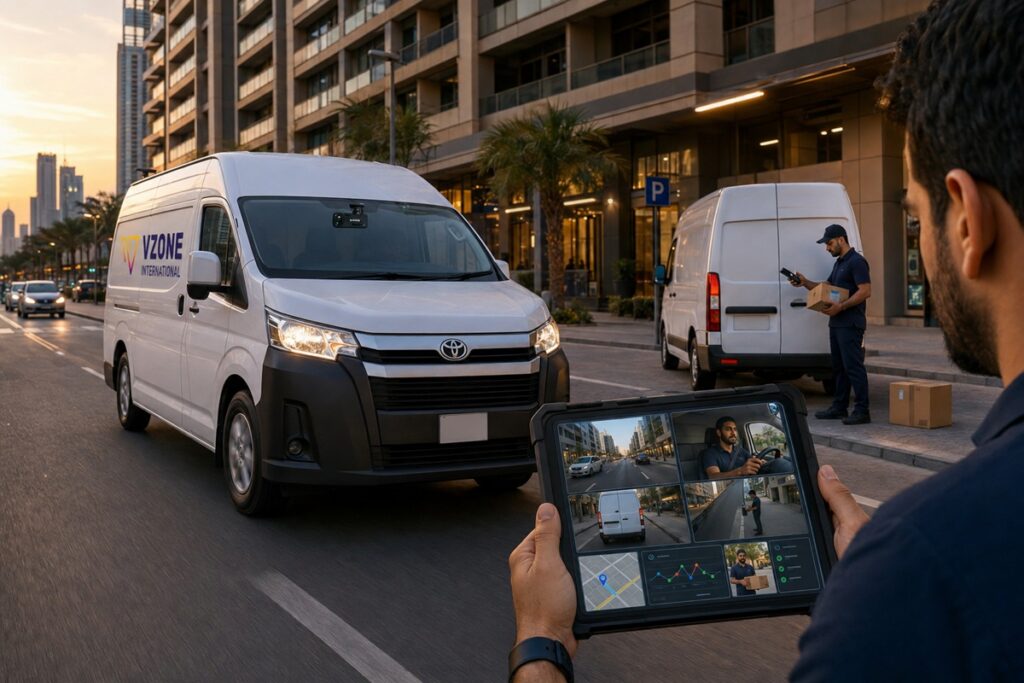
For UAE last-mile delivery fleets, AI dashcam distraction detection is more operationally relevant than fatigue detection. Long-haul fatigue is the primary risk for desert route operations; distraction is the primary risk for urban multi-stop operations. The driver who has been operating for 2 hours on a 25-stop route is not typically fatigued they are distracted by the operational phone demands of the delivery environment. The AI dashcam’s distraction detection capability phone-to-ear detection, hands-on-wheel compliance, eyes-off-road duration monitoring, extended gaze anomaly directly addresses the specific risk profile of urban last-mile delivery.
Distraction detection operates in real time: an in-cab alert fires within 2 to 3 seconds of a detected phone use or extended gaze event, creating the immediate feedback loop that modifies driver behaviour. The alert frequency pattern across the daily route also provides the coaching data for the weekly driver review: a driver who generates 8 phone-use events in a single delivery shift has a measurable behaviour pattern that a coaching conversation can address specifically not a generic ‘no phone while driving’ briefing, but ‘you had 8 phone events on Tuesday, the majority between stops 12 and 18, which maps to the route segment where you typically navigate through the Al Karama residential area without pre-loaded navigation.’
Electronic Proof of Delivery Connecting Telematics to Delivery Workflow
Electronic proof of delivery (ePOD) integrates the GPS telematics record with the delivery confirmation event creating a GPS-timestamped, location-verified delivery record that satisfies the documentation requirements of retail, e-commerce, and corporate customers while protecting the delivery operator against failed-delivery disputes. A delivery that the GPS record confirms occurred at the correct address at the correct time, confirmed by a driver-captured photo or digital signature on the driver app, cannot be disputed by a customer claiming non-delivery without challenging two independent electronic records simultaneously.
VZone International’s driver app integrates ePOD with GPS telematics: the delivery confirmation event (photo capture, digital signature, or one-tap confirmation) is GPS-timestamped at the moment of capture and linked to the vehicle’s GPS position at that exact second. The combined record GPS location confirming the vehicle was at the delivery address, driver app capture timestamped at the delivery moment provides the dual-system delivery confirmation that major UAE retail and e-commerce clients increasingly specify as a supplier documentation requirement. Operators who cannot provide GPS-verified delivery records are at a competitive disadvantage in B2B delivery contract negotiations where documentation standards are specified.
Customer-Facing ETA From Safety Data to Service Differentiator
The same GPS telematics infrastructure that powers safety monitoring, driver coaching, and compliance reporting also enables the customer-facing ETA visibility that UAE e-commerce and quick commerce customers expect. A customer who ordered a two-hour delivery slot and receives a push notification when the delivery vehicle is 10 minutes away with a live tracking link showing the vehicle’s progress toward their address is receiving a customer experience that the GPS data already supports without any additional hardware investment. The ETA calculation (stops remaining × average stop duration + distance to customer) uses the same GPS route data that the fleet manager monitors for operational management.
For UAE last-mile delivery operators competing for retail chain and corporate client contracts, GPS-verified customer ETA capability has shifted from a competitive advantage to a commercial baseline expectation in the past three years. Operators who cannot offer live customer tracking alongside their delivery service are competing on price alone against operators who offer tracking as standard. The GPS telematics platform that drives safety monitoring drives this commercial capability simultaneously the safety ROI and the commercial ROI of the platform investment are additive rather than competing.
Driver Safety Scoring Across High-Stop Routes
Generating a meaningful driver safety score across a 25-stop urban delivery route requires different scoring calibration from the highway driving scoring that most telematics platforms default to. Harsh braking events on a delivery route are more frequent per km than on a highway route because the stop frequency creates more braking occasions; cornering events are more frequent in urban turn-dense environments than on straight highway segments. A safety scoring algorithm that applies highway norms to urban delivery data produces inflated harsh event counts that do not accurately reflect driver risk and that create frustration among drivers who know their behaviour is being scored against the wrong benchmark.
VZone International’s safety scoring calibration for last-mile delivery fleets uses urban stop-route norms event frequency benchmarks calibrated against the actual stop density and route complexity of UAE urban delivery operations producing safety scores that distinguish between the harsh event rate that normal urban delivery requires and the excess harsh event rate that indicates specific driver risk behaviour. This calibration is what makes the safety score useful for coaching rather than just frustrating the driver whose score is below benchmark has a genuinely elevated risk pattern, not just a busy route.
Video Telematics for Different Last-Mile Delivery Sectors in UAE
| Delivery Sector | Primary Risk Pattern | Video Telematics Priority | Key Operational Benefit |
| E-commerce (packages/parcels) | High stop frequency, roadside parking, phone navigation in unfamiliar areas | Distraction detection + ePOD + forward footage for parking manoeuvres | ePOD GPS verification reduces failed-delivery disputes; footage defends against parking incident claims |
| Quick commerce (sub-2hr groceries) | Extreme time pressure, high stop density, temperature-sensitive cargo for some orders | Distraction detection + real-time customer ETA + stop completion monitoring | Customer ETA notification reduces delivery-related customer contacts; driver coaching reduces pressure-induced risk behaviour |
| Food delivery (restaurant to consumer) | Night-time peak hours, motorbike-adjacent mixed traffic, unfamiliar residential addressing | Distraction detection + ePOD + night vision forward footage | Night footage provides clear incident evidence; ePOD protects against disputed deliveries; distraction coaching for peak-hour periods |
| B2B distribution (retail/hospitality) | Large retail and hotel receiving docks, loading bay manoeuvres, strict delivery windows | Forward + side cameras for dock approach + ePOD + GPS-verified window compliance | Dock approach footage defends property damage claims; ePOD satisfies retail client documentation requirements |
| Pharmaceutical last-mile | High-value cargo, compliance documentation, cold chain for some items, access restrictions | ePOD + cold chain integration + forward footage + driver identity per delivery | GDP-compatible delivery records; temperature-verified delivery confirmation; access-controlled facility approach documentation |
| Grocery retail delivery (supermarket) | Heavy loads, frequency of ground-floor and multi-storey residential delivery, customer interaction | Distraction detection + ePOD + driver coaching for residential approach | Customer satisfaction protected by verified delivery; safety coaching reduces residential-area incident rate |
The Financial Case for Video Telematics in Last-Mile Delivery
The ROI calculation for video telematics in last-mile delivery fleets is more favourable than for most other fleet types because the high incident frequency means there are more claim defence opportunities and more coaching impact points per vehicle per month. For a 30-vehicle UAE urban delivery fleet, the financial case typically includes:
| Financial Benefit | Mechanism | Typical UAE Value (30-vehicle fleet) |
| Incident rate reduction from coaching | AI event data enables specific coaching conversations that reduce distraction and harsh event rates by 25-40% over 12 months | AED 60,000-120,000/year in avoided accident costs at UAE urban delivery incident rates |
| Insurance premium reduction | Structured AI safety event data + reduced claims history at renewal | AED 30,000-70,000/year (Year 2+ as coaching impact shows in claims history) |
| Fraudulent claim defence | Urban delivery incidents are highest-fraud-risk category GPS speed + footage defends inflated injury claims | AED 20,000-80,000 per defended claim; delivery fleets typically face 2-4 high-risk claims/year |
| Failed delivery dispute resolution | ePOD GPS-timestamp eliminates ‘not delivered’ claims that result in redelivery cost or customer credit | AED 15,000-35,000/year in avoided redelivery and credit costs for 30-vehicle fleet |
| Customer retention from ETA service | GPS-verified ETA and live tracking satisfies B2B client documentation requirements | Contract retention value; typically AED 200,000+ annually for major B2B delivery contracts |
| Total combined annual value | All mechanisms, conservative estimates | AED 325,000-505,000/year vs platform cost of AED 70,000-100,000/year |
How VZone International Deploys Video Telematics for UAE Last-Mile Fleets
VZone International’s video telematics deployment for UAE last-mile delivery fleets combines dual-lens AI dashcam (forward road camera plus driver-facing infrared distraction detection), GPS route telematics with urban stop-route calibrated safety scoring, driver app with ePOD functionality, customer ETA portal integration, and fleet management dashboard with live delivery progress visibility all on the Wialon platform with a single login for fleet managers, operations supervisors, and safety officers.
Urban Stop-Route Calibrated Safety Scoring
VZone’s safety scoring for last-mile delivery fleets uses calibration developed from UAE urban delivery route data setting harsh event thresholds that reflect the stop density and turn complexity of Dubai and Abu Dhabi urban routes rather than applying highway benchmarks that misrepresent the risk profile of urban delivery operations. The calibrated scores produce meaningful coaching conversations: a driver whose score is below the urban delivery benchmark has a genuine excess harsh event pattern relative to their peers on similar routes, not an artefact of applying the wrong scoring standard to a demanding operational environment.
Driver App Dispatch, Navigation, and ePOD
VZone’s driver app for last-mile delivery provides the operational tools that reduce the unsafe phone behaviour that delivery operations generate: in-app job dispatch eliminates WhatsApp-based delivery instructions that drivers read while driving; integrated navigation (with the delivery stop sequence pre-loaded) reduces the need for separate Google Maps sessions on the driver’s personal phone; and ePOD capture (photo, signature, or confirmation tap) in the same app eliminates the additional device interactions that separate ePOD systems require. The principle is to consolidate all operational phone interactions into the fleet app reducing the total phone interaction load and ensuring that all interactions are captured in the operational record rather than dispersed across personal messaging apps.
Live Route Progress and Customer ETA
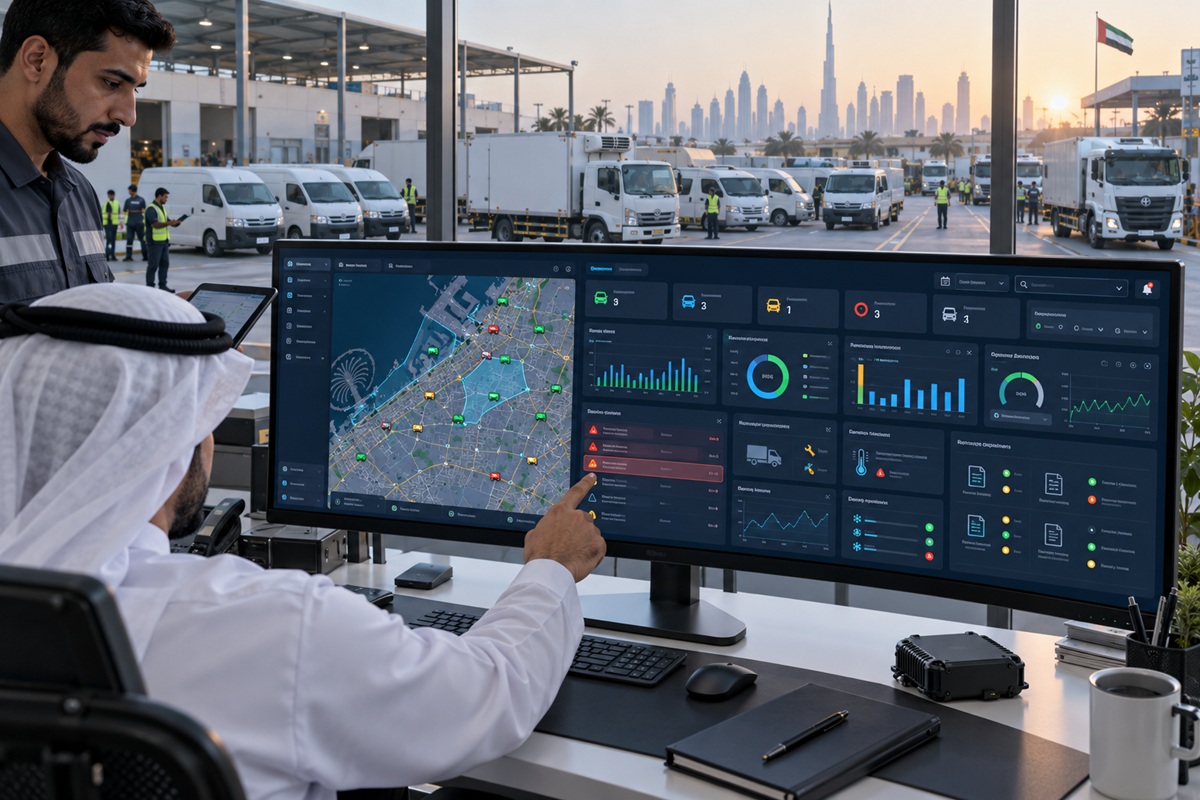
The fleet manager’s Wialon dashboard shows all delivery vehicles’ live GPS positions with stop completion progress stops done, stops remaining, estimated completion time, and any vehicles deviating from the planned route. The customer-facing ETA module draws on the same GPS data to provide recipients with a live tracking link (showing the delivery vehicle’s current position and estimated arrival) and a push notification when the vehicle is within the configured distance of the delivery address. The configuration is managed by the fleet operator which clients receive ETA notifications, at what distance threshold, in which format without requiring any technical work from the end customer.
Conclusion: Video Telematics Is the Infrastructure That Makes Last-Mile Delivery Sustainable
UAE’s last-mile delivery sector is growing faster than the safety and service infrastructure of many operators can accommodate. The same rapid expansion that fills fulfilment centres and powers quick commerce growth also puts more delivery vehicles on congested urban roads, more drivers in phone-dependent multi-stop operations, and more incident risk into the insurance pool that prices commercial delivery fleet coverage. The operators who invest in video telematics infrastructure AI distraction detection, urban stop-route calibrated safety scoring, ePOD, customer ETA are building a sustainable operation that grows without proportionally growing its incident rate, insurance cost, or customer service failure rate.
The operators who do not are running faster on a treadmill: more deliveries, more incidents, more insurance loading, more customer disputes, more pressure on drivers who are inadequately supported by the tools that would help them manage the operational phone demands of delivery work safely. Video telematics is not a luxury for large last-mile fleets with safety budgets it is the operational infrastructure that allows any last-mile fleet to scale safely in UAE’s demanding urban delivery environment.
VZone International’s video telematics deployment for UAE last-mile delivery fleets provides the complete infrastructure in a single platform: AI distraction detection, urban safety scoring, ePOD integration, customer ETA, and fleet management visibility with the Asateel compliance data submission that every UAE commercial delivery vehicle requires alongside the advanced monitoring that market-leading last-mile operators are already deploying.
Build the safety and service infrastructure your UAE delivery fleet needs to scale.
VZone International deploys video telematics for UAE last-mile delivery fleets AI distraction detection, ePOD integration, customer ETA portal, urban stop-route safety scoring, and Asateel compliance in a single platform deployment. Contact our team for a free delivery fleet telematics assessment.
Frequently Asked Questions
Video telematics for last-mile delivery fleets is the combination of AI dashcam monitoring, GPS route telematics, driver app, and customer-facing ETA visibility that addresses the specific operational and safety requirements of high-frequency urban stop delivery operations. The AI dashcam provides distraction detection for the phone-dependent driving environment that UAE delivery operations create; GPS telematics provides route management, safety scoring calibrated for urban stop routes, and customer ETA data; the driver app provides ePOD, dispatch integration, and navigation; and the fleet management platform integrates all data streams for the operations manager's live route visibility and the safety manager's driver coaching programme. This combined capability is what distinguishes a video telematics deployment from a standalone dashcam or GPS-only fleet tracking system.
AI dashcams help UAE delivery fleets in four specific ways: distraction detection fires real-time in-cab alerts when drivers use phones or look away from the road during the transit segments between delivery stops the specific behaviour pattern that urban delivery operations generate most frequently; forward footage provides accident evidence for the roadside parking and traffic re-entry incidents that are most common in high-stop delivery routes; driver safety scores calibrated for urban stop routes enable specific coaching conversations that reduce repeat distraction events over 12 months; and GPS-matched footage provides the fraud defence evidence that is most valuable for the urban delivery fleet category with the highest fraudulent and exaggerated claim frequency per vehicle.
ePOD (electronic proof of delivery) connects to fleet video telematics through the driver app: the ePOD capture event (photo, signature, or confirmation tap) is GPS-timestamped at the moment of capture and linked to the vehicle's GPS position at that second creating a delivery confirmation record that shows both when the delivery occurred and where the vehicle was when it occurred. This GPS-linked ePOD record satisfies two needs simultaneously: the customer accountability requirement (the delivery was completed at the correct address) and the failed-delivery defence requirement (the GPS record proves the vehicle was present regardless of the customer's claim). VZone International's driver app integrates ePOD with GPS telematics on the same platform, making the linked record available to fleet managers and customer service teams in the same system view.
Yes verifiably. UAE last-mile delivery fleets that have deployed AI dashcam distraction detection with systematic driver coaching programmes report 25 to 40 percent reductions in harsh event rates over 12 months, with proportional reductions in at-fault incident frequency. The primary mechanism is the feedback loop: real-time in-cab alerts when distraction events occur create immediate behavioural feedback; weekly coaching reviews using AI event data create sustained improvement; and the combination of immediate and sustained feedback produces the durable behaviour change that incident rate reduction requires. Passive dashcam recording without real-time alerts and without coaching programme integration does not produce the same behaviour change the footage exists but the feedback loop that changes driving behaviour does not.