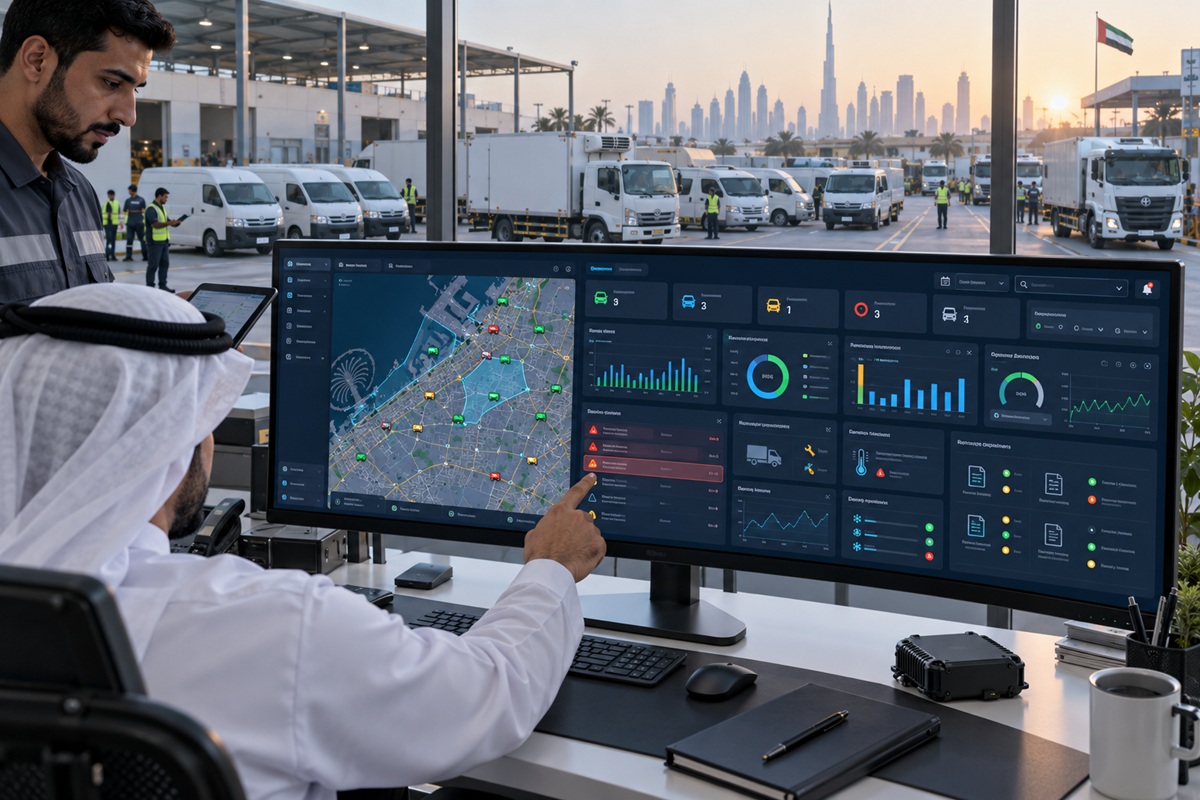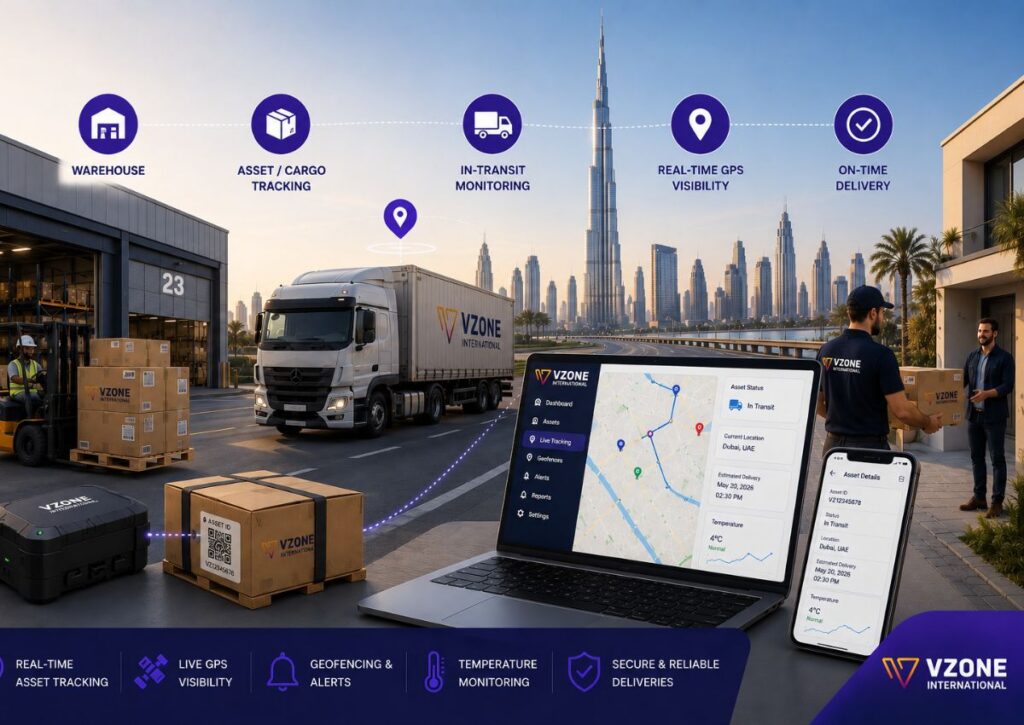
In a country where Jebel Ali is one of the world’s busiest ports and UAE logistics complexity rivals any global hub, visibility over assets and cargo is the difference between operational excellence and expensive guesswork. Assets disappear at the Jebel Ali gate, reappear four days late, and the window between ‘left the port’ and ‘arrived at the warehouse’ is opaque without active tracking. Medical specimens transit between hospitals and laboratories in conditions that determine whether a test result is valid or needs to be repeated. High-value cargo moves across the GCC on routes where a single unmonitored handover is enough for a consignment to go missing.
GPS and IoT asset tracking creates visibility where operational blind spots previously existed not just for vehicles, but for every category of asset that has commercial, clinical, or compliance value while in motion or at rest. This guide covers the full spectrum of asset and cargo types tracked in UAE, the technology stack appropriate for each, the specific monitoring requirements of container tracking, medical specimen chain-of-custody, and pharmaceutical cargo, and what an effective UAE asset tracking implementation looks like across multiple asset categories simultaneously.
Key Takeaways
- Asset tracking in UAE is not a single technology it spans hardwired GPS for vehicles, battery-powered GPS tags for containers and equipment, BLE beacons for indoor and short-range tracking, and IoT sensors for condition monitoring each appropriate for different asset categories and tracking ranges.
- Container tracking from Jebel Ali requires GPS tags with both cellular and satellite connectivity the port environment and cross-border GCC routes both involve areas where cellular coverage is insufficient for continuous tracking without satellite fallback.
- Medical specimen tracking in UAE must satisfy chain-of-custody documentation requirements that are both regulatory (MOHAP and DHA) and operational a specimen that cannot demonstrate unbroken temperature and custody records may produce invalid results regardless of clinical quality.
- Pharmaceutical cargo tracking under WHO GDP guidelines requires calibrated temperature monitoring instruments with documented alarm management not standard commercial GPS cold chain sensors the calibration and audit trail requirements are specifically different from food cold chain monitoring.
- High-value cargo tracking needs tamper detection capability beyond standard GPS location monitoring door-open sensors, shock detection, and rapid geofence breach alerts create the multi-layer security record that protects high-value consignments and resolves theft insurance claims.
- Supply chain visibility across UAE and GCC requires tracking technology that maintains data continuity across the full journey including cross-border zones, remote desert routes, and port handling environments where standard cellular GPS loses connectivity.
Types of Assets UAE Businesses Track with GPS and IoT
Asset tracking in the UAE context covers a substantially wider range of asset categories than fleet vehicle GPS tracking alone. Each category has distinct tracking requirements different hardware, different monitoring priorities, and different regulatory or commercial documentation needs.
Fleet Vehicles and Heavy Equipment
The most mature asset tracking category in UAE GPS telematics for road vehicles is well-established, and heavy equipment asset trackers for construction and oil field plant are increasingly standard. Covered extensively in earlier articles in this series; in the asset tracking context the key point is that vehicle and equipment tracking should feed the same unified platform as cargo and specimen tracking, providing operations managers with a single dashboard view across all asset categories rather than separate tracking systems for vehicles, equipment, and cargo.
Shipping Containers and Cargo
Shipping containers both owned containers in a logistics company’s fleet and leased containers in transit represent one of the highest-value and most visibility-challenged asset categories in UAE logistics. A 40-foot reefer container carrying pharmaceutical cargo from Jebel Ali to a hospital distribution centre in Abu Dhabi is worth hundreds of thousands of dirhams in combined asset and cargo value, yet standard logistics tracking provides only port-in and port-out records with nothing between them. GPS container tracking fills this visibility gap but requires hardware that addresses the specific challenges of container environments: metal enclosures that attenuate GPS and cellular signals, outdoor desert exposure, and the international transit routes that cross cellular coverage boundaries.
Construction and Industrial Equipment
Construction equipment tracking has been covered in the construction fleet context excavators, cranes, generators, and portable tools all have tracking solutions appropriate to their operating environment and value tier. In the asset tracking context, the key consideration is inventory management across multiple project sites: knowing which pieces of equipment are at which site, their current operational status, and whether any have moved without authorisation is the core asset management function that GPS tracking enables at the portfolio level for companies managing equipment inventories across simultaneous UAE projects.
Medical Specimens and Pharmaceutical Cargo
Medical specimen and pharmaceutical cargo tracking are among the most documentation-intensive asset tracking applications in UAE operations. Specimens collected at patient sites and transported to central laboratories must maintain specific temperature ranges and documented custody throughout transit a chain-of-custody record that is both a regulatory requirement and a clinical quality standard. Pharmaceutical cargo moving between UAE distributors and hospitals operates under MOHAP regulations and WHO GDP guidelines that specify calibrated monitoring, alarm management procedures, and complete temperature audit trails. These requirements go substantially beyond standard GPS location tracking and require purpose-configured monitoring solutions.
High-Value Goods and Temperature-Sensitive Products
High-value cargo jewellery, electronics, currency, luxury goods, and sensitive industrial equipment requires tracking that goes beyond location monitoring to include tamper detection, shock and vibration monitoring, and rapid security alerts for route deviations and unauthorised access events. Temperature-sensitive products that are not pharmaceutical specialty food ingredients, heat-sensitive chemicals, cosmetics, and certain industrial materials require condition monitoring that confirms product integrity throughout transit without the full GDP documentation burden of pharmaceutical cargo. Each category requires a different monitoring configuration from the same underlying GPS and IoT hardware platform.
How GPS Asset Tracking Works – Technology Overview
The technology stack for asset tracking spans four distinct categories of hardware, each appropriate for different asset types, tracking ranges, and operating environments. Understanding which technology is right for which asset type prevents both over-engineering (deploying expensive cellular GPS on assets that only need zone-level presence detection) and under-engineering (deploying BLE tags on assets that need real-time location across large geographic areas).
Hardwired GPS for Vehicles and Heavy Plant
Hardwired GPS telematics devices connected to the vehicle’s ignition circuit and battery provide continuous real-time tracking with 4G LTE cellular data transmission, update frequencies of 10 to 30 seconds, and the full behavioral data capture that fleet management platforms require. This is the appropriate technology for road vehicles of all types and for heavy plant with accessible power circuits. Power dependency on the vehicle’s electrical system is the limitation hardwired GPS on a vehicle that has its battery disconnected ceases to transmit, which is why backup battery configurations are standard for vehicle security applications where tamper resistance matters.
Battery-Powered GPS Tags for Non-Vehicle Assets
Battery-powered GPS asset trackers operate independently of any vehicle power source, transmitting location data via cellular or satellite from their internal battery. The transmission strategy determines battery life: a device transmitting every 30 seconds draws down battery within weeks; a device configured for motion-activated transmission actively tracking when moving, switching to periodic hourly check-ins when stationary can sustain months of operation on a single battery charge. This makes battery GPS tags the appropriate technology for shipping containers, portable construction equipment, cargo consignments, and any asset that moves between locations without a consistent power source.
Battery GPS tags for UAE deployment must be rated for the thermal extremes of container and desert operating environments interior temperatures in a metal shipping container sitting in Jebel Ali in August can exceed 70°C, and devices not rated for these conditions fail within their first deployment cycle. Hardware specification review for UAE ambient conditions is as important for asset tags as it is for vehicle-mounted GPS devices.
Bluetooth BLE Tags for Short-Range Indoor Tracking
Bluetooth Low Energy tags are the appropriate technology for high-turnover, lower-value assets in environments where GPS signal is unavailable or prohibitively expensive per item. Warehouse inventory, laboratory specimen containers, tool cribs, and medical supply rooms all benefit from BLE zone-presence tracking: tags broadcast their presence to BLE gateway readers installed at zone entry and exit points, creating a presence log that shows when tagged items entered and left each monitored zone. The range limitation typically 10 to 30 metres per gateway means BLE tracking is zone-level (which room, which vehicle, which site compound) rather than precise-position. For the asset categories where zone-level tracking is sufficient, BLE provides significant inventory management value at a cost per tag that makes fleet-wide deployment practical.
IoT Sensor Integration for Condition Monitoring
GPS location tracking tells you where an asset is. IoT sensor integration tells you what condition the asset is in the critical additional layer for cargo categories where arrival at the correct location with compromised product condition is no better than non-delivery. Temperature sensors, humidity sensors, door-open detection, shock and impact sensors, light exposure detection, and tilt sensors all generate the condition data that GPS alone cannot provide. The IoT sensor layer is what transforms a cargo GPS tracker into a cargo monitoring system the technology that tells a pharmaceutical distributor not just that their shipment arrived at the hospital but that it arrived at the correct temperature with the chain-of-custody record intact.
| Asset Type | Tracking Technology | Key Monitoring Data Points | Primary Industry | Compliance Requirement |
| Shipping containers (standard) | Battery GPS tag + cellular/satellite | Location, door-open/close, shock, humidity | Logistics / trade | Bill of lading, cargo insurance documentation |
| Refrigerated containers (reefer) | Battery GPS + temp sensor + humidity | Location, temperature, humidity, door events | Food / pharma logistics | FSRA, HACCP, WHO GDP depending on cargo |
| Heavy equipment (excavators, cranes) | Hardwired GPS asset tracker | Location, engine hours, movement alerts | Construction / oil & gas | ADNOC IVMS for oil field equipment |
| Medical specimens (pathology) | Sealed GPS + calibrated temp sensor | Location, temperature, chain of custody log | Healthcare / diagnostics | MOHAP, DHA, HAAD lab transport standards |
| Pharmaceutical cargo | Vehicle GPS + calibrated IoT sensor | Location, temp, alarm records, GDP audit trail | Pharmaceutical distribution | WHO GDP, MOHAP, MoHAP GDP for UAE |
| High-value goods (jewellery, electronics) | Active GPS + tamper sensor + shock | Location, tamper alerts, shock events, geo-alerts | High-value logistics / retail | Insurance conditions, security audit |
| Portable tools and small equipment | BLE asset tag + gateway | Zone presence, last-seen location, exit alerts | Construction / field service | Project HSE plan optional but recommended |
| Cargo containers in transit (cross-border) | Satellite-capable GPS tag | Location across GCC borders, cellular fallback | International logistics | Customs documentation, cargo insurance |
Container Tracking in UAE – Jebel Ali and Beyond
Jebel Ali Port one of the world’s top ten busiest container ports by throughput handles millions of container movements per year as the primary import and transhipment hub for the UAE and wider GCC region. For logistics companies, importers, and distributors whose cargo moves through Jebel Ali, the visibility gap between container arrival at port and final delivery to the customer or warehouse is one of the most persistent operational frustrations in the UAE supply chain. GPS container tracking eliminates this gap but the port and cross-border route environment creates specific technical challenges that standard urban GPS tracking does not encounter.
GPS Container Tracking from Port to Final Delivery
Battery-powered GPS tags installed inside or mounted on shipping containers transmit location continuously from port arrival through to final delivery providing logistics managers with a live map showing every container’s position throughout the distribution chain. At Jebel Ali, where cellular signal inside the port’s dense container stack areas can be intermittent, GPS tags with satellite fallback or the ability to buffer location data during connectivity gaps and upload on reconnection maintain the tracking record even in signal-challenged port environments.
The operational value of GPS container tracking in the UAE context is most acute for high-value and time-sensitive consignments: pharmaceutical cold chain cargo where temperature documentation must cover the entire transit chain including port handling, electronics and high-value goods where the port-to-warehouse segment is historically the highest-risk theft window, and perishable food cargo where confirmed delivery timing determines product condition at receipt. For each of these categories, the container GPS tag provides the visibility that standard logistics documentation (port receipts, delivery notes) cannot offer between handover points.
Temperature and Humidity Monitoring During Container Transit
Refrigerated container tracking adds temperature and humidity sensor data to the GPS location record creating the complete condition monitoring record that food safety and pharmaceutical regulations require. Reefer containers plugged into port power points maintain temperature through the port handling period, but the transition from port power to a refrigerated truck for final delivery creates a monitoring gap if the tracking system does not cover both the static reefer and the delivery vehicle’s refrigeration unit. Continuous GPS tag-based monitoring that operates independently of the reefer unit’s power supply bridges this gap recording temperature throughout the container’s journey regardless of how many power sources the reefer unit cycles through.
Humidity monitoring is particularly relevant for cargo categories sensitive to moisture ingress electronic components, certain pharmaceutical raw materials, and premium packaged foods where condensation during temperature transitions creates product damage that temperature monitoring alone does not capture. Combined temperature and humidity monitoring from the same IoT sensor package provides the complete environmental condition record that specialist cargo categories require.
Cross-Border Container Tracking UAE to GCC
Container and cargo movements between UAE and Saudi Arabia, Oman, Qatar, and Kuwait involve border crossing procedures, customs clearance waiting periods, and transit routes that cross cellular coverage boundaries in remote desert and mountainous terrain. Standard GPS tags with single-SIM cellular connectivity lose tracking continuity in these environments creating the visibility gaps that are most commercially damaging precisely in the highest-risk segments of the transit journey.
GPS tags with dual-SIM configurations roaming between local cellular operators in each country and satellite fallback capability maintain continuous location records across GCC cross-border routes. For cross-border pharmaceutical and high-value cargo, this continuous tracking capability is both an operational requirement and an insurance condition: insurers covering high-value cross-border shipments increasingly require documented continuous GPS tracking as a condition of coverage, not just GPS tracking for UAE -internal segments.
Medical Specimen Tracking UAE – Chain of Custody
Medical specimen tracking is one of the most compliance-intensive and operationally consequential asset tracking applications in the UAE healthcare sector. Specimens collected at patient sites blood samples, tissue biopsies, microbiological cultures, genetic materials have a finite viability window that is directly affected by temperature conditions and handling time during transport. A specimen that arrives at the laboratory with a broken cold chain record, or where the custody transfer documentation has gaps, may produce invalid results requiring repeat collection from the patient at additional cost and delay.
How Specimen Transport Works in UAE Laboratories
UAE hospital laboratory networks and independent diagnostic laboratory chains manage specimen transport between collection points clinics, hospitals, patient service centres and central processing laboratories using dedicated specimen courier vehicles or contracted medical courier services. Each specimen type has specific temperature and transit time requirements: routine blood samples typically require +4°C to +8°C and transit within four hours of collection; microbiological cultures require ambient temperature and strict transit time limits; genetic and molecular samples often require frozen transport at -20°C or lower. A single vehicle may carry specimens from multiple collection points to a central lab, creating a multi-stop route where each stop introduces a handling event that the chain-of-custody record must capture.
The chain-of-custody requirement means that the tracking record must confirm not only where the vehicle was at each point in the journey but which specific specimens were on the vehicle at each moment linking individual specimen barcodes to the vehicle’s GPS position and temperature record at the time of each collection and delivery event. This specimen-level granularity is beyond what vehicle GPS tracking alone provides and requires integration between the GPS platform and the laboratory information system (LIS) or a dedicated specimen tracking application.
GPS and Temperature Monitoring for Sample Integrity
Specimen transport vehicles carry GPS telematics devices for location tracking alongside calibrated temperature sensors typically one in the specimen transport cool box and one recording ambient vehicle compartment temperature. The sensor calibration requirement is the critical distinction from commercial cold chain monitoring: medical specimen transport sensors must have current calibration certificates, traceable to national or international standards, and must be recalibrated at defined intervals. An uncalibrated sensor provides temperature data that cannot be used for regulatory compliance documentation even if the readings are technically accurate.
Real-time temperature alerts for specimen transport serve a safety function that is more immediate than for most other cargo categories. If a specimen transport cool box temperature rises above the required range while the courier is still en route, the laboratory can direct the courier to the nearest collection point for immediate transfer to a correctly maintained container potentially preserving samples that would otherwise be invalidated upon arrival. Without real-time temperature alerts, the excursion is discovered only at specimen receipt, at which point the damage cannot be reversed.
Chain-of-Custody Documentation for MOHAP Compliance
MOHAP (UAE Ministry of Health and Prevention) and the emirate-level health authorities (DHA Dubai, HAAD Abu Dhabi now SEHA) set standards for medical laboratory operations that include specimen transport requirements. Chain-of-custody documentation an unbroken record of specimen custody from collection through delivery to the laboratory is both a regulatory requirement and a legal document in contexts where specimen results are used in clinical decision-making, insurance claims, or legal proceedings.
Automated chain-of-custody reports generated from GPS and temperature data, combined with specimen barcode scanning records at collection and delivery, provide the documentation standard that MOHAP and DHA laboratory inspections examine. The critical feature is automation: a chain-of-custody record that requires manual compilation from multiple sources introduces both administrative overhead and error risk that automated reporting from integrated GPS, temperature, and barcode systems eliminates. VZone International’s specimen tracking solution generates these reports automatically for each specimen delivery available to laboratory quality managers immediately after delivery completion without requiring manual data assembly.
High-Value Cargo Tracking – Security Beyond Location
High-value cargo tracking in UAE logistics operations covering jewellery, electronics, currency, luxury goods, and sensitive industrial equipment requires security monitoring that goes beyond GPS location to include the tamper detection, shock recording, and rapid alert capabilities that protect high-value consignments and create the forensic record that insurance claims and theft investigations require.
Tamper Detection and Door-Open Sensors
Container and vehicle security for high-value cargo is monitored through door-open sensors that record every door opening event with a precise timestamp and GPS location. An unauthorised door opening outside a geofenced delivery location or outside the delivery window defined in the logistics contract triggers an immediate alert that reaches the logistics security team before the cargo exposure is complete. Combined with a GPS location record showing whether the vehicle was at an authorised delivery point when the door opened, door-open sensor data provides an unambiguous security audit trail.
Tamper detection extends to the GPS device itself: enterprise GPS tags for high-value cargo include tamper-detection features that alert when the device is removed or its enclosure is opened detecting attempts to disable tracking before a theft is executed. A cargo thief who removes a GPS tag from a container triggers an alert that confirms the GPS device has been tampered with at a specific GPS-recorded location, even if the device ceases to transmit after removal.
Shock and Impact Detection for Fragile Cargo
Electronic components, precision instruments, and fragile cargo categories are damaged not only by temperature excursions but by impact events drops during loading and unloading, rough handling at transhipment points, and vehicle vibration on poorly maintained roads. IoT shock sensors integrated with GPS asset trackers record the magnitude, direction, and timestamp of impact events above a configured threshold, creating a condition monitoring record that identifies when and where cargo damage likely occurred. This data resolves the handling responsibility disputes that are endemic in multi-leg logistics chains where damage is discovered at receipt but the responsible handling point is contested.
VZone International’s Asset and Cargo Tracking Platform
VZone International provides integrated GPS and IoT asset tracking for UAE businesses covering shipping container tracking, medical specimen chain-of-custody monitoring, pharmaceutical cargo GDP tracking, high-value cargo security, and construction equipment asset management on a unified Wialon and FMSiTrack platform. The platform’s multi-asset capability means that an operations manager can monitor a reefer container in transit, a specimen courier vehicle on its hospital route, and a piece of construction equipment on a remote site from the same dashboard without logging into separate tracking systems for each asset category.
Hardware Range GPS Tags, IoT Sensors, and BLE Beacons
VZone supplies GPS asset tracking hardware across the full technology spectrum: hardwired GPS telematics for vehicles and heavy equipment, battery-powered GPS tags for containers and mobile assets (with UAE desert temperature specifications and satellite fallback capability for cross-border routes), calibrated temperature and humidity IoT sensors for cold chain and pharmaceutical applications, door-open and tamper detection sensors for high-value cargo security, shock and impact sensors for fragile cargo, and BLE asset tags for high-turnover short-range tracking applications.
All hardware deployed by VZone for UAE asset tracking applications carries operating temperature specifications appropriate for the UAE environment a non-negotiable hardware selection criterion that eliminates the early-failure rates that plague devices specified for temperate climate deployments in UAE summer conditions.
Automated Compliance Documentation
VZone’s platform generates automated compliance documentation for regulated asset tracking applications HACCP-compatible temperature journey reports for food cold chain cargo, GDP-formatted audit trails for pharmaceutical distribution, chain-of-custody logs for medical specimen transport, and condition monitoring records for insurance and customs documentation. These reports are generated automatically from platform data at trip completion, available immediately to quality managers, compliance teams, and auditors without requiring manual data extraction or report compilation.
Conclusion: Asset Tracking Is Supply Chain Intelligence, Not Just Location Data
The evolution of asset tracking in UAE from simple GPS location logging to multi-layer GPS, IoT, and condition monitoring reflects the growing commercial and regulatory demands on UAE supply chain operations. A shipping container tracked from Jebel Ali to its final delivery point with continuous temperature, humidity, and door-event monitoring is not just a tracked asset it is a documented product condition record that satisfies food safety regulations, supports insurance claims, and provides the supply chain transparency that major retail and pharmaceutical customers increasingly require as a condition of supply agreement.
Medical specimen chain-of-custody tracking that generates automated MOHAP-compliant reports is not administrative overhead it is clinical quality infrastructure that determines whether laboratory results are valid and legally defensible. High-value cargo security that combines GPS location with tamper detection and shock monitoring is not a premium add-on it is the forensic evidence layer that resolves theft and damage disputes without protracted litigation.
For UAE businesses managing diverse asset portfolios across logistics, healthcare, construction, and oil and gas sectors, the most effective implementation is a unified platform that covers all asset categories in a single operational view reducing the system fragmentation and cross-referencing overhead that separate tracking systems for vehicles, containers, specimens, and equipment consistently create. VZone International’s multi-asset platform delivers this unified view, with hardware specified for UAE operating conditions and compliance documentation configured for UAE regulatory requirements across each asset category it serves.
Track everything that moves – and everything that doesn’t.
VZone International provides GPS and IoT asset tracking for UAE businesses across all industries from shipping containers and medical specimens to construction equipment and high-value cargo. Get a solution assessment today and see how unified asset tracking transforms operational visibility across your entire asset portfolio.
Frequently Asked Questions
The best asset tracking software for UAE businesses integrates GPS and IoT sensors across multiple asset categories vehicles, containers, equipment, and cargo in a unified platform with real-time location, condition monitoring, tamper detection, and automated compliance reporting. VZone International's Wialon-based platform covers the full asset tracking spectrum for UAE businesses, from shipping container tracking with satellite fallback capability to medical specimen chain-of-custody documentation for MOHAP compliance.
Container tracking in UAE uses battery-powered GPS tags with cellular and satellite connectivity the satellite capability is essential for maintaining tracking continuity in Jebel Ali's dense port environment and on cross-border GCC routes beyond reliable cellular coverage. For refrigerated containers, IoT temperature and humidity sensors integrated with the GPS tag provide the condition monitoring record that cold chain cargo requires. VZone International deploys container GPS tags rated for UAE desert operating temperatures with satellite fallback for cross-border shipments.
Medical specimen tracking uses GPS vehicle telematics combined with calibrated temperature sensors in specimen transport cool boxes, linked to a laboratory information system integration that records each specimen barcode against the vehicle's GPS position and temperature record at collection and delivery. Chain-of-custody reports are generated automatically for each delivery. MOHAP and DHA regulations require that monitoring instruments carry current calibration certificates a requirement distinct from commercial cold chain monitoring that VZone International addresses through calibration management as part of its healthcare specimen tracking solution.
Specimen transport vehicles carry GPS trackers and calibrated temperature sensors that transmit real-time data to a monitoring dashboard. Laboratory managers receive automated alerts for temperature excursions or route deviations while the courier is still en route enabling corrective action before specimens are invalidated at receipt. Automated chain-of-custody reports are generated for each specimen delivery, providing the MOHAP-compliant documentation record without requiring manual compilation. VZone International provides complete specimen tracking solutions for UAE hospital laboratory networks and independent diagnostic laboratory chains.
Cross-border cargo tracking for UAE-GCC shipments requires GPS tags with dual-SIM configurations roaming between cellular operators in each country and satellite fallback capability for remote desert and mountainous terrain between border zones. Data is transmitted continuously from departure through customs, border crossing, and final delivery in the destination country. Condition monitoring (temperature, humidity) is maintained throughout the journey. VZone International provides cross-border GPS cargo tracking for UAE-Saudi Arabia, UAE-Oman, and multi-country GCC logistics operations.
Chain-of-custody tracking is an unbroken documented record of who had custody of an asset or specimen at every point in its transit journey from collection or dispatch through every handling event to final delivery. In UAE, chain-of-custody tracking is required for medical specimens (MOHAP and DHA laboratory standards), pharmaceutical cargo (WHO GDP and MoHAP distribution guidelines), legal evidence (court and law enforcement chain-of-custody standards), and high-value cargo insurance (insurer conditions for coverage of transit losses). Each application has different documentation format requirements but shares the same core need: an automated, tamper-resistant GPS-backed record of custody transitions.