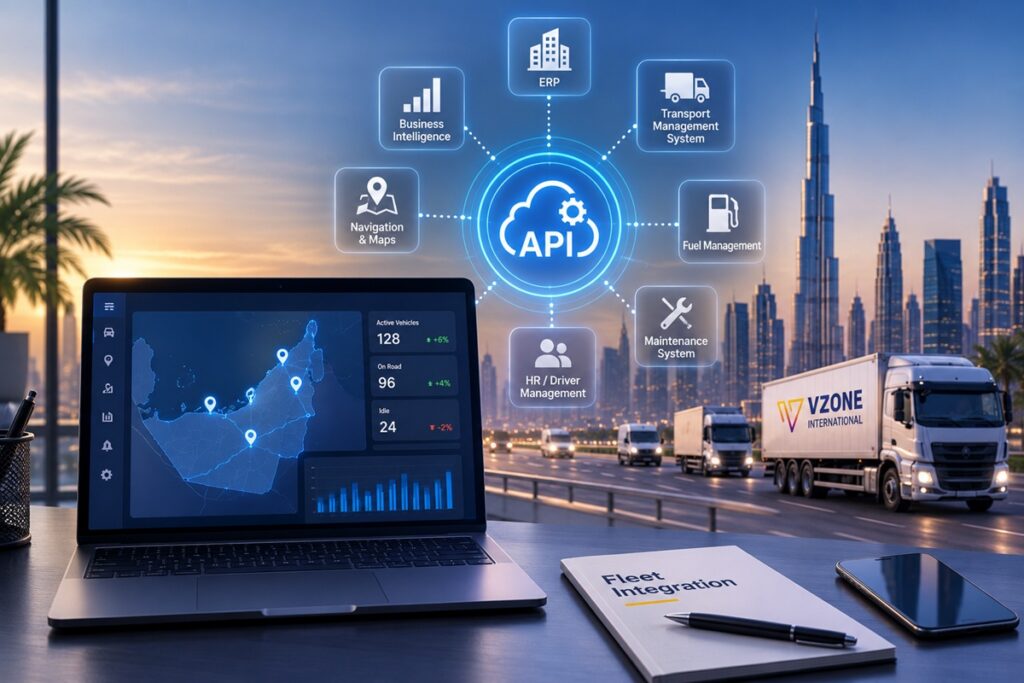
Fleet management data is operationally useful inside the fleet management platform. It becomes strategically valuable when it flows into the systems that the rest of the enterprise actually uses the ERP where finance tracks costs, the HR system where payroll is calculated, the customer portal where clients track their deliveries, and the BI platform where senior leadership reviews business performance. Without integration, fleet data sits in a specialist system that only fleet managers access visible to the team responsible for fleet operations but invisible to the finance, HR, and commercial teams who need it for their own processes.
For UAE enterprise fleet operators logistics companies managing 100+ vehicles, EPC contractors tracking equipment and personnel across multiple sites, pharmaceutical distributors generating daily GDP compliance records, government fleet operators managing multi-entity vehicle pools the integration gap between fleet management software and enterprise systems creates specific operational problems: finance teams manually re-enter mileage data into SAP for cost allocation; HR teams compile driver overtime from fleet reports and payroll records separately; operations teams export delivery data from the fleet platform and customer data from the CRM to produce SLA reports that should generate automatically.
This guide explains what fleet management API integration involves, which enterprise system integrations deliver the most value for UAE fleet operations, how the Wialon API and VZone’s native connectors work, and the implementation approach that gets fleet data flowing into enterprise systems within weeks rather than months.
Key Takeaways
- Fleet management API integration connects GPS telematics data to enterprise systems converting fleet data from operational information visible only to fleet managers into business intelligence visible across the organisation.
- The four highest-value fleet API integrations for UAE enterprises are: ERP cost integration (fleet spend into SAP, Oracle, Odoo, or Zoho financial reporting), customer delivery portal integration (live GPS-based ETA in customer-facing interfaces), HR and payroll integration (driver mileage and hours feeding salary and expense systems), and BI platform integration (fleet KPIs in Power BI or Tableau executive dashboards).
- The Wialon Remote API provides the technical foundation for all fleet data integrations a well-documented REST API with endpoints for vehicle data, position history, events, reports, and notifications that enterprise integration teams can consume directly or through VZone’s pre-built connectors.
- Pre-built ERP connectors (SAP, Oracle, Odoo, Zoho) significantly reduce integration implementation time compared to custom API development from weeks to days for standard data flows, with configuration rather than development as the primary implementation task.
- Webhook-based event notification enables real-time integration for time-sensitive use cases customer delivery notifications, compliance alert routing to quality management systems, driver safety score updates to HR performance systems without requiring polling-based API calls that create unnecessary data transfer volume.
Why Fleet Data Integration Matters for UAE Enterprise Operations
The value of fleet management API integration is most clearly visible by examining what happens without it the manual processes that enterprise teams perform to compensate for the absence of automated data flow between fleet and business systems.
| Manual Process (Without Integration) | System Gap | Integration Solution | Time Saved (per month) |
| Finance team exports monthly mileage from fleet platform and re-enters into SAP for cost centre allocation | Fleet platform → SAP FI/CO | Automated mileage and cost feed to SAP cost centre structure | 8–15 hours/month |
| HR team pulls driver overtime hours from fleet route reports and matches to payroll records manually | Fleet platform → HR/Payroll system | Driver hours API feed to HR platform with shift-based overtime calculation | 5–10 hours/month |
| Operations exports delivery data from fleet platform and customer orders from CRM to produce SLA reports | Fleet platform → CRM/Customer portal | Automated delivery event webhook to CRM; SLA calculated automatically | 6–12 hours/month |
| Quality team exports temperature records from cold chain module and compiles GDP reports manually | Fleet platform → QMS/compliance system | Automated GDP-format report API feed to quality management system | 10–20 hours/month (pharmaceutical fleets) |
| IT team builds custom dashboards in Power BI by manually importing weekly fleet exports | Fleet platform → BI platform | Direct API connector from Wialon to Power BI/Tableau; live data refresh | 4–8 hours/week |
| Customer service team checks fleet platform for delivery ETAs and manually updates customer communications | Fleet platform → Customer portal / CRM | Real-time GPS ETA webhook to customer portal; automated ETA notifications | 3–6 hours/day for large fleets |
The aggregate administrative overhead of managing these manual processes for a 50-vehicle UAE enterprise fleet typically amounts to 40 to 80 person-hours per month AED 8,000 to AED 24,000 in fully-loaded staff cost, at zero operational value. Every one of these processes is eliminated by the corresponding API integration.
The Wialon Remote API Technical Foundation
VZone International’s fleet platform is built on Wialon, developed by Gurtam one of the most comprehensively documented fleet management APIs in the industry. The Wialon Remote API provides programmatic access to all data stored and generated by the platform, enabling enterprise integration teams to retrieve, subscribe to, and act on fleet data without manual export or platform switching.
What the API Provides
The Wialon Remote API exposes the following data categories through REST-based endpoints, enabling enterprise systems to consume fleet data in real time or at configured intervals:
| API Data Category | Data Available | Typical Integration Use Case | Delivery Method |
| Vehicle position data | Real-time latitude, longitude, speed, heading, timestamp for all fleet units | Customer delivery portal ETA; live map in customer mobile app | Polling (every 30–60 sec) or webhook on movement event |
| Trip and journey history | Complete trip records with start/end times, distance, stops, speed profile | SAP mileage allocation; driver expense validation; route audit | Batch API call (daily/weekly) or event-driven on trip completion |
| Driver behaviour events | Harsh braking, acceleration, cornering, speeding, seatbelt events per driver | HR performance scoring; IVMS HSE report feed; insurance data export | Event webhook on occurrence + batch summary report |
| Fuel data (with IoT sensors) | Fuel level readings, fill-up events, drain events, consumption per trip | Finance fuel cost allocation; fuel card reconciliation; fraud alert | Webhook on anomaly event + batch periodic report |
| Temperature / IoT sensor data | Temperature readings by zone, alarm events, reefer status | QMS compliance document generation; pharmaceutical GDP system feed | Webhook on alarm event + automated trip report at journey end |
| Maintenance and fault codes | OBD-II fault codes, service due status, vehicle downtime events | CMMS/maintenance system work order trigger; SAP PM module feed | Webhook on fault code + scheduled maintenance notification |
| Geofence and zone events | Entry/exit events for defined zones with timestamp and vehicle ID | Customer delivery confirmation; site access log; billing trigger | Webhook on event occurrence |
| Compliance report outputs | Formatted IVMS, Asateel, HACCP, GDP report data | QMS feed; compliance portal submission; auditor-accessible documentation | Scheduled automated report or API pull on demand |
Authentication and Security
The Wialon Remote API uses token-based authentication API tokens are generated within the Wialon platform with configurable access scope (read-only position data for customer portals vs full data access for ERP integration) and configurable expiry. Enterprise integration teams connecting UAE business systems to VZone’s fleet platform receive dedicated API credentials scoped to the specific data endpoints their integration requires, preventing over-privileged access and satisfying information security policies that require least-privilege API authentication.
For UAE enterprise deployments with data residency requirements government entities and regulated industries specifying that data must remain within UAE jurisdiction Wialon’s hosted deployment options include UAE-region data hosting, ensuring that fleet telemetry data is stored and processed within the applicable data residency boundary. VZone International advises enterprise clients on the appropriate hosting configuration for their specific data governance requirements.
Webhook vs Polling Choosing the Right Integration Pattern
The choice between webhook-based integration (the fleet platform pushes data to the enterprise system when events occur) and polling-based integration (the enterprise system requests data from the fleet platform at regular intervals) affects both integration performance and system load. Webhooks are appropriate for event-driven use cases where immediacy matters: a delivery confirmed event that triggers an automated customer email; a temperature alarm that initiates an investigation workflow in the QMS; a harsh braking event that updates a driver’s safety score in the HR system. Polling is appropriate for periodic data aggregation: end-of-day mileage records that feed overnight SAP batch processing; weekly driver performance summaries that feed HR reporting; monthly fuel consumption data that feeds finance reporting.
VZone’s implementation team recommends webhook-first architecture for UAE enterprise integrations preferring event-driven data delivery that reduces system polling load and delivers real-time data to downstream systems with polling reserved for scheduled batch processes where latency is acceptable and real-time delivery is not required.
The Four Highest-Value Fleet API Integrations for UAE Enterprises
1. ERP Integration SAP, Oracle, Odoo, Zoho
ERP integration is the highest-priority fleet API integration for UAE enterprises because it resolves the most expensive manual process gap: fleet cost data that finance needs for cost centre allocation, project cost reporting, and business performance analysis sitting in a fleet management platform that finance does not access. The integration pushes trip-level mileage records, fuel consumption by vehicle, maintenance cost records, and driver cost allocation data from VZone’s platform to the ERP’s finance module automatically, at configured intervals, without manual export or re-entry.
For SAP deployments the most common ERP in UAE enterprise operations across oil and gas, construction, government, and large logistics VZone’s SAP connector maps fleet data to SAP FI/CO cost centre structures, PM module maintenance records, and PS module project cost allocations. A vehicle that completed 15 deliveries on 3 different project codes in one day generates three separate mileage and cost records in SAP automatically, without a finance analyst reconciling the fleet report against the project allocation manually. For Oracle, Odoo, and Zoho deployments, equivalent connectors map to each system’s cost and project management structures.
2. Customer Delivery Portal Integration
Customer-facing delivery tracking is one of the highest-visibility fleet API use cases in UAE’s B2B logistics market and one of the most commercially significant. UAE enterprise customers increasingly expect real-time delivery tracking as standard not an optional premium feature. A retail chain receiving daily stock deliveries from a UAE distributor wants to see the delivery vehicle’s ETA on a screen in their receiving department. A hospital pharmacy waiting for a pharmaceutical cold chain delivery wants a push notification when the vehicle is 20 minutes away.
Fleet API integration with customer portals delivers this capability by exposing vehicle position data filtered to show only the vehicle relevant to the customer’s order, not the entire fleet through the customer-facing interface. The integration pattern is typically: customer order system generates a delivery token → fleet API links the token to the vehicle assigned to that delivery → customer portal displays real-time GPS position and ETA for that vehicle → delivery confirmation event closes the tracking session and triggers invoice or proof-of-delivery workflow. VZone’s delivery portal integration supports both branded customer web portals and customer mobile app SDK integration.
3. HR and Payroll Integration
Driver mileage, working hours, and performance data from fleet management platforms is the source data for multiple HR and payroll calculations that UAE enterprise fleet operators manage monthly: mileage-based allowance payments (common in UAE enterprise fleet policies for sales and service drivers), overtime hour calculations for drivers who exceed standard working hours on long delivery routes, and performance-based incentive calculations tied to safety scores and delivery KPIs. Without fleet API integration, these calculations require HR teams to extract data from the fleet platform and reconcile it with timesheet records and salary tables manually a process that takes days and introduces reconciliation errors.
Fleet API integration with HR and payroll systems SAP HCM, Oracle HCM, and standalone HR platforms common in UAE enterprise operations pushes trip-level hours and mileage records to the HR system at shift or route completion, with driver identification linking fleet records to the employee master data automatically. The HR system calculates mileage allowances and overtime from the verified fleet data rather than from driver self-reporting, improving accuracy and reducing the dispute rate on monthly payroll adjustments.
4. BI Platform Integration Power BI and Tableau
Business intelligence platform integration extends fleet KPI visibility to senior leadership and cross-functional management teams who need fleet performance data in the same reporting environment as other business metrics. A CFO who reviews financial performance in Power BI should not need to log in to the fleet management platform separately to see fleet cost per kilometre that metric should appear on the same financial performance dashboard as all other cost categories. An operations director reviewing business KPIs in Tableau should see fleet utilisation rate, on-time delivery performance, and driver safety score trends alongside revenue, margin, and customer satisfaction metrics.
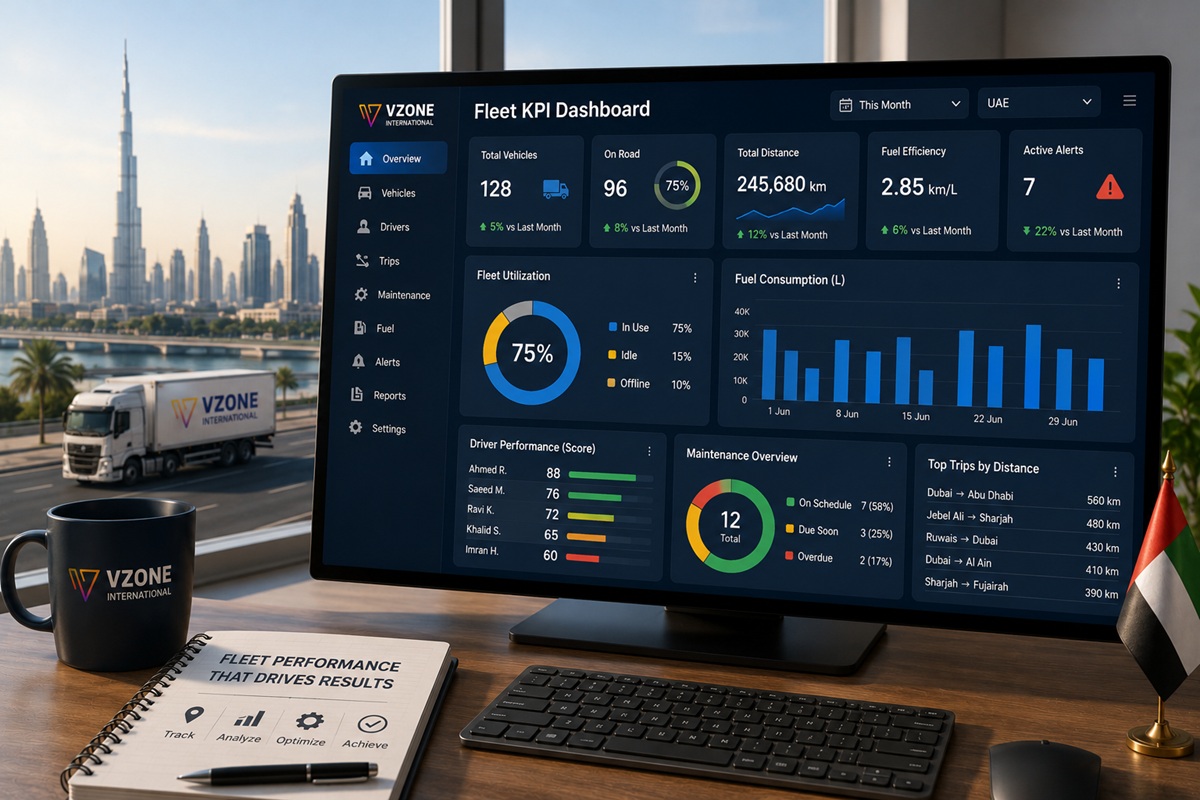
VZone’s BI connector provides a direct data connection from Wialon to Power BI and Tableau, enabling fleet KPI dashboards to refresh automatically from live fleet data without analyst intervention. The connector exposes pre-built data models that match the five KPI categories in VZone’s fleet dashboard (financial, operational, safety, compliance, maintenance) enabling Power BI report designers to build fleet performance visualisations from a structured data source rather than from raw API data that requires significant data modelling to make usable.
Implementation Approach Getting Fleet Data Flowing in Weeks
Fleet API integration for UAE enterprises typically follows a four-phase implementation process. The timeline depends on the complexity of the target enterprise systems and the number of integration points being connected simultaneously a single ERP integration can be completed in 2 to 3 weeks; a full enterprise integration programme covering ERP, HR, customer portal, and BI typically requires 6 to 10 weeks.
| Phase | Duration | Activities | Output |
| Discovery and mapping | Week 1 | Identify integration requirements; map fleet data fields to target system fields; confirm authentication and security requirements; document data volumes and frequency requirements | Integration specification document with data mapping, API endpoint list, security configuration, and implementation timeline |
| API configuration and credentials | Week 1–2 | Generate API credentials with appropriate access scope; configure webhook endpoints in Wialon; establish test environment connection; validate data format against target system schema | API credentials configured; test data flowing to development environment; format validation complete |
| Connector deployment and testing | Week 2–5 | Deploy pre-built connector (ERP/BI) or custom webhook integration; configure field mappings; run integration tests with production-representative data volumes; resolve data quality issues | Integration running in test environment; data flowing correctly to target system; test sign-off from IT and business stakeholders |
| Go-live and stabilisation | Week 4–8 | Production deployment with monitoring; parallel operation with existing manual processes for 1–2 weeks; staff training on new automated workflow; decommission manual process after validation | Integration live in production; manual process retired; monitoring dashboard configured; support handover complete |
UAE-Specific Integration Considerations
Compliance Data Integration IVMS and GDP
UAE enterprise fleet operators with ADNOC IVMS compliance obligations face a specific integration requirement that generic fleet API guides do not address: IVMS driver behaviour data must not only be recorded in the fleet management platform but must be accessible to ADNOC HSE management systems, contractor HSE reporting portals, and internal QHSE management platforms in the format that ADNOC specifies. VZone’s IVMS data API enables direct integration between the fleet platform’s driver behaviour event records and ADNOC contractor HSE management systems eliminating the manual HSE report compilation that consumes fleet administrator time every week.
For pharmaceutical cold chain fleet operators, GDP compliance data integration connects VZone’s automated temperature monitoring records to the Quality Management System (QMS) that manages excursion investigations, corrective actions, and management review records. The integration pattern triggers: temperature alarm event → QMS investigation record creation → investigation workflow assignment → corrective action tracking → management review evidence collection all automatically from the temperature event detected in the fleet platform, without requiring a quality analyst to monitor the fleet dashboard and manually initiate QMS processes.
Arabic Language and Local Calendar Support
UAE enterprise systems particularly HR and ERP deployments in government-affiliated organisations and established UAE-based companies frequently use Hijri calendar date formats alongside or instead of Gregorian dates for reporting and document generation. Fleet API integrations for these organisations must map fleet event timestamps (which are generated in UTC and typically displayed in Gulf Standard Time Gregorian format) to the Hijri equivalent where required by the target system. VZone’s integration team has experience with UAE-specific date format requirements and provides Hijri calendar mapping in HR and government fleet integrations where the target system requires it.
Data Residency for Government and Regulated Sectors
UAE government entities and organisations in regulated sectors (financial services, healthcare, critical infrastructure) are increasingly subject to data residency requirements under the UAE’s Personal Data Protection Law (PDPL) and sector-specific regulations. For fleet management API integrations involving driver personal data driver identification, behaviour records, location history data residency requirements specify that this data must be stored and processed within UAE jurisdiction. VZone International’s platform can be configured with UAE-region data hosting for enterprise clients with residency requirements, ensuring that both the fleet data and the API data feeds between the fleet platform and enterprise systems remain within the applicable jurisdiction.
Conclusion: Fleet Data Should Flow Not Be Exported
The administrative overhead of managing fleet data as a separate island exported, reformatted, and manually entered into the enterprise systems that need it is a cost that compounds with fleet size, data volume, and the number of downstream systems that require fleet information. For a 10-vehicle fleet producing basic mileage reports, the overhead is manageable. For a 100-vehicle enterprise fleet producing IVMS compliance data, temperature monitoring records, customer SLA reports, and financial cost allocation data daily across multiple enterprise systems, the overhead is a full-time administrative function that API integration makes redundant.
Fleet management API integration is not a luxury feature for large enterprise deployments it is the architecture that makes fleet management data operationally useful beyond the fleet manager’s own screen. Finance teams see fleet cost data in SAP. HR teams see driver hours in the payroll system. Customers see delivery ETAs in the customer portal. Senior leadership sees fleet KPIs in the Power BI executive dashboard. The fleet manager sees all of this happening automatically, without spending hours every week producing reports and exporting data that should have been flowing automatically from the day the platform was deployed.
VZone International’s integration programme for UAE enterprise fleet clients covers the full range of enterprise integration requirements from SAP and Oracle ERP connectors to customer portal SDK to Power BI data models with UAE-specific configuration for IVMS compliance data integration, Arabic language and Hijri calendar support, and data residency options for government and regulated sector clients. Integration planning is included in VZone’s enterprise fleet assessment at no additional cost.
Connect your fleet data to your enterprise systems automatically.
VZone International provides fleet API integration for UAE enterprises: SAP, Oracle, Odoo and Zoho ERP connectors; customer delivery portal SDK; Power BI and Tableau data connectors; IVMS and GDP compliance system integration. Free integration assessment with enterprise fleet demos. Contact our enterprise team today.
Frequently Asked Questions
Wialon provides the Wialon Remote API a REST-based API with comprehensive documentation covering all platform data categories: vehicle position and movement, trip history, driver behaviour events, fuel sensor readings, IoT temperature data, geofence events, maintenance fault codes, and compliance report outputs. The API uses token-based authentication with configurable access scope and supports both polling (for scheduled data extraction) and webhook notifications (for real-time event-driven integration). VZone International provides API credentials and integration support for UAE enterprise clients connecting Wialon fleet data to SAP, Oracle, Odoo, Zoho, Power BI, Tableau, and custom enterprise systems.
Integrating fleet management with SAP in UAE involves four steps: (1) configure VZone's SAP connector with the API credentials and the SAP system landscape details (system ID, client, RFC or web service endpoint); (2) map fleet data fields to the target SAP modules FI/CO cost centre structure for mileage and fuel cost allocation, PM module for maintenance work orders, PS module for project cost records; (3) configure the data transfer schedule (typically nightly batch for cost records, real-time for maintenance fault code alerts); (4) test with a representative data volume, validate cost allocations against manual calculations, then go live with parallel running for 2 weeks before decommissioning the manual process. VZone's pre-built SAP connector reduces implementation time from 6 to 8 weeks (custom development) to 2 to 3 weeks (configuration only).
Building a customer delivery tracking portal using fleet API involves: generating customer-scoped API tokens that expose only the vehicle assigned to each customer's current delivery (not the full fleet); embedding a map component in the customer web or mobile interface that polls the vehicle position endpoint every 30 to 60 seconds; calculating and displaying ETA from GPS position and route distance; triggering a webhook notification to the customer portal when the vehicle enters the customer's delivery geofence; and closing the tracking session with a delivery confirmation event when the driver completes the delivery. VZone's customer portal SDK provides pre-built UI components for the map and ETA display, reducing customer portal development to configuration of the token scope and the delivery assignment workflow rather than full API implementation.
VZone's BI connector provides Power BI and Tableau with five pre-built data models covering the fleet KPI categories: financial (cost per kilometre, fuel spend, maintenance cost by vehicle and period), operational (utilisation rate, on-time delivery rate, stops per driver, idle time), safety (driver safety score trends, harsh event rates, incident rates), compliance (Asateel submission status, IVMS event rates, document expiry pipeline), and maintenance (unplanned downtime rate, planned vs unplanned maintenance ratio, open fault codes). Each model refreshes automatically from the Wialon data source at configured intervals typically 15 to 60 minutes for operational dashboards, nightly for financial reporting. Fleet KPIs appear in the same Power BI or Tableau workspace as other business metrics without separate fleet platform access.