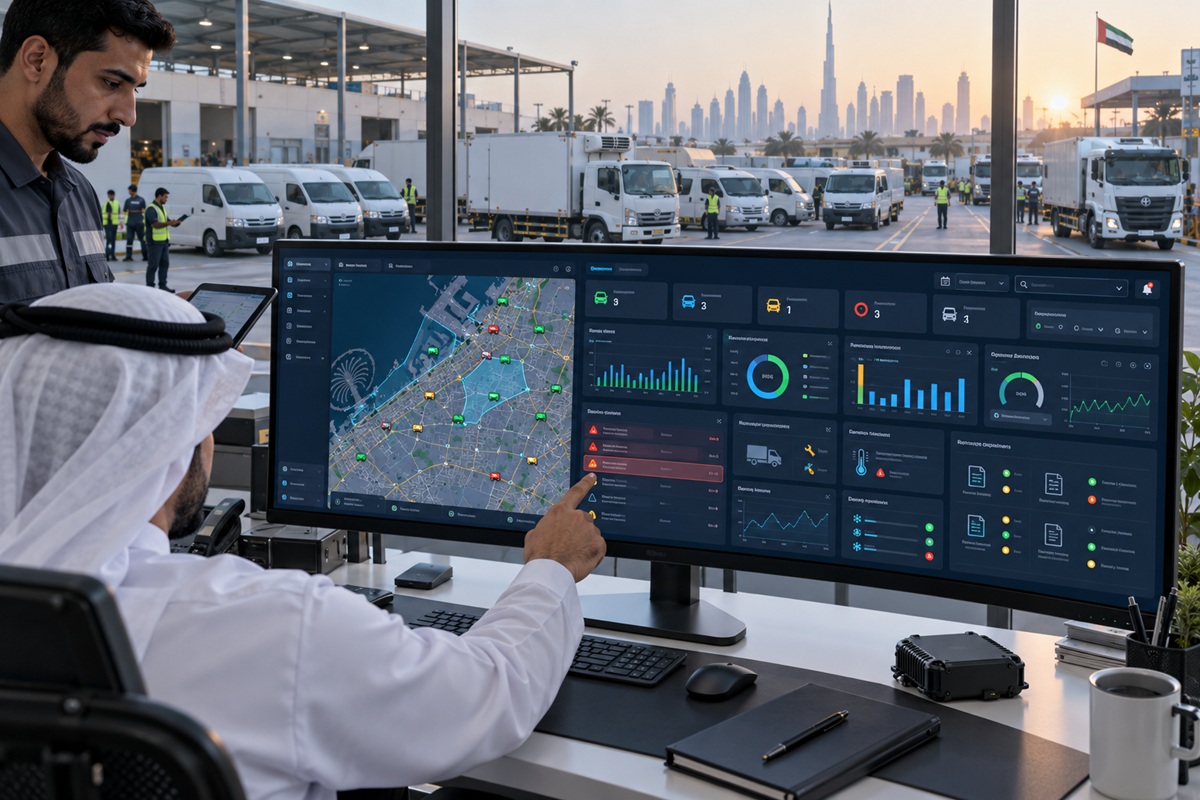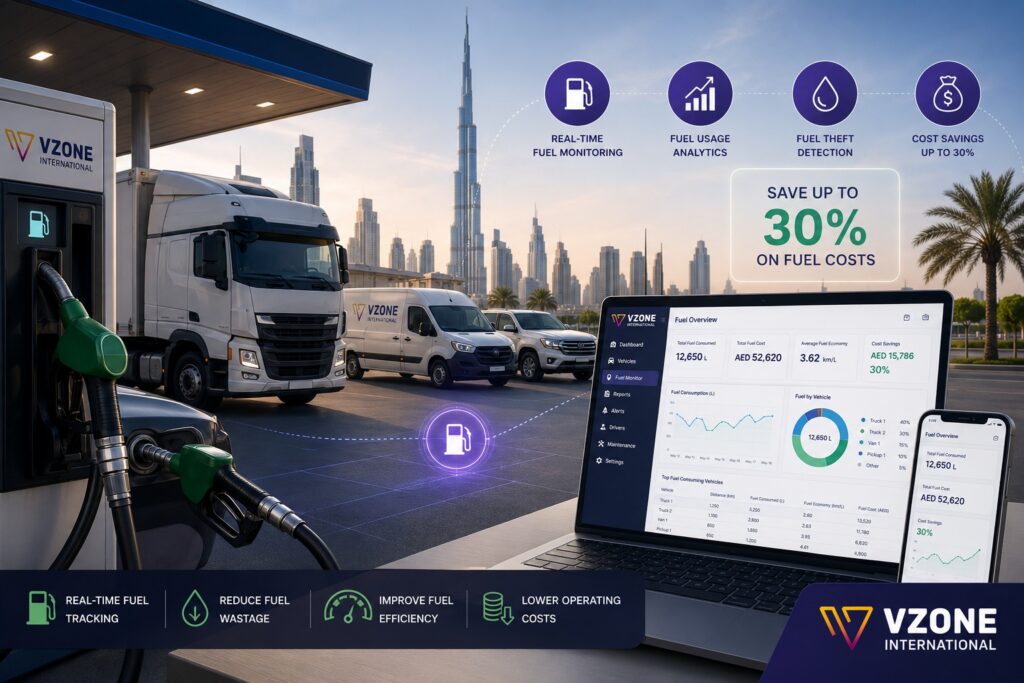
Fuel is the single largest variable operating cost for most UAE fleet operators and it is also the most vulnerable to waste, misuse, and outright theft. Without fuel monitoring software, fleet managers rely on fuel card transaction reports and end-of-month expense summaries that tell them what was spent in total but nothing about why, where, or by whom. A driver who fills up twice in one day at two different stations generates two fuel card entries; without GPS-verified location data at fill-up time, the double fill is invisible. A generator that runs dry every four days instead of the expected seven has been losing fuel to unauthorised drain, but without a sensor recording the tank level continuously, that pattern never surfaces.
GPS-integrated fuel monitoring changes this picture completely. In-tank sensors record fuel level continuously every fill-up, every drain, every consumption trend. GPS location data at the moment of each fill-up cross-references the transaction against a GPS-verified position. Idle time monitoring attributes fuel burn to specific drivers and operational contexts. The result is not just an expense record but an operational intelligence layer that makes fuel misuse visible, attributable, and actionable before it completes its absorption into the fuel budget as an unexplained cost.
This guide explains how GPS fuel monitoring works technically, where UAE fleets actually lose fuel and why standard paper-based tracking misses it, what specific features to look for in a fuel monitoring platform and the realistic cost reductions that UAE fleet operators achieve when monitoring is implemented effectively.
Key Takeaways
- Fuel theft in UAE commercial fleets takes three distinct forms siphoning from tanks, falsified fill-up records, and double-fill with fuel card each with a different detection signature that GPS fuel monitoring identifies.
- UAE summer conditions add a unique idle fuel cost layer: air conditioning load at maximum capacity during stops increases idle fuel burn by 0.5 to 1.5 litres per hour beyond standard idle consumption, a factor that standard fuel monitoring benchmarks from temperate climates do not account for.
- Fill-up verification cross-referencing GPS vehicle location at the time of a fuel card transaction against the transaction’s claimed station location is the simplest and most effective fraud detection mechanism available to fleet managers, requiring no hardware beyond the GPS device.
- Per-driver fuel consumption analysis, normalised for route distance and vehicle type, is the most actionable fuel management data available identifying which drivers are generating disproportionate consumption through aggressive driving patterns.
- Remote generator fuel monitoring via IoT sensors protects against the most prevalent form of construction and oil field fuel theft: unauthorised drain from generator tanks at night or during reduced-security periods.
- UAE fleets that implement GPS-linked fuel monitoring with active driver coaching typically achieve fuel cost reductions of 15 to 30 percent within 12 months with theft detection, idle reduction, and driving behaviour improvement each contributing distinct savings streams.
What Is Fleet Fuel Monitoring Software?
Fleet fuel monitoring software is a GPS fleet management platform module that integrates vehicle location and operational data with real-time fuel level data from in-tank sensors to provide continuous visibility over fuel consumption, fill-up events, and drain events across every monitored vehicle and asset. It goes substantially beyond fuel card tracking which records transactions at the point of purchase to provide continuous tank-level visibility between transactions that reveals consumption patterns, idle waste, and the anomalous drain events that indicate theft or mechanical issues.
How GPS Integrates with In-Tank Fuel Sensors
In-tank fuel level sensors are the hardware foundation of GPS fuel monitoring. The sensor a resistive or ultrasonic level probe installed in the fuel tank measures fuel volume continuously and transmits readings to the GPS telematics device installed in the vehicle or generator. The GPS device pairs the fuel level reading with the vehicle’s real-time GPS position, speed, and engine status, and transmits this combined data package to the cloud platform at configured intervals typically every two to five minutes for monitoring purposes.
The cloud platform processes the continuous fuel level data stream to identify discrete events: a fill-up event (fuel level rising rapidly, typically by more than 5 percent of tank capacity), a drain event (fuel level falling rapidly in a pattern inconsistent with normal consumption at the current engine status and speed), and normal consumption (gradual fuel level decline correlated with engine-on status and mileage). This event classification is what transforms a continuous data stream into actionable monitoring the platform presents fleet managers with a fuel level graph per vehicle, events flagged for review, and structured reports rather than raw sensor data.
What Fuel Monitoring Records Fill-Ups, Drains and Consumption
A GPS fuel monitoring system records three distinct categories of fuel events. Fill-up records capture every fuel addition to the tank: the volume added (calculated from the sensor level difference), the timestamp, the GPS location of the vehicle at the time of fill-up, and the engine status. This data is the basis for fill-up verification cross-referencing whether the vehicle was actually at the location claimed in the fuel card transaction. Drain records capture rapid, anomalous fuel level declines: the volume lost, the timestamp, the GPS location and the engine and movement status that distinguishes an operational consumption event from an unauthorised drain. Consumption records provide the continuous depletion profile between fill-ups the data used to calculate fuel cost per kilometre, per driver and per route.
Common Causes of Fuel Loss in UAE Fleets
Understanding the specific ways that UAE fleets lose fuel is essential for configuring monitoring systems that detect them. The four primary fuel loss mechanisms have different operational signatures and different detection methods.
Fuel Theft The Biggest Hidden Cost
Fuel theft in UAE commercial fleets takes three forms, each with a different detection approach. Siphoning physically extracting fuel from the tank using a pump creates the most distinctive sensor signature: a rapid fuel level decline (typically 10 to 30 percent of tank capacity within 15 to 30 minutes) while the vehicle is stationary with the engine off. The combination of rapid drain rate, stationary vehicle, and off-hours timing creates an unmistakable theft signature that GPS fuel monitoring detects automatically. Drain alerts configured for this pattern trigger within minutes of the event beginning providing an intervention window before the full tank volume is extracted.
False fill-up fraud a driver submitting a fuel card transaction for a fill-up that either did not occur or was for a smaller volume than claimed is detected by cross-referencing the fill-up sensor data against the fuel card record. If the card records a 60-litre fill-up at a station in Jebel Ali but the sensor shows a 15-litre tank level increase while the vehicle’s GPS shows it was in Al Quoz at the time of the transaction, the discrepancy is flagged automatically. This verification capability requires no additional hardware beyond the GPS device it simply requires configuring the platform to cross-reference fuel card transaction data against GPS fill-up records.
Double-fill fraud a driver filling up a personal vehicle or a second container at the same station using the company fuel card after genuinely filling the company vehicle is harder to detect from fuel sensor data alone but leaves a GPS footprint: the vehicle stays at the fuel station significantly longer than a standard fill duration for its tank size. Configuring station dwell-time alerts notifications when a vehicle remains stationary at a known fuel station for more than a defined duration beyond expected fill-up time flags this pattern for investigation.
Excessive Idling in UAE Heat How Much Fuel It Actually Burns
Excessive idling in UAE operating conditions is a fuel waste category that standard monitoring benchmarks from cooler climates systematically underestimate. At UAE summer ambient temperatures of 40°C to 47°C, vehicle air conditioning systems run at maximum load adding 0.5 to 1.5 litres per hour of fuel consumption above the base idle rate for the engine alone. A heavy truck idling for two hours at a delivery wait in Dubai summer with air conditioning running at full capacity burns four to six litres of diesel producing zero operational output more than the fuel cost of a 30-kilometre loaded delivery in many route configurations.
GPS fuel monitoring quantifies this precisely: the idle fuel consumption rate for each vehicle under actual UAE operating conditions is calculable from the sensor data, enabling fleet managers to set UAE-appropriate idle cost benchmarks rather than using standard industry averages that do not reflect the A/C load factor. The idle monitoring data by driver which drivers idle most, on which routes, and for how long provides the coaching input that directly addresses the highest-waste idle patterns.
Inefficient Routes Unnecessary Kilometres Driven
Route inefficiency is a fuel cost driver that fuel monitoring surfaces indirectly through the per-kilometre consumption analysis. A vehicle generating higher-than-average fuel consumption per kilometre on a route that should have predictable consumption is either driven inefficiently harsh acceleration, excessive speed, heavy braking or is covering unnecessary distance. Combining fuel consumption per kilometre with GPS route analysis identifies both inefficient driving behaviour and route optimisation opportunities that together reduce the fuel cost per delivery.
Unauthorised Vehicle Use After-Hours Trips
Unauthorised after-hours vehicle use burns fuel that has no operational attribution it simply appears as higher-than-expected monthly consumption for vehicles that, on paper, have not been driven any additional distance during authorised hours. GPS after-hours movement alerts identify these events in real time; fuel sensor data then quantifies the fuel consumed during the unauthorised trip, enabling fleet managers to attribute the cost directly to the event rather than absorbing it as unexplained variance.
Key Features in Fuel Monitoring Software
Real-Time Fuel Level Graphs Vehicle by Vehicle
The primary interface for fuel monitoring is a real-time fuel level graph for each vehicle showing tank level over time as a continuous line that makes fill-up events (upward spikes), drain events (abnormally steep declines), and normal consumption (gradual steady decline) visually obvious. Fleet managers monitoring for theft look for the steep-decline-while-stationary pattern. Finance managers reviewing consumption efficiency look for the consumption slope per 100 km compared against vehicle type benchmarks. Operations managers planning refuelling schedules look at current levels and projected time-to-empty based on current consumption trends.
The graph presentation transforms fuel data from a numbers-in-a-table format into a pattern-recognition tool anomalies that would require manual calculation to detect in raw data are visually obvious in graphical format. Most fleet managers review fuel level graphs retrospectively for analysis purposes, but real-time dashboard access is essential during active theft investigation or when monitoring a specific vehicle whose consumption has been flagged as anomalous.
Abnormal Drain Alerts Theft Detection in Real Time
Drain alerts are the real-time theft detection mechanism in GPS fuel monitoring. The alert triggers when fuel level declines at a rate above the configured threshold expressed as a percentage of tank capacity per unit time or as an absolute volume per hour that is inconsistent with normal consumption at the current engine status. The threshold configuration is the critical tuning element: set too sensitive and the alert fires for normal heavy acceleration consumption; set too broadly and genuine theft events generate only a slow-decline pattern that takes hours to trigger.
A practical threshold for UAE heavy truck monitoring: a drain rate above 15 percent of tank capacity per 30-minute period while the vehicle is stationary and the engine is off is essentially never explained by legitimate consumption and almost always indicates active siphoning. At this threshold, a standard 400-litre truck tank would trigger an alert within 15 to 20 minutes of a siphoning event beginning before more than 60 to 80 litres have been extracted. The alert includes the vehicle’s GPS location, enabling the operations team to dispatch a response immediately.
Fill-Up Verification GPS Location vs. Fuel Card Data
Fill-up verification is the most powerful anti-fraud feature in fuel monitoring software and it requires no additional hardware beyond the standard GPS device already installed for fleet tracking. The verification process cross-references three data points: the fuel card transaction record (station name or location, volume purchased, timestamp), the GPS sensor fill-up event record (volume increase in tank, timestamp, GPS coordinates), and the vehicle’s GPS position at the time of the transaction. A match across all three confirms a legitimate fill-up. A mismatch card transaction at location X while GPS shows vehicle at location Y, or card volume significantly exceeding sensor-recorded volume increase flags the transaction for manual review.
In UAE fleet deployments, fill-up verification routinely identifies discrepancies in 3 to 8 percent of fuel card transactions in fleets without prior monitoring a proportion that typically drops to below 1 percent within three months of monitoring going live, as the awareness of verification eliminates opportunistic fraud. The financial recovery from this reduction alone typically pays back the fuel monitoring system investment within the first year.
Per-Driver and Per-Route Fuel Consumption Analysis
Normalised fuel consumption analysis calculating fuel cost per kilometre per driver, adjusted for vehicle type and route profile is the management reporting layer that converts raw monitoring data into coaching priorities. A driver generating 20 percent higher fuel consumption per kilometre than the fleet average on the same route in the same vehicle category is either driving aggressively (harsh acceleration and braking), speeding excessively, or idling more than average. GPS behavioral data from the same platform identifies which of these is the primary driver enabling a specific coaching conversation rather than a generic fuel efficiency awareness campaign.
Per-route analysis identifies the routes where fuel consumption consistently exceeds the expected cost per kilometre based on route distance and vehicle load profile. These routes either involve structural inefficiencies unnecessary detours, known congestion patterns that could be avoided with timing adjustments or they have driver behaviour patterns that the route-level analysis flags for investigation at the driver level.
Remote Generator Fuel Monitoring
Remote generator fuel monitoring extends the same sensor-based monitoring approach to static generator assets on construction sites, oil and gas facilities, and remote operational locations. The IoT sensor configuration for generators is identical in principle to vehicle fuel monitoring an in-tank sensor transmitting to a GPS communication module but the data interpretation priorities are different. For generators, the primary monitoring objectives are: confirming adequate fuel level for continued operation, detecting unauthorised drain events that indicate theft, recording runtime hours for maintenance scheduling, and monitoring consumption rate trends that indicate load changes or mechanical inefficiency.
Generator fuel theft in UAE construction and oil field contexts follows a well-established pattern: portable pumps are used to extract diesel from generator tanks during periods of reduced site security nights, Fridays, and public holidays. The drain signature is distinctive: a rapid level decline (often 20 to 40 percent of tank capacity within 30 minutes) while the generator is in standby or low-load mode. The IoT sensor detects this pattern within minutes and transmits an alert that can reach a site security contact before the theft is complete.
What UAE Fleets Actually Achieve Before vs. After Fuel Monitoring
The metrics below represent typical outcomes from UAE fleet fuel monitoring implementations based on operational results from 50-truck mixed commercial fleet deployments across logistics and construction sectors.
| Metric | Before GPS Fuel Monitoring | After GPS Fuel Monitoring (12 months) | Improvement |
| Monthly fuel spend (50 trucks) | AED 285,000 | AED 201,000 | –29% (AED 84,000/month saved) |
| Fuel theft incidents detected | 0 (unknown absorbed in variance) | 4 drain incidents flagged and investigated | AED 12,000 recovered in first 90 days |
| Average idle time per vehicle per day | 2.1 hours | 0.7 hours | –67% (AED 31,000/month idle saving) |
| Fuel cost per km (fleet average) | AED 0.91 | AED 0.64 | –30% |
| Fill-up discrepancies detected | Not measured | 47 transactions flagged in month 1; 6 in month 12 | 3–8% initial fraud rate → <1% sustained |
| Driver fuel variance (top vs bottom) | ±22% within same vehicle category | ±6% within same vehicle category | Significantly tightened across fleet |
| Fuel card reconciliation time | 3–4 days per month (manual) | Automated 2 hours per month | 80% admin time reduction |
| Maintenance scheduling (vehicles with CAN) | Calendar-based frequent missed intervals | Runtime-based automated alerts | Reduced unplanned breakdowns by ~35% |
Fuel Monitoring for Trucks Specific Considerations
Multi-Tank Trucks Managing Multiple Tanks Simultaneously
Many UAE heavy trucks carry two fuel tanks a main tank and a secondary reserve tank with either a manual or automatic switchover between them. Standard single-sensor monitoring deployed only on the main tank misses consumption events on the secondary tank and cannot accurately track total fuel inventory for multi-tank vehicles. Multi-sensor monitoring configurations one sensor per tank provide independent level monitoring for each tank, with the platform aggregating the combined fuel level for total inventory reporting while maintaining separate drain and fill-up detection capability per tank.
The theft detection implication for multi-tank trucks is significant: a siphoning event targeting only the secondary tank generates no alert on a single-sensor system monitoring the main tank. Multi-sensor configuration closes this detection gap. For UAE long-haul truck fleets where drivers routinely switch between tanks during extended highway runs, multi-sensor monitoring also provides the accurate total fuel tracking that per-kilometre consumption analysis requires.
Diesel Theft on Long-Haul UAE Routes
Long-haul trucks on UAE-Saudi Arabia and UAE-Oman routes are particularly vulnerable to fuel theft at rest stops and overnight parking locations far from depot security and parked in areas with limited surveillance. The standard siphoning event that takes 20 to 30 minutes in a depot car park may take 45 to 60 minutes at a remote rest stop, but the sensor detection and alert mechanism is identical. The critical operational element for remote route monitoring is alert routing: the alert must reach a person who can take action dispatching a supervisor to the GPS-confirmed location, filing a police report with precise coordinates rather than generating a system notification that goes unread until the truck returns to depot.
For UAE-GCC cross-border trucks where fuel theft risk is elevated at specific known stopping points, geofenced monitoring configurations that apply heightened drain alert sensitivity when the vehicle is parked at a known high-risk zone a specific rest stop, a border queue location, a roadside parking area identified from previous theft incidents create targeted monitoring that triggers faster responses in higher-risk contexts.
VZone International’s Fuel Management Solution
VZone International provides GPS-integrated fuel monitoring for UAE fleet operators combining in-tank fuel sensor hardware with the Wialon and FMSiTrack enterprise platforms to deliver real-time fuel level monitoring, automated theft detection, fill-up verification, and per-driver consumption analysis across vehicles, trucks, and remote generators.
Hardware Fuel Level Sensors and GPS Devices
VZone installs certified in-tank fuel level sensors resistive probes for standard fuel tanks and ultrasonic sensors for applications where tank penetration is restricted with UAE-rated operating specifications for the thermal and vibration environments of heavy commercial vehicles and generators in desert operating conditions. Multi-tank truck configurations are handled with independent sensors per tank feeding the same GPS device, maintaining a combined total inventory view alongside per-tank monitoring. For generators, VZone deploys IoT sensor packages with GPS communication modules rated for outdoor desert installation IP67 protection, operating temperature rated to 70°C ambient.
Platform Real-Time Dashboards and Automated Alerts
VZone’s Wialon-based fuel monitoring platform presents real-time fuel level graphs per vehicle, automated drain and fill-up event feeds, and an alert dashboard that surfaces the anomalies requiring management attention without requiring manual data review. Drain alert configurations are calibrated to each vehicle type and operating context different thresholds for urban delivery vans, highway trucks, and remote generators rather than applying a single fleet-wide sensitivity that generates false alerts for some asset types while missing genuine events in others.
Fill-up verification is automated through the platform’s fuel card reconciliation module transaction records from major UAE fuel card providers are imported into the platform and cross-referenced against GPS fill-up events daily, with discrepancy reports generated automatically for the fleet manager’s review. The reconciliation module eliminates the manual cross-referencing process that previously required two to four days of administrative work per month in fleets of 50 or more vehicles.
Reporting Cost Analysis, Theft Reports, and HSE Integration
VZone’s fuel reporting suite covers four report categories that fleet managers and finance teams use for different purposes. Monthly fuel cost analysis reports show total consumption by vehicle, by driver, and by route the management reporting input for fleet budget reviews and procurement decisions. Theft and anomaly investigation reports present the drain events, fill-up discrepancies, and consumption variance findings with the GPS evidence context needed for HR and legal proceedings. Per-driver efficiency reports show fuel consumption per kilometre by driver, with trend comparisons and fleet ranking the coaching input for fleet safety and efficiency programmes. For ADNOC contractor fleets, fuel monitoring data integrates with the HSE reporting module to include fuel consumption per driver and idle time attribution in the monthly HSE performance report.
Conclusion: Fuel Monitoring Converts Your Largest Variable Cost Into a Managed Budget Line
Fuel represents 30 to 40 percent of total fleet operating costs in UAE commercial operations and without monitoring, a significant and growing proportion of that spend is lost to theft, waste, and inefficiency that is invisible in standard expense reporting. GPS-integrated fuel monitoring converts this opaque cost into a managed, visible, attributable budget line: every fill-up verified, every drain detected, every idle hour attributed, every driver’s consumption profile quantifiable.
The financial returns from UAE fuel monitoring implementations are consistently documented: 15 to 30 percent fuel cost reduction within 12 months, theft recovery from the first monitoring period, idle time reduction of 50 to 70 percent in managed fleets, and fill-up fraud rates dropping from 3 to 8 percent to below 1 percent as monitoring awareness eliminates opportunistic misuse. Against a fuel monitoring subscription cost of AED 80 to AED 150 per vehicle per month, the payback period for a 50-vehicle fleet is typically three to six months.
The selection criteria for UAE fuel monitoring are clear: in-tank sensors rated for UAE desert operating conditions, drain alert configurations calibrated for your specific vehicle types rather than generic thresholds, fill-up verification against fuel card records, per-driver consumption analysis for coaching, and a platform built on enterprise infrastructure with the UAE-specific idle cost benchmarks that summer A/C loads require. VZone International provides all of these capabilities from a single platform, with UAE-based implementation and support.
Stop losing fuel revenue to theft, waste and inefficiency.
VZone International’s GPS fuel monitoring can reduce your UAE fleet’s fuel costs by up to 30% real-time drain alerts, fill-up verification, per-driver consumption reports, and remote generator monitoring on a unified platform. Book a free fuel audit today we will show you exactly where your fleet is losing fuel before you commit to any investment.
Frequently Asked Questions
VZone International's fuel monitoring solution integrates GPS tracking with in-tank fuel sensors to provide real-time fuel level monitoring, fill-up and drain detection, theft alerts, fill-up verification against fuel card records, and per-vehicle consumption reports supporting trucks, multi-tank heavy vehicles, generators, and mixed fleet configurations across UAE and GCC. The platform is built on the Wialon enterprise stack with UAE-specific calibration for desert operating conditions and air conditioning idle load factors.
GPS fuel monitoring detects three types of fuel theft: siphoning (rapid tank level decline while vehicle is stationary and engine is off drain alert triggers within minutes), false fill-up fraud (fuel card transaction at location A while GPS shows vehicle at location B fill-up verification flags the discrepancy automatically) and double-fill fraud (vehicle remains at fuel station significantly longer than expected fill duration dwell time alert flags for investigation). Each detection method requires different configuration but all operate automatically from the same GPS platform.
In-tank fuel sensor hardware for UAE fleet vehicles costs approximately AED 300 to AED 600 per sensor depending on specification resistive probes at the lower end, ultrasonic sensors for restricted-access tanks at the higher end. Installation is typically AED 150 to AED 250 per vehicle. Monthly platform subscription for fuel monitoring integrated with GPS fleet management is approximately AED 80 to AED 150 per vehicle. For most UAE mid-size fleets, the ROI payback period measured through fuel savings, theft recovery, and reduced reconciliation overhead is three to six months.
Fleet management software reduces fuel costs through five direct mechanisms: eliminating theft through drain alerts and fill-up verification; reducing idle time through driver alerts and coaching based on per-vehicle idle consumption data; improving driving efficiency through per-driver consumption analysis and harsh-driving behavior coaching; optimising routes to reduce unnecessary kilometres; and detecting mechanical fuel efficiency issues such as injector problems or excessive engine load before they compound into larger cost increases. UAE fleets implementing all five mechanisms consistently achieve total fuel cost reductions of 15 to 30 percent.
Remote generator fuel monitoring installs IoT fuel level sensors in generator tanks, connected to GPS communication modules that transmit real-time fuel level data every 15 to 30 minutes to a cloud dashboard. Fleet managers see current fuel level as a percentage, estimated runtime remaining at current consumption rate, and receive pre-alerts when fuel drops to 25 to 30 percent capacity. Drain alerts fire when fuel level declines at a rate inconsistent with normal generator consumption detecting unauthorised fuel removal within minutes of the event starting.
An abnormal drain alert is triggered when a vehicle's or generator's fuel level declines at a rate above the configured theft-detection threshold typically when the level drops more than 10 to 15 percent of tank capacity in 30 minutes while the vehicle is stationary with the engine off. This pattern is virtually never explained by legitimate consumption and is the characteristic signature of fuel siphoning. The alert fires in real time, including the vehicle's GPS coordinates, enabling an immediate response to an active theft event rather than discovering it retrospectively from a monthly fuel report.