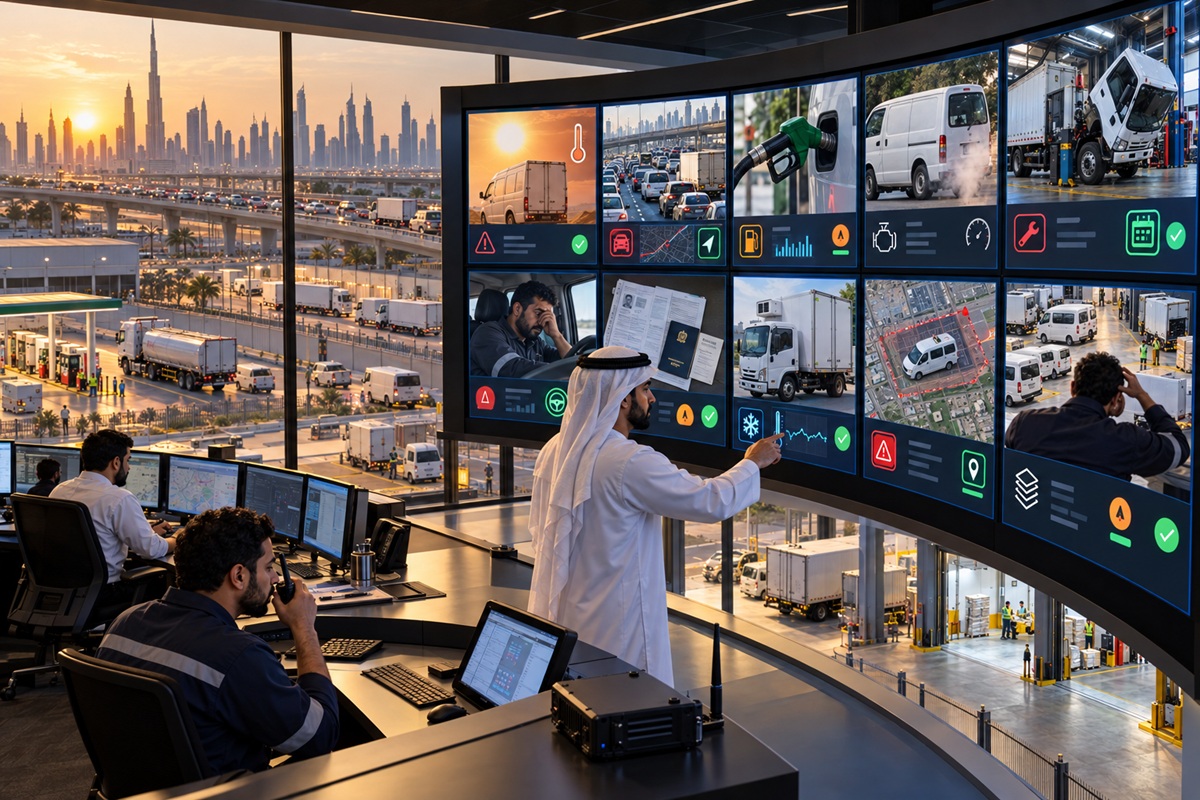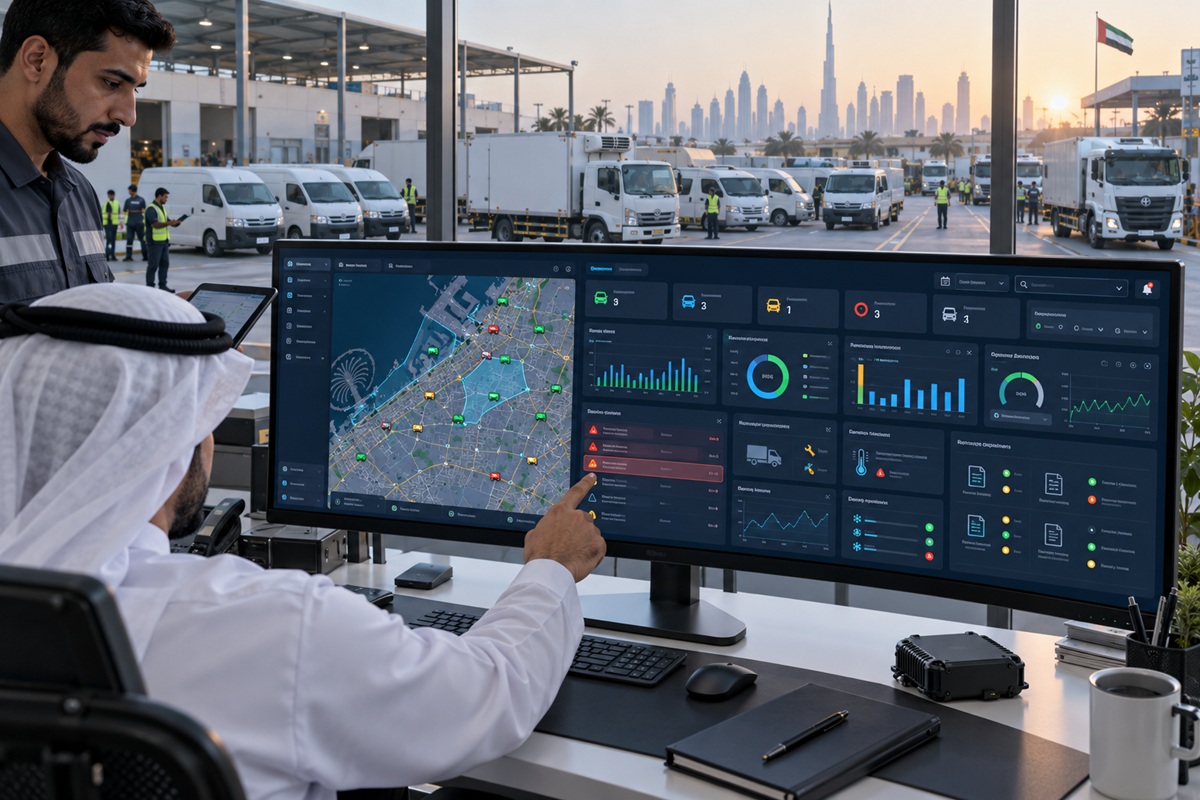
Most UAE fleet operators do not replace their fleet management system because it stops working. They replace it because the gap between what it can do and what their regulatory environment and operational competitors expect has grown large enough to become a commercial liability. The system still tracks vehicles. It still generates mileage reports. It just cannot generate the IVMS driver behaviour report that ADNOC now requires. It cannot submit data to the Asateel portal continuously. It has no cold chain module. It cannot show a driver safety score. And the workaround manual export, spreadsheet compilation, separate temperature logger, paper IVMS log has consumed enough of the fleet manager’s time that the hidden cost of the old system now exceeds the cost of replacing it.
Fleet management technology in UAE has moved fast. The Asateel programme, which now mandates continuous GPS data submission for commercial vehicles in Abu Dhabi, did not exist in its current form a decade ago. ADNOC’s IVMS requirements for contractor vehicles have tightened substantially. AI dashcam capability that was enterprise-only three years ago is now standard in mid-market fleet deployments. A system that was adequate when it was purchased may now be creating compliance exposure, operational disadvantage, or both not because the system has failed, but because the market has moved.
This guide identifies the seven most reliable signs that a UAE fleet management system is outdated, explains the specific operational or compliance cost each sign creates, and describes what upgrading actually addresses in each case.
Key Takeaways
- Outdated fleet management systems in UAE create two categories of cost: compliance exposure (failing to satisfy Asateel, IVMS, SecurePath, or cold chain documentation requirements) and operational overhead (manual report compilation, separate system logins, data fragmentation between GPS and other monitoring functions).
- The most commercially urgent outdatedness sign is UAE regulatory non-compliance, a system that cannot submit Asateel data continuously, generate IVMS driver behaviour reports, or produce HACCP/GDP cold chain documentation creates direct regulatory and contractual risk.
- The most financially significant outdatedness sign is manual reporting overhead quality teams that spend two to four days per month compiling fleet compliance reports from a system that cannot automate them are absorbing a cost that modern fleet platforms eliminate entirely.
- Data fragmentation running GPS on one platform, temperature on another, fuel on a third, and maintenance on a spreadsheet creates audit risk, management overhead, and the inability to generate cross-data insights that unified platform deployments provide.
- The decision to upgrade a fleet management system in UAE should be driven by a total cost of ownership comparison that includes the hidden costs of the current system manual reporting labour, compliance fine exposure, operational inefficiency not just a subscription price comparison.
The 7 Signs And What to Do About Each
Sign 1: Your System Cannot Submit Asateel or SecurePath Data Continuously
The ITC Abu Dhabi’s Asateel programme requires continuous GPS data transmission from all registered commercial vehicles to the Asateel portal. Dubai RTA’s SecurePath programme requires the same for rental cars, taxis, and public transport vehicles. A fleet management system that uses non-certified hardware, transmits data in batches rather than continuously, or lacks the portal integration to submit in the required format creates compliance gaps that ITC and RTA monitoring systems detect and flag resulting in notices, warnings, and ultimately financial penalties for persistent non-compliance.The most common version of this sign is a fleet using older GPS hardware that was purchased before the Asateel certified device list was established. The hardware tracks vehicles the basic location function works but the device is not on the current ITC certified list and cannot satisfy the Asateel submission requirement regardless of how the platform is configured. Continuing to operate with non-certified hardware is not a temporary workaround; it is an ongoing compliance liability that grows as the regulatory environment tightens.
What to do: Verify your hardware against the current ITC Asateel certified device list. If your devices are not on the list, hardware replacement is required this is not a software fix. VZone International installs Teltonika certified devices that appear on both the Asateel and OPAL approved lists, with managed portal registration ensuring continuous compliant data submission from day one.
Sign 2: Your System Tracks Location But Not Driver Behaviour
If your current fleet management system provides GPS location and journey history but no driver behaviour data no harsh braking events, no acceleration events, no cornering alerts, no driver identification per trip it is a basic AVL system, not a telematics platform. For most UAE commercial fleet operations, this distinction has become operationally and commercially significant.For ADNOC contractor fleets, the distinction is mandatory: IVMS compliance requires multi-tier speed event capture, harsh behaviour recording, seatbelt monitoring, and driver ID per trip data that basic AVL hardware cannot produce. For non-ADNOC fleets, driver behaviour data has become commercially significant through the insurance channel: UAE commercial fleet insurers increasingly offer premium reductions for fleets with telematics-verified driver behaviour data, and refuse to extend coverage or load premiums heavily for fleets with no behaviour monitoring capability. A fleet that cannot provide driver behaviour data to its insurer is paying the non-data premium rate regardless of how safely its drivers actually drive.
What to do: Upgrade from basic AVL to a standard telematics deployment with accelerometer-based driver behaviour capture and iButton or RFID driver identification. The hardware upgrade cost per vehicle is typically AED 200 to AED 400 above basic AVL hardware. The insurance premium reduction from verified safe-driver data typically recovers this within the first policy renewal cycle. For ADNOC contractor fleets, IVMS certification requires specific hardware not just any telematics device.
Sign 3: Compliance Reports Take Days to Compile Each Month
When the question ‘can you show me the temperature records for the pharmaceutical deliveries last week?’ requires a quality manager to spend half a day downloading data logger files, cross-referencing them with GPS records from a separate system, and manually assembling a report in a spreadsheet that is an outdated fleet management system. Not because the technology has failed, but because it has never had the capability to generate this report automatically.The manual compilation overhead compounds with fleet size and regulatory intensity. A 30-vehicle pharmaceutical distribution fleet with daily deliveries generates thousands of trip records per month. Manual compliance report assembly for this volume is a full-time quality team task a task that a modern fleet management platform with automated GDP-formatted report generation eliminates entirely. Every hour spent on manual report compilation is an hour not spent on quality improvement, driver coaching, or operational planning.
What to do: Evaluate your current system’s automated reporting capability against the specific formats required by your regulatory framework (HACCP, WHO GDP, ADNOC HSE reports). If the system requires manual compilation for any of these, the automation gap is a direct labour cost and an audit risk. Enterprise fleet platforms like VZone International’s Wialon deployment generate all these report formats automatically at trip or route completion quality managers review rather than compile.
Sign 4: Your Temperature Monitoring Is on a Separate System From Your GPS
Cold chain operators running GPS tracking on one platform and temperature monitoring on a separate system often a standalone data logger or a different IoT provider’s portal face a data integration problem that creates three distinct costs. First, GPS-paired temperature documentation: MOHAP WHO GDP requirements specify that pharmaceutical temperature records must include the vehicle’s GPS location at each monitoring interval. Two separate systems cannot produce this documentation without manual cross-referencing. Second, operational response: when a temperature alert fires on System B, the operations manager has to switch to System A to find out where the vehicle is. The seconds that decision takes in a time-critical excursion situation matter. Third, audit preparation: compiling a GDP temperature audit trail that shows both location and temperature data from two separate systems is a manual task that takes hours rather than the minutes a unified platform takes.
What to do: Move to a unified fleet management platform that integrates GPS and IoT temperature monitoring in the same data stream, the same dashboard, and the same automated report output. For pharmaceutical cold chain operations, this integration is a GDP compliance requirement separate systems cannot produce the GPS-paired documentation that MOHAP auditors examine. VZone International’s Wialon platform processes GPS and temperature sensor data simultaneously, generating GPS-location-stamped temperature records as a standard trip report output.
Sign 5: You Have No Visibility Into Fuel Consumption Beyond Fuel Card Statements
Fuel card statements tell you how much fuel was purchased and where. They do not tell you how much fuel was consumed by each vehicle on each route, whether a vehicle’s fuel consumption is higher than normal for its route (indicating a mechanical issue, unauthorised driving behaviour, or fuel siphoning), whether the fuel purchased corresponds to the tank capacity of the vehicle (a basic check for fuel theft that many UAE fleets do not perform), or how much fuel is being wasted on idling which in UAE summer conditions, where air conditioning creates a continuous engine load during stationary periods, can represent 15 to 25 percent of total fuel consumption for urban delivery fleets.A fleet management system that relies exclusively on fuel card statements for fuel management is missing the operational intelligence layer that IoT fuel monitoring provides. And a fleet paying for a fuel card reconciliation process that catches theft after the fact, rather than a monitoring system that detects anomalies in real time, is paying for investigation rather than prevention.
What to do: Deploy in-tank IoT fuel sensors on high-consumption vehicles particularly trucks and heavy vans where the per-vehicle fuel cost justifies the monitoring investment most clearly. Fuel sensor data integrated with GPS route data enables consumption per kilometre per route analysis, fill-up verification against tank capacity, and drain event detection that fuel card statements cannot provide. VZone International’s fuel monitoring module integrates in-tank sensors with GPS data on the same platform, with automated fuel anomaly alerts and monthly fuel waste reports.
Sign 6: Your Drivers Cannot Use the System From Their Phones
A fleet management system without a functional driver mobile app is increasingly operationally limiting in UAE’s commercial fleet environment. Modern fleet operations use driver apps for: digital job dispatch (replacing radio and WhatsApp dispatch); electronic proof of delivery (photo capture with GPS timestamp replacing paper delivery notes); driver pre-trip inspection checklists (replacing paper vehicle condition reports); in-cab temperature alerts (showing drivers the current cargo compartment temperature so they can take action before an excursion is confirmed); navigation with traffic integration (replacing separate sat-nav devices); and two-way messaging between drivers and dispatchers.A fleet management system that has no driver app, or one whose driver app crashes on UAE-standard Android devices, or one that requires drivers to log in to a web portal on a phone browser, is creating friction and workarounds that reduce operational efficiency, increase error rates in delivery documentation, and prevent the driver-level engagement with fleet data that behaviour coaching requires.
What to do: Evaluate the driver mobile app capability of any replacement system as seriously as the management dashboard capability the app is the operational interface that drivers interact with for every shift. Verify it works on the Android devices your drivers actually carry (Samsung and Huawei mid-range devices are standard in UAE commercial fleets), that it functions in Arabic and English, and that it supports the specific workflows your drivers need: job dispatch, proof of delivery, vehicle inspection, and in-cab alerts.
Sign 7: The System Cannot Connect to Your ERP, Finance, or HR Systems
A fleet management system that operates as a data island generating its own reports that have to be manually re-entered into your accounting system, manually reconciled with your payroll system for driver overtime calculations, and manually exported to your maintenance management system for work order creation is creating integration overhead that scales linearly with fleet size and activity level. At 10 vehicles, the manual data transfer is a minor annoyance. At 100 vehicles with daily route data, it is a significant operational cost.The commercial relevance of ERP integration has grown in the UAE market as enterprise fleet operators have standardised on SAP, Oracle, Odoo, and Zoho for their business management infrastructure. A fleet management system that cannot connect via API to the ERP the finance team uses for cost reporting means fleet cost data lives in a separate system that finance does not access, resulting in fleet costs being managed at summary level rather than at the vehicle, route, or driver granularity that modern cost control requires.
What to do: Verify whether your current system or any replacement system offers pre-built connectors for your specific ERP. SAP, Oracle, Odoo, and Zoho are the most common UAE enterprise ERP deployments. VZone International’s platform provides REST API access and native ERP connectors, enabling fleet cost data, mileage records, driver performance data, and vehicle maintenance records to flow into the same financial reporting infrastructure as other business data without manual export or reconciliation.
How Outdated Is Your Current System? Quick Assessment
Count how many of the seven signs apply to your current fleet management system:
| Signs Identified | Assessment | Recommended Action |
| 0–1 signs | Current system is broadly adequate for your requirements | Review in 12 months; monitor UAE regulatory changes for Asateel and IVMS updates |
| 2–3 signs | System has meaningful gaps operational overhead or compliance exposure building | Prioritise the compliance-related signs first; plan upgrade within 6–12 months |
| 4–5 signs | Significant gaps across compliance, operations, and integration | Begin upgrade evaluation immediately; cost of inaction exceeds upgrade cost |
| 6–7 signs | System is materially limiting your operation and creating compliance risk | Urgent upgrade required; calculate the monthly cost of current gaps to build the business case |
The Real Cost of Running an Outdated Fleet System in UAE
The total cost of operating an outdated fleet management system in UAE is rarely visible as a single line item because it accumulates across multiple budget categories that are not typically connected in management reporting. Quantifying it requires adding together the hidden costs that the existing system creates and comparing the total against the upgrade investment.
| Cost Category | How It Manifests | Estimated Monthly Cost (AED) |
| Manual report compilation | Quality/fleet analyst time: 2–5 days/month on data extraction and report assembly | AED 2,000–6,000 (analyst fully loaded cost) |
| Compliance fines Asateel/IVMS gaps | ITC penalty for non-certified devices or data submission gaps; ADNOC audit findings | AED 2,000–10,000 per incident |
| Fuel waste no consumption monitoring | Undetected idle time (UAE summer A/C), route inefficiency, undetected fuel theft | AED 1,500–8,000 per month (fleet size dependent) |
| Insurance premium loading | Non-data or bad-data premium rate vs telematics-verified reduced rate | AED 500–3,000 per month for 20-vehicle fleet |
| Cargo loss no cold chain monitoring | Temperature excursions not detected or prevented; HACCP/GDP audit findings | AED 5,000–50,000 per incident (pharmaceutical/food) |
| Missed contract value | Contracts lost or not won because system cannot satisfy documentation requirements | AED 20,000–200,000 per contract (one-time opportunity cost) |
For a typical UAE commercial fleet of 25 vehicles with 3 to 4 of the seven signs present, the combined monthly cost of system outdatedness typically ranges from AED 8,000 to AED 30,000 against a fleet management platform upgrade cost of AED 80 to AED 200 per vehicle per month, or AED 2,000 to AED 5,000 monthly for the same fleet size. The upgrade investment pays back within one to three months in most cases.
How VZone International Addresses All Seven Signs
| Sign | VZone Solution |
| 1. No Asateel / SecurePath compliance | Teltonika hardware on ITC Asateel certified list + managed portal registration + 24/7 submission monitoring |
| 2. Location only, no driver behaviour | Accelerometer + CAN bus driver behaviour capture; iButton/RFID driver ID; IVMS-certified for ADNOC contractor fleets |
| 3. Manual compliance reports | Automated GDP, HACCP, IVMS, and HSE reports generated at trip/route completion; quality manager reviews, not compiles |
| 4. Separate GPS and temperature systems | Wialon platform co-processes GPS + IoT temperature data; GPS-paired temperature records in every automated trip report |
| 5. Fuel card only no consumption monitoring | In-tank IoT fuel sensors with GPS route integration; fill-up verification; drain event alerts; consumption per km by route |
| 6. No functioning driver mobile app | iOS and Android driver app in Arabic and English: job dispatch, ePOD, pre-trip inspection, in-cab temperature alerts, navigation |
| 7. No ERP integration | REST API + native connectors for SAP, Oracle, Odoo, Zoho; fleet cost, mileage, and performance data feeding enterprise financial systems |
Conclusion: The Cost of Staying Is Higher Than the Cost of Upgrading
Fleet management technology in UAE has evolved faster than most fleet operators’ review cycles. A system purchased five years ago to satisfy the GPS tracking requirement that was current at the time may now be creating compliance exposure for Asateel certification, IVMS contractor obligations, or pharmaceutical GDP documentation requirements that did not exist in their current form when the original purchasing decision was made. The system has not failed. The regulatory and commercial environment has moved.
The seven signs in this guide are not theoretical risk indicators. They are observable, measurable operational patterns that UAE fleet managers experience daily in operations running on outdated systems. Manual report compilation days. Compliance notices from ITC. Insurance premium loading from non-data rates. Cold chain excursions discovered at delivery because there was no real-time monitoring. These are the recurring costs of staying with a system that is no longer adequate for the environment it operates in.
Calculating the total monthly cost of those patterns and comparing it to the monthly cost of a fleet management system upgrade produces the business case that makes the replacement decision straightforward rather than speculative. In most UAE fleet operations where three or more of the seven signs are present, the payback period for an upgrade is measured in months, not years.
Find out exactly which signs apply to your fleet and what they’re costing you.
VZone International offers a free fleet system assessment: we review your current technology against the seven outdatedness signs, quantify the monthly cost of each gap using UAE fleet benchmarks, and produce an upgrade ROI projection before you commit to anything. No obligation. Book your free assessment today.
Frequently Asked Questions
The seven most reliable signs are: your system cannot submit Asateel or SecurePath data continuously; it tracks location but not driver behaviour; compliance reports require manual compilation; temperature monitoring runs on a separate platform from GPS; you have no fuel consumption data beyond fuel card statements; drivers cannot use the system effectively from their phones; and the system cannot integrate with your ERP or finance systems. If three or more of these signs apply, the monthly cost of system outdatedness is almost certainly higher than the cost of upgrading to a current fleet management platform.
If your fleet GPS hardware is not on the ITC Abu Dhabi Asateel certified device list, your vehicles cannot satisfy the mandatory GPS data submission requirement for commercial vehicles in Abu Dhabi. ITC monitoring detects vehicles without active Asateel data transmission and generates compliance notices. Persistent non-compliance results in financial penalties and can affect vehicle registration renewal. The device list is maintained by ITC and updated periodically a device that was compliant when purchased may have been removed from the current list if it no longer satisfies ITC's technical specifications. Verification against the current list should be part of any fleet management system review.
Replace your fleet management system when: it cannot satisfy a current UAE regulatory compliance requirement (Asateel, IVMS, SecurePath); the manual workarounds your team uses to compensate for system limitations are consuming more than one working day per month in aggregate; you have experienced a compliance finding, cargo loss, or contract loss that a capable system would have prevented; or a competitor or customer has specified documentation requirements your system cannot satisfy. The replacement decision should be based on the total cost of the current system's limitations compared against the upgrade investment not on feature comparison lists alone.
A fleet management system upgrade in UAE typically involves three cost components: hardware replacement (AED 250 to AED 600 per vehicle for standard telematics devices; AED 800 to AED 2,000 for vehicles requiring cold chain sensor kits); installation (AED 150 to AED 350 per vehicle); and platform subscription (AED 80 to AED 250 per vehicle per month depending on capability level). For a 25-vehicle fleet upgrading from basic GPS to full telematics with cold chain monitoring, the total 24-month investment typically ranges from AED 80,000 to AED 150,000. Against the AED 8,000 to AED 30,000 monthly cost of system outdatedness for the same fleet, the payback period is typically one to four months.
Whether to upgrade or replace depends on whether your current hardware supports the capability you need to add. If your existing GPS devices have temperature sensor input ports and your current platform supports IoT integration, adding cold chain monitoring is a sensor and configuration upgrade rather than a platform replacement. If your existing hardware is not on the Asateel certified list, or cannot capture driver behaviour event data, hardware replacement is required and hardware replacement makes it practical to also change the platform. Most UAE fleet management system upgrades involve both hardware replacement (to satisfy Asateel or IVMS requirements) and platform migration (to access automated reporting, ERP integration, and driver app capabilities that legacy platforms lack).