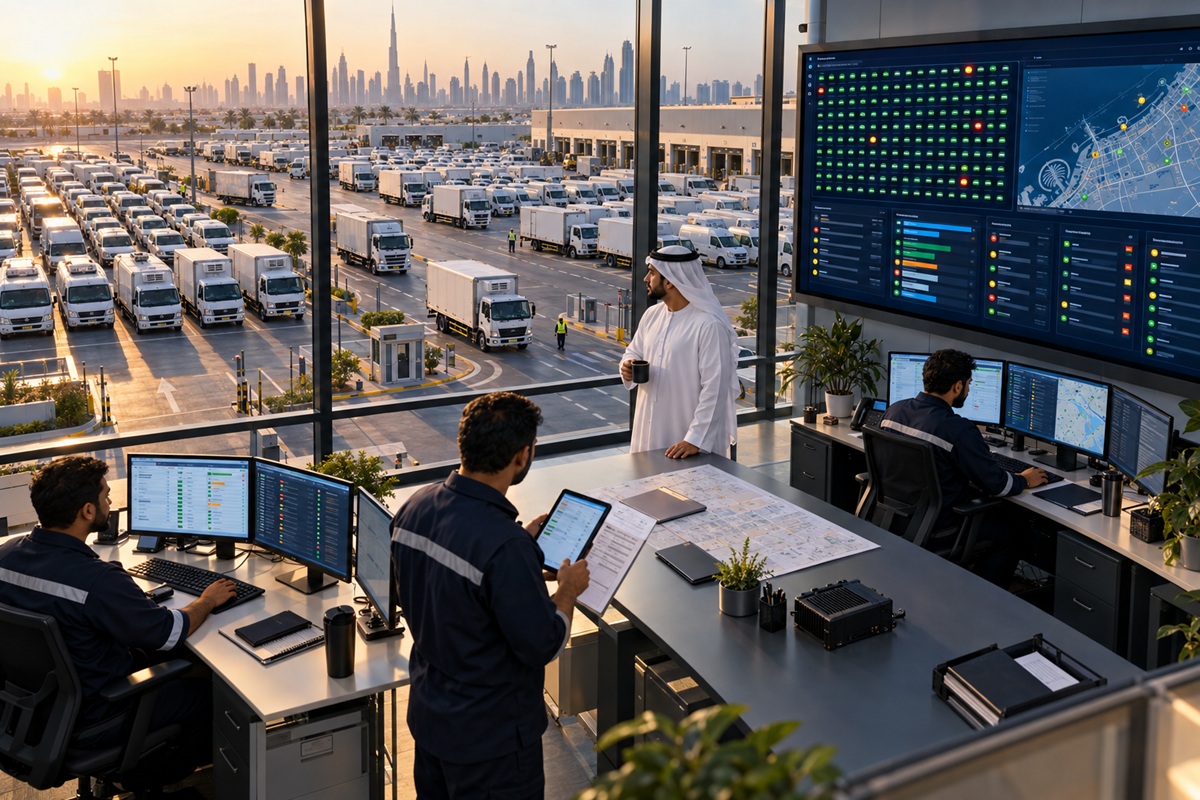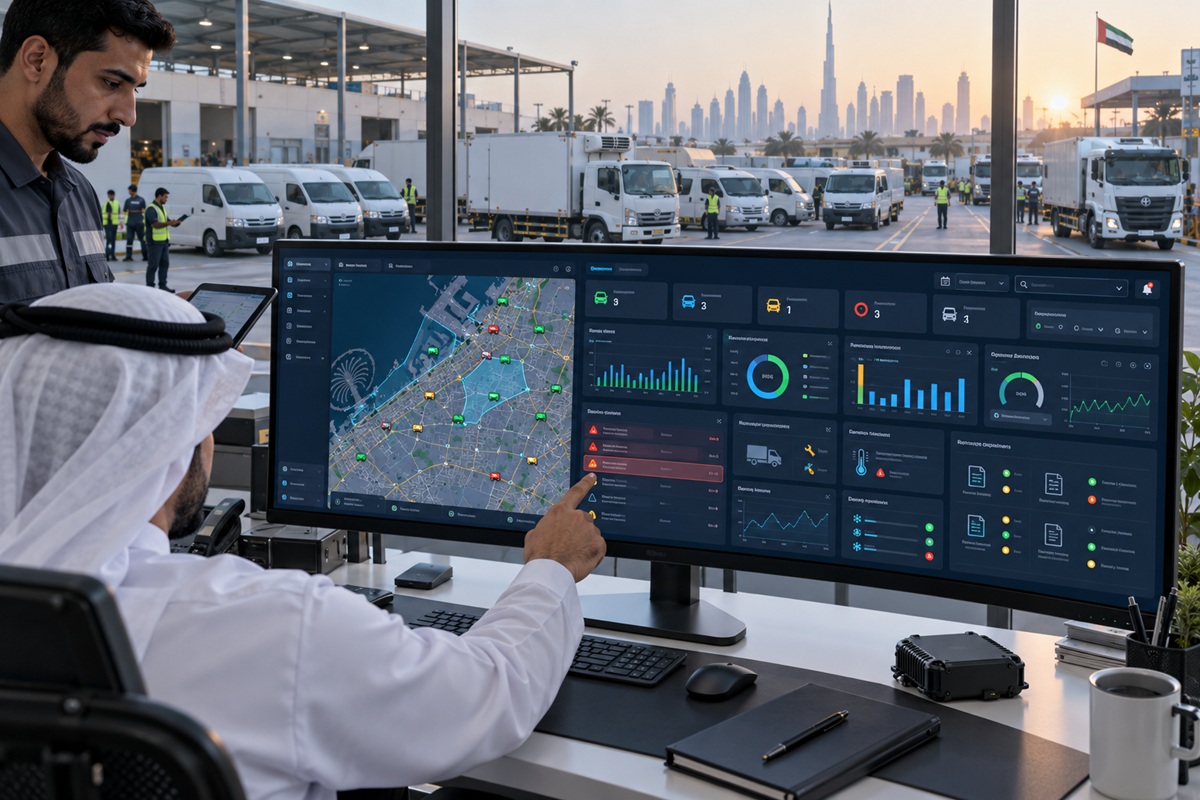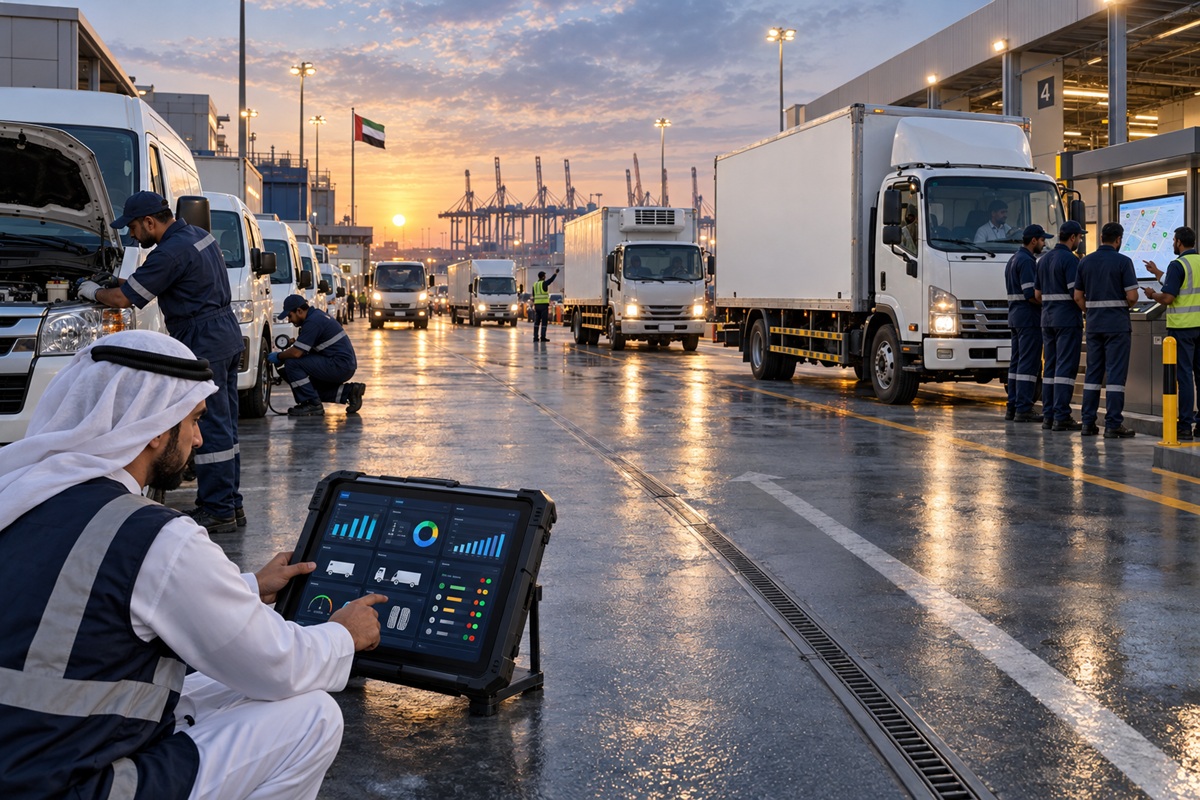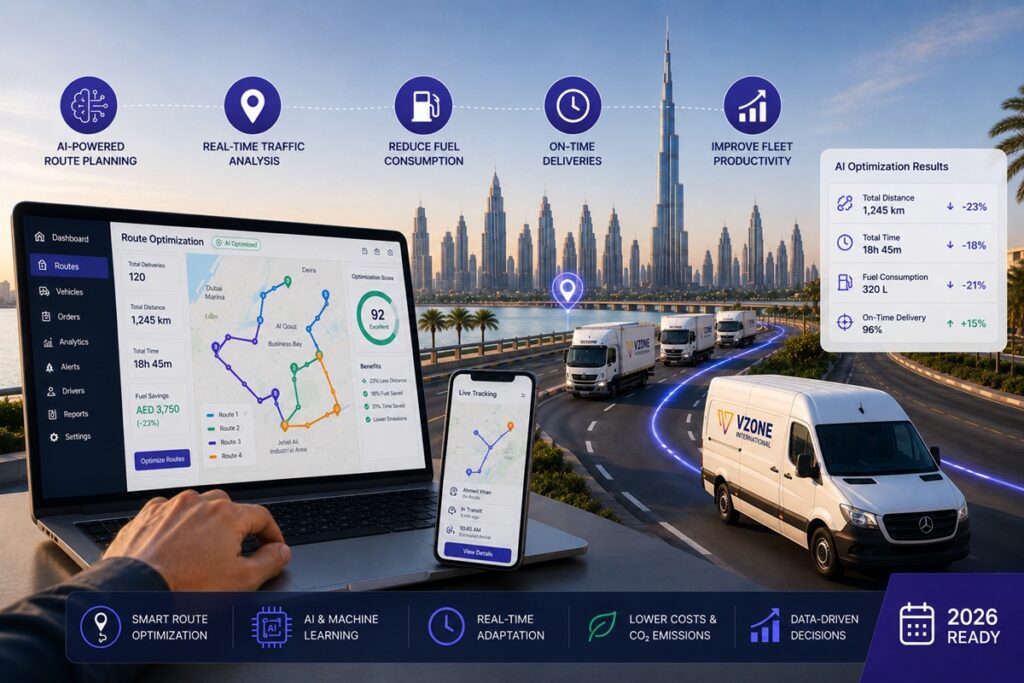
In the UAE, where traffic on Sheikh Zayed Road can turn a 20-minute delivery into a 90-minute ordeal and where same-day delivery expectations from e-commerce customers are non-negotiable, route planning is a strategic operational decision not an administrative task that a dispatcher handles in a spreadsheet each morning. The difference between a delivery fleet that plans routes manually and one using AI-powered optimisation is not a marginal efficiency improvement it is the difference between a fleet operating at 74 percent on-time delivery and one consistently achieving 93 percent, with fewer drivers covering more stops in the same hours.
AI route optimisation for UAE fleets works because the problem it solves calculating the most efficient sequence for multiple stops across a city with real-time traffic variability, customer time windows, vehicle load constraints, and driver scheduling is genuinely too complex for human planners to solve optimally. A dispatcher planning routes for 15 drivers making 20 stops each is working with a combinatorial problem of enormous scale. An AI routing engine solves it in seconds, adjusts it in real time when traffic conditions change, and integrates the delivery execution data driver app confirmation, customer ETA notifications, proof of delivery that transforms a route plan into an accountable delivery operation.
This guide covers what fleet route optimisation is, how AI planning algorithms work in the UAE context, the business outcomes fleet operators consistently achieve, and how dispatch management connects the optimised plan to actual delivery execution.
Key Takeaways
- AI route optimisation solves a combinatorial planning problem the optimal sequence for multiple multi-stop routes that is genuinely beyond the practical capacity of manual planning, even by experienced dispatchers.
- UAE fleet operators implementing AI routing typically achieve 15 to 29 percent fuel cost reductions per delivery, primarily through shorter total distance driven and fewer unnecessary route segments.
- On-time delivery rate improvements of 15 to 20 percentage points are consistently reported from UAE routing deployments driven by accurate traffic-aware ETAs, customer time window compliance, and elimination of ad-hoc last-minute route changes.
- Dynamic re-routing adjusting active routes in real time based on traffic incidents, new orders, or driver delays is the capability that maintains on-time performance in UAE’s unpredictable traffic environment rather than locking in a morning plan that becomes obsolete by 9am.
- Digital dispatch and proof of delivery integration closes the loop between route planning and execution accountability connecting the plan to driver confirmation, customer signature, and delivery photo evidence.
- Ramadan operating patterns compressed delivery windows, earlier peak traffic periods, route timing shifts create specific route planning challenges in the UAE market that AI routing engines with flexible time window constraints handle more effectively than manual replanning.
What Is Fleet Route Optimisation?
Fleet route optimisation is the process of calculating the most efficient sequence and grouping of delivery stops across a vehicle fleet minimising total distance driven, travel time, fuel consumed, or delivery time windows missed, subject to constraints including vehicle load capacity, customer time windows, driver shift hours, and road network conditions. The term ‘optimisation’ has a specific mathematical meaning here: not just a better plan than yesterday’s, but the plan that produces the best possible outcome across all constraints simultaneously.
In practice, fleet route optimisation for a UAE delivery operation means taking a day’s order list say, 300 delivery addresses across Dubai and calculating which driver should cover which stops, in which sequence, using which vehicles, starting from which depot, to minimise total fleet distance while ensuring every stop is reached within its customer time window before the driver’s shift ends. An experienced dispatcher can produce a workable plan for this problem in an hour. An AI route engine produces a mathematically superior plan in under 60 seconds.
Manual Routing vs. AI-Powered Optimisation
Manual routing by experienced dispatchers is not random it draws on local knowledge, customer relationship awareness, and pattern recognition that has real operational value. But it has a fundamental limitation: the human brain cannot simultaneously evaluate the thousands of possible stop sequences and assignment combinations that a multi-driver, multi-stop routing problem contains. Experienced dispatchers apply heuristics mental rules of thumb that produce good-enough routes most of the time, but leave significant efficiency gains uncaptured.
| Factor | Manual Routing (Dispatcher) | AI Route Optimisation Engine |
| Speed of plan generation | 45–90 minutes for a full day’s routes | Under 60 seconds for the same route set |
| Number of constraints handled simultaneously | 3–5 (experience-dependent) | 10–15+ simultaneously (capacity, time, traffic, shifts) |
| Traffic data integration | Manual dispatcher’s local knowledge, static | Live Google Maps / HERE Maps real-time feed |
| Adaptation to new orders mid-day | Manual replanning 20–30 minutes per adjustment | Instant re-optimisation for the remaining route |
| Consistency across dispatchers | Variable quality depends on individual experience | Consistent same algorithm, same quality daily |
| Scalability with fleet growth | Linear each new driver adds planning burden | Non-linear same time regardless of fleet size increase |
| Customer ETA accuracy | Estimate-based often 1–2 hour windows | GPS + traffic model 15–30 minute accuracy windows |
| Route quality vs theoretical optimum | Typically 15–30% above minimum distance possible | Within 1–5% of theoretical optimum |
Dynamic Re-Routing Adjusting to Live Traffic and New Orders
The limitation of even the best morning route plan is that it was calculated against the traffic conditions and order list at the time of planning. By 8:30am in Dubai, a multi-vehicle accident on the E11 has changed the fastest route for three of your drivers. By 10am, a high-priority same-day order has arrived that needs to be inserted into an active route. By 11am, a driver is running 45 minutes behind schedule because a customer required a long service time at their site.
Dynamic re-routing is the capability that handles all three of these scenarios in real time. When GPS tracking shows a driver falling behind schedule, the route engine recalculates the remaining stops potentially reassigning some stops to a nearby driver who is running ahead and automatically updates both drivers’ route instructions. When a new priority order arrives, the engine inserts it into the most efficient position across all active routes and pushes the updated plan to the relevant driver’s mobile app within seconds. When a major traffic incident creates a blocked route, affected drivers receive re-routed instructions before they reach the blockage.
For UAE delivery operations running during peak morning hours in Dubai’s Sheikh Mohammed Bin Rashid Boulevard, JLT, and Business Bay clusters, or during the Abu Dhabi Corniche and Al Raha Beach rush periods, the ability to re-route dynamically rather than lock in a morning plan that traffic conditions will defeat is the operational feature that most directly protects the on-time delivery rate through the working day.
Key Benefits of Route Optimisation for UAE Fleets
The business outcomes from AI route optimisation are measurable and consistent across UAE delivery fleet deployments. The table below represents typical outcomes from UAE logistics fleet routing implementations across e-commerce, food distribution, and B2B delivery sectors.
| KPI | Before AI Routing | After AI Routing (6 months) | Improvement |
| Fuel cost per delivery | AED 18.50 | AED 13.20 | –29% |
| On-time delivery rate | 74% | 93% | +19 percentage points |
| Average stops per driver per day | 14 | 19 | +36% productivity |
| Driver overtime hours per week | 12 hours | 4 hours | –67% |
| Customer complaints (delivery-related) | 7.8% of deliveries | 1.9% of deliveries | –76% |
| CO₂ per delivery | 2.4 kg | 1.7 kg | –29% carbon reduction |
| Dispatcher time on route planning | 75 minutes/morning | 12 minutes/morning | –84% planning overhead |
| Failed first delivery attempts | 11% of deliveries | 4% of deliveries | –64% redelivery cost |
Fuel Cost Reduction via Shorter, Smarter Routes
The fuel saving from AI route optimisation comes from three sources. The primary source is shorter total route distance: an AI-optimised route covers the same stops in significantly fewer kilometres than a manually planned route, by finding stop sequences that eliminate the backtracking and inefficient geographic groupings that manual planning produces. The secondary source is traffic avoidance: routing around known congestion points and incident-affected roads eliminates the fuel wasted in slow-moving traffic that manual plans cannot consistently avoid. The third source is reduced overtime: drivers who complete routes without overtime idling during extended shifts waste less fuel at idle.
For a 50-vehicle UAE delivery fleet averaging AED 18.50 fuel cost per delivery across 200 deliveries per vehicle per month a total fuel spend of AED 185,000 per month a 29 percent fuel saving from AI routing represents AED 53,650 per month saved, or over AED 640,000 annually. Against a route optimisation platform subscription cost of AED 150 to AED 300 per vehicle per month, the ROI payback period is typically two to three months.
On-Time Delivery Improvement Customer SLA Impact
On-time delivery rate is the KPI that most directly affects customer retention in UAE logistics. E-commerce customers who experience late deliveries are significantly more likely to use a competing platform for their next order. B2B logistics clients with JIT supply chain requirements face production disruptions from late deliveries that can translate into penalty clauses. Food service customers whose morning orders arrive after kitchen preparation begins face service disruptions that damage the supplier relationship.
The on-time improvement from AI routing is not primarily from driving faster it is from planning realistic routes that account for traffic conditions and delivery time windows accurately, then giving drivers the GPS-confirmed ETAs and route updates that keep them on target through the day. A customer who was previously given a vague ‘morning delivery’ window and experienced late arrivals 26 percent of the time receives a 30-minute ETA notification from the driver app and is then delivered within that window 93 percent of the time. The customer experience improvement is direct, measurable, and commercially significant.
Driver Productivity More Stops, Same Hours
Increasing stops per driver per day from 14 to 19 – a 36 percent productivity improvement is the capacity equivalent of deploying 36 percent more drivers without hiring anyone. For UAE fleet operators facing both driver cost pressure and driver availability challenges, route optimisation-driven productivity improvement is a direct headcount offset. The same delivery volume is covered by fewer drivers working within their contracted hours, with overtime reduced by more than half and failed deliveries (requiring a second attempt) cut by nearly two thirds.
The driver experience improvement is also commercially significant for retention. Drivers whose routes are realistically planned achievable within their shift hours without the stress of perpetually running behind schedule report higher job satisfaction and are less likely to seek alternative employment. In UAE’s competitive logistics driver labour market, reducing route-related driver stress is a retention benefit alongside the commercial efficiency gains.
AI-Powered Route Planning – How It Works
Multi-Constraint Optimisation Time Windows, Capacity, Traffic
The technical core of AI route optimisation is solving what logistics engineers call the Vehicle Routing Problem with Time Windows (VRPTW) a mathematically complex optimisation challenge that involves assigning and sequencing delivery stops across a fleet of vehicles subject to multiple simultaneous constraints. The constraints that UAE delivery operations typically apply include: customer time windows (deliver between 9am and 11am, or between 2pm and 4pm); vehicle load capacity (the total weight or volume of stops assigned to a vehicle cannot exceed its payload); driver shift hours (the route must be completable within the driver’s contracted hours including loading and break times); depot return time (the vehicle must return to the designated depot by a specified time); vehicle type matching (refrigerated vehicles serve cold chain stops, heavy vehicles serve high-weight stops); and geographic clustering (stops should be geographically grouped to minimise total distance).
An AI route engine evaluates millions of possible assignment and sequence combinations against all of these constraints simultaneously, converging on the solution that produces the minimum total cost measured as distance, time, fuel consumption, or a weighted combination while satisfying all constraints. This is computationally intensive but executes in seconds on modern cloud infrastructure, producing a plan that human dispatchers cannot achieve manually even with significantly more time.
Live Traffic Integration UAE Roads, Google Maps, HERE Maps
Route optimisation in the UAE context without live traffic data integration is planning for a road network that does not exist during operational hours. Sheikh Zayed Road, the E311 Emirates Road, the Abu Dhabi Corniche approach, and the Sharjah-Dubai corridor all experience severe congestion during morning and evening peak periods that can double or triple travel times on key route segments. A route plan that assigns a driver a 9:30am delivery in Business Bay after a 9am stop in JLT is unrealistic during weekday morning peak without traffic data to confirm whether that sequence is achievable.
Live traffic feeds from Google Maps API or HERE Maps the two most commonly integrated traffic data sources for UAE route optimisation platforms provide real-time congestion data, incident alerts, and historical traffic pattern models that the optimisation engine uses to calculate realistic travel times for each route segment at the time each stop is planned to be traversed. The result is route plans whose ETAs reflect actual UAE road conditions rather than free-flow speed assumptions that morning traffic makes fictional.
Multi-Stop and Multi-Day Route Planning
UAE logistics operations frequently require planning beyond the single-day horizon. Same-day delivery operations need routes recalculated multiple times per day as new orders arrive. Scheduled route operations regular B2B delivery cycles for retail or food service benefit from multi-day route planning that optimises the full weekly schedule rather than each day in isolation, enabling consistent customer visit patterns and predictable driver schedules. For operations with a mix of same-day and next-day deliveries, the route engine balances urgent same-day insertions against the impact on committed next-day route structures.
Ramadan is a specific UAE planning context that highlights the value of flexible multi-stop routing. Delivery time windows shift as business operating hours change; traffic peaks move earlier as Iftar approaches; customer availability patterns change significantly from non-Ramadan months. AI routing platforms that allow time window constraints to be adjusted for specific calendar periods, and that reoptimise based on updated traffic patterns, handle Ramadan’s operational complexity more effectively than fixed route plans that were designed for normal operating conditions.
Dispatch Management – Connecting Planning to Execution
The route plan is only as valuable as the execution it enables. Dispatch management the digital infrastructure that connects the route plan to the driver in the field, to the customer expecting delivery, and to the operations manager monitoring performance is what converts a scheduling optimisation exercise into an accountable delivery operation.
Digital Dispatch Sending Routes to Driver Mobile App
Digital dispatch pushes the optimised route plan directly to the driver’s mobile app a turn-by-turn navigation sequence with each stop’s customer details, delivery instructions, and time window visible at a glance. The driver app records the actual time of arrival and departure at each stop, creating a real-time execution record that the dispatcher and operations manager can monitor from the platform dashboard. Route deviations a driver who skips a stop, takes a significantly different route segment, or falls more than a defined time behind the planned schedule trigger automatic alerts that allow dispatchers to intervene before a customer time window is missed.
The transition from paper route sheets or WhatsApp group instructions to digital dispatch is typically the most operationally impactful change in a route optimisation implementation not because the route plan itself changes dramatically, but because the execution visibility and accountability infrastructure it creates eliminates the communication overhead and uncertainty that paper-based dispatch generates throughout the working day.
Real-Time Order Tracking for Customers
Customer-facing ETA notifications are the feature that most directly affects customer satisfaction in UAE last-mile delivery. An automated notification sent when the driver is 30 minutes away calculated from GPS position and live traffic data enables the customer to be available for delivery without waiting in an undefined window. A live tracking link that the customer can check from their phone gives them confidence that the driver is on the way and shows them exactly where the vehicle is in real time.
In the UAE e-commerce and food delivery market, where customer expectations for delivery visibility have been set by consumer app experiences, B2B logistics operators who provide enterprise customer ETA notifications and live tracking links differentiate their service quality from competitors who rely on driver phone calls and manual estimated arrival updates. The technology investment is minimal the customer notification module is a standard component of enterprise route optimisation platforms but the customer experience impact is significant.
Proof of Delivery Digital Signatures and Photos
Proof of delivery (POD) documentation captured digitally at the point of delivery through the driver’s mobile app creates the delivery confirmation record that resolves customer disputes, supports invoice processing, and provides the compliance documentation that regulated supply chains require. Digital POD captures the customer signature on the driver’s smartphone screen, a GPS-confirmed delivery location and timestamp, and in many configurations, a photo of the delivered goods at the delivery point. All of this is uploaded automatically to the platform and linked to the delivery record, available to the operations team and the customer immediately after delivery.
For UAE logistics operators delivering to large retail clients or food service accounts that process hundreds of deliveries per day, digital POD significantly accelerates invoice processing automatic matching of delivery records to purchase orders eliminates the manual reconciliation that paper POD requires. For cold chain logistics operators, digital POD combined with temperature records at delivery confirmation provides the compliance documentation chain that HACCP and GDP standards require without manual compilation.
VZone International’s Route Optimisation and Dispatching Solution
VZone International provides AI route optimisation and dispatch management integrated with live GPS fleet tracking on the Wialon and FMSiTrack enterprise platform delivering end-to-end route planning and delivery execution management for UAE logistics operators across e-commerce, food distribution, pharmaceutical delivery, and B2B supply chain sectors.
AI Route Engine with Live UAE Traffic Data
VZone’s route optimisation engine integrates live traffic feeds from Google Maps and HERE Maps providing real-time road condition data for UAE, Saudi Arabia, Oman, and the wider GCC route network. The engine handles multi-constraint optimisation across time windows, vehicle capacity, driver shift hours, and vehicle type matching for mixed fleets, producing optimised daily route plans in seconds and dynamic re-routing updates throughout the operational day as conditions change.
Dispatcher Dashboard and Driver App
The dispatcher dashboard provides the operations team with a live map showing every vehicle’s current position and route progress, active alerts for delays and deviations, and the tools to manually override or re-assign stops when operational judgement requires a human decision. The driver-facing mobile app available on Android and iOS delivers turn-by-turn navigation, stop-level delivery instructions, customer contact details, and digital POD capture. The app works with reduced functionality in areas of intermittent cellular connectivity, syncing execution records when connectivity is restored.
Integration with GPS Fleet Tracking for Real-Time Monitoring
VZone’s route optimisation module sits within the same Wialon platform that manages GPS fleet tracking, driver behaviour monitoring, fuel management, and compliance reporting meaning that route performance data is not in a separate system from the operational fleet data. Operations managers can view a driver’s route deviation alongside their speed events and harsh driving alerts in the same session, connecting delivery performance with safety performance in a way that separate routing and GPS systems cannot provide.
Conclusion: Route Optimisation Is the Highest-ROI Technology Investment Available to UAE Delivery Fleets
Among the technology investments available to UAE logistics and delivery fleet operators, AI route optimisation consistently delivers the fastest and clearest ROI because it directly addresses the two largest controllable cost drivers in delivery operations: fuel spend per delivery and driver time per stop. The outcomes are measurable within the first month of deployment, and the financial returns typically AED 600,000 to AED 1,200,000 annually for a 50-vehicle fleet are large enough to justify the investment on fuel savings alone, before accounting for on-time delivery rate improvements, customer satisfaction gains, and dispatcher productivity.
The technology has matured to the point where implementation barriers are primarily organisational rather than technical. The route engine is proven. The driver app is practical for field use. The live traffic integration is reliable for UAE road conditions. What determines whether a route optimisation deployment delivers its full potential is whether the organisation commits to the change management process getting dispatchers to trust the algorithm rather than manually overriding it, getting drivers to use the app rather than self-planning routes, and getting management to review route performance KPIs rather than only looking at delivery complaints after the fact.
For UAE fleet operators still routing by spreadsheet or dispatcher experience, the competitive pressure from operations that have already made this transition is the most immediate business case. When a competitor fleet delivers 19 stops per driver per day against your 14, and achieves 93 percent on-time performance against your 74 percent, the technology investment is not about optimisation at the margin it is about operational competitiveness in the market.
Stop routing by spreadsheet.
VZone’s AI route optimisation cuts UAE fleet delivery costs by up to 29% and boosts on-time delivery rates by 19 percentage points or more. Book a live routing demo for your fleet today we will run your actual delivery addresses through the system and show you the difference in real numbers before you commit to anything.
Frequently Asked Questions
GPS devices transmit vehicle location every 10 to 60 seconds to a cloud platform. Dispatch managers see all vehicles on a live map, receive alerts for delays or route deviations, and customers receive automated ETAs via SMS or app notification based on real-time vehicle position calculated against live traffic data. When a vehicle falls behind schedule, the route optimisation engine can automatically recalculate the remaining stops and push updated instructions to the driver app all without dispatcher intervention.
UAE fleet operators implementing AI route optimisation consistently achieve fuel cost reductions of 15 to 29 percent per delivery, on-time delivery rate improvements of 15 to 20 percentage points, 30 to 40 percent increases in stops per driver per day, and dispatcher planning time reductions of over 80 percent. For a 50-vehicle fleet with AED 185,000 monthly fuel spend, a 29 percent fuel saving represents over AED 640,000 annually typically achieving full ROI payback within two to three months of deployment.
The best logistics fleet management solution for the Middle East must combine real-time GPS tracking with AI route optimisation, delivery dispatch management, driver behaviour monitoring, fuel management, and multi-country GCC coverage across UAE, Saudi Arabia, Oman, and Kuwait all in a single platform. VZone International's Wialon-based platform provides all of these capabilities with UAE compliance certifications (Asateel, SecurePath, IVMS) for operators requiring regulatory compliance alongside commercial fleet management.
AI route optimisation platforms handle Ramadan delivery schedule changes by adjusting time window constraints and traffic pattern inputs to reflect the shifted operating hours and congestion patterns of the Ramadan period. Time windows can be configured to exclude Iftar hours when customer availability drops, delivery capacity constraints can be adjusted for the reduced working hour environment, and the live traffic feed updates automatically to reflect the earlier peak congestion timing that Ramadan mornings produce in UAE cities. Manual replanning of Ramadan schedules from scratch each year is one of the highest-value AI routing use cases for UAE operators.
Proof of delivery (POD) is the documentation confirming that a delivery was made to the correct recipient at the correct location and time. Digital POD is captured through the driver's mobile app: the customer signs on the driver's smartphone screen, the app records the GPS-confirmed delivery location and timestamp, and optionally takes a photo of the goods at the delivery point. All POD data uploads automatically to the platform, available immediately to the operations team. Digital POD eliminates paper POD processing delays, accelerates invoice reconciliation, and provides GPS-verified delivery confirmation for dispute resolution.
Yes. Enterprise route optimisation platforms provide API integrations that connect with ERP systems (SAP, Oracle, Microsoft Dynamics), order management systems, warehouse management systems, and e-commerce platforms. Orders flow automatically from the OMS into the route planning system without manual data entry, optimised routes are created and dispatched without dispatcher replanning effort, and delivery execution records (POD, timestamps, exceptions) are fed back into the ERP for invoice and fulfilment processing. VZone International provides API connectivity for route and dispatch platform integration with major UAE enterprise systems.