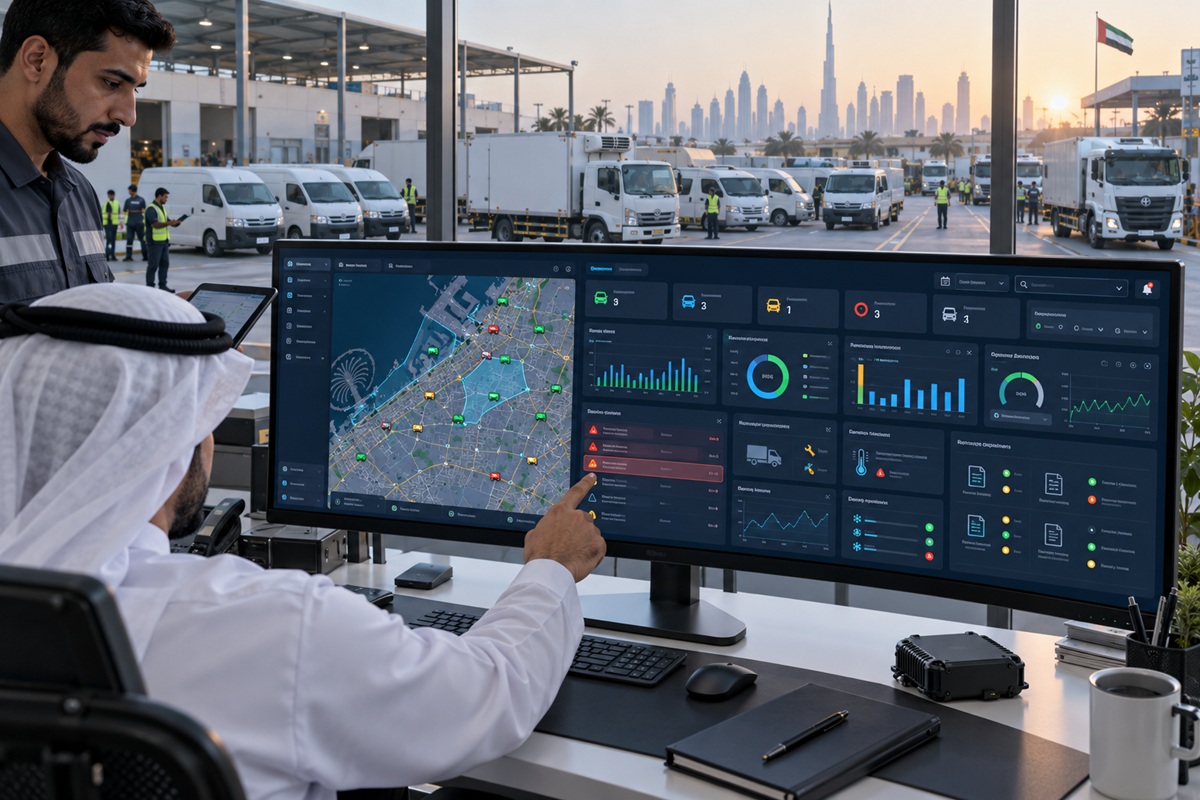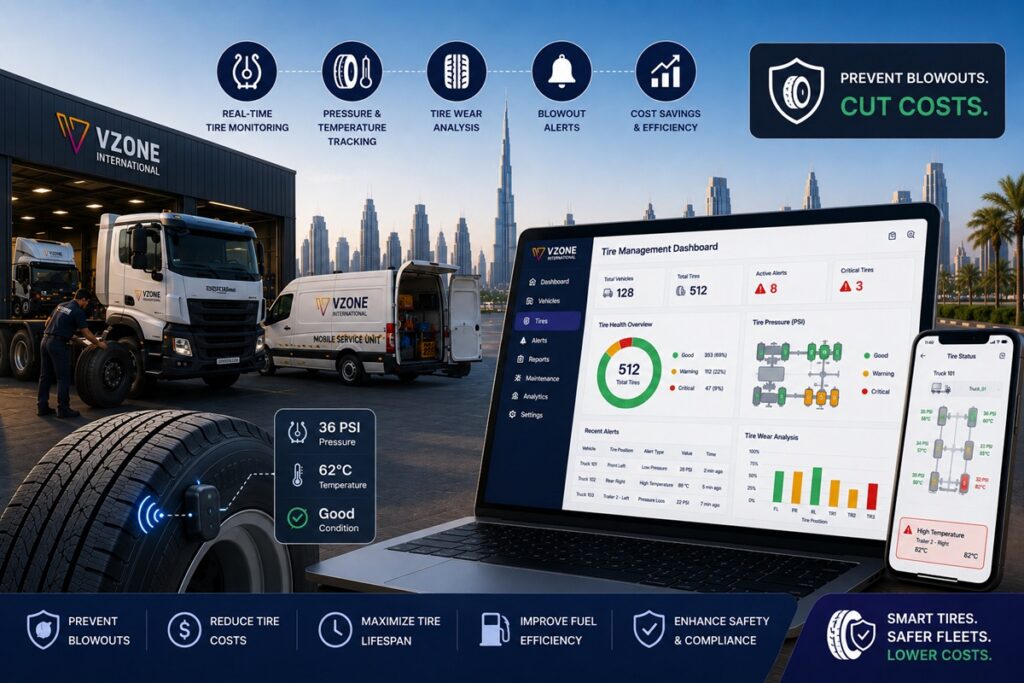
In the UAE, where summer road surface temperatures regularly reach 70°C to 80°C on asphalt highways and heavy commercial vehicles cover long desert routes under full load, tyre blowouts are not a routine maintenance inconvenience they are a safety emergency. A heavy truck tyre blowout at highway speed on the E11 or the E611 Abu Dhabi, Dubai road can cause a rollover event, create multi-vehicle collision risk, and generate insurance claims and liability exposure that dwarf the cost of any tyre monitoring system. For fleet operators managing dozens or hundreds of vehicles, the reality is that manual tyre pressure checks conducted at depot before departure provide a point-in-time snapshot that is already outdated by the time the vehicle reaches operating temperature on the highway.
GPS-integrated tyre management software automates the monitoring entirely: TPMS (Tyre Pressure Monitoring System) sensors installed on each wheel transmit real-time pressure and temperature data continuously to the fleet platform, alerting the driver and the fleet manager the moment a tyre deviates from its safe operating parameters. That alert arrives before the pressure drop becomes a structural failure before the blowout, not after it.
Beyond the safety case, the financial case for tyre management software in UAE commercial fleets is equally direct. Under-inflated tyres increase fuel consumption by 2 to 4 percent per psi below optimal pressure. Tyres operating outside optimal temperature ranges experience accelerated degradation that shortens replacement intervals. Poor rotation scheduling creates uneven wear patterns that require early replacement of individual tyres rather than planned full-set replacements. The combination of safety improvement and tyre life extension from GPS-integrated tyre management typically delivers ROI within the first year.
Key Takeaways
- UAE summer road surface temperatures of 70°C to 80°C create thermal stress on commercial vehicle tyres that significantly exceeds the conditions under which European or North American tyre pressure standards were established making UAE-specific monitoring thresholds necessary.
- TPMS sensors monitor individual tyre pressure and temperature continuously not just at the start of a journey providing the real-time data that manual pre-departure checks cannot, particularly on long desert highway routes where thermal expansion changes pressure significantly after departure.
- Under-inflation is the primary preventable cause of UAE commercial vehicle tyre failures: a tyre at 80 percent of recommended pressure runs significantly hotter, degrades faster, and is far more likely to fail under highway load conditions than a correctly inflated tyre.
- Tyre management software integrated with GPS fleet platforms connects pressure and temperature data to vehicle location enabling fleet managers to identify a pressure drop event on a specific highway at a specific location and respond with a roadside support dispatch before the tyre fails.
- Tyre rotation and replacement scheduling based on actual GPS-tracked mileage is more precise than calendar-based scheduling, particularly for UAE fleets where vehicle utilisation rates vary significantly between fleet members on different routes.
- RTA Mulkia renewal, insurance expiry, and periodic vehicle inspection alerts integrated in fleet maintenance software alongside tyre management create a unified compliance maintenance calendar that eliminates the administrative gaps that create fines and licence exposure.
Why Tyre Management Is Critical for UAE Fleets
UAE Heat The Enemy of Tyre Longevity
The physics of tyre failure in UAE conditions is straightforward: heat is the primary enemy of tyre structural integrity. Every 10°C increase in tyre operating temperature above the design optimum accelerates rubber compound degradation, weakens tyre sidewalls, and increases the probability of a structural failure under load. UAE highway road surface temperatures of 70°C to 80°C in summer translate to tyre operating temperatures that can exceed 100°C during extended highway running far above the temperature range for which most commercial tyres are designed to operate continuously.
The effect on tyre lifespan is significant and directly measurable. A commercial tyre that achieves 80,000 km under normal European operating conditions may achieve only 50,000 to 60,000 km in UAE summer conditions if pressure and temperature management is not actively maintained. Fleets that monitor and maintain correct tyre pressure throughout UAE summer operations extend tyre life substantially because correct inflation maintains the tyre’s designed heat dissipation geometry, while under-inflation causes heat to concentrate in the sidewall flexion zone that is most vulnerable to thermal fatigue.
Blowout Risk on UAE Highways The Safety Stakes
Tyre blowouts on UAE federal highways the E11 Sheikh Zayed Road corridor, the E311 Emirates Road, the E66 Al Ain Road represent one of the most serious safety risk categories in commercial fleet operations. A heavy vehicle tyre blowout at 100 to 120 km/h creates an immediate vehicle control emergency: the vehicle pulls sharply toward the blown tyre, and drivers who are unprepared for the event or who overcorrect can lose control entirely. For articulated trucks and semi-trailers, a rear axle blowout can cause trailer swing and jackknife risk that endangers multiple vehicles.
Beyond the direct incident risk, a blowout on a busy UAE highway creates a secondary hazard: the debris field from a commercial tyre failure tread strips, steel belt fragments, and rim damage is distributed over a wide highway area that creates risk for subsequent vehicles before the incident scene is cleared. The accident prevention value of a single blowout avoided by TPMS monitoring is not just the direct incident cost it is the cascading risk to other road users that the blowout would have created.
Cost of a Tyre Blowout Vehicle Damage, Downtime, and Accident Risk
The total cost of a commercial vehicle tyre blowout in UAE fleet operations has multiple components that individually appear manageable but combine into a significant financial exposure. The direct tyre and rim replacement cost for a heavy truck blowout typically runs AED 800 to AED 2,500 per wheel with rim damage from running on a deflated tyre often exceeding the tyre replacement cost itself. Recovery and roadside assistance in UAE desert highway locations can cost AED 500 to AED 2,000 depending on distance and response time. Vehicle downtime the time from blowout to return to service typically spans four to eight hours for a highway recovery, including driver wait time, tow truck response, tyre replacement, and safety inspection.
If the blowout causes a collision or vehicle damage beyond the tyre and rim, insurance claim costs escalate dramatically. A third-party property damage claim from a tyre blowout incident on a UAE highway commonly exceeds AED 50,000 and if personal injury is involved, the financial exposure is an order of magnitude larger. Against this cost profile, the AED 200 to AED 400 per-vehicle annual cost of TPMS monitoring that prevents a single blowout event delivers immediate and obvious ROI.
What Is Fleet Tyre Management Software?
Fleet tyre management software is a module within GPS fleet management platforms that combines TPMS hardware data with mileage tracking, maintenance scheduling, and cost analysis to provide fleet managers with a complete tyre health management system. It covers four operational areas: real-time monitoring (pressure and temperature from TPMS sensors), preventive maintenance (rotation and replacement scheduling based on mileage), cost management (cost per kilometre analysis per tyre position and vendor), and compliance reminders (RTA vehicle inspection, Mulkia renewal, insurance expiry alerts integrated in the same maintenance calendar).
TPMS (Tyre Pressure Monitoring System) Integration
TPMS hardware consists of battery-powered pressure and temperature sensors installed in each tyre valve one per wheel. Each sensor broadcasts its readings at 30-second intervals to a receiver unit installed in the vehicle cab, which in turn forwards the data to the GPS fleet platform via the vehicle’s telematics device. The platform stores the continuous pressure and temperature readings per tyre position, presents them in a per-vehicle dashboard view, and evaluates each reading against the vehicle’s configured pressure specification and temperature thresholds to determine whether an alert is warranted.
TPMS sensors for commercial fleet vehicles must be rated for the temperature and vibration environment of heavy vehicle operation sensors designed for passenger cars operate at pressure and temperature ranges that commercial tyre conditions exceed. For UAE deployments specifically, sensors must be rated for ambient operating temperatures that regularly exceed 60°C, and for the tyre temperature ranges that UAE summer highway operation generates. Hardware specification review for UAE conditions is as relevant for TPMS sensors as for GPS devices an under-spec’d sensor provides unreliable readings precisely in the high-heat conditions where accurate monitoring matters most.
GPS-Linked Tyre Data Position, Pressure, and Temperature Together
The operational value of GPS-linked tyre monitoring rather than standalone TPMS is the location context that GPS adds to every pressure and temperature reading. When a tyre pressure alert fires, the fleet manager simultaneously knows the vehicle’s GPS location, speed, current route segment, and distance to the nearest safe stopping point or tyre service centre. This context transforms the alert from a notification that something is wrong into actionable dispatch intelligence: the fleet manager can contact the driver, confirm the situation, and arrange roadside assistance to the specific GPS-confirmed location not just a general highway description.
The GPS-tyre data combination also enables post-event analysis that identifies road segments where pressure events consistently occur indicating either road surface conditions that create tyre stress at specific locations, or route-specific loading conditions that affect tyre operating parameters. This pattern data enables both route management adjustments and tyre specification optimisation for specific route profiles.
Key Features of Tyre Management Software
Real-Time Pressure and Temperature Monitoring
Per-tyre pressure and temperature display on the fleet dashboard showing every wheel on every vehicle simultaneously is the operational monitoring layer that replaces manual spot checks. Fleet managers reviewing the morning dashboard before vehicle dispatch can identify any tyre showing below-specification pressure before the vehicle enters service, resolving the issue at depot rather than on a highway. During active routes, the continuous monitoring alerts the operations team and the driver simultaneously to developing pressure loss events from a slow puncture generating progressive pressure decline to a rapid deflation from a road hazard impact.
Pressure Deviation Alerts Under-Inflation and Over-Inflation
Pressure deviation alerts fire when a tyre’s pressure reading moves outside the vehicle’s configured specification range. Under-inflation alerts are the primary safety-focused configuration triggered when a tyre drops below, typically, 90 percent of specified cold inflation pressure during operation. Over-inflation alerts pressure above the recommended maximum are less common in practice but equally important in UAE heat conditions where a tyre inflated to maximum cold pressure at a 25°C depot environment may exceed the maximum hot pressure specification after running at 45°C ambient temperature on a loaded highway run.
A best-practice pressure monitoring configuration for UAE commercial fleets sets under-inflation alerts at 90 percent of specified pressure for advisory notification and 80 percent for urgent alert. Temperature alerts are configured with two tiers: an advisory alert at the operating temperature threshold where rapid tyre degradation begins typically 90°C to 95°C for standard commercial tyres and a critical alert at the temperature where structural failure risk is acute, typically 100°C to 110°C. These temperature thresholds are vehicle and tyre specification dependent and should be configured by the fleet manager in consultation with the tyre supplier.
Tyre Rotation and Replacement Scheduling
Regular tyre rotation moving tyres between axle positions to equalise wear across all positions is the most cost-effective tyre life extension practice available to fleet operators. In UAE fleet conditions, where front axles experience disproportionate wear from steering loads and rear drive axles experience accelerated wear from power delivery, rotation intervals of every 10,000 to 15,000 km significantly extend total tyre life compared to leaving tyres in fixed positions until replacement is required.
GPS mileage tracking enables rotation scheduling that is based on actual accumulated mileage per vehicle rather than calendar intervals critical for fleets where individual vehicle utilisation rates vary significantly. A vehicle covering 8,000 km per month reaches its rotation interval in six to seven weeks; a vehicle covering 3,000 km per month reaches the same interval in 17 weeks. Calendar-based scheduling results in either premature rotation for low-mileage vehicles or overdue rotation for high-mileage vehicles. Mileage-based automated alerts generated by the GPS platform when a vehicle reaches its rotation threshold ensure every vehicle receives rotation at the correct interval regardless of utilisation rate variation.
Tyre Cost Management Vendor Tracking and Cost Per KM
Tyre cost management within fleet maintenance software tracks the financial dimension of tyre operations alongside the safety and maintenance dimensions. Per-tyre cost records capture the purchase price, installation date, mileage at installation, and retirement mileage for each tyre position on each vehicle enabling calculation of actual cost per kilometre per tyre position per supplier. This data supports supplier performance comparison different tyre brands at different price points may deliver different actual service lives in UAE conditions, making cost per kilometre a better procurement criterion than purchase price per unit.
Vendor performance data accumulated over a full tyre lifecycle typically 12 to 24 months for heavy commercial vehicle tyres in UAE conditions provides objective evidence for tyre procurement decisions that is more reliable than supplier claims or anecdotal driver feedback. A tyre that costs AED 800 and delivers 45,000 km has a cost per kilometre of AED 0.018; a tyre that costs AED 650 and delivers 32,000 km has a cost per kilometre of AED 0.020 the apparently cheaper tyre is actually more expensive in operation. Fleet maintenance software makes this calculation automatically from the service record data.
| Feature | Why It Matters in UAE Specifically | Monitoring Interval | Alert Type |
| Real-time tyre pressure monitoring | Heat causes rapid pressure expansion manual checks are outdated within hours of departure | Continuous every 30 seconds per tyre | Advisory at 90% spec; urgent at 80% spec |
| High-temperature tyre alerts | UAE road surface 70–80°C creates tyre fire risk above 100°C tyre temp | Continuous threshold-based | Advisory at 90°C; critical at 100°C+ |
| Tyre rotation scheduling | UAE road heat + load distribution accelerates uneven wear significantly | Every 10,000–15,000 km GPS mileage triggered | Automated maintenance alert |
| Tread depth tracking | UAE highway speeds (100–120 km/h) require adequate tread for wet-weather safety | Monthly manual + GPS mileage correlation | Manual inspection prompt |
| Mileage-based replacement forecasting | Utilisation rate varies calendar scheduling creates over/under-servicing | Per-vehicle GPS mileage tracking | Replacement forecast alert 5,000 km before threshold |
| Vendor cost per km analysis | UAE tyre market multiple suppliers with varied performance vs price | Per purchase and retirement event | Automated on tyre retirement |
| Fleet-wide tyre health dashboard | Preventive maintenance planning across 50–500 vehicle fleets | Weekly automated report | Summary and exception report |
Fleet Maintenance Scheduling Beyond Tyre Management
Tyre management is the highest-visibility maintenance category in UAE fleet operations because it has the most immediate safety consequences. But comprehensive fleet maintenance software integrates tyre management within a broader maintenance scheduling framework that covers all service intervals, regulatory compliance deadlines, and cost tracking across the vehicle’s full maintenance profile.
Integrating Tyre Management with Full Fleet Maintenance Software
A unified fleet maintenance module covers oil and filter changes, brake system inspections, transmission service, air filter replacement, coolant checks, and tyre management all triggered by GPS-tracked mileage or engine-hour data, with alerts generated automatically when each vehicle approaches its service threshold. The practical advantage of unified maintenance management over separate tyre tracking is consolidated visibility: a fleet manager reviewing the maintenance dashboard sees every vehicle’s upcoming service needs across all maintenance categories simultaneously, enabling batch service scheduling that minimises vehicle off-road time.
For ADNOC contractor fleets where vehicle maintenance records are subject to HSE audit review, unified GPS-linked maintenance records provide a complete and tamper-resistant service history that satisfies audit requirements more effectively than paper service books or manually updated spreadsheets. The maintenance record shows not just what work was done and when, but the mileage and date at which the GPS system generated the maintenance alert demonstrating that maintenance was performed proactively before system failures rather than reactively after them.
RTA Renewal, Insurance, and Mulkia Expiry Alerts
UAE fleet compliance administration RTA vehicle registration renewal (Mulkia), insurance policy renewal, periodic vehicle roadworthiness inspection (Fahas), and driver licence expiry creates a continuous cycle of compliance deadlines that large fleet teams manage manually in spreadsheets or shared calendars. GPS fleet maintenance software integrates these compliance deadlines into the same alert system as mechanical maintenance generating reminders at 60, 30, and 7 days before each expiry to give the fleet administration team sufficient lead time to process renewals without last-minute urgency.
The integration of compliance deadline management with operational GPS tracking creates a meaningful efficiency gain: a vehicle with an approaching Mulkia renewal that is currently on an active delivery route can be flagged for prioritisation at its next depot return rather than being discovered overdue during a random check. Proactive compliance management through the GPS platform eliminates the fines and vehicle grounding events that reactive compliance management regularly produces in large UAE fleet operations.
VZone International’s Tyre and Maintenance Management Solution
VZone International integrates TPMS tyre monitoring with full fleet maintenance scheduling on the Wialon and FMSiTrack enterprise platform providing UAE fleet operators with real-time tyre pressure and temperature alerts, GPS mileage-triggered maintenance scheduling, RTA compliance deadline management, and tyre cost per kilometre analysis in a single maintenance management interface.
TPMS Hardware and GPS Integration
VZone supplies TPMS sensors rated for UAE operating conditions heat, vibration, and pressure ranges appropriate for heavy commercial vehicle tyres in desert operating environments. Sensor installation covers all wheel positions on each vehicle, with the receiver unit integrated with the GPS telematics device so that tyre data and location data are co-transmitted and co-processed on the Wialon platform. Per-tyre pressure and temperature readings are visible on the vehicle detail view alongside GPS position, speed, and behavioral alerts a unified operational view rather than a separate tyre-monitoring screen.
Maintenance Scheduling with GPS Mileage Triggers
VZone’s maintenance module configures service intervals for each vehicle type tyre rotation, oil changes, brake inspections, and all other service categories triggered by GPS-tracked mileage accumulated on the platform. Automated alerts are generated at the configured lead distance before each threshold, with the fleet manager able to view all upcoming maintenance across the entire fleet in a consolidated calendar view. Service completion records are logged against the vehicle’s maintenance history with timestamp and mileage, creating the complete documented service record that HSE audits and RTA vehicle inspections require.
Conclusion: Tyre Management Is the Safety-Cost Intersection Where GPS Monitoring Delivers Clearest Value
Fleet tyre management in the UAE context is where safety and cost considerations converge most directly. The same TPMS monitoring that prevents a blowout on the E11 at 110 km/h also extends tyre life by 15 to 25 percent through pressure optimisation, reduces fuel consumption by 2 to 4 percent through under-inflation prevention, and provides the GPS-linked maintenance records that satisfy HSE audit requirements for ADNOC contractor fleets.
Manual tyre management processes depot pressure checks before departure, paper service records, calendar-based rotation reminders are not adequate for UAE fleet conditions where temperatures change tyre behaviour significantly during a single shift, where vehicle utilisation rates vary too much for calendar-based scheduling to be accurate, and where the consequences of a missed pressure event on a highway operating at 120 km/h are immediate and potentially catastrophic.
For UAE fleet managers evaluating tyre management software, the starting point is simple: the AED 1,000 to AED 2,500 TPMS hardware cost per heavy truck, and the annual monitoring subscription included in the fleet management platform, are recovered from a single blowout prevented. Every subsequent blowout prevented is pure return on investment alongside the tyre life extension and fuel savings that correct pressure maintenance delivers every operating day.
Ready to explore GPS tracking for your UAE fleet?
VZone International’s tyre management software protects your UAE fleet in real time from per-tyre pressure and temperature alerts to GPS mileage-triggered rotation scheduling, RTA Mulkia renewal reminders, and full maintenance cost tracking. Get a maintenance management demo today and see your fleet’s current tyre health status in real time.
Frequently Asked Questions
Tyre management software uses TPMS sensors installed on each wheel to monitor real-time pressure and temperature, transmitting data to a GPS-linked fleet platform every 30 seconds. When pressure deviates from the safe range typically below 90 percent of specified cold inflation pressure instant alerts are sent to the driver via in-cab display and to the fleet manager via mobile app or platform dashboard. GPS location data is paired with each pressure reading, enabling the fleet team to identify the precise location of a tyre issue and dispatch roadside support with exact coordinates.
The primary causes of commercial tyre blowouts in UAE are: under-inflation (the most common cause under-inflated tyres run hotter, flex excessively, and fail under load); excessive heat from UAE road surface temperatures of 70°C to 80°C combined with full payload operation; over-inflation in cold ambient conditions that creates over-pressure when the tyre reaches operating temperature on summer highways; and tyre age or wear-related structural degradation that creates weakness the heat and load conditions then exploit. TPMS monitoring addresses the first three causes directly; mileage-based rotation and replacement scheduling addresses the fourth.
TPMS sensor hardware for commercial fleet vehicles typically costs AED 100 to AED 250 per wheel, including valve sensor and receiver unit. For a heavy truck with 10 wheels, the hardware cost is AED 1,000 to AED 2,500 per vehicle. Monthly platform subscription for tyre management integrated with GPS fleet management is typically included within the standard fleet management subscription at AED 80 to AED 150 per vehicle per month. For most UAE commercial fleets, a single blowout avoided with its recovery, replacement, and potential incident costs recovers the full TPMS hardware investment for that vehicle.
VZone International provides fleet maintenance scheduling integrated with GPS tracking in UAE covering TPMS tyre management, all mechanical service interval alerts, RTA Mulkia renewal reminders, insurance expiry notifications, and full maintenance cost tracking for all vehicle types from light vans to heavy trucks. VZone's maintenance module runs on the Wialon enterprise platform with UAE-based implementation support. Contact VZone for a maintenance management demo tailored to your fleet type and size.
GPS mileage tracking records actual kilometres driven by each vehicle continuously enabling rotation scheduling that triggers at the correct mileage threshold for each vehicle regardless of how quickly that mileage is accumulated. Calendar-based rotation scheduling checking every four months regardless of mileage under-services high-mileage vehicles and over-services low-mileage vehicles in fleets with variable utilisation rates. GPS mileage-triggered alerts ensure that each vehicle receives rotation at the correct interval, extending average tyre life and reducing the proportion of tyres retired due to uneven wear patterns.