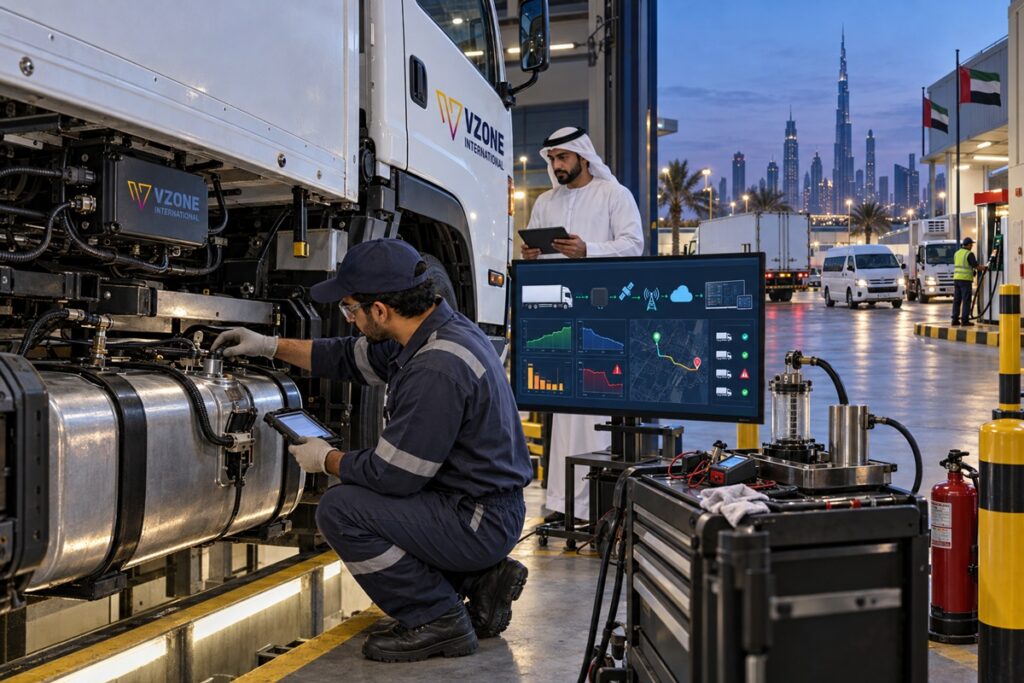
Fuel is one of the largest and most difficult operating costs for commercial fleets to control. Knowing how much diesel was purchased at the end of the month is no longer enough fleet operators need to know where every litre goes, which vehicles are consuming more than expected, how much fuel is being wasted through idling, and whether theft or misuse is occurring.
A fuel monitoring system closes this visibility gap by combining calibrated fuel sensors, GPS telematics, and fleet management software to track fuel levels and consumption in real time, helping operators turn fuel from an opaque monthly expense into a measurable, controllable cost per vehicle, trip, and kilometre.
Key Takeaways
- A fuel monitoring system uses calibrated sensors to track fuel levels and consumption in real time, flagging theft or unusual drops within minutes of the event.
- It integrates with GPS and fleet management platforms to correlate fuel data with routes, drivers, and vehicle behaviour turning raw sensor data into actionable management insight.
- ROI typically comes from theft prevention and waste reduction, with most UAE commercial fleets recovering the hardware cost within 4 to 8 weeks of deployment.
What Is a Fuel Monitoring System?
A fuel monitoring system is the combination of sensor hardware, communication technology, and fleet management software that gives commercial fleet operators real-time visibility of fuel consumption, fuel stock levels, and fuel losses per vehicle, per trip, and per driver rather than the monthly aggregate view that fuel card statements provide.
The core problem a fuel monitoring system solves is the gap between fuel purchased and fuel consumed. In a typical UAE commercial fleet without monitoring, the only fuel visibility is the monthly card statement total a figure that confirms how much was spent but cannot reveal how much was wasted through idling, how much was lost to siphoning, or which specific vehicles are consuming 40 percent more fuel per kilometre than their efficient counterparts. A fuel monitoring system closes this visibility gap by measuring fuel at the point of consumption the vehicle tank rather than only at the point of purchase the filling station or depot dispenser.
How Does a Fuel Monitoring System Work?
A fuel monitoring system works by placing calibrated sensors inside vehicle fuel tanks (or fuel storage tanks at depots) that measure fuel level continuously and transmit readings through the vehicle’s GPS device to a cloud fleet management platform. The platform compares incoming fuel level data against GPS position and trip data to calculate fuel consumption per kilometre, identify fill events, and detect anomalies siphoning events, unusual consumption above the vehicle’s established baseline, or fuel card transactions that do not match the vehicle’s GPS location.
Fuel Level Sensors and Data Transmission
The fuel level sensor is the hardware core of the system a calibrated probe installed vertically inside the vehicle’s fuel tank that measures the height of fuel in the tank and converts the measurement into a continuous electrical signal proportional to fuel volume. Unlike the factory-standard fuel gauge (which provides a generalised level indication across 5 to 8 bands), a calibrated monitoring sensor provides fuel level accuracy to within 1 to 2 percent of tank capacity sufficient to detect a 5-litre siphoning event in a 70-litre tank, or to calculate consumption from fill events with the precision required for per-kilometre efficiency comparison.
The sensor connects to the vehicle’s GPS telematics device, which packages the fuel level reading alongside the vehicle’s GPS position, speed, and ignition status and transmits the complete data packet to the fleet management cloud platform at the configured reporting interval typically every 30 seconds to 1 minute. The cloud platform processes incoming packets in real time, updating the vehicle’s fuel curve (a graph of fuel level over time and distance) and applying the fleet manager’s configured alert thresholds.
Fuel Monitoring System Alerts
Alerts are the operational output of a fuel monitoring system the notifications that convert raw sensor data into management actions. Well-configured fuel monitoring systems generate four primary alert types:
- Siphoning alert: fuel level drops rapidly (configurable threshold typically more than 5 litres in under 2 minutes) without a corresponding ignition-on event. This pattern distinguishes siphoning (tank level drops while the vehicle is parked) from normal consumption (level drops while the vehicle is moving).
- Fuel card location mismatch alert: a fuel card transaction is recorded at a location that does not match the vehicle’s GPS position at the transaction time. Location mismatch within a configurable tolerance (typically 200 to 500 metres to account for GPS position accuracy variation) flags potential card misuse for investigation.
- Consumption above baseline alert: the vehicle’s current consumption per 100 km exceeds its established baseline by more than the configured percentage (typically 15 to 20 percent). This alert distinguishes the normal day-to-day variation of ±5 percent from a genuine consumption anomaly that may indicate a developing mechanical fault, route change, or driving behaviour change.
- Low fuel alert: tank level falls below the configured minimum threshold configurable per vehicle based on route length and fuelling point accessibility. Prevents drivers from running low on remote UAE routes where the next fuel point may be 100+ km away.
Components of a Fuel Monitoring System
| Component | Function | Hardware or Software | UAE Consideration |
| Calibrated fuel level sensor | Measures fuel volume in vehicle tank continuously to ±1–2% accuracy | Hardware installed in vehicle tank | Must be rated for UAE summer fuel tank temperatures (up to 70°C); stainless steel probe preferred for UAE diesel quality variation |
| GPS telematics device | Transmits sensor data alongside vehicle position, speed, and ignition status | Hardware installed in vehicle | 4G LTE with store-and-forward for remote Western Region routes; Teltonika FMB/FMC series most common for UAE Asateel compliance |
| Fuel card API integration | Connects fuel card transaction data (ENOC, ADNOC Distribution) to GPS platform for location reconciliation | Software integration no hardware | ENOC and ADNOC Distribution card APIs most relevant for UAE commercial fleets; international card APIs for GCC cross-border operations |
| Fleet management platform | Receives, processes, and presents all sensor and GPS data; generates alerts and reports | Software cloud-hosted | VZone International’s Wialon platform; Arabic and English interface; UAE compliance reports (Asateel, IVMS) alongside fuel monitoring |
| Depot bulk tank sensor (optional) | Monitors fuel levels in depot storage tanks tracks deliveries in, dispensing out, and stock level | Hardware IoT sensor on storage tank | Critical for UAE construction and ADNOC contractor operations with site fuel storage; detects delivery shortfalls and overnight siphoning |
| Manager dashboard and mobile app | Displays live fuel data, alerts, and reports for fleet manager review | Software web browser and iOS/Android | Push notifications for critical alerts (siphoning, card mismatch) enable response from mobile without requiring dashboard login |
Fuel Monitoring System vs Manual Fuel Logs
| Dimension | Manual Fuel Logs / Card Statements | Fuel Monitoring System |
| Data granularity | Fleet-total monthly spend; no per-vehicle breakdown without manual calculation | Per-vehicle, per-trip, per-100-km consumption; fill event records; consumption trend per driver |
| Theft detection | Not possible theft is invisible in aggregate card statements | Siphoning detected within minutes; card misuse flagged per transaction; deterrence effect stops most theft within days of deployment |
| Data accuracy | Driver-reported volumes and odometer readings systematically understated for service interval deferral; card statement volumes may include personal vehicle fills | GPS-verified odometer; sensor-measured tank volume independent of driver input; not manipulable |
| Reporting lag | Monthly data 30 days old when reviewed | Real-time live fuel curve per vehicle; daily consumption report available next morning |
| Idling visibility | None | GPS idling detection correlated with fuel level change idling fuel cost per vehicle per day calculated automatically |
| Management time | 3–5 hours/month for manual reconciliation of card statement against trip records | 20–30 minutes/week to review automated exception alerts and weekly fuel efficiency report |
Benefits of a Fuel Monitoring System for Fleets
The four primary benefits of a fuel monitoring system for UAE commercial fleet operators, in order of typical financial impact:
- Theft and misuse elimination: fuel theft and card misuse typically consume 5 to 12 percent of the annual fuel budget in UAE fleets without monitoring. A fuel monitoring system recovers this loss within days of activation through deterrence (drivers aware of monitoring stop theft before it is detected and investigated) and detection (the siphoning and card mismatch alerts identify theft events that deterrence alone does not prevent).
- Idling cost reduction: GPS-integrated idling detection correlated with fuel sensor data calculates the exact AED cost of each idling event per vehicle. Fleets that configure idling alerts and communicate the policy to drivers consistently reduce idling-related fuel waste by 30 to 50 percent within 30 days eliminating the 10 to 15 percent of total fuel consumption that unmanaged idling represents in UAE commercial operations.
- Consumption baseline management: per-vehicle consumption per 100 km tracked over time establishes each vehicle’s efficiency baseline and identifies vehicles that are trending above baseline indicating developing mechanical faults (injector issues, air filter blockage, tyre pressure loss) that affect fuel efficiency before they generate OBD fault codes or visible symptoms. Early detection enables preventive maintenance that avoids both the breakdown and the accumulated fuel waste from operating a deteriorating vehicle.
- Driver behaviour coaching data: consumption per 100 km per driver, normalised for route type, provides the objective performance data that makes driver coaching conversations evidence-based rather than impression-based. Drivers whose fuel efficiency data is visible to them through the driver app consistently improve their own efficiency without requiring management intervention the transparency effect of visible performance data is a behavioural change mechanism that operates continuously rather than only at coaching conversations.
How Much Does a Fuel Monitoring System Cost?
Fuel monitoring system costs for UAE commercial fleets have two components: one-time hardware and installation costs, and ongoing software subscription costs.
| Cost Component | Typical UAE Range | Notes |
| Calibrated fuel level sensor | AED 350–600 per vehicle | Stainless steel probe; compatible with vehicle tank geometry; includes calibration labour |
| GPS telematics device (if not already installed) | AED 400–900 per vehicle | 4G LTE commercial fleet device; Teltonika FMB/FMC series for Asateel compliance |
| Professional installation | AED 250–450 per vehicle | Certified installer required for sensor calibration and GPS device configuration; VZone International is Teltonika certified |
| Fleet management platform subscription | AED 50–130 per vehicle per month | Includes fuel monitoring module, GPS tracking, driver scoring, compliance monitoring, and reporting |
| Fuel card API integration | Typically included in platform subscription | ENOC and ADNOC Distribution API connectors included in VZone/Wialon deployment |
| TOTAL Year 1 (per vehicle) | AED 1,600–2,960 (hardware + 12 months subscription) | Payback from theft and waste recovery typically within 4–8 weeks for UAE commercial fleet |
Fuel Monitoring System ROI UAE Commercial Fleet Example 50-vehicle fleet annual fuel spend: AED 750,000Theft and card misuse recovered (10% of spend): AED 75,000/yearIdling reduction saving (12% of spend reduced by 40%): AED 36,000/yearConsumption baseline improvement (8% efficiency gain): AED 60,000/yearTotal annual saving: AED 171,000Hardware + installation cost (50 vehicles): AED 55,000–75,000 one-timePayback period: 3–5 months |
Conclusion
A fuel monitoring system is the foundational technology investment for UAE commercial fleet operators who want to move from managing fuel cost as an opaque monthly total to managing it as a per-vehicle, per-trip, per-driver operational variable. The definition is straightforward sensors, GPS, and software that measure fuel at the point of consumption but the operational value is broad: theft detection, idling quantification, consumption baseline management, driver coaching data, and the predictive maintenance signals that prevent fuel efficiency from deteriorating between scheduled services.
For most UAE commercial fleets, the fuel monitoring system pays back its hardware cost within 4 to 8 weeks from theft and card misuse recovery alone making it one of the highest-return technology investments available regardless of fleet size or sector. VZone International deploys calibrated fuel monitoring systems for UAE commercial fleets of all types from urban delivery vans to heavy construction trucks and bulk depot tank installations. Contact our team for a fuel monitoring system deployment assessment for your fleet.
VZone International Fuel Monitoring System Installed, Calibrated, and Integrated for UAE Fleets
VZone International deploys calibrated fuel monitoring systems for UAE commercial fleets vehicle fuel sensors, depot bulk tank monitoring, GPS integration, and fuel card API reconciliation on the Wialon platform. Teltonika certified installer. 4,000+ UAE fleets. Full Arabic and English interface. Contact our team for a fuel monitoring system assessment and deployment plan for your fleet.
Frequently Asked Questions
A fuel monitoring system is used for four primary purposes in commercial fleet operations. First, theft detection calibrated fuel level sensors detect siphoning (rapid tank level drops without vehicle movement) and GPS-to-fuel-card reconciliation detects card misuse (transactions at locations that don't match the vehicle's GPS position). Second, consumption monitoring per-vehicle, per-trip fuel consumption per 100 km is calculated automatically from sensor and GPS data, enabling comparison against vehicle baselines and peer vehicles. Third, idling quantification fuel consumed during engine-on, zero-speed periods is calculated and costed per vehicle per day, providing the data for idling reduction coaching. Fourth, predictive maintenance signalling vehicles trending above their established consumption baseline are flagged for mechanical inspection, catching efficiency-affecting faults before they generate visible symptoms or breakdown events.
A properly calibrated fuel monitoring system achieves fuel level accuracy of ±1 to 2 percent of tank capacity sufficient to detect a 5-litre siphoning event in a 70-litre tank, calculate consumption between fill events with meaningful precision, and generate reliable per-100-km consumption figures. Accuracy depends on calibration quality (the sensor must be calibrated against the specific tank geometry of each vehicle model tanks are not uniformly shaped), installation quality (the probe must be vertical and securely mounted), and the fuel grade's consistent density (diesel density variation affects volumetric calculations at the margins). A professionally installed and calibrated system from a Teltonika certified installer maintains ±1 to 2 percent accuracy over its operational life without recalibration systems installed without professional calibration may achieve only ±5 to 10 percent accuracy, which is insufficient for siphoning detection of small-volume theft events.
Yes fuel monitoring systems work on all commercially operated vehicle types with liquid fuel tanks, including petrol and diesel passenger vehicles, light commercial vans, pickup trucks, rigid trucks, semi-trailer trucks, buses, and construction equipment. The sensor specification and installation method vary by vehicle type: light vehicle tanks typically use a 220 mm to 400 mm probe length; heavy truck saddle tanks require longer probes (600 mm to 1,000 mm) and may require dual-probe installation for accurate level measurement in asymmetric tanks; construction equipment with irregular fuel tank geometries require custom calibration. Fuel monitoring systems also work on bulk fuel storage tanks at depots and construction sites IoT-connected ultrasonic or pressure sensors provide stock level monitoring, delivery reconciliation, and theft detection for stationary storage tanks.
Professional installation of a fuel monitoring system takes 2 to 4 hours per vehicle, depending on vehicle type and tank accessibility. Light commercial vans and pickup trucks typically complete in 2 to 3 hours the fuel tank is accessible, the probe installation is straightforward, and GPS device wiring to vehicle power and ignition is standard. Heavy trucks with saddle tanks or multiple fuel tanks take 3 to 4 hours per vehicle due to the more complex tank access, longer probe installation, and additional calibration data points required for accurate measurement across the full tank range. Bulk storage tank installations (depot or construction site) take 4 to 8 hours per tank depending on tank size, access configuration, and cellular connectivity at the site. VZone International schedules fleet installations in batches a 20-vehicle fleet can typically be fully installed and commissioned in 3 to 5 days with two installation teams working simultaneously.